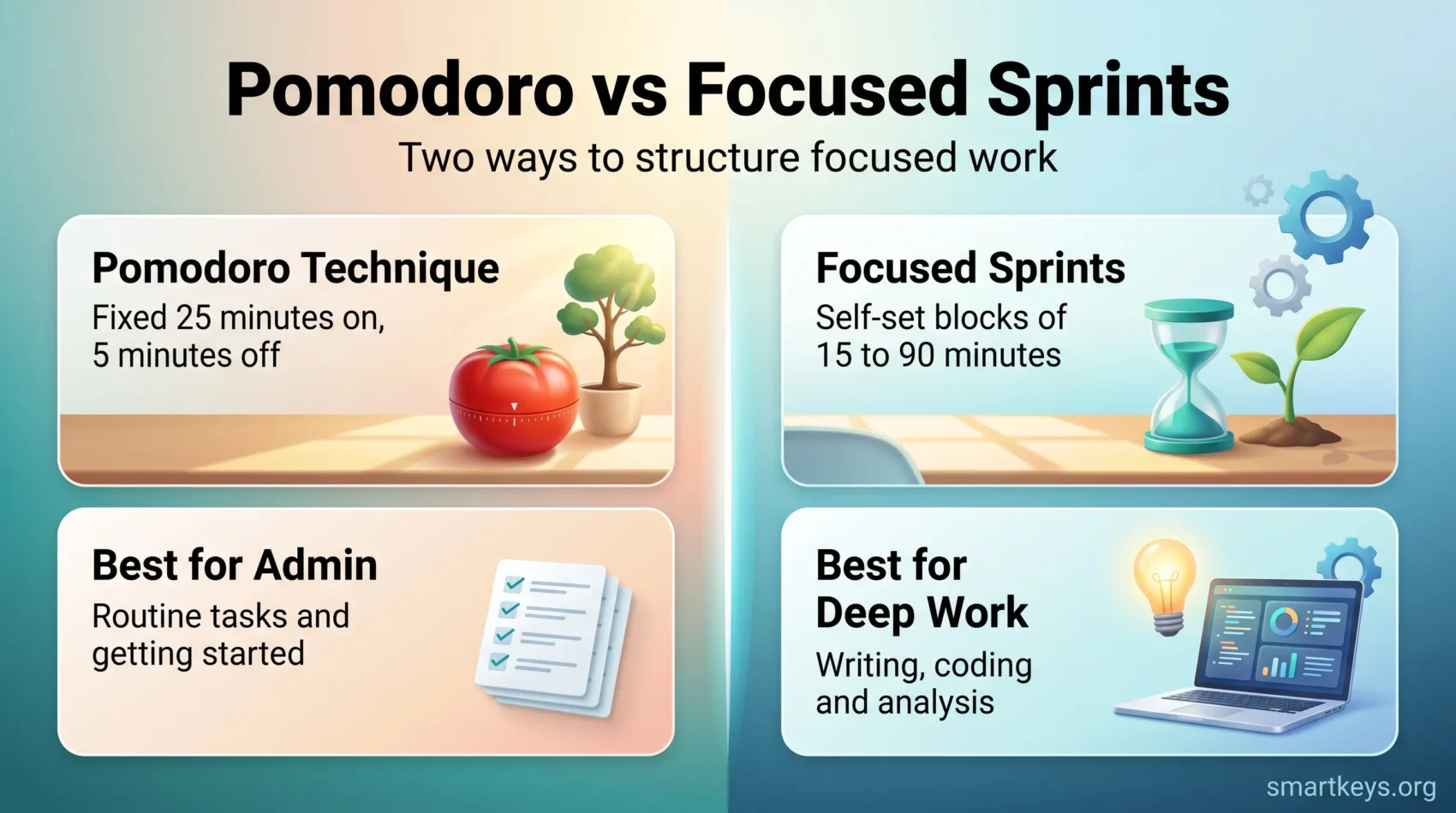
Two ideas dominate how people structure focused work: the Pomodoro Technique, a fixed rhythm of 25 minutes on and five minutes off, and focused sprints, a looser habit of setting your own block length and stopping when the work reaches a natural seam. Both try to solve the same problem. A workday that is broken up every couple of minutes leaves very little room for anything that needs sustained thought.
The scale of that problem is well documented. Research led by Gloria Mark at UC Irvine tracked how long people stay on a single screen before switching, and found the average has fallen to roughly 47 seconds, down from about two and a half minutes two decades earlier. Against that background, any method that reliably buys you 25 uninterrupted minutes is doing real work. The question is which structure you will actually keep using.
This comparison covers what each method is, what the research supports and does not support, which one suits deep work better, and how to pick the interval length that matches your tasks.
Key Takeaways
- The Pomodoro Technique is a fixed protocol: 25 minutes of work, a five-minute break, and a longer 15 to 30 minute break after four cycles.
- Focused sprints keep the work-then-break pattern but let you set the length, usually somewhere between 15 and 90 minutes.
- Evidence on breaks is stronger for mood and energy than for raw output. A 2022 meta-analysis found clear gains in vigor and reduced fatigue, but no significant overall performance effect.
- Fixed and self-chosen breaks perform about the same on results. Which one feels better depends heavily on the person and the task.
- Start with the Pomodoro protocol if your day is fragmented, and move to longer self-set sprints once you can protect the time.
Understanding the Pomodoro Technique
The Pomodoro Technique is the most prescriptive of the interval methods, and that is its main strength. There is nothing to decide once you start. You know how long the block is, when the break comes, and what counts as finished.
History and Origin of the Pomodoro Technique
Francesco Cirillo developed the method in the late 1980s as a university student in Italy and named it after his tomato-shaped kitchen timer (pomodoro is Italian for tomato).
What often gets lost is that the method is not only about timing. It also covers estimating how many pomodoros a task needs, recording what happened, and handling interruptions deliberately. The timer is the visible part of a fuller task management practice.
How the Pomodoro Technique Works
The core loop is short enough to memorise:
- Pick one task and write it down.
- Set a timer for 25 minutes and work on that task only.
- When the timer rings, mark the pomodoro as complete.
- Take a five-minute break away from the task.
- After four pomodoros, take a longer break of 15 to 30 minutes.
Interruptions get a specific treatment. If something comes up mid-pomodoro, you note it on a list and deal with it later rather than switching. If the interruption cannot wait, the pomodoro is voided rather than paused, which is deliberately a little painful and makes you notice how often it happens. Our step-by-step guide to the Pomodoro Technique walks through the full protocol.
Benefits of Using the Pomodoro Technique
The technique earns its reputation on a few concrete points:
- No decision cost: the interval is fixed, so you spend no energy negotiating with yourself about when to stop.
- A low bar to start: 25 minutes is short enough to begin even when you do not feel like it, which is why it is a common recommendation for overcoming procrastination.
- Visible interruption data: logging voided pomodoros shows you exactly where your day leaks.
- Built-in estimation: counting pomodoros per task gives you a rough unit for planning the next one.
Overview of Focused Sprints
A focused sprint is a self-defined block of uninterrupted work on one task, followed by a real break. Unlike the Pomodoro Technique, it is not a branded protocol with fixed numbers. It is closer to a general practice that many people arrive at independently, and it goes under several names, including focus blocks and focus sprints.
Definition and Key Features of Focused Sprints
The defining features are consistent even when the numbers are not:
- One task per block, chosen before the block starts.
- A length you set to match the task, commonly 45 to 90 minutes for demanding work.
- A break long enough to actually recover, not just long enough to check a phone.
- Permission to stop at a natural seam rather than mid-sentence when a timer rings.
That last point is the main practical difference. Long-form writing, debugging and analysis often have a rhythm that a 25-minute bell cuts across, which is why people doing that kind of work drift toward longer blocks and closer to what Cal Newport calls deep work.
Where Focused Sprints Came From
There is no single origin story, and it is worth being honest about that. The idea borrows its name from sprint-based planning in software development, and its logic from the observation that attention runs in cycles. Nathaniel Kleitman’s basic rest-activity cycle hypothesis, which proposed roughly 90-minute cycles of alertness during waking hours, is the usual reference point, though the evidence for tight 90-minute work cycles in adults is thinner than popular accounts suggest. Treat the number as a starting guess, not a law.
Pomodoro vs Focused Sprints: Key Differences
The two methods share a skeleton. The differences sit in three places.
Who sets the interval. Pomodoro fixes it at 25 minutes for everyone. Sprints leave it to you, which is more flexible and also one more decision to make when your willpower is already low.
What happens at the boundary. A pomodoro ends when the timer rings, full stop. A sprint usually ends at the nearest sensible stopping point, which protects momentum but can also quietly stretch into a two-hour block with no break.
How much protocol comes with it. Pomodoro brings estimation, logging and an explicit interruption rule. Sprints bring only the block itself, so you supply the rest, often through a prioritization framework or a planning habit of your own.
Neither is more serious than the other. The fixed protocol is a scaffold, most useful while you are still building the habit. If your real comparison is between Pomodoro and a calendar-first approach, see our look at Pomodoro versus time blocking.
What the Research Actually Shows
The honest summary is that structured breaks reliably help how you feel, and their effect on output depends on the task.
A 2022 systematic review and meta-analysis in PLOS ONE pooled 22 samples covering 2,335 participants. Micro-breaks produced small but significant improvements in vigor (d = 0.36) and reductions in fatigue (d = 0.35). Overall performance, however, did not improve significantly (d = 0.16). Breaking that down by task type is where it gets useful: performance gains showed up for clerical work (d = 0.56) and creative tasks (d = 0.38), but not for cognitively demanding work (d = -0.09). The authors also found that longer breaks helped more, and noted that recovering from highly depleting tasks likely needs more than ten minutes.
On the fixed-versus-flexible question, the evidence points both ways. A 2023 study in the British Journal of Educational Psychology followed 87 students during real self-study sessions and found that those taking systematic Pomodoro-style breaks reported less fatigue and distraction and more concentration and motivation than students who chose their own break times, with no difference in task completion. A 2026 randomised experiment in Behavioral Sciences with 176 students found the opposite pattern on mood: self-regulated breaks scored higher on energy, concentration and motivation, again with no difference in comprehension scores.
Read together, they say something useful. Completion and comprehension barely move. What changes is how the session feels, and that swings with the person and the task. Anyone claiming a single interval is optimal for everyone is going beyond the evidence.
Effectiveness in Different Work Environments
Where you work changes which method survives contact with reality.
Benefits of the Pomodoro Technique in Office Settings
Shared offices are interruption machines, and the Pomodoro Technique is unusually well suited to them. The block is short enough that declining a quick question for 20 minutes is socially easy, and the interruption log turns a vague complaint into evidence you can take to a manager.
It pairs well with a few environmental fixes:
- Agree team-wide quiet hours so pomodoros are not fighting the calendar.
- Silence non-urgent alerts for the duration; our guide to managing work notifications covers how far you can take this without going dark.
- Use a visible timer. Visual timers signal to colleagues that you are mid-block without you having to say anything.
If noise is the bigger problem than interruptions, the fixes are different, and our piece on managing distractions in an open office goes into the acoustic side.
How Focused Sprints Fit into Remote Work
At home, the constraint flips. Interruptions are fewer, so the 25-minute ceiling starts to feel like an interruption of its own. Longer sprints usually fit better, particularly for work that takes 15 minutes just to load into memory.
Remote work also removes the ambient cues that end a session, which is the failure mode to watch for. A sprint with no scheduled end runs until something external stops it. Two habits prevent that: book the break in your calendar as if it were a meeting, and set a hard end time for the day. A well-arranged home office helps by making it obvious when you have left work behind.
Tools for Timing Your Work
Tooling matters less than most round-ups suggest. What counts is a timer you cannot ignore, a record of what you finished, and little friction between deciding to start and starting.
Timers for the Pomodoro Technique
For the Pomodoro protocol you want something that handles the cycle counting for you, so you are not tracking whether this is the third or fourth block. Options fall into three groups:
- Physical timers: a mechanical kitchen timer or a countdown disc. No notifications, no screen, and the ticking is a surprisingly effective commitment device.
- Browser and mobile timers: lightweight web apps and phone timers that count pomodoros and prompt the long break automatically.
- Timers inside a task app: several task managers and time trackers now include a built-in pomodoro mode, so the block is attached to the task it belongs to.
Before paying for anything, check whether your operating system already covers it. Focus modes on macOS, iOS, Windows and Android will suppress notifications on a schedule, which is most of what a paid focus app sells.
Tracking and Planning Focused Sprints
Sprints need less timing and more planning, because the block length comes from the work rather than a rule. A time tracker that records what you actually did is more useful here than a countdown. Some people block the sprint directly in a calendar; others prefer a paper system such as bullet journals. Keep the setup light either way, because a system that takes five minutes to configure will not survive a bad week.
Work Interval Comparison: Finding Your Rhythm
There is no interval that suits everyone, but there is a sensible way to search for yours.
Optimal Work Intervals and Break Times
The Pomodoro numbers are a reasonable default: 25 minutes of work, five minutes off, and 15 to 30 minutes after four cycles. Popular alternatives include 50 minutes on with 10 off, and 90-minute blocks with a longer recovery period. None of these is backed by evidence showing it beats the others. What the break research does suggest is that break length should scale with how depleting the work is, since the PLOS ONE meta-analysis found longer breaks helped more and that ten minutes may not be enough after genuinely demanding work.
Break quality matters as much as length. A break spent scrolling gives your attention a different task rather than a rest. Moving, looking out of a window, or getting a drink works better, and for heavier fatigue a short nap outperforms anything on a screen. Our overview of how short breaks affect focus covers what to do with the five minutes.
Customization for Personal Preferences
Treat interval length as something to test rather than choose. A practical approach:
- Run the standard 25/5 cycle for a week and note where it helped and where the bell landed badly.
- Adjust in one direction only. If you were consistently cut off mid-thought, try 45 minutes. If you were fading before the bell, try 15.
- Keep the break proportional. Roughly one part break to five parts work is a common ratio, and increase it after demanding sessions.
- Log completed blocks per task for two weeks. That gives you an estimation baseline, which is the part of the method most people skip and later miss.
Expect the answer to differ by task type rather than settling on one number. Most people end up with a short interval for admin and a long one for anything that requires holding a problem in their head.
Choosing the Right Method for Your Tasks
The most useful question is not which method is better but which one matches the work in front of you today.
Identifying Tasks Best Suited for Each Technique
- Admin and inbox work: Pomodoro. The short block stops routine tasks expanding to fill the morning.
- Writing, coding, analysis: longer sprints. These have a warm-up cost that a 25-minute block wastes.
- Repetitive or tedious work: Pomodoro. The frequent breaks keep it tolerable, and the cycle count gives you visible progress.
- Work you are avoiding: Pomodoro, at a shortened interval. Ten minutes is often enough to break the stall, which is the same logic behind timeboxing against procrastination.
- Large, vague projects: neither, until you have split them. Interval methods need a defined next action to work against.
Adapting Techniques to Personal Work Styles
A few adjustments that hold up in practice:
- Batch similar tasks into the same block. Switching context inside a block undoes most of the benefit, and the cost of task switching is well established.
- Schedule your hardest block when your energy is highest, rather than fitting it around meetings.
- Decide the task before the timer starts. Choosing what to do while the clock runs is the most common way a block is wasted.
- Use a prioritization pass at the start of the day, or the 80/20 rule, so the blocks are pointed at work that matters.
- Do not run intervals all day. Meetings, conversation and unstructured thinking all need room, and the research on multitasking suggests the goal is fewer switches, not a fuller schedule.
Conclusion
The Pomodoro Technique and focused sprints are the same idea at two levels of formality. Pomodoro supplies the numbers, the interruption rule and the log, which is exactly what you want when your day is fragmented or you are struggling to start. Focused sprints hand those decisions back to you, which works better once the habit is established and your work needs longer runs.
The evidence supports the shared principle more than either specific version. Structured breaks improve how a work session feels, they help performance most on routine and creative tasks, and no fixed interval has been shown to beat the alternatives for everyone. That leaves interval length as a personal setting rather than a correct answer.
Run the standard 25/5 cycle for a week, note where the bell helped and where it interrupted you, and adjust from there. Most people land somewhere between the two methods.
Found this useful?
Make SmartKeys a preferred source on Google, and our articles will surface more often in your Top Stories, AI Overviews, and AI Mode.
Add as Preferred Source