A résumé is no longer proof of anything. Anyone can generate a polished work history in seconds, and a growing share of applicants are not who they claim to be. That single shift has moved tamper-evident employee records from an interesting experiment to a procurement conversation.
Traditional centralized HR systems still leave sensitive personnel data exposed to breaches, manipulation, and plain human error. A decentralized, cryptographically verifiable model changes that risk profile — and hands more control back to the employee.
What makes 2026 different is that the plumbing finally exists. The W3C ratified the Verifiable Credentials 2.0 standard in May 2025, every EU member state faces a December 2026 deadline to ship a digital identity wallet, and screening consortia are running verified credentials at real volume rather than in demos.
This guide covers what actually changed, how to evaluate fit for your organization, and a rollout path that keeps privacy and compliance front and center.
Key Takeaways
- Credential fraud, not storage cost, is now the strongest business case.
- Immutable, time-stamped entries make audits and disputes far cheaper.
- W3C VC 2.0 and the EU wallet mandate give you real standards to build on.
- Sensitive data stays off-chain; only proofs go on the ledger.
- Start with one narrow use case and measure verification turnaround.
Why blockchain HR records matter right now
Two pressures are converging on your talent function at the same time: verification is getting more expensive, and the thing you are verifying is getting easier to fake.
Verification costs and legal exposure keep climbing
SHRM’s 2025 Benchmarking Report puts the average U.S. cost per hire at roughly $5,475 for non-executive roles and about $35,879 for executives — up sharply from the $4,700 figure still quoted in older articles. Third-party employment verification typically bills $50–$100 per request, and every request adds days to your time-to-fill.
The compliance side is moving in the same direction. FCRA filings hit 5,171 cases in the first half of 2026 alone, running roughly 43% ahead of the same period in 2025 according to WebRecon’s litigation tracking. Most of that exposure comes from procedural missteps — disclosure, consent, adverse action — not from bad intent.
The newer problem: candidates who do not exist
Gartner projects that one in four candidate profiles worldwide will be fake by 2028. In its survey of 3,000 job seekers, 6% openly admitted to interview fraud — impersonating someone else or having someone sit the interview for them. Treat that as a floor, not a ceiling.
This is not theoretical. HireRight’s benchmarking recorded a 92% jump in employer-reported candidate fraud incidents between 2023 and 2025. Amazon’s security team has said it blocked more than 1,800 suspected North Korean operatives from being hired since April 2024.
Background checks were never designed for this. They tell you whether a person is safe to hire; they do not tell you whether the person on the video call is the person whose record you pulled. That gap is exactly where cryptographically signed, issuer-backed credentials do work no screening vendor can replicate.
If your pipeline already leans heavily on automation, it is worth reading this alongside our look at AI-driven recruitment and where it breaks down.
How blockchain HR records actually work
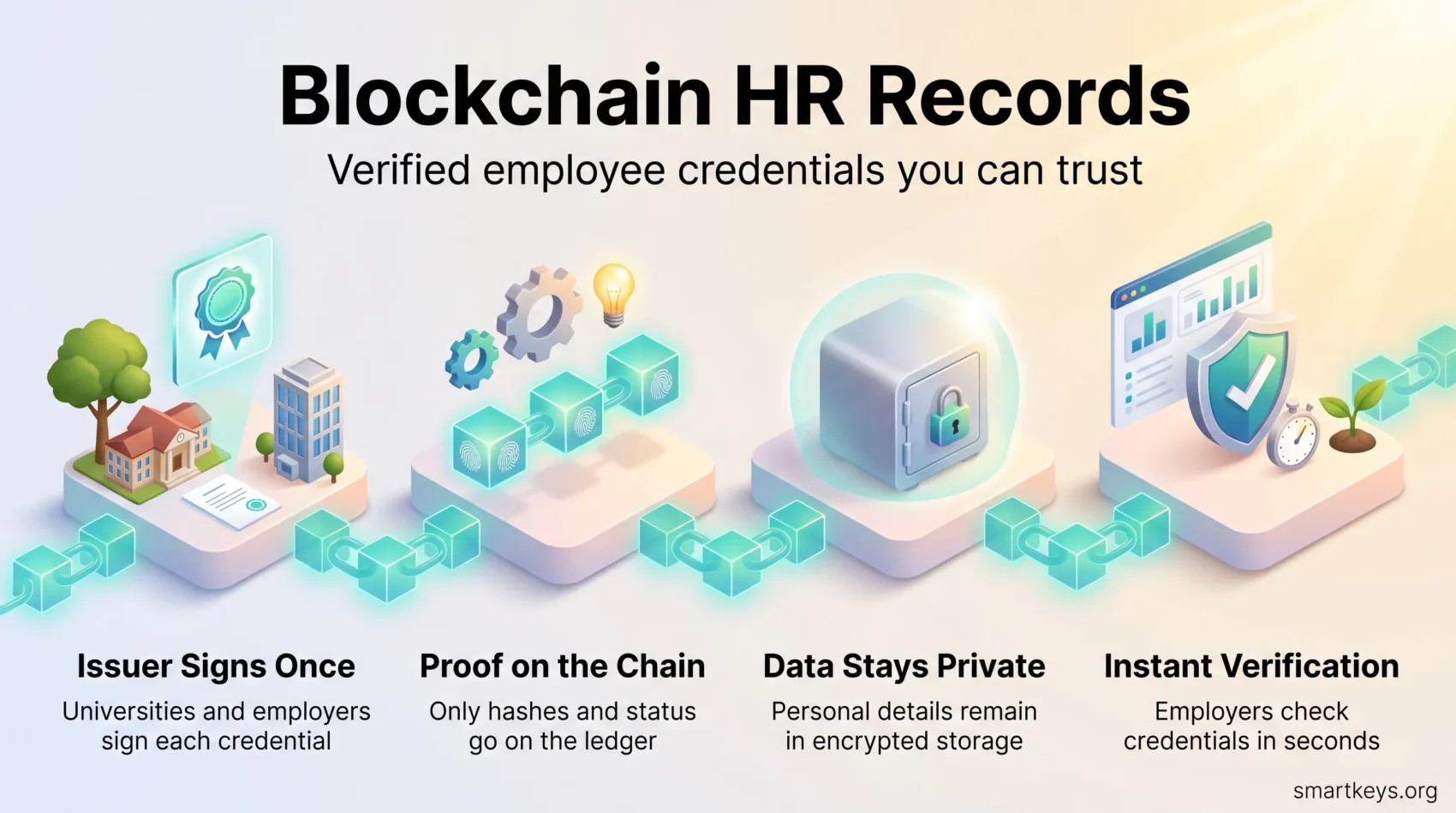
The short version: the ledger stores proof, not people. This is the single most common misunderstanding, and getting it right is what makes the model legally workable.
The ledger and verifiable credentials
A distributed ledger is a shared list of time-stamped entries, each cryptographically linked to the one before it. Change an old entry and the chain breaks visibly. That property is what turns a claim into evidence.
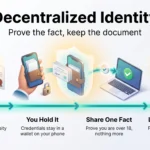
On top of it sits the actual standard you should be asking vendors about: W3C Verifiable Credentials 2.0, published as a full W3C Recommendation in May 2025. It defines a three-party model — issuer, holder, verifier — and how credentials are signed, presented, and revoked. Ask whether a platform implements it. If the answer is vague, that is your answer.
Credential verification in seconds, not days
Degrees, licenses, certifications, and past employment can each be issued as a signed credential. When a university or former employer signs the record once, every future employer can verify it instantly without contacting anyone.
The same logic underpins micro-credentials in hiring, where short, skill-specific certificates only carry weight if their provenance can be checked.
Automated payroll with smart contracts
Smart contracts release funds when pre-set conditions are met — approved hours, completed milestones, signed deliverables. That cuts reconciliation work and shortens payment cycles, particularly for contractors and cross-border teams.
The mechanics carry over almost directly from commercial agreements; our breakdown of smart contracts in B2B transactions covers the contract logic, and crypto payroll for remote workers covers the payment rails.
Privacy-first employee data management
In a well-designed system, personally identifiable information never touches the chain. What goes on-chain is a hash or a status entry; the underlying data sits in encrypted, permissioned storage.
Selective disclosure does the rest. An employee can prove they hold a valid license without revealing their address, or prove continuous employment without exposing salary history. This aligns neatly with how data privacy laws are reshaping the workplace — data minimization stops being a policy promise and becomes a technical constraint.
What changed in 2025 and 2026
If you evaluated this space two or three years ago and shelved it, the ground has moved. Three developments matter.
Standards settled. The VC 2.0 family reached Recommendation status in May 2025, ending years of competing draft approaches. Interoperability is no longer a research question.
Regulation created a deadline. Under eIDAS 2.0, all 27 EU member states must offer citizens a digital identity wallet by December 2026, with regulated private-sector organizations required to accept it a year later. Those wallets are specified to hold diplomas and professional qualifications, not just ID documents. Several states will miss or partially miss the date — Germany has signaled early January 2027 — but the direction is fixed.
Volume arrived. The Velocity Network Foundation’s SkillsONWARD program reports more than 47,000 healthcare background screenings completed in Florida and Texas, with an 81% opt-in rate among practitioners accepting verifiable credentials. Opt-in rates were the open question for years; that number answers it.
How to implement a blockchain HR verification system step by step
Start where the payback is measurable: identity checks, automated pay, or protected personnel records. Pick one, prove it, then expand.
Identify a high-impact use case. Employment verification is usually the cleanest first target — it has an obvious baseline cost, an obvious turnaround metric, and a clear owner.
Build a cross-functional team. HR, IT, legal, and compliance need to be in the room from week one. Retrofitting a consent flow after the pilot is far more expensive than designing it in.
- Select the platform and partners. Require W3C VC 2.0 support, published revocation handling, and a documented exit path for your data. Ask what happens to issued credentials if you leave.
- Scope a tight pilot. One department, one credential type, defined KPIs: verification turnaround, cost per verification, error rate, help-desk tickets.
- Map data flows and protect them. Decide explicitly what goes on-chain versus off-chain, set role-based access, and document retention rules before go-live.
- Train and communicate the benefit. Adoption depends on employees understanding that they gain portability, not surveillance. Short demos beat policy documents.
- Measure, then scale. Expand to additional credential types and departments only once the pilot metrics hold up under real volume.
For distributed teams, the operational design questions differ; our guide to securing remote work with blockchain covers access control and device trust in more depth.
Real-world applications and ROI
The savings case is real, but it is rarely where people expect it. Direct verification fees are the smallest line. Internal hours and avoided compliance exposure are the large ones.
Where the money actually is
Start by quantifying three things: what you pay third parties per verification, how many internal hours go into chasing and responding to verification requests, and what a single FCRA procedural claim would cost you in legal fees alone.
Vendor-reported figures give a sense of the ceiling. TransCrypts has published a case in which a large airline reduced employment verification work from roughly 270 staff hours per month to about one hour. Treat vendor case studies as directional rather than as a forecast for your own environment — but the order of magnitude is consistent with what removing manual lookups should do.
Payroll and contracts
Programmable payouts cut approval friction and reconciliation effort, and faster, more predictable payment cycles measurably reduce payroll-related support tickets. For contractor-heavy or cross-border teams, this is often a bigger win than verification.
Employee-owned records
When employees hold their own verified employment history, they can share it instantly with lenders, landlords, or licensing bodies — without an HR service request. That removes a recurring administrative load from your team and gives the employee something genuinely portable.
Combining verified records with workforce analytics also improves data quality upstream, since the underlying employment facts are attested rather than self-reported.
Managing risks: regulation, interoperability, and change
Map the technical, legal, and human risks before you scale, not after.
Compliance by design
Immutability and the right to erasure are in tension. Resolve it architecturally: keep personal data off-chain in deletable storage, and put only revocable status entries and hashes on-chain. Legal should sign off on that split explicitly.
Define retention, consent, and audit rules up front so that tamper-evident records support your FCRA and privacy obligations rather than complicating them. Role-based access and strong encryption keep departments in control while preserving an auditable trail.
Scalability and interoperability
Plan how verified data flows into your HRIS, ATS, and payroll systems. Test API behavior and latency in the pilot, not in production. The failure mode here is a parallel silo that nobody updates.
The identity layer underneath is worth understanding on its own terms — our piece on decentralized identity and onboarding explains how issuer-holder-verifier flows behave when they meet real customer and employee journeys.
Practical guardrails
- Vendor risk: insist on open standards and a documented migration path before signing.
- Fraud detection: pair verified credentials with anomaly monitoring; a valid credential presented by the wrong person is still fraud.
- Change management: document the new workflow so no department is left running the old manual process in parallel.
- Fallbacks: keep an off-chain backup and a human dispute-resolution route for every automated decision.
Conclusion
The case for blockchain HR records stopped being about storage and became about trust. When a plausible résumé costs nothing to produce, a signed, issuer-backed credential is the only thing that still means something.
The standards are settled, the regulatory deadlines are on the calendar, and the opt-in data suggests employees will participate when the benefit is portability rather than monitoring. That is a meaningfully different picture than the one that existed three years ago.
Start small and specific: one use case, one cross-functional team, one platform that implements W3C VC 2.0, and one pilot with numbers you agreed on in advance. Prove the verification turnaround, then widen the scope.
Found this useful?
Make SmartKeys a preferred source on Google, and our articles will surface more often in your Top Stories, AI Overviews, and AI Mode.
Add as Preferred Source