A sabbatical is a long, employer-approved break from work, usually a month or more, with an agreed date to come back. It sits between vacation and resignation: longer than annual leave, but unlike quitting, the job is still there at the end.
Demand is rising for a reason. Gallup’s State of the Global Workplace put employee engagement at 20% in 2025, down from 23% in 2022, and manager engagement at 22%, a nine point fall over the same period. Long breaks are one of the few benefits that address exhaustion directly.
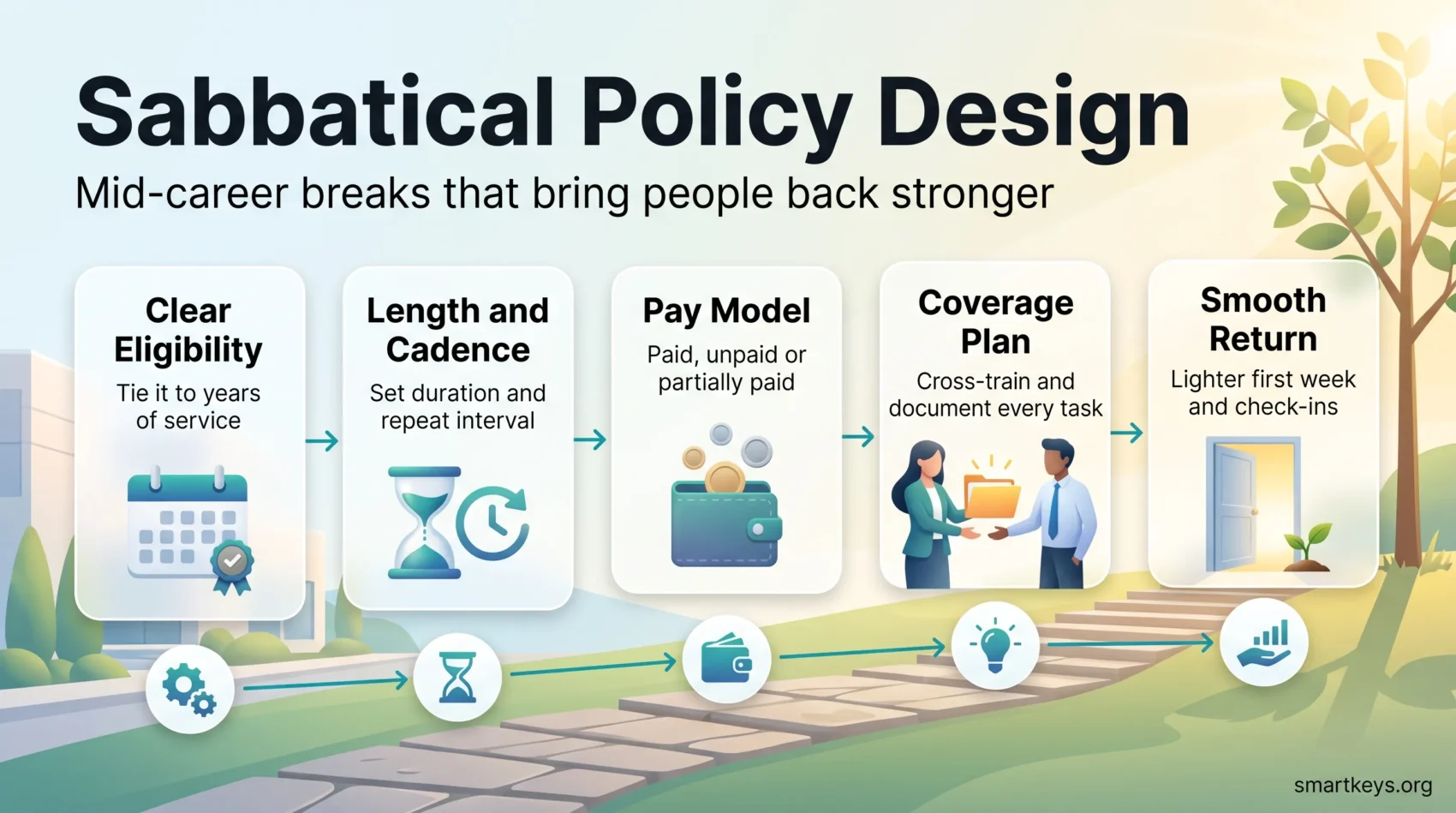
This guide covers what belongs in a sabbatical policy: who qualifies, how long the break runs, whether it is paid, how much notice you need, who covers the work, and what happens on the day the person comes back.
Key Takeaways
- A sabbatical is a defined break with a guaranteed return date, not an open-ended leave of absence.
- Roughly one employer in ten offers a paid sabbatical, so a formal program is a genuine differentiator.
- Eligibility is normally tied to years of service, commonly somewhere between four and ten years.
- The pay model decides who can actually afford the break, so choose it before you announce anything.
- Coverage planning and the return-to-work plan matter more than the length of the break.
What a Sabbatical Is and Why It Matters Right Now
The defining feature is the agreement to return. An employee steps away for a fixed period, the employment relationship stays intact, and both sides know the return date. In practice these breaks run from four weeks to twelve months.
People use the time for travel, study, volunteering, caregiving, recovery, or a project they never get to in a normal week. That separates a sabbatical from a career break, where someone leaves the payroll and has to job hunt on the way back, and from open-ended unpaid leave, which gives managers nothing to plan around.
- Defined length: a fixed number of weeks and a return date, agreed in writing.
- Clear entry point: a service threshold people can see coming years ahead.
- Agreed purpose: rest, study, or a project, stated in the request.
Most standard responses to burnout, such as a wellness app or an extra vacation week, are small relative to the problem. A month away is not. If you are reviewing how your benefits package is evolving, this is one of the few additions employees notice immediately.
The Business Case: What the Evidence Actually Supports
Be careful here. Sabbaticals attract confident claims that trace back to nothing. Three things are reasonably well supported.
Recovery that outlasts the break. Research summarized in Harvard Business Review in 2017 followed 129 professors through their sabbaticals and found reduced stress and improved wellbeing that persisted after they returned, rather than evaporating in the first week back.
The stand-in benefits too. A companion study of 61 nonprofit managers found that the colleagues who covered the work grew into the responsibility and stayed more effective after the leave-taker came back. The absence works as a live test of your bench strength, which is a real argument for anyone doing contingency planning for key roles.
Scarcity value in hiring. Because so few employers offer it, a sabbatical is a distinctive line in a job ad, which helps most in senior roles where retaining experienced people costs more than replacing them.
What the evidence does not support is a clean return-on-investment figure. Treat sabbaticals as a retention and resilience benefit, and be honest with your leadership team about that.
Core Elements of a Sabbatical Leave Policy
A vague policy produces inconsistent decisions and quiet resentment. Write these elements down before you publish anything.
Eligibility and service thresholds
Tie eligibility to continuous service. Common thresholds sit between four and ten years, with roughly half of published programs clustering around five.
Keep the criteria objective: length of service, employment status, and whether the person is in a formal performance process. Once eligibility depends on a manager’s opinion, uptake collapses among the people who need the break most.
Duration, frequency, and cadence
Set a minimum and a maximum: four to six weeks is the common minimum, twelve months a realistic ceiling. Then set the interval, for example one sabbatical every five to seven years of service.
The interval is what protects your staffing. Without it, a policy written for a 40 person company behaves very differently at 400 people.
Pay structure
Decide whether the break is paid, unpaid, or partially paid, and whether that depends on how the time is used. Some employers fund accredited study in full, part-fund volunteering, and leave personal travel unpaid. That is defensible, as long as the rule is written down.
Notice, benefits, and obligations during the break
Require notice: two to three months is typical, six for roles that are hard to cover. Name the approver and the decision deadline. Then spell out the mechanics, because these are the questions people actually ask:
- Health coverage and retirement contributions: do they continue, pause, or shift to employee-paid?
- Seniority and vesting: does the time count toward tenure, promotion eligibility, and equity vesting?
- Outside work: confidentiality and IP obligations continue, so say what paid work, if any, is permitted.
- Return commitment: whether the person owes a period of service afterwards, which is common with fully paid breaks.
Publish the policy as a document employees can read without asking HR. Anything you would have to explain in a meeting is not written clearly enough.
For a model of the format, a well-structured hybrid work policy template uses the same building blocks: scope, eligibility, approval path, and exceptions.
Paid, Unpaid, or Partially Paid: Choosing the Model
The pay model decides who can use the benefit. An unpaid sabbatical is open to everyone on paper and affordable to almost nobody in practice. Name that gap openly rather than discovering it two years in.
Paid programs are the minority. In its 2019 benefits survey, SHRM found 5% of employers offered a paid sabbatical and 11% an unpaid one. WorldatWork’s 2022 survey of 990 organizations found 10% offering paid sabbaticals, up from 8% in 2016, and 27% offering unpaid ones, up from 18%. Both point the same way: growing slowly, still uncommon.
When full pay earns its cost
Full pay removes the financial barrier, which is the main reason eligible employees decline. It suits long tenure milestones, where the number crossing the threshold each year is small and predictable, and roles where the alternative to a break is resignation.
When partial pay is the better trade
Partial pay is the practical middle ground for smaller employers. A fixed stipend, or 40-60% of salary, makes the break affordable for more people at a fraction of the cost, and scales more safely if uptake runs higher than you modelled.
- Model the cost at realistic uptake, not the theoretical maximum.
- Cap the number of concurrent sabbaticals per team, not just per company.
- If the leave is unpaid, lower the barrier another way, such as a wellbeing stipend or banked time off.
Running the Program Without Disrupting Operations
Most sabbatical policies fail operationally, not financially: the break gets approved, nobody plans the handover, and the team absorbs the work badly for two months.
Approvals and transparent criteria
Publish the eligibility rules, the notice period, and the approval timeline together, and give managers a short decision framework so two people with identical tenure get the same answer. Keep the application short: dates, purpose, and a coverage proposal.
Coverage and knowledge transfer
Use one coverage plan template listing every recurring task, who takes it, what training they need, and who to escalate to.
Two practices do most of the work. The first is deliberate cross-training, so a second person already knows the job before the notice period starts. The second is written standard operating procedures, which turn undocumented knowledge into something a colleague can follow. Both are worth having anyway; a sabbatical exposes whether you have them.
Time the break against your business cycle. Approving a six week absence during your busiest quarter is a choice, not an accident.
Communication and manager training
Train the managers. They decide in practice whether the benefit is usable. Give them a short guide on responding to a request, building the coverage plan, and handling two requests from one team at once.
Then tell everyone the program exists, repeatedly. Benefits that are technically available but rarely mentioned get used by the confident and missed by everyone else, which is the pattern that fuels burnout in the people least likely to ask.
Return to Work: Making the Comeback Count
The return is where the value is won or lost. Someone who comes back rested to an unchanged inbox and a reorganized team loses most of the benefit within a fortnight.
Agree the role and the return date before the break begins. Say in writing whether the person returns to the same job or a comparable one, and what happens if the role is restructured while they are away.
Reboarding is a short onboarding for someone who already knows the company: what changed in priorities, people, tools, and decisions that affect their work.
- Confirm the role and date before the sabbatical starts, in writing.
- Plan a lighter first week rather than a full workload from day one.
- Schedule short check-ins at week one and week four, not a single catch-up meeting.
- Capture what they learned if the break involved study or a project.
- Keep the stand-in’s new responsibilities where it makes sense, instead of quietly reversing them.
That last point matters. If covering a sabbatical is a dead end, people stop volunteering. If it feeds into visible sideways career moves or an internal talent marketplace, coverage becomes something people want. Teams using continuous performance management also handle returns better, because the first conversation back is not an annual review.
Benchmarks: What Real Programs Look Like
Published programs are a useful sanity check on your own design. These come from company benefit documentation and Buildremote’s compilation of 76 employers with paid sabbaticals, last updated in May 2025.
- Adobe: four weeks paid after five years, five weeks after ten, six weeks after fifteen, then six weeks every five years. Pay continues at normal salary and equity vesting is unaffected.
- Intel: four weeks after four years of service, or eight weeks after seven years.
- Bank of America: four weeks paid after fifteen years of service.
- Nike: five weeks after ten years.
- Monzo: three months after four years, unusually early and unusually long.
- Zillow: three weeks paid plus three weeks unpaid after six years, an example of a blended model.
- Patagonia: up to two months for employees taking part in an environmental internship.
The pattern across those 76 programs is clear: about one month of paid leave after five years is the most common design, and a reasonable starting point.
Two lessons transfer regardless of size. Tier the benefit so people see the next milestone rather than one distant reward, and connect longer breaks to something the company gains: study, a documented project, or a tested succession plan.
Alternatives When a Long Break Is Not Realistic
Plenty of teams cannot cover a six week absence, and pretending otherwise produces a policy nobody approves. Smaller options deliver part of the benefit.
- Short-term leave: one to three weeks of extra unpaid or partly paid leave, covering exams, caregiving, and recovery.
- Compressed schedules: a four day week for a defined period, or temporary part time. The four day week evidence is worth reading first.
- Flexible scheduling: shifted hours or extra remote days, covered in our guide to flexible work schedules.
- Flexible time off: a flexible PTO policy with a stated minimum, since unlimited policies without a floor often reduce time taken.
- Funded learning: course fees, certifications, a microlearning program, or broader upskilling.
- Phased approaches: for late-career staff, phased retirement handles the same need with more notice.
- Protected disconnection: clear rules on after-hours contact, along the lines of right to disconnect policies.
Whichever route you take, state the eligibility, the approval path, and the limits. Ambiguous benefits get used unevenly, and uneven use turns a good idea into a fairness complaint. The same holds for most work-life balance policies.
Conclusion
A sabbatical policy is a staffing decision as much as a benefits decision. The generous part is easy to announce. What determines whether it works is the service threshold, the pay model, the notice period, the coverage plan, and the first month back.
Start with what you can defend: a clear threshold, a duration your team can absorb, and a pay model costed at realistic uptake. Publish it, train managers to apply it consistently, then measure what you can see: retention among eligible employees, whether coverage plans held, and what people say in engagement surveys afterwards.
The point is not the time away. It is that people come back able to do their best work.
Found this useful?
Make SmartKeys a preferred source on Google, and our articles will surface more often in your Top Stories, AI Overviews, and AI Mode.
Add as Preferred Source