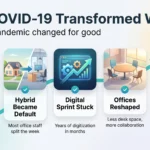
Remote work moved from emergency mode during the pandemic to a lasting operating model. In the United States, about a quarter of all paid workdays were worked from home in May 2026, according to Stanford’s Survey of Working Arrangements and Attitudes; before 2020 the share was in the single digits.
That shift created a need for someone who owns distributed work as a whole: a leader who turns strategy into daily routines instead of leaving every team to improvise. The chief remote officer (CRO), also called head of remote or head of distributed work, fills that gap.
This person sets fair policies, picks the right tools, and keeps employees connected across time zones. Without that ownership, one team documents everything, the next runs on hallway conversations, and nobody knows which rule applies.
Key Takeaways
- Remote and hybrid work have settled. Gallup found 51% of remote-capable US employees working hybrid in 2025, with the mix barely changing since 2022.
- The chief remote officer turns leadership intent into daily practice: policies, tools, meeting norms and documentation standards that apply to every team.
- The title has evolved since the first “head of remote” appeared in 2019. Today the same work often sits under workplace experience or people operations.
- Atlassian and Cimpress show two workable models: fully distributed with intentional in-person gatherings, and remote-first knowledge work alongside on-site manufacturing.
- You need dedicated ownership when informal fixes keep breaking: recurring scheduling, documentation and fairness problems that no single department can solve.
How remote work created the Chief Remote Officer
Before the pandemic, most organizations treated remote work as an exception granted to individuals. When COVID-19 forced a large-scale change in 2020, companies proved that distributed setups could work at scale.
It also exposed real challenges: uneven documentation, unclear expectations, tool sprawl, and security gaps. Team-by-team fixes did not scale.
The title has a short history. GitLab created the first “head of remote” role in 2019, and by 2021 it was one of the most talked-about jobs in tech. Facebook (now Meta), Dropbox, Okta and LinkedIn followed with similar positions under names like chief remote officer, head of distributed work or VP of remote working. The scope was the same: make remote work a designed system.
What has changed by 2026
The hiring wave of 2021 and 2022 has cooled, but the work has not gone away. In many companies it now sits inside workplace experience or people and culture teams. The question has shifted from “how do we set this up” to “how do we make hybrid teams effective and fair.”
The underlying pattern is stable. Gallup’s 2025 data puts remote-capable US employees at 51% hybrid, 28% fully remote and 21% fully on-site, with little movement since 2022. Some large employers have ordered staff back full time, yet Flex Index data from 2025 showed required office days rising much faster than actual attendance. The coordination problem a CRO solves is still there. For the bigger picture, see how remote work changed the workplace.
Why dedicated leadership matters
Distributed work touches HR, IT, facilities, security, legal and every line manager. When no one owns the whole picture, each function optimizes its own corner and the seams show. A named leader sets consistent ways of working and ties them to strategy.
- Sustainability over speed: design systems that last as work norms evolve.
- Clear rhythms: define decision rights and escalation paths across time zones.
- Cross-functional oversight: standardize tools and rules once, for everyone.
What a Chief Remote Officer does in your company
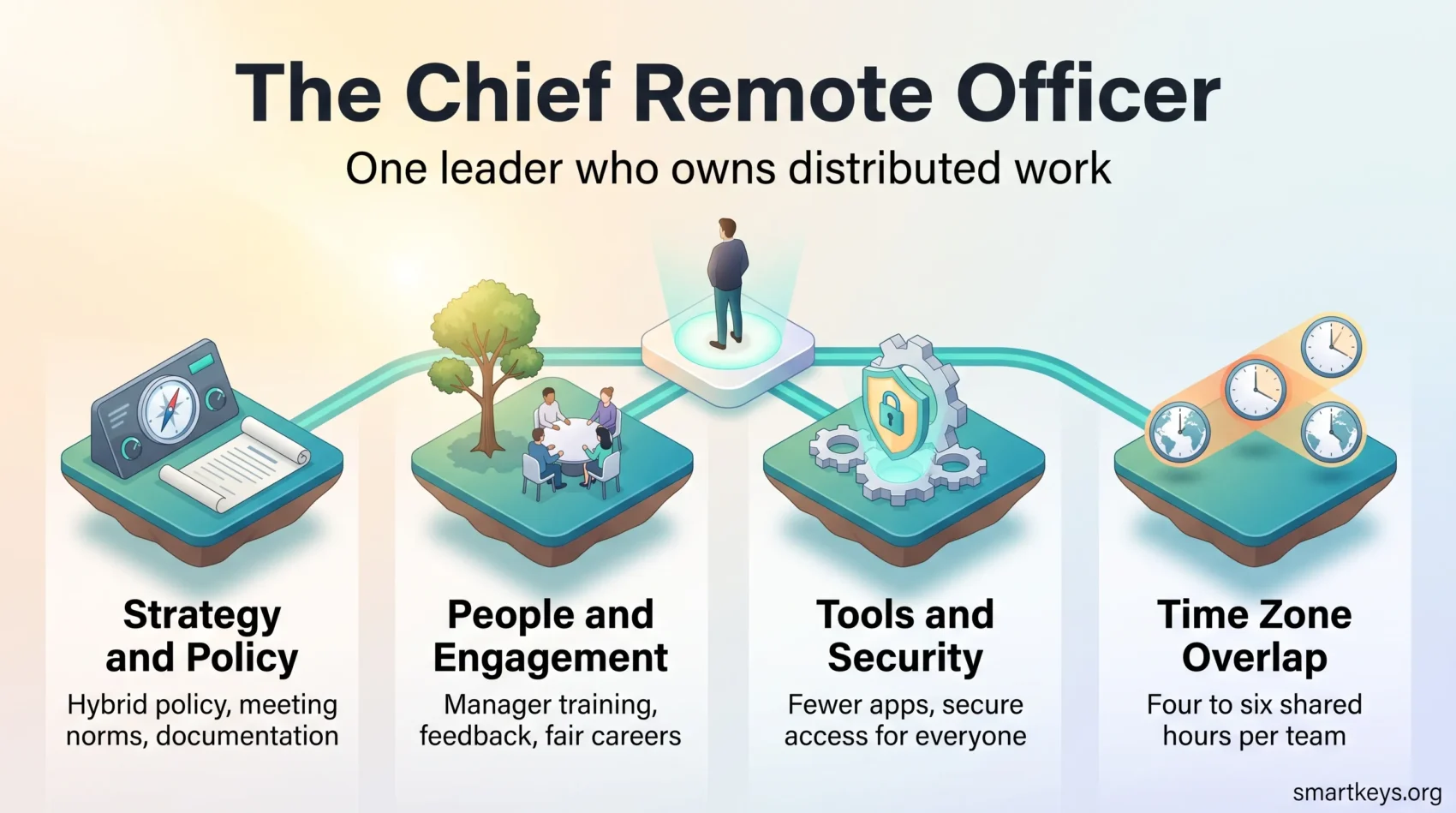
In practice the job splits into three areas.
Strategy and policy: setting clear guidelines
A CRO owns strategy-to-execution for distributed work. That means turning a principle like “we are remote-first” into practical policies teams can follow every day.
Typical outputs are a written hybrid policy, core collaboration hours, communication protocols (which channel for what), documentation standards, and meeting norms. A concrete example: every decision made in a call is written into a shared decision log within 24 hours, so colleagues in other time zones are never left guessing. A hybrid work policy template gives you the skeleton.
Productivity and engagement programs
The role ties recognition, learning, and wellbeing to outcomes, so employees sustain performance without burning out.
Typical initiatives include manager training for leading people you rarely see, regular feedback loops, and career paths that judge results rather than visibility. This matters because remote employees are easily overlooked for promotion, a pattern known as proximity bias. A CRO also watches for the opposite failure, productivity paranoia, where managers distrust work they cannot see. Remote leadership skills usually become part of the manager curriculum.
Technology, security, and compliance
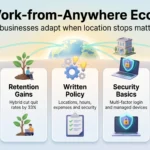
A CRO centralizes tool decisions, reduces overlap between apps, and hardens security. The standard building blocks are least-privilege access (people only get the permissions their job needs), multi-factor authentication, and a clear incident response plan. Our guide to cybersecurity in remote work covers the basics. Shadow IT, the unapproved apps staff adopt on their own, is often the first problem to tackle.
On the compliance side, the role works with HR and legal to map policies to multi-state labor rules, tax exposure when employees relocate, and data protection requirements. An employee mobility policy and, for international teams, global payroll solutions are the usual tools here.
Real-world playbooks: how Atlassian and Cimpress lead distributed work
Two companies show how practical rules and rituals make distributed models work at scale. Their businesses differ, so their answers do too.
Atlassian’s distributed-first model: time zones, tools, and intentional togetherness
Atlassian, the software company behind Jira and Confluence, launched its Team Anywhere program in 2020. Employees choose where they work every day; there is no office mandate. In March 2022 the company hired Annie Dean, previously Meta’s first director of remote work, to lead the program. Her remit covered real estate, workplace experience and the Teamwork Lab, a group of behavioral scientists who test ways of working. She led Team Anywhere until she left Atlassian in 2025. The company has kept the model through the return-to-office push: in 2025 it reported about 12,000 employees working from more than 10,000 locations.
Key practice: teams are built around time zones so members share at least four to six hours of working time, according to CTO Rajeev Rajan. Atlassian has turned down candidates who did not fit their team’s overlap window.
Intentional togetherness is the second pillar. Since August 2022, Atlassian has run more than 1,600 in-person team gatherings, averaging 16 people each. Its research found that team connection rose by 27% after a gathering and faded back to baseline after roughly four months. That is why teams meet about three times a year. Atlassian’s 2024 distributed work report also stated that 91% of employees named the policy as an important reason for staying.
Cimpress’s remote-first approach: manufacturing realities and distributed knowledge work
Cimpress, the parent company of Vistaprint, cannot send its printing plants home. Its knowledge workers in finance, communications, engineering and marketing went remote-first in mid-2020. Paul McKinlay, VP of Communications and Head of Remote First, has led that side of the business since then.
The model is deliberately hybrid rather than one-size-fits-all. Offices were rebuilt as collaboration hubs for project work and team building, not daily desks. Office space in McKinlay’s region shrank from about 300,000 to 75,000 square feet. Nobody in the remote-first group must be anywhere on a regular schedule. Cimpress reported that job applications rose about 300% compared with pre-pandemic levels, with 70% of new hires citing flexibility as a reason for applying.
Takeaway: both companies show how one accountable leader and a focused team can unify practices across business units, and both measure whether their rituals actually help.
Designing operations for hybrid work and collaboration
Designing how people work together across locations turns hybrid into a predictable system instead of a set of ad-hoc choices.
Scheduling for overlap: time-zone-based team design
Define time-zone clusters so teams have predictable overlap windows. Atlassian’s four-to-six-hour minimum is a useful benchmark. For teams that span the globe, follow-the-sun scheduling hands work from one region to the next instead of forcing overlap.
Set team charters that say when to meet live and when to work asynchronously, meaning without expecting an immediate reply. This protects deep work while keeping cross-team touchpoints reliable. Our guides to asynchronous work and managing cross-border remote teams go deeper.
Culture at a distance: building connection beyond the office
Build culture with purposeful rituals and in-person moments. Use periodic gatherings for onboarding, trust-building, and thorny problems that benefit from real-time whiteboarding. Atlassian’s finding that connection fades after about four months is a practical planning number: a January offsite will not carry a team through the autumn.
- Operations design: schedule overlap, map office use, and tune the environment for connection.
- Team practices: lightweight rituals such as standups, decision logs and demo days keep collaboration moving.
- Leadership role: model documentation-first habits and fair meeting times. Hybrid meeting etiquette is where this shows up first.
Our articles on remote company culture and remote employee engagement cover what the evidence supports.
Tools that support the CRO: VMS, desk booking, and IWMS
The three tool categories below are the facilities side of the stack; collaboration software is covered in our guide to hybrid workforce tools.

Visitor Management Systems for secure, compliant office entry
A visitor management system (VMS) replaces the paper sign-in sheet. Typical features are contactless check-in at a kiosk or by QR code, real-time visitor tracking, host notifications, and approval workflows for sensitive areas.
Audit logs and privacy controls help you meet compliance obligations and keep trustworthy records across sites, which matters when hybrid staff and contractors come and go on different days.
Desk booking and space analytics to optimize office utilization
Desk booking tools show real-time availability so people reserve a workspace or room before they commute in. This prevents overcrowding on popular days and makes hybrid days predictable.
Space analytics reveal patterns by floor, team, and weekday. Use those insights to improve layouts and amenities, or to shrink a footprint that is no longer needed. Our piece on the future of workspaces looks at what the occupancy data shows.
Integrated Workplace Management Systems for cross-functional data and workflows
An integrated workplace management system (IWMS) unifies people, locations, and assets in one platform. It supports space planning, reservations, wayfinding, and floor plans, and it pulls badge swipes, bookings and occupancy sensors into shared dashboards.
Result: your CRO and facilities teams get a shared source of truth, so workplace changes can be tested, measured, and improved.
Do you need a chief remote officer?
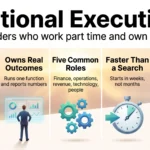
If coordination and tools keep tripping up teams, your company may need a single advocate for hybrid systems. Smaller companies often get the same result with a part-time leader; see our guide to fractional executives.
Signals your leadership and workforce are ready
Hybrid is new and repeated fixes still cause scheduling, documentation, or accountability problems. A pattern of recurring problems shows you need targeted oversight.
Leadership is at capacity or lacks specialized expertise, so a specialist beats another item on a full plate.
Employees report uneven experiences: different tools, inconsistent meeting norms, and unclear expectations across teams and offices. That variance is measurable.
Bridging gaps in communication, equity, and technology
Missed handoffs, duplicated work and unclear decisions cost time and trust. A CRO sets communication frameworks and clear policies so teams move in sync. A shared knowledge management system is usually one of the first deliverables.
If legacy systems block work, you need someone empowered to integrate platforms rather than tinker at the edges. A senior, tech-forward leader closes technology gaps and improves fairness in visibility and career advancement for remote staff.
Quick checklist:
- You likely need a CRO if informal fixes keep breaking and the same problems return.
- Quantify the case with metrics like time-to-decision, onboarding speed, and employee sentiment. Our remote vs. office ROI guide shows how to frame the numbers.
- Appoint a CRO to streamline decisions, standardize policies, and align practices across the organization.
When you are ready, learn how to structure a digital headquarters and support distributed teams at digital headquarters for remote teams. The role also fits a wider trend of new leadership positions; see our overview of emerging C-suite roles.
Conclusion
When you pair governance with the right stack, distributed teams become an advantage. Appointing a chief remote officer, or giving one senior leader that brief under another title, focuses leadership, aligns tools, and ties policies to measurable outcomes. That named role protects culture and raises productivity as employees split time between office and home.
Start simple: assess the scale of your need, give a senior owner real authority, and invest in tools that centralize workplace data. Then iterate. Atlassian and Cimpress did not get their models right on day one; they measured, adjusted, and kept what worked.
Found this useful?
Make SmartKeys a preferred source on Google, and our articles will surface more often in your Top Stories, AI Overviews, and AI Mode.
Add as Preferred Source