Pipedrive is a sales CRM built around a single idea: put every open deal on a board, and make the next action obvious. Founded in 2010 and now used by more than 105,000 companies across over 180 countries, it has stayed deliberately narrower than the all-in-one suites, and that focus is still the main reason teams pick it.
Two things changed recently, and both matter if you are pricing the tool in 2026. Pipedrive consolidated its five legacy plans into four with new names, and it moved a set of AI features from novelty into daily use, including a native connection to AI assistants. This review covers what the plans actually cost, which capabilities sit behind paid add-ons, what the AI does and does not do, what reviewers report, and which teams are better served elsewhere.
Key Takeaways
- Pipedrive now sells four plans: Lite at $14, Growth at $39, Premium at $59 and Ultimate at $79 per user per month on annual billing.
- The old Essential, Advanced, Professional, Power and Enterprise tiers were folded into those four, so older price comparisons no longer apply.
- LeadBooster, Projects, Campaigns, Web Visitors and Smart Docs are paid add-ons rather than standard plan features, though Premium and Ultimate bundle LeadBooster.
- The Marketplace lists over 500 integrations, and a native MCP server released in June 2026 exposes CRM records to assistants such as ChatGPT and Claude.
- Reviewers rate Pipedrive 4.5 out of 5 on Capterra (3,058 reviews) and 4.3 out of 5 on G2 (3,123 reviews).
- The free trial runs 14 days and requires no credit card.
What Pipedrive Is Built For
Pipedrive is a deal-centric CRM. The pipeline view is the product: columns are stages, cards are deals, and dragging a card right is how progress gets recorded. Around that sit contacts, organizations, activities, products, email sync and reporting.
That narrow scope is a deliberate trade. Pipedrive does not try to be a marketing suite, a service desk and a CRM at once, which is what separates it from platforms like Salesforce and HubSpot Marketing Hub. If your problem is that reps forget to follow up and managers cannot see what is in play, Pipedrive solves it quickly. If your problem is orchestrating campaigns, support tickets and billing in one system, it will not.
The company is headquartered in New York and backed by Vista Equity Partners. That has funded a steady release cadence rather than a rewrite, so the interface a team learned three years ago is still recognisable today.
Pipedrive Pricing in 2026
Pipedrive publishes its prices, which already puts it ahead of several enterprise CRMs. All figures below are per user per month on annual billing. Monthly billing costs more.
The Four Plans
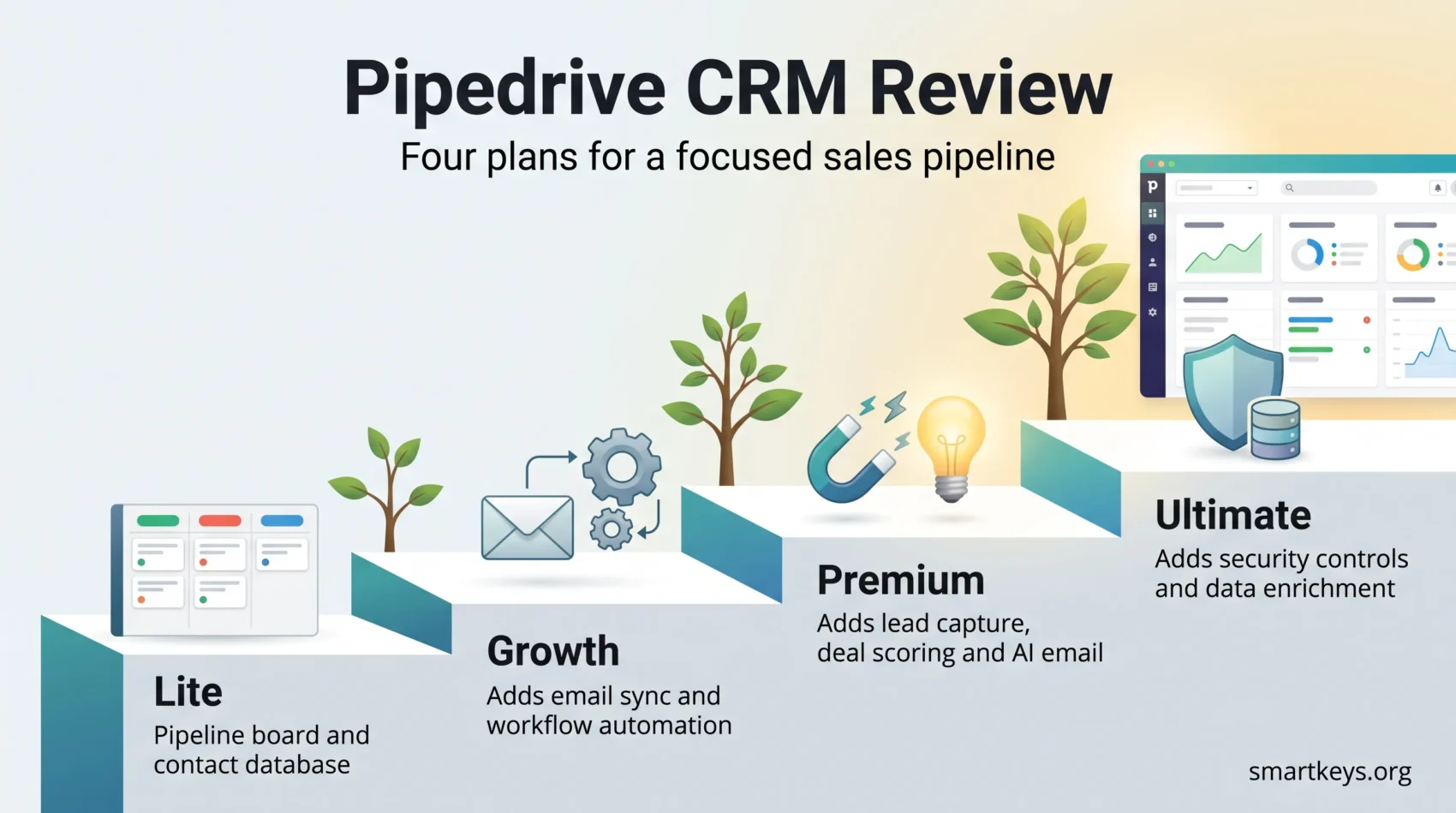
- Lite, $14. Lead, calendar and pipeline management, AI-assisted report creation, real-time sales feed, and access to the integration Marketplace. Capacity is capped at 2,500 leads and deals per user.
- Growth, $39. Adds full email sync with open and click tracking, workflow automation, nurturing sequences, a meeting scheduler and forecast reports. Limits rise to 5,000 leads and deals per user, 50 reports and three if/else steps per automation.
- Premium, $59. Bundles LeadBooster, adds custom deal scoring, AI email tools, contracts and e-signatures, and deeper customization. Capacity moves to 15,000 leads and deals per company, 250 reports per user, ten if/else steps, 15 teams and 25 sequences.
- Ultimate, $79. Adds account security controls, phone and email data enrichment, a sandbox account and extended phone support, with 500 custom fields, 500 reports and 25 teams.
The jump from Lite to Growth is the one that stings. Email tracking and workflow automation are the two features most teams assume come with a CRM, and on Pipedrive they start at $39. Treat Lite as a pipeline board with a contact database attached, not as a working sales system.
What Happened to the Old Plans
If you are comparing against an older review, the mapping is straightforward: Essential became Lite, Advanced became Growth, Professional and Power were merged into Premium, and Enterprise became Ultimate. Existing subscribers can migrate from account settings without losing data, but switching moves the subscription to current list pricing. Anyone still sitting on a legacy tier should model the new price before clicking, because the consolidation was not cost-neutral for every account.
Add-Ons That Change the Bill
Several capabilities are sold separately, and this is where quoted budgets tend to slip. Published starting prices are LeadBooster from $32.50, Smart Docs from $32.50, Web Visitors from $41, Projects from $16 and Campaigns from $13.33. A Growth seat that needs lead capture and document signing can therefore cost more than a Premium seat that includes LeadBooster. Price the combination you actually need rather than the headline tier.
For email marketing specifically, the Campaigns add-on covers basic broadcasts and segmentation, but a dedicated platform such as those compared in our MailerLite and ActiveCampaign comparison will do more for less if newsletters are central to your funnel.
Key Features Worth Paying For
Deal and Pipeline Management
Pipelines are fully customizable: you name the stages, set rotting reminders for deals that sit still, and create separate pipelines for different motions such as new business and renewals. Deal cards hold the value, expected close date, linked contacts, products and full activity history. The rotting indicator is the underrated part, because it surfaces neglected deals without anyone running a report.
Activity Scheduling and Tracking
Every deal can carry scheduled activities: calls, meetings, emails, custom types. The calendar view and the activity list make it hard to end a day without knowing what is overdue. Pipedrive also nudges toward the practice it was designed around, which is never closing a deal card without a next action attached. That discipline, more than any individual feature, is what changes team behaviour.
Contacts, Organizations and Products
Contacts link to organizations, deals and notes, with custom fields for whatever your business tracks. The products catalogue attaches line items to deals, which gives reasonable visibility into what is selling without pretending to be inventory management. If you need real enrichment on top, tools covered in our Lusha review and Clay AI review connect through the Marketplace.
Reporting and Forecasting
Insights covers deal, activity and revenue reporting with customizable dashboards, and forecast views arrive with Growth. Report allowances are tiered rather than unlimited, which is worth checking if several managers each build their own views.
What Pipedrive AI Actually Does
Pipedrive splits its AI across plans rather than selling it as one add-on, and the split is clear.
Every plan, including Lite, gets the AI import assistant that maps spreadsheet columns to Pipedrive fields, AI-assisted report creation that builds reports from a written prompt, natural language search in the Marketplace, app recommendations and a Sales Assistant in beta that answers questions about your own data.
Premium and Ultimate add the email-side tools: AI email drafting in the Sales Inbox with tone and length controls, context-based performance notifications, and beta features for email thread summarization and suggested replies. Pipedrive’s documentation does not publish AI credit limits per plan, which is a genuine difference from vendors that meter every generation.
The more interesting release is the native MCP server, launched on 30 June 2026. It lets assistants such as ChatGPT and Claude search deals, contacts, organizations and leads in natural language, create and update records, convert leads into deals, generate pipeline insights and turn meeting notes into structured records, all under existing permission controls and audit trails. For teams that already start the day in an assistant, this removes the copy-and-paste step that made earlier CRM AI features feel optional.
None of this makes Pipedrive an agentic platform in the sense that Salesforce and HubSpot now market. It is assistive rather than autonomous, and priced accordingly.
Integrations and Automation
The Marketplace lists over 500 integrations, including Google Workspace, QuickBooks, Slack and the major calling tools. Two-way email sync is the integration most teams rely on daily, and it lands on Growth and above.
Workflow automation handles the repetitive middle of a sales process: create an activity when a deal enters a stage, send a templated email when it moves, assign an owner when a lead arrives. The if/else branching limit is the constraint to watch, since three steps on Growth runs out faster than it sounds.
For anything Pipedrive cannot reach natively, general automation platforms fill the gap. Our Zapier and Make comparison and Workato versus Zapier review cover the trade-offs. Proposal and signature workflows can be routed through tools like Proposify or Docusign, accounting through QuickBooks Online, and internal notifications into Slack.
What Reviewers Report
Pipedrive holds 4.5 out of 5 on Capterra across 3,058 reviews, with ease of use at 4.5, customer service at 4.4, features at 4.3 and value for money at 4.4. On G2 it sits at 4.3 out of 5 across 3,123 reviews.
The pattern in those scores is consistent with what the product is. Ease of use scores highest, features lowest. Reviewers who need a CRM their team will actually update rate it well. Reviewers who arrive expecting marketing automation, complex quoting or deep service functionality rate features down, and the gap between the ease-of-use and features scores is the clearest summary of the trade you are making.
The recurring complaints are also stable: entry-level plans feel thin, add-on costs accumulate, and marketing automation is weaker than in combined platforms such as those in our ActiveCampaign and HubSpot comparison.
Pros and Cons
Strengths
- Adoption rate. The pipeline metaphor is understood in minutes, which is why reps keep it current.
- Transparent pricing. All four tiers and every add-on are published, so budgets can be modelled without a sales call.
- Customizable pipelines and fields. Multiple pipelines and custom fields cover most sales motions without consultancy.
- Integration breadth. Over 500 Marketplace apps, plus native MCP access for AI assistants.
- Mobile app. Genuinely usable for updating deals between meetings rather than a cut-down viewer.
Limitations
- Lite is thin. No email tracking and no workflow automation makes the cheapest tier a hard sell for a working team.
- Add-on stacking. LeadBooster, Smart Docs, Projects, Campaigns and Web Visitors each carry their own per-seat cost.
- Tiered limits. Leads, deals, reports, teams, sequences and automation branches are all capped by plan.
- Marketing automation. Campaigns covers basics only; anything sophisticated needs a second platform.
- Short trial. Fourteen days is tight for a proper pilot with a full team.
How Pipedrive Compares
Against Salesforce, Pipedrive wins on time to value and loses on extensibility. Against HubSpot, it wins on price predictability and loses on the marketing side. Against lighter tools, the calculation flips: our folk.app review and Salesflare review cover options that automate more of the data entry for very small teams, while Bitrix24 bundles far more for the money if you can accept a busier interface.
For direct head-to-heads, see our Freshworks CRM versus Pipedrive comparison and Pipedrive versus Insightly comparison. If you are evaluating the heavier end, Freshworks versus Salesforce and the Adobe Marketo Engage review set the upper boundary of what a sales and marketing stack can cost.
Getting Started
Setup follows a predictable order. Build your pipeline first in the Pipelines section and name the stages after decisions rather than activities, so a stage means something changed on the customer side. Import contacts next, using the AI import assistant to map columns. Connect email on Growth or above so conversations attach themselves to deals without manual logging.
Then add automations one at a time. The common mistake is building ten rules on day one and spending the following month untangling them. Start with the two that remove the most manual work, usually activity creation on stage change and owner assignment on new leads.
Finally, agree one reporting view before anyone builds a personal dashboard. Report limits are per plan, and shared definitions stop three managers measuring conversion three different ways.
Verdict
Pipedrive remains one of the easiest CRMs to get a sales team to actually use, and in 2026 it is still priced honestly and documented clearly. The plan consolidation simplified a confusing five-tier lineup, and the AI additions, particularly the MCP server, are practical rather than decorative.
The caveat has not changed. Budget for Growth or Premium rather than Lite, add up the add-ons you need before comparing tiers, and accept that marketing automation belongs somewhere else. Judged as a focused sales pipeline tool rather than a business platform, it earns its place.
Found this useful?
Make SmartKeys a preferred source on Google, and our articles will surface more often in your Top Stories, AI Overviews, and AI Mode.
Add as Preferred SourceFAQ
How much does Pipedrive cost in 2026?
Pipedrive sells four plans, priced per user per month on annual billing: Lite at $14, Growth at $39, Premium at $59 and Ultimate at $79. Monthly billing costs more. Those figures cover the core CRM only. LeadBooster, Smart Docs, Web Visitors, Projects and Campaigns are separate add-ons with their own per-seat prices, starting at $32.50, $32.50, $41, $16 and $13.33 respectively, although Premium and Ultimate include LeadBooster. Before comparing tiers, list the add-ons you actually need, because a Growth seat with two add-ons can cost more than a Premium seat that bundles one of them.
What happened to the Essential, Advanced, Professional and Power plans?
Pipedrive consolidated five legacy tiers into four. Essential became Lite, Advanced became Growth, Professional and Power were merged into Premium, and Enterprise became Ultimate. Existing subscribers can move to the new lineup from their account settings without losing data, and accounts that exceed old limits keep their records when they upgrade. Switching does update the subscription to current list pricing, so the change is not automatically cost-neutral. If you are on a legacy plan, model the new price against your seat count and add-ons before migrating, and treat any review or price comparison written before the change as out of date.
What can Pipedrive AI actually do?
Every plan includes an AI import assistant that maps spreadsheet columns to Pipedrive fields, AI-assisted report creation from a written prompt, natural language Marketplace search, app recommendations and a Sales Assistant in beta that answers questions about your data. Premium and Ultimate add AI email drafting with tone and length controls, context-based notifications, and beta email summarization and suggested replies. Pipedrive also launched a native MCP server on 30 June 2026, which lets assistants such as ChatGPT and Claude search records, create and update them, convert leads into deals and generate pipeline insights under your existing permissions and audit trails.
Is Pipedrive suitable for small businesses?
Yes, and small sales teams are the clearest fit. The pipeline view is understood without training, which is the single biggest predictor of whether a CRM survives past month three. The caution is which plan you choose. Lite at $14 lacks email tracking and workflow automation, so most small teams end up on Growth at $39 to get a system that reduces manual work rather than adding to it. If your team is two or three people who mainly need contacts and follow-up reminders, a lighter tool may cost less and demand less setup than Pipedrive plus its add-ons.
How does Pipedrive compare with Salesforce and HubSpot?
Pipedrive is narrower and cheaper. Salesforce offers far more extensibility, custom objects and enterprise governance, at the cost of setup time and usually an implementation partner. HubSpot bundles marketing, sales and service on one record, which is valuable if you want a single platform, but its pricing scales sharply once you pass free tools. Pipedrive publishes every price, deploys in days rather than months and concentrates on deal progression. Choose it when your bottleneck is sales discipline and visibility. Choose one of the suites when your bottleneck is connecting marketing, sales and support data in one system.
What do Pipedrive users say in reviews?
Pipedrive holds 4.5 out of 5 on Capterra across 3,058 reviews, with ease of use rated 4.5, customer service 4.4, features 4.3 and value for money 4.4. On G2 it scores 4.3 out of 5 across 3,123 reviews. The shape of those numbers is telling: usability rates higher than feature depth, which matches a product built for focus rather than coverage. The recurring criticisms are consistent across both sites. Entry-level plans feel limited, add-on costs accumulate faster than expected, and marketing automation is weaker than in combined sales and marketing platforms.
What does Pipedrive integrate with?
The Pipedrive Marketplace lists over 500 integrations, covering Google Workspace, QuickBooks, Slack, calling tools, accounting software and e-signature platforms. Two-way email sync with open and click tracking is the integration most teams use daily, and it starts on the Growth plan. For anything without a native connector, general automation platforms such as Zapier, Make and Workato can move data in and out of Pipedrive. Since June 2026 there is also a native MCP server, which connects Pipedrive directly to AI assistants so records can be searched and updated in conversation while permissions and audit trails still apply.
What are the main advantages and limitations of Pipedrive?
The advantages are adoption speed, transparent published pricing, customizable pipelines and fields, over 500 integrations and a mobile app that is usable rather than token. The limitations are equally clear. The Lite plan omits email tracking and workflow automation, so it rarely works as a team’s only system. Add-ons for lead capture, documents, projects, campaigns and web visitor tracking each carry a separate per-seat cost. Leads, deals, reports, teams, sequences and automation branches are all capped by plan. Marketing automation stays basic, so campaign-heavy businesses will need a second platform alongside it.
Can I try Pipedrive before committing to a plan?
Yes. Pipedrive offers a 14-day free trial that does not require a credit card. Two weeks is short for a full team pilot, so plan it before you start: import a real subset of contacts rather than sample data, build the pipeline stages you would genuinely use, connect one email account and run two or three live deals through the full process. Test the specific things that would block adoption, such as your email sync, your reporting needs and any integration your team depends on. Trialling the plan you would actually buy matters, because features differ substantially between tiers.