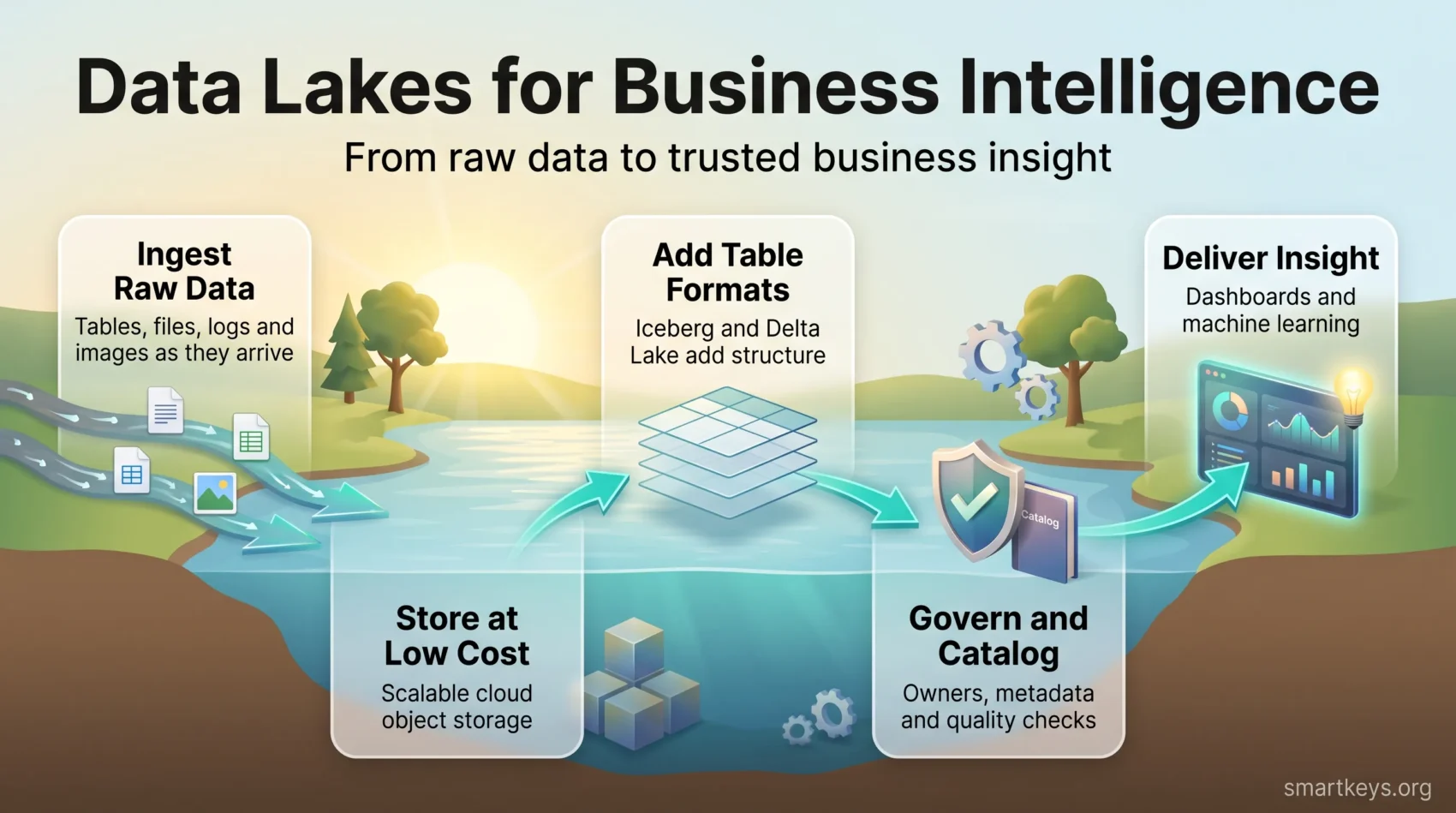
A data lake is one large storage pool that holds all of a company’s data in its original form. Spreadsheets, database exports, server logs, PDFs, product photos and sensor readings go in as they are, with no reformatting first. That part is simple. Turning the pool into useful business intelligence, meaning analysis people actually act on, is the hard part.
The approach has moved from niche to mainstream. In June 2026, Gartner analyst Prasad Pore put lakehouse adoption at 65 percent of Gartner’s client base, a fast climb for an architecture that barely existed a decade ago. A lakehouse is a data lake with a management layer on top, so raw files behave more like tables in a normal database.
Key Takeaways
- A data lake stores raw data of every type in one place, so analysis is not limited to what was tidied up in advance.
- Storage is cheap. The query engines and the people maintaining pipelines are where the budget goes.
- Open table formats such as Apache Iceberg and Delta Lake now sit between the raw files and your BI tools.
- Governance decides the outcome. Gartner expects 60 percent of AI projects without AI-ready data to be abandoned through 2026.
- Start with one business question you cannot answer today, not with a platform purchase.
Understanding Data Lakes and Their Importance
Most companies hold data in a dozen disconnected systems: the CRM, the accounting tool, the ticketing system, the ad dashboards. Answering a question that crosses two of them means exporting spreadsheets and hoping the definitions match.
What a Data Lake Actually Is
A data lake keeps data in the format it arrived in. Nothing is reshaped on the way in. It holds three kinds of content:
- Structured data: neat rows and columns, such as an orders table.
- Semi-structured data: files with some labelling but no fixed shape, such as JSON exports from an app.
- Unstructured data: everything with no built-in table, such as call recordings, contracts and images.
Underneath, a data lake uses object storage. Files are held as self-contained objects with an identifier rather than in a folder tree on a server. Amazon S3, Google Cloud Storage and Azure Data Lake Storage Gen2 are the common choices. You pay for what you store and add capacity without buying hardware. Because nothing is discarded on the way in, an analyst can later ask a question nobody anticipated.
Data Lake vs Data Warehouse
A data warehouse takes the opposite approach. Data is cleaned and loaded into a fixed model before anyone queries it, which is called schema on write. That makes dashboards fast and consistent, and it remains the right home for standard business intelligence reporting. The trade-off is rigidity: if a column was not in the model, it is not in the warehouse.
A data lake applies structure at the moment of the query instead, called schema on read. A retailer’s warehouse reports weekly revenue by store in seconds, but cannot say whether customers who complained about delivery went on to churn, because the call transcripts were never loaded. A lake holds those transcripts and joins them to sales records later.
By 2026 the two designs have largely converged. The lakehouse keeps raw files in cheap object storage but adds warehouse-style tables, permissions and transactions on top. Most teams now run one lakehouse rather than a lake and a warehouse side by side, which also simplifies cloud cost control.

Benefits of Using Data Lakes for Business Intelligence
Enhanced Analytics Capabilities
Data lakes separate storage from compute. Storage is the disk space holding your files; compute is the processing power that reads them. Keeping them apart lets you park ten years of history cheaply and spin up a large cluster for one afternoon of heavy analysis.
That flexibility makes machine learning practical. Models need long histories and messy inputs, not a tidy summary table. A logistics firm can train a delivery-delay model on years of GPS traces, weather files and driver notes, the raw material behind most predictive analytics projects and AI-assisted analytics tools.
Cost-Effective Data Storage
Object storage is priced per gigabyte per month, cheap enough that keeping raw history is rarely the expensive decision. Storing data in its original form also removes upfront transformation work.
One warning, because this catches teams out. Cheap storage does not mean a cheap platform. Query engines, the catalog and the people maintaining pipelines cost far more than the disk. Treat cloud spend management as part of the project.

Data Lake Architecture for Effective Business Intelligence
A data lake is not one product. It is four layers you assemble.
Components of a Data Lake
- Storage layer: where the files live, usually Amazon S3, Google Cloud Storage or Azure Data Lake Storage.
- Ingestion layer: the pipelines that bring data in, whether nightly batches or continuous streams. This is where an integration platform usually sits.
- Processing layer: the engines that read and transform files, such as Apache Spark, Trino or a cloud SQL service.
- Governance layer: the catalog, access rules and quality checks that decide who sees what and whether it can be trusted.
Why Object Storage Matters
Object storage is durable, so files survive hardware failure without you managing backups. It is reachable over standard interfaces, so tools like Power BI and Tableau read the same data. And it scales without a capacity plan.
Open Table Formats: The 2026 Shift
The biggest recent change is the arrival of open table formats. A table format is a metadata layer that makes a folder of files behave like a database table. It tracks which files belong to which version, giving you transactions, safe schema changes and the ability to query a table as it looked last Tuesday.
Two formats dominate. Apache Iceberg has become the interoperability standard, and every major cloud now ships a managed Iceberg service. Delta Lake, created at Databricks, remains widely used and reads and writes Iceberg tables too. The vendor moves tell the story: Databricks agreed to acquire Tabular, founded by Iceberg’s original creators, in June 2024, and Amazon introduced S3 Tables, managed Iceberg storage, at re:Invent in December 2024.
For a buyer: pick a format your existing tools can read, and insist your catalog speaks the open REST standard.
Data Lake Implementation Strategies
Most failed data lakes were built before anyone agreed what they were for. These steps put the business question first.
Key Steps in Implementing a Data Lake
- Name the question you cannot answer today. One concrete example, such as which customers are likely to cancel next quarter, beats a general wish for better insight.
- Audit what you already hold. List the systems, the owners and the update frequency. Half the effort is finding out who controls a source.
- Plan growth and access together. Retrofitting permission rules onto a live lake is painful.
- Match ingestion tooling to your sources. Batch loads are fine for finance exports. Streaming is worth the complexity only when a decision depends on fresh data.
- Set up governance before the second source lands. A catalog, an owner per dataset and basic quality checks are cheap now and expensive later.
Integrating Data Lakes with Existing Systems
A data lake rarely replaces anything on day one. It sits alongside the systems you have.
- Keep the warehouse where it earns its place. Financial reporting can stay there while exploratory work happens in the lake.
- Use managed services rather than building your own. Running your own cluster is rarely worth the operational burden, one reason managed cloud platforms carry most new workloads.
- Apply role-based access from the start, so permissions stay reviewable instead of accumulating as one-off requests.
- Decide what stays on premises. Regulated or latency-sensitive data may need a hybrid cloud arrangement or processing closer to the source, an argument for edge computing in industrial settings.
- Consider bought-in data as a source. External market data can be subscribed to through a data-as-a-service provider and landed in the same lake.
Data Management and Governance in Data Lakes
Governance is the least glamorous part of a data lake and the part that decides whether it works.
Ensuring Data Quality and Governance
Gartner surveyed 1,203 data management leaders in July 2024 and found 63 percent of organisations either lacked the right data management practices for AI or were unsure whether they had them. On that basis Gartner predicted that through 2026, organisations would abandon 60 percent of AI projects not supported by AI-ready data.
AI-ready simply means the data is documented, consistent and permitted for the use you have in mind. Getting there needs a written business case, a named executive sponsor, and a framework that says who owns each dataset.
Metadata does the quiet work. Metadata is the description attached to a dataset: where it came from, what each field means, when it was last refreshed. Without it, an analyst cannot tell a reliable table from an abandoned experiment. A clear governance strategy keeps that description current.
Executing Effective Data Management Plans
- Access policies stating who can view sensitive fields, and who approves exceptions.
- Data lineage tracking, meaning a record of where each figure came from and what was done to it.
- Regular audits against the rules that apply to you, which keep shifting as privacy regulation expands.
- Retention rules, so the lake does not quietly become a legal liability.
Good governance pays back in time. When datasets are documented and trusted, analysts spend their hours on analysis rather than checking whether a table is safe to use. That is the foundation for self-service analytics, where teams answer their own questions instead of queuing for the data team.

Data Lake Analytics: Unlocking Insights
Leveraging AI and Machine Learning
Analytics on a data lake usually means one of two engines. A SQL query engine such as Trino, Amazon Athena or Databricks SQL lets analysts use the language they already know. A processing framework such as Apache Spark handles heavier transformation and model training.
A note on an old recommendation: Microsoft retired Azure Data Lake Analytics on 29 February 2024 and directed customers to Synapse Analytics, with Microsoft Fabric now the main path. If you inherited a project built on it, that migration is overdue.
What these engines make possible is straightforward. A bank can score transactions for fraud against years of history. A retailer can join web behaviour to store purchases and see which promotions shifted units, which is where customer experience analysis pays off.
Real-Time Data Processing Capabilities
Data lakes commonly use ELT rather than ETL. In ETL, data is transformed before loading. In ELT, it is extracted and loaded first, then transformed when needed. Loading first is faster, so data can land continuously instead of waiting for a nightly window.
Be honest about whether you need that speed. Fraud checks and stock availability change decisions minute by minute. A monthly board report does not. The value of real-time data depends on whether anyone can act faster as a result.

Data Lake Integration: Maximizing Value
Connecting Various Data Sources
Most of what an organisation collects has no rows and columns. Industry estimates have put the unstructured share of enterprise data at roughly 80 percent for years, and the exact figure matters less than the direction. Contracts, images, recordings and free-text notes keep growing faster than tidy database tables.
Traditional warehouses cannot hold that material, which is the plainest argument for a lake. Pull in the operational systems, the records in a customer data platform, the web logs and the document stores, plus location data where it drives decisions.
Facilitating Cross-Departmental Collaboration
Shared data reduces arguments about whose number is right. When marketing, supply chain and finance read the same tables, meetings move on from reconciliation to decisions.
Coca-Cola Andina offers a documented example. The bottler built a data lake on AWS and replaced once-daily updates from its on-premises system with refreshes every 15 minutes. Its published results are modest but concrete: a one percent increase in order fill rate, a 0.2 percent reduction in out-of-stock frequency and a 0.3 percent reduction in orders not received, alongside a doubling of the product lines it could manage.
Those percentages look small until you apply them to a bottler’s volume. That is usually what success looks like, and data storytelling is what turns a modest number into a decision.
Data Lake Strategy for Business Intelligence Implementation
Aligning Data Lakes with Business Goals
Ask each department which decision they currently make on instinct because the data is out of reach. Those answers become your first use cases, and they tell you which sources to load first.
Be realistic about your starting point too. An analytics maturity assessment shows whether the constraint is technology or the fact that few people read a dashboard confidently. If it is the latter, a data literacy programme will do more for adoption than another platform.
Developing a Comprehensive Data Lake Strategy
- Governance rules covering data quality, ownership and regulatory compliance.
- A phased roadmap on scalable services such as Amazon S3 or Azure Data Lake Storage, delivering one use case at a time.
- A tooling choice, typically Spark for transformation and a SQL engine for analyst access.
- An open table format and catalog decision made early, since changing it later means rewriting pipelines.
- Milestones tied to business outcomes, not to volumes of data loaded.

Sequencing matters more than the tool list. A lake that answers one real question in three months earns the budget for the next phase. One that loads forty sources before producing a report usually does not.
Challenges in Utilizing Data Lakes for Business Intelligence
Data Swamps: The Most Common Failure
A data swamp is a data lake nobody trusts. Files went in, documentation did not follow, and now no one can say which version of the customer table is current. It is a governance failure rather than a technical one. The usual causes:
- Undocumented ingestion. Pipelines get built quickly and their outputs are never catalogued or assigned an owner.
- No quality checks. Broken loads pass silently and the errors surface in a report months later.
- No self-service access. When analysts cannot browse what exists, they request extracts instead, and copies multiply.
Overcoming Scalability and Performance Issues
Performance problems are rarely about raw volume. They are about how files are organised.
- The small file problem. Streaming ingestion produces thousands of tiny files, and reading them is far slower than reading a few large ones. Regular compaction fixes it.
- Unreliable writes. Without transactions, a failed job can leave half-written data that queries silently pick up.
- Poor partitioning. If the layout does not match how people query, every question scans the whole table.
Open table formats address the first two. Delta Lake and Apache Iceberg both add ACID transactions, meaning a write either completes fully or not at all, and both support compaction and schema changes without rewriting history.
Conclusion
A data lake is worth building when your questions outgrow the data your warehouse was designed to hold. It gives you one place for structured and unstructured data, cheap long-term storage, and raw material for machine learning.
What changed by 2026 is that the architecture settled. The lakehouse pattern is mainstream, open table formats made the storage layer portable, and the interesting decisions moved up the stack to governance and use cases.
That is also where projects still fail. The technology will scale; documentation, ownership and access rules determine whether anyone trusts the output. Start with one question worth answering, load only the data it needs, and treat governance as part of the build. For the wider context, see our overviews of AI in business operations and big data analytics trends.
Found this useful?
Make SmartKeys a preferred source on Google, and our articles will surface more often in your Top Stories, AI Overviews, and AI Mode.
Add as Preferred Source