Welcome to our Lusha Review for 2026, where we look at what the Lusha platform actually delivers today: how its contact data holds up, what the credit model really costs, and how seriously it takes privacy. By the end you will know whether Lusha fits your prospecting workflow or whether a different B2B data tool serves you better.
Key Takeaways
- Lusha is a B2B contact data and sales intelligence platform built around a credit system rather than flat seat pricing.
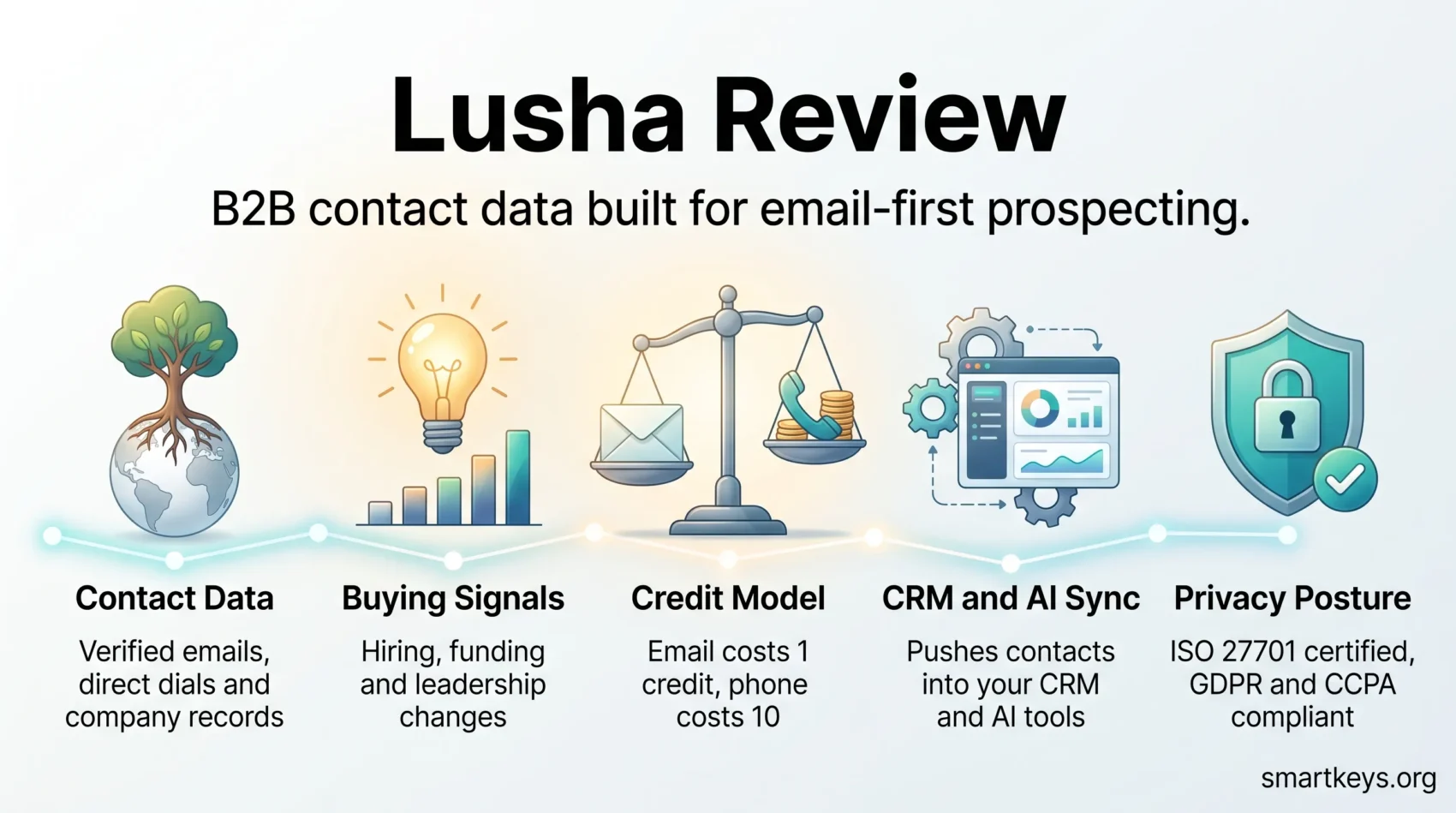
- Lusha states its database covers 290 million-plus verified contacts and 26 million-plus companies, with 98% email accuracy and 86% phone accuracy (source: lusha.com/data). These are vendor figures, not independently audited numbers.
- On G2, Lusha holds a 4.3 out of 5 rating across roughly 1,665 reviews as of August 2026 — solid, but not flawless.
- The free plan gives up to 40 credits per month. A verified email costs 1 credit, a phone number costs 10.
- Lusha is ISO 27701 certified and states GDPR and CCPA compliance, yet criticism about how contact data is sourced has not gone away.
- Phone-heavy prospecting burns credits fast, which is where Lusha gets expensive compared with email-only workflows.
What Is Lusha?
Lusha is a go-to-market intelligence platform for sales, marketing and recruitment teams. It supplies business email addresses, direct dials and company records, so reps spend less time hunting for a contact and more time actually reaching them.
The core product is a searchable database with filters for role, seniority, industry, company size and location. Alongside it sits the browser extension, which reveals contact details directly on LinkedIn and company websites, and an API for teams that want to enrich records in bulk instead of one profile at a time.

Lusha connects to the CRMs most sales teams already run, including Salesforce, HubSpot Marketing Hub and Pipedrive CRM. That matters more than it sounds: a data tool that does not write cleanly back into your CRM creates duplicate records instead of pipeline.
If you are still choosing the CRM itself, our comparisons of Freshworks CRM and Pipedrive and of Pipedrive and Insightly cover the trade-offs, while folk.app, Salesflare and Bitrix24 are worth a look for smaller teams.
Lusha Review: Key Features You Should Know
Lusha has moved beyond simple contact lookup. Three feature groups define what you are paying for in 2026.
Contact and Company Data
Lusha’s database is the product. The company states coverage of 290 million-plus verified contacts and 26 million-plus companies across 78 data fields, spanning North America, EMEA, LATAM and APAC. Enrichment fills gaps in records you already own, which is often more valuable than net-new prospecting: a CRM full of stale job titles quietly wrecks routing, segmentation and forecasting.
Buying Signals and Intent
Lusha lists 24 real-time intent and buying signals grouped into categories such as hiring surges and headcount growth, funding rounds and leadership changes, website visitor intent, champion job changes, lookalike accounts, and risk indicators like layoffs. Signals are the difference between a list and a reason to call. They also overlap with what a customer data platform does, so check where the responsibility sits in your stack before paying twice.
Integrations, API and AI Workflows
Beyond CRM sync, Lusha now exposes its data to automation and AI tooling: Salesforce, HubSpot, n8n, Make, plus ChatGPT, Claude and any MCP-compatible client. If you are building AI agent workflows or automated outbound sequences, that removes a lot of glue code. Pair it with disciplined outbound sequencing and the data actually gets used instead of sitting in a CSV.
Lusha Pricing: How the Credit Model Works
Lusha does not charge a flat fee for unlimited lookups. You buy credits, and every reveal spends them. Understanding that mechanic matters more than comparing headline prices.
What a Reveal Actually Costs
According to Lusha’s own pricing page, revealing a verified email address costs 1 credit and revealing a phone number costs 10. That ten-to-one ratio is the single most important number in this review. A team doing email-first outreach stretches its allowance a long way. A team that lives on the phone will burn through the same allowance ten times faster — and that is where the bills that surprise people come from.
Free Plan, Paid Tiers and Scale
The free plan includes up to 40 credits per month plus basic prospecting, the browser extension and CRM integrations. Paid self-serve tiers add larger credit pools, list management, team credit sharing and bulk reveals. Teams larger than five users are routed to sales for a custom Scale quote.
Published prices for the paid tiers change often, and third-party roundups frequently contradict each other, so check Lusha’s pricing page before you budget. The more useful exercise is to model your own cost: estimate monthly phone reveals, multiply by ten, add email reveals, then compare that credit requirement against each tier.
User Experience: What Users Are Saying
Reviewer sentiment is broadly positive but far from unanimous. On G2, Lusha holds a rating of 4.3 out of 5 from around 1,665 reviews as of August 2026, placing it firmly in the “good, with caveats” band alongside most established data vendors.
What Reviewers Praise
The recurring compliments are speed and simplicity. The browser extension is quick to learn, the interface does not require training, and reps can go from install to first reveal in a single session. For small sales teams without a data ops function, that low friction is the main argument for Lusha over heavier enterprise platforms.
Where the Criticism Lands
Two complaints appear again and again. The first is credit handling: users dislike losing unused credits when they downgrade or when a reveal returns a contact that turns out to be wrong. The second is support responsiveness, particularly for billing and data-removal requests, which is a recurring theme in lower-star reviews. Neither is unique to Lusha, but both are worth testing during a trial rather than discovering after signing an annual contract.

Data Accuracy: The Heart of the Matter
Lusha publishes accuracy figures of 98% for email and 86% for phone. Treat those as vendor claims: they are self-reported, the measurement method is not published, and no independent audit backs them up. Every B2B data vendor publishes numbers in this range, which tells you something about how the category markets itself.
What reviewers consistently report is more nuanced. Email accuracy tends to hold up well in North America and Western Europe. Phone numbers are the weaker link, especially outside those regions and especially for mobile numbers — which is precisely the field that costs ten credits. Coverage also thins out for very small companies and for roles below director level.
The practical implication: run a paid pilot on a real segment before committing. Pull 100 contacts that match your actual ICP, verify them, and calculate your own hit rate. A vendor average is meaningless if your target market sits in the tail of the distribution.

Privacy and Compliance
No review of a contact data vendor is complete without the privacy question, and Lusha attracts more of it than most.
Where the Criticism Comes From
The friction is structural, not incidental. Platforms in this category compile business contact details from public and partner sources, which means people regularly discover their own phone number in a database they never signed up for. That produces two predictable complaints: unsolicited outreach, and frustration with the process of getting a record removed. If your outbound touches EU residents, this is your compliance exposure as much as Lusha’s — the sender carries obligations too, and data localization laws add another layer for global teams.
What Lusha Has Certified
On the record side, Lusha’s position is stronger than the criticism suggests. It states GDPR and CCPA compliance and holds ISO 27701 certification from an accredited body — a privacy information management standard it announced in 2022 as the first B2B sales intelligence platform to achieve it. It also states it does not sell customer data. Certification is not the same as being uncontroversial, but it does mean there is an audited privacy management system behind the claims rather than a marketing page.

Pros and Cons of Using Lusha
Advantages of Using Lusha
- Fast to adopt: the browser extension and interface need almost no onboarding, which suits teams without a data ops function.
- Strong integration surface: major CRMs, automation platforms like n8n and Make, plus MCP-compatible AI clients.
- Genuine free tier: 40 credits a month is enough to evaluate data quality on your own ICP before paying.
- Audited privacy posture: ISO 27701 certification is uncommon in this category.
- Buying signals included: intent and trigger data reduce the need for a separate signals vendor.
Drawbacks to Consider
- Phone reveals are expensive: at 10 credits each, dial-heavy teams hit their ceiling quickly.
- Credit rules frustrate users: losing unused credits on downgrade is a common complaint.
- Uneven international coverage: accuracy drops outside core North American and Western European markets.
- Support is a weak point: billing and data-removal requests are the most cited pain in negative reviews.
- Self-reported accuracy: the headline percentages are not independently verified.
Comparing Lusha with Alternatives
Lusha sits in a crowded market, and the right choice depends on which failure mode hurts you most.
ZoomInfo is the enterprise incumbent — deeper firmographics and broader coverage, at enterprise pricing and with a heavier implementation. Clay takes a different approach entirely, chaining multiple data providers together in a waterfall so a miss at one source is retried at the next; it is more powerful and more work to operate. FullEnrich applies the same waterfall idea specifically to contact enrichment.
Lusha’s positioning between those poles is coherent: easier than ZoomInfo, less assembly required than Clay, and cheaper than both for small teams — provided your workflow is not phone-first. If it is, model the credit cost carefully before you commit.
Who Should Use Lusha?
Lusha makes most sense for small and mid-sized sales, marketing or recruitment teams that prospect primarily by email, work mainly in North America or Western Europe, and want a tool reps can use on day one without a rollout project.
It makes least sense for teams whose motion is cold calling at volume, for organisations targeting emerging markets or very small companies, and for enterprises that need contractual data guarantees and dedicated support.
Teams building a broader revenue stack should also weigh where contact data fits against sales enablement investment and, for campaign execution, tools like Mailchimp.
Conclusion
Lusha is a competent, approachable B2B contact data platform with a credit model that rewards email-led prospecting and punishes phone-led prospecting. Its integration surface is genuinely good, its free tier is generous enough for a real evaluation, and its ISO 27701 certification puts it ahead of most competitors on documented privacy practice.
The caveats are equally clear. Accuracy claims are self-reported, international coverage is uneven, support draws consistent criticism, and the credit rules irritate people who downgrade. None of that disqualifies Lusha — it just means the free tier exists for a reason. Test it on your own target list, count your hit rate, and let your numbers decide.
As you assess business intelligence tools, weigh Lusha against how your team actually prospects rather than against a feature checklist.
Found this useful?
Make SmartKeys a preferred source on Google, and our articles will surface more often in your Top Stories, AI Overviews, and AI Mode.
Add as Preferred Source