Hiring for content and marketing roles has a volume problem. A single remote job ad can pull in hundreds of applications, most written by people who read the same advice about tailoring a resume. Sorting them by hand is slow, and a CV carries weak signal. Workello attacks that from one angle: candidates take a short skills test before a human reads their application.
This Workello review covers what the platform does in 2026, what the four plans cost, where skills testing sits in the evidence on hiring, and which teams it suits. If you hire writers, editors, support agents or virtual assistants at volume, it is worth a look. If you need a full HR suite with payroll and compliance, it is not.
Key Takeaways
- Workello is a skills testing platform with a light applicant tracking system around it, not a full HRIS.
- Pricing starts with a Free Forever tier and runs to $1,497 per year on the Scale plan (source: Workello pricing page, August 2026).
- Every plan includes unlimited candidates and test invites. What you pay for is the number of completed tests you review.
- Peer-reviewed selection research puts work sample tests among the stronger predictors of job performance, behind structured interviews.
- It fits content teams, agencies and lean recruiting functions, but does not replace payroll or performance tooling.
What Workello Is
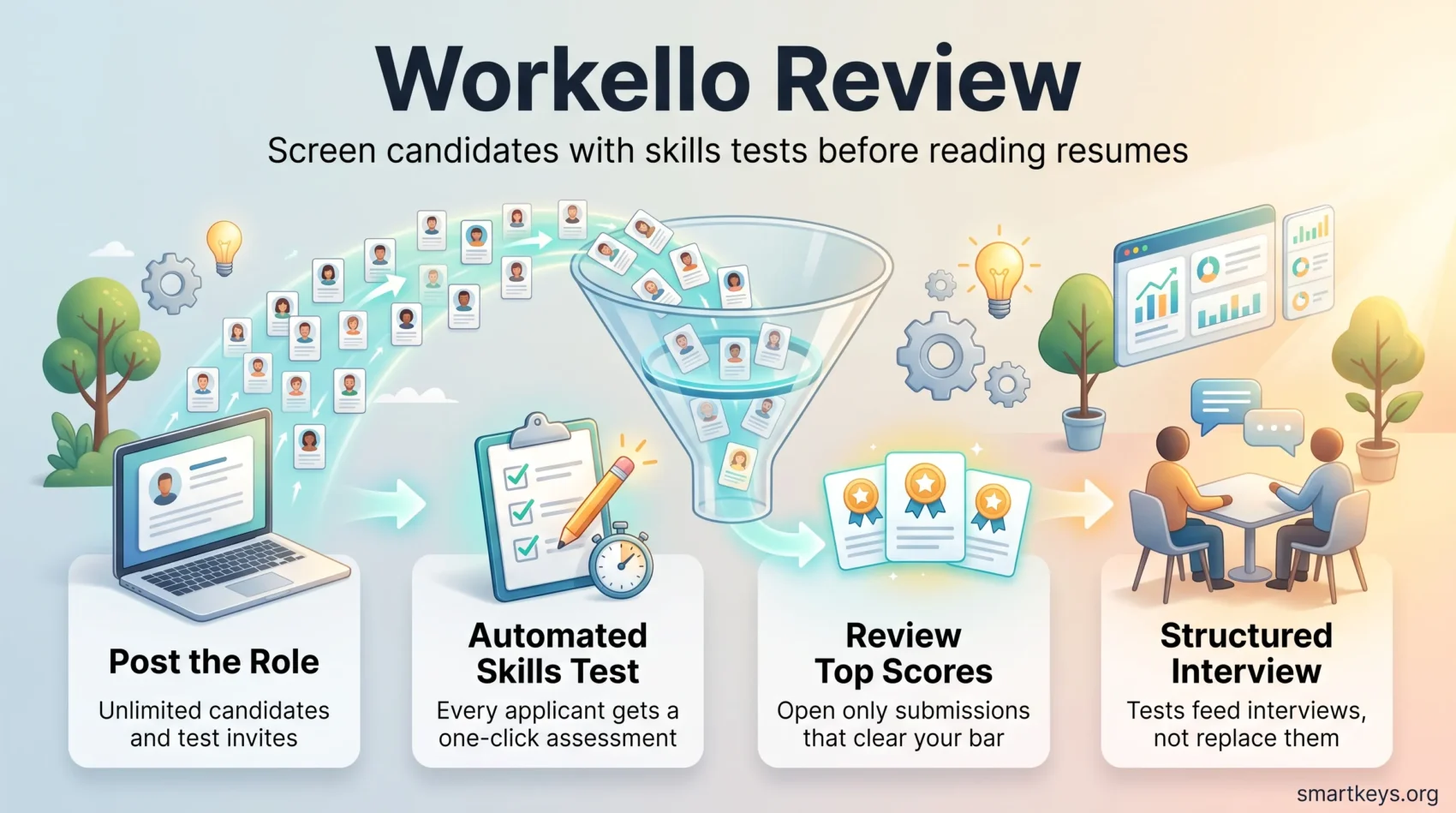
Workello is a skills testing platform for companies that want to hire from the top of their applicant pool rather than the top of their inbox. The workflow is deliberately narrow: you publish a role, candidates apply, everyone gets an automated test invite, and you review only the people who scored well.
Around that core sit the supporting pieces. Hiring templates supply job descriptions, interview questions and candidate emails. A single dashboard collects applicants from different job boards, and one-click actions handle test invitations, advancement and rejection emails.
Setup is fast because so much is pre-built. That is the argument for a tool this focused: you are not configuring an enterprise system, you are turning on a filter. Teams that already run structured hiring may find it thin; teams drowning in unscreened applications find it a relief.
The Hiring Problems Workello Targets
Three problems recur in remote and content hiring, and Workello is built around them.
Application volume without signal. Remote-friendly roles attract applicants globally, which is both a feature and a burden. Screening resumes at that scale is expensive, and a resume is a poor proxy for whether someone can do the work. This is the same pressure driving interest in AI-driven hiring tools.
Slow processes losing good candidates. Strong applicants sit in several pipelines at once, and every day a decision waits is a day a competitor can move first. Automated invites and rejections compress that timeline.
Credential inflation. Degrees and job titles say less about capability than they used to, which is why micro-credentials in hiring have gained ground. A work sample sidesteps the question by asking the candidate to do a small version of the job.
None of this makes hiring easy. It shifts the effort from reading applications to designing a test that reflects the role: real work, just better spent.
Workello Features
Skills Tests
Skills tests are the reason to buy Workello. Candidates receive a one-click assessment tied to the role, complete it in their own time, and arrive scored. For writing roles that usually means a short writing task; for support roles, a scenario response.
The benefit is triage: instead of reading 200 applications, you read the 20 submissions that cleared a bar. The risk is test design, because a badly written prompt filters for the wrong thing just as efficiently as a good one filters for the right thing. Budget time to write yours, and revisit it after your first few hires.
Applicant Tracking and Hiring Templates
The applicant tracking side is functional rather than deep. Applications from multiple channels land in one pipeline, candidates move between stages, and each person’s status is visible without a spreadsheet. If you want a dedicated ATS, compare a purpose-built option such as Breezy HR.
Hiring templates cover job descriptions, interview questions, candidate emails and job board suggestions. They are a starting point, not a finished process: useful scaffolding, worth editing before it goes out under your company’s name.
Automated Candidate Communication
Automated emails handle the parts of hiring that teams reliably neglect: confirming an application arrived, inviting candidates to test, and telling rejected applicants where they stand. That last one matters more than it sounds, because silence shapes how future applicants see your company.
Automation here is a floor, not a ceiling. It guarantees nobody falls through the cracks, but it does not make your process feel personal, and candidates can tell. The same tradeoff shows up wherever companies deploy HR chatbots for employee support.
Workello Pricing in 2026
Workello publishes its pricing openly, which is more than many hiring tools manage. As of August 2026 it lists four tiers:
- Free Forever: $0. Unlimited candidates and test invites, but only one reviewable skills test.
- Start: $299 per quarter (about $99 per month). Review 30 skills tests per quarter, one active job.
- Grow: $597 per year (about $49 per month). Review 300 skills tests per year, two active jobs, two sub-users.
- Scale: $1,497 per year (about $124 per month). Review 1,000 skills tests per year, unlimited jobs, five sub-users.
Two things stand out. The annual plans are cheaper per month than the quarterly one, so Start is a short-term option rather than the entry point it looks like. And the metered unit is reviewed tests, not candidates or jobs: unlimited applicants is genuinely generous, but your cost scales with how many completed assessments you open.
That structure rewards a tighter funnel: if you use the score to gate what you open, the same allowance covers far more hiring. Model your own volume before choosing a tier.
All plans offer a free trial without a credit card, and Workello states you can cancel at any time. Pricing changes, so check the current page before committing. (Source: workello.com/pricing, retrieved August 2026.)
Does Skills Testing Actually Work?
This is the question a review should answer, and the answer comes from selection research rather than vendor marketing.
The most widely cited recent work is Sackett and colleagues’ 2022 re-analysis of personnel selection validity in the Journal of Applied Psychology. Correcting a long-standing statistical overcorrection, they ranked structured interviews highest (r = .42), then job knowledge tests (r = .40), empirically keyed biodata (r = .38), work sample tests (r = .33) and cognitive ability tests (r = .31). Source: SIOP summary of Sackett et al. (2022).
Two takeaways follow. Skills tests are a genuinely useful signal, better than an unstructured conversation and far better than a resume alone, but they are not the strongest tool available: a platform that screens well still needs a structured interview behind it. So the real comparison is not “test versus no test.” It is whether automated screening at the top of the funnel frees enough time to run a proper structured interview at the bottom. For most small teams, it does.
Workello Pros and Cons
What works well
- Fast setup, with templates covering most of what a small team would otherwise write from scratch.
- Transparent public pricing, with a free tier that lets you test the workflow before paying.
- Unlimited candidates and invites on every plan, so a viral job post creates no surprise bill.
- Automated rejections, which quietly protect your employer brand.
Where it falls short
- Narrow scope: no payroll, benefits or performance management. Pair it with Gusto or Zenefits if you need those.
- Integrations are limited next to enterprise ATS platforms, so expect manual handoff into your other systems.
- The metered review model gets expensive if your funnel is loose.
- Test quality is entirely on you; the platform will not warn you that your assessment measures the wrong thing.
Who Should Use Workello
Workello makes most sense for content agencies, publishers and marketing teams hiring writers and editors repeatedly, and for lean startups without a dedicated recruiter. If you hire in bursts of similar roles, the economics work.
It makes less sense if you hire rarely, if your roles are senior enough that assessment happens through portfolio and conversation, or if you need an integrated system of record; teams building broader people infrastructure should look at workforce analytics tools and employee experience platforms instead.
And if much of your hiring is project-based, a platform for freelance talent or a contract-to-hire approach may reach the same outcome with less process. The right answer depends on whether you want employees or output.
Fitting Workello Into Your Hiring Process
A screening tool only pays off if the steps around it are solid.
Fairness. Automated screening reduces some biases and introduces others, especially when a test rewards a specific style. Review score distributions periodically and read some low-scoring submissions by hand. Our guide to AI hiring bias covers what to watch for, and AI in HR management covers the governance question.
After the offer. A fast funnel is wasted if new hires leave within a year. Distributed teams need deliberate work on digital trust, and retention deserves its own plan; see our overview of talent retention strategies. Longer term, cross-training and upskilling often beat hiring for a skill you could build internally. For content roles, it also helps to understand how AI writing tools change what a writing test measures: see our Byword AI review and the wider picture in HR trends for 2026.
Verdict
Workello does one thing competently: it puts a skills test between an application and your attention. Pricing is transparent, the free tier is real, and the unlimited-candidate model removes the anxiety of a job post going viral.
It will not run your HR function, its integrations are thin, and the metered review model punishes a sloppy funnel. But for a content team or agency losing hours to unscreened applications, that trade is easy to accept. Start on the free tier, write one good test, and see how much time it buys back before paying.
Found this useful?
Make SmartKeys a preferred source on Google, and our articles will surface more often in your Top Stories, AI Overviews, and AI Mode.
Add as Preferred Source