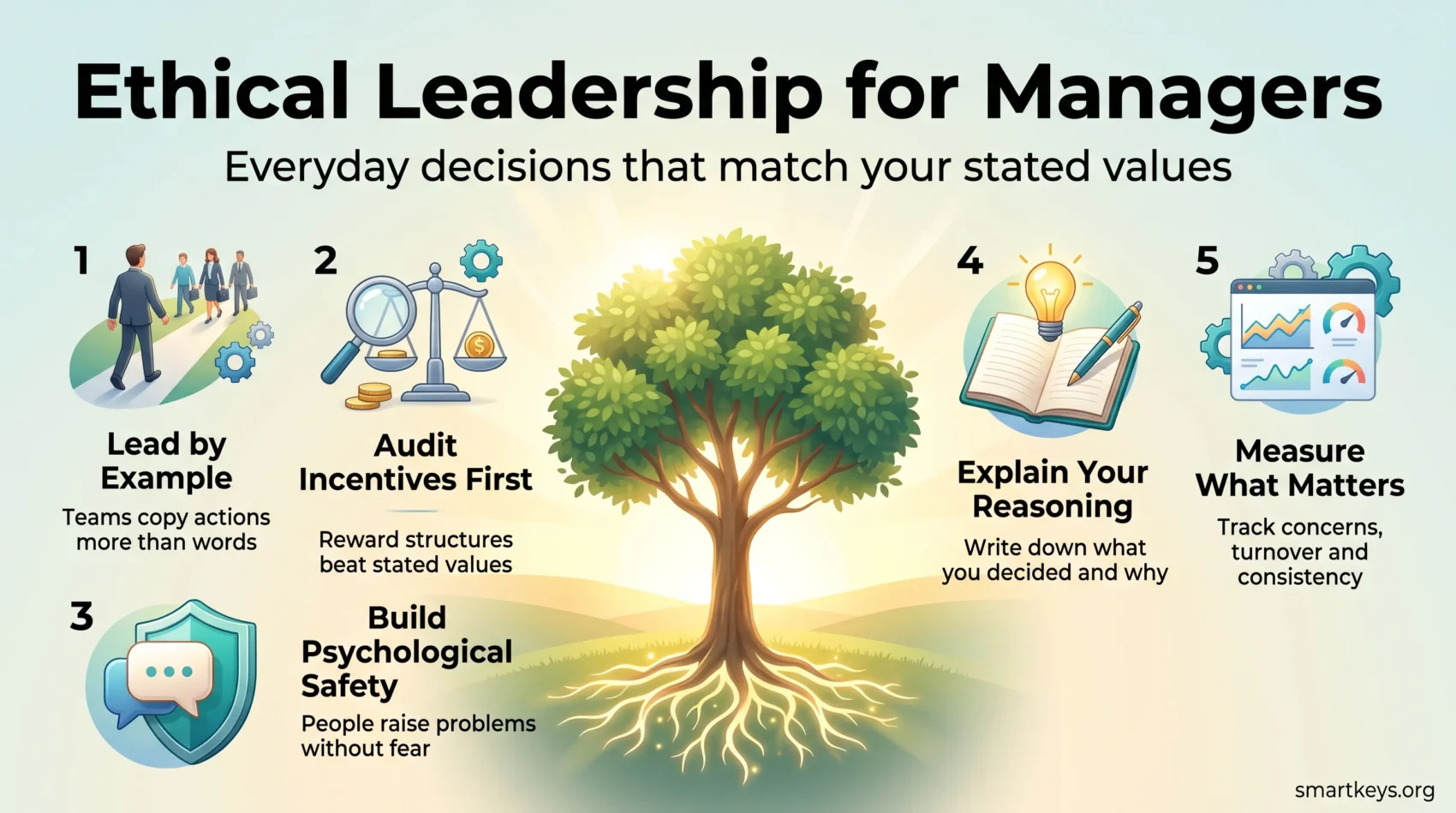
Ethical leadership means your everyday decisions match the values your company says it holds. Not the poster in reception. The call you make when a deadline slips, a customer complains, or a top performer behaves badly.
That gap between stated and actual is where trust is won or lost. And employees are watching closely. In the 2026 Edelman Trust Barometer, 78% of people said they trust their employer to do the right thing, more than any other institution in the study. Three quarters said chief executives have a duty to help repair trust in society, but only 44% thought CEOs actually do it well.
So the goodwill is there, and the credibility gap is too. This guide is written for managers and team leads who want to close it: what ethical leadership involves day to day, three frameworks that make it teachable, what real companies show, and the specific habits, policies and measures that make it real rather than decorative.
Key Takeaways
- Ethical leadership is a pattern of behavior, not a statement of intent. People judge you by your decisions under pressure.
- Employees trust their employer more than any other institution, which makes that trust an asset worth protecting.
- Incentives shape conduct more powerfully than training does. Audit them first.
- Principled choices sometimes cost money in the short term, and the companies that hold the line say so openly.
- You can measure this: engagement, turnover, reported concerns and how many people say speaking up feels safe.
What ethical leadership actually means
Strip away the abstraction and ethical leadership comes down to four observable habits. You keep your commitments. You apply the same rules to everyone. You explain your reasoning, and you admit when you were wrong.
None of that is complicated. It is just harder than it sounds when a quarter is going badly.
Researchers describe it as leading by example plus two-way communication. You demonstrate the conduct you want, and you talk about it openly enough that people know where the lines are. The second half matters as much as the first. A manager who behaves impeccably but never discusses the reasoning leaves the team guessing which principle applied.
The scope runs from small daily moments to major strategy. Whether you interrupt a junior colleague in a meeting sits on the same continuum as whether you take on a lucrative client with a poor labor record. Both send a signal about what counts here.
Why it belongs in ordinary management, not a compliance binder
Compliance answers the question “is this allowed?” Ethical leadership answers the harder one: “is this right, given who we say we are?” Most judgment calls sit in that second category. No rulebook anticipates every situation. That is why the practice belongs with line managers rather than filed under legal. If you are formalizing the written half of this, a business ethics framework gives you the structure to build on.
The business case: what changes when leaders are trusted
The internal effects are the best documented. When people believe decisions are made fairly, they report higher job satisfaction, they raise problems earlier, and they leave less often. Lower turnover is not a soft benefit. It is recruitment fees you do not pay and institutional knowledge you do not lose. Our guide to talent retention strategies covers the mechanics in detail.
Early reporting is the underrated one. Problems that surface in week one are cheap. The same problem discovered by a regulator, a journalist or a customer eighteen months later is not.
Where most programs break down
LRN’s 2026 Ethics and Compliance Program Effectiveness Report, based on responses from more than 2,500 practitioners across 26 industries and 8 countries, found two consistent weak points. Values are reinforced inconsistently at the middle-management level, and board oversight has not kept pace with rising complexity and risk.
Both are worth sitting with. Senior leadership writes the code and the board signs it off. But the person who decides whether it means anything is a team lead handling one awkward situation on a Tuesday. If your middle managers have not been equipped to make those calls, the program exists only on paper. That is also why continuous performance management matters here: the conversations that shape behavior happen weekly, not once a year.
External results: reputation, customers and capital
Customers and investors both price in the risk of a company that behaves unpredictably, though the effect is easier to see when it goes wrong than when it goes right. Scandals produce measurable losses. Steady, unremarkable integrity produces the absence of those losses, which no dashboard reports.
Core traits, described as behavior
Lists of virtues are easy to nod along to and hard to act on. Here is the behavioral version.
Integrity means the answer you give in private matches the one you give in public. Test: could you repeat this decision, and your reason for it, to the person it affects most?
Fairness means the same criteria produce the same outcome regardless of who is involved. Test: if a less popular employee had done this, would the consequence be identical?
Accountability means you name your own errors before someone else does. Test: when did you last correct yourself in front of your team?
Respect means people keep their dignity even in bad news. Test: does someone leaving your office after a hard conversation still know where they stand?
Emotional intelligence, minus the buzzword
Emotional intelligence here means one practical skill: noticing what is happening with people before it becomes a problem. The colleague who has gone quiet in meetings. The team that stopped disagreeing with you. Those are early signals, and they arrive well before anything shows up in a survey.
You develop it by asking specific questions instead of general ones. “How’s everything?” gets you nothing. “What’s the most frustrating part of this project right now?” gets you the truth.
Three frameworks worth knowing
Frameworks are useful because they turn a vague aspiration into something you can teach and check. These three cover most of what you need.
FATHER principles
FATHER is a memory aid for six commitments: Fairness, Accountability, Trust, Honesty, Equality and Respect. Its value is not the acronym but the exercise of translating each word into a named behavior. Honesty in a sales team might mean never letting a customer sign without knowing a limitation of the product. Write those specifics down, because the words alone are too broad to act on.
Social learning theory
Social learning theory, developed by psychologist Albert Bandura, says people learn conduct largely by watching others, especially people with status. In practice this means your team copies what you do far more reliably than what you say. If you answer email at midnight while telling people to protect their evenings, the behavior wins. The same logic makes visible correction powerful: a leader who publicly reverses a bad call teaches that reversing bad calls is normal here.
Leader-Member Exchange
Leader-Member Exchange, usually shortened to LMX, is the study of the one-to-one relationship between a manager and each person reporting to them. The core finding is that these relationships vary in quality within the same team. The difference matters: people in higher-quality relationships get more information, more discretion and more support.
The ethical implication is uncomfortable but useful. Most managers have an inner circle without meaning to create one. Naming that honestly, then working on the relationships you have neglected, is a concrete fairness improvement rather than an abstract one.
From mission statement to everyday behavior
A value becomes real when it is attached to an action someone can perform, notice and repeat. Take “we treat each other with respect.” Unusable as written. Translated: meetings start and end on time, nobody is interrupted twice, decisions taken without someone present are explained to them the same day. Now it is checkable.
Three things carry that translation into daily work:
- Rituals. Recurring moments where the behavior is expected, such as a project retrospective that opens with what went wrong.
- Stories. Specific examples repeated often. People remember the colleague who flagged a billing error that cost the company money. They forget the value statement entirely.
- Recognition. What gets praised gets repeated. If the only recognition in your company is for hitting numbers, you have told everyone what actually matters.
The audit question is simple: where do the posters on the wall not match the behavior in the corridor? Fair treatment across a mixed workforce is part of the same test, which our guide to diversity and inclusion at work takes further. A transparency culture shrinks that gap because the mismatches are visible to everyone, including you.
Trust, communication and psychological safety
Psychological safety is the shared belief that you can raise a problem, admit an error or disagree with your manager without being punished for it. It is not comfort, and it is not the absence of disagreement. Teams with high safety argue more, not less. They just argue about the work.
It is also the mechanism that makes everything else here function. Codes of conduct and reporting channels are useless if people expect a cost for using them. Three things build it, and all three are unglamorous:
- Share context, including bad context. People who understand the constraints make better decisions and speculate less. Withholding information reads as either distrust or bad news, and usually both.
- Respond well the first time. The initial reaction to unwelcome news sets the pattern for a year. One defensive response teaches the whole team to route around you.
- Close the loop. Tell people what happened with what they raised, including when the answer was no. Concerns that vanish into silence stop being raised.
Distributed teams have to be more deliberate about this, because the informal signals that carry trust in an office do not travel through a chat tool. Our guide to building digital trust in remote teams goes into the specifics, and participatory management covers what changes when employees hold real decision rights.
Decision-making when there is no time
Hard ethical calls rarely arrive with a week to consider them. What helps is deciding in advance how you will think, so pressure changes the speed of the decision rather than its quality. A short checklist does most of the work:
- Who is affected, including people not in the room? Customers, junior staff and future colleagues rarely have a representative present.
- Would I make the same call if it were public? Not as a PR test. As a check on reasoning you would be embarrassed to say out loud.
- What precedent does this set? Every exception becomes the new rule for the next similar case.
- What is the reversible option? When genuinely uncertain, prefer the choice you can undo.
- Who should I not be deciding this alone with? Serious calls need a second person on the record.
Write down what you decided and why. Not for the file, but because the reasoning is what your team learns from. A decision without a stated reason teaches nothing, and next time someone will guess. For a more formal structure, compare the options in our overview of decision-making models. Note too that AI decision support shifts where the judgment sits rather than removing it.
When targets crowd out judgment
Researchers use the term bottom-line mentality for a mindset that treats financial results as the only thing that counts. The risk is not that leaders become dishonest. It is that they stop noticing the other considerations, and everyone below them adjusts accordingly.
Wells Fargo is the case study nobody in this field can avoid. Employees were set sales targets they could not meet honestly, and the response was to open accounts customers had not asked for. In February 2020, the Department of Justice and the Securities and Exchange Commission fined the bank $3 billion. What matters for leadership is what the authorities described about the years before: senior executives treated the problem as individual misconduct rather than examining the sales model that produced it.
Read that as a diagnostic. When the same “individual” failure keeps recurring across different people and locations, the design is the cause.
Guardrails that actually hold
- Audit incentives before training. A day of ethics training cannot outweigh a bonus structure that rewards the opposite. Our look at performance-based pay models covers where these structures tend to distort behavior.
- Make targets challengeable. If no manager has ever successfully argued that a target was unachievable, you do not have a process, you have a ritual.
- Watch for undermining between colleagues. Rising internal rivalry, information hoarding and quiet sabotage are symptoms of pressure, not of bad hires.
- Track leading signals. Sudden improvement in one metric with no operational explanation deserves a question, not a celebration.
The dilemmas leaders actually face
Most real dilemmas are mundane, which is exactly why they get mishandled. They do not feel important enough to slow down for.
Pay and promotion fairness. Use written criteria, decided before you look at candidates. Hold a calibration conversation with someone who can disagree with you. Record the reason for the outcome. Bias mostly enters through vagueness, not malice, which is also the finding behind concerns about bias in algorithmic hiring tools. Public salary bands, covered in our guide to pay transparency, remove a lot of the discretion where bias lives.
Conflicts of interest. The rule that works is disclose early and let someone else judge. People are unreliable assessors of their own objectivity, which is not a character flaw, just how it works.
Handling misconduct. Move quickly, keep the process consistent with previous cases, and tell people what happened to the extent you are able. Silence after a known incident is read as protection.
Concerns raised in confidence. Whoever raises something needs to know what will happen to their name before they speak. If you cannot promise confidentiality, say so upfront rather than after.
Monitoring and employee data. Any surveillance you would not describe openly to the people being monitored is a trust problem waiting to happen. The legal picture in 2026 is covered in our guides to AI in employee monitoring and data privacy at work.
What it looks like in practice: three companies
These cases are useful because the outcomes are documented, including the parts that were expensive.
Dick’s Sporting Goods: the version with the cost included
In 2018, after the Parkland shooting, Dick’s Sporting Goods stopped selling assault-style rifles and raised its minimum age for firearm purchases. Then chief executive Ed Stack said the decision cost the company roughly $150 million in lost sales, and that he did not regret it.
That is the honest shape of most principled decisions. There was a bill, the company paid it, and it kept operating. Any case study where the ethical choice was also immediately the profitable one is either unusual or incompletely told.
Patagonia: a commitment with a number attached
Since 1985, Patagonia has pledged 1% of sales, not profits, to environmental causes, and reports having awarded more than $140 million in cash and in-kind donations. The distinction matters: a share of sales is owed in a bad year too, while a share of profits can quietly become nothing.
In 2022, founder Yvon Chouinard transferred ownership so that profits not reinvested in the business fund environmental work. Whatever you make of the model, it is a commitment written into the ownership structure rather than a policy a future executive can revise.
WD-40: naming mistakes differently
Under Garry Ridge, chief executive from 1997 to 2022, WD-40 replaced the word “mistake” with “learning moment,” on the reasoning that people hide errors they expect to be punished for. The company reports employee engagement scores consistently above 90%, with 99% of employees saying their opinions and values are a good fit for the company.
The point is not the vocabulary. It is that Ridge changed what happened after an error, and then kept measuring whether people believed him.
Building the capability
Ethical judgment improves with practice on realistic cases, which is why lecture-format training changes so little.
Train on real dilemmas, not clear ones
Discard scenarios with obvious answers. Nobody needs practice deciding not to commit fraud. Use the cases where two reasonable people disagree. The client whose payment terms keep slipping. The strong performer whose team keeps requesting transfers. The customer complaint that is technically not your fault.
Run them in small groups, ask people to commit to an answer before discussing, then compare. The disagreements are the learning. Short sessions repeated over time work better than an annual workshop.
Develop the managers who set the tone
Given that middle management is where values are reinforced most inconsistently, that is where development pays off most. Promote on judgment as well as results, and be honest that these sometimes point in different directions. For the broader skill set, see our guide to remote leadership skills and the wider view in leadership trends for 2026.
Coach in the moment
The most useful coaching happens within a day of a real decision. “You handled that well, and here is what made it work” teaches more than a quarterly review, because the situation is still fresh.
Policies, escalation and consistency
Written standards matter less for what they say than for settling arguments about what was expected. A workable code of conduct is short enough to be read, specific enough to resolve a real case, and names the consequence for breaching it. Long codes get filed and forgotten.
Escalation paths need three things stated plainly: who to go to, what happens next, and how long it takes. Ambiguity on any of these means people either escalate nothing or escalate everything.
Consistency is where most companies lose credibility. If a similar case last year ended differently, everyone knows, and the code is now understood to be negotiable depending on who is involved. Keeping records is what makes consistency possible, since nobody remembers accurately at this distance.
Measuring what matters
This is measurable, and the point of measuring is to catch drift before it becomes an incident. A small set of indicators is enough:
- Reported concerns, tracked as a rate. A drop is ambiguous and often bad. It can mean fewer problems or less confidence in reporting them, and you need to know which.
- Voluntary turnover by manager. One team consistently losing people is a signal about that team.
- One safety question in your engagement survey. “I can raise a difficult issue with my manager without it counting against me,” measured over time. The trend is what matters, not the absolute score.
- Case consistency. Review similar cases across the year. Different outcomes for comparable facts is the clearest warning sign you can get.
- Repeat issues. The same problem recurring in different teams points at a process, not at people.
Then close the loop by publishing something. Teams that never hear what came of a survey stop filling it in honestly, and you lose the instrument. Our guide to employee engagement trends covers how to keep survey data usable.
Pitfalls worth naming
Performative ethics. Public statements that daily behavior does not support. Employees notice within weeks, and the statement itself becomes evidence against you.
Selective enforcement. One rule for high performers, another for everyone else. This does more damage than having no rule, because it teaches that standing matters more than conduct.
Incentives nobody audited. The Wells Fargo pattern. Reward structures reliably beat stated values, so check them first.
Ethics as a department. Once responsibility sits with compliance, line managers stop treating it as theirs. Where you do formalize a role, our pieces on the AI ethics officer and on automation ethics boards cover how those functions work alongside management rather than replacing it.
Silence after a decision. An unexplained call gets an explanation invented for it, and the invented one is usually worse than the real reason.
Conclusion
Ethical leadership is not a program you launch. It is the accumulated record of decisions people can point to.
The practical version fits in a few lines. Audit your incentives before you buy training. Equip middle managers, because they decide what the code means in practice. Write down your reasoning so people can learn from it. Measure whether speaking up feels safe, and act on what you find. Expect principled choices to cost something occasionally, and say so plainly when they do.
Employees already extend more trust to their employer than to almost anyone else. The work is to be worth it, one visible decision at a time. If you are formalizing the technical side of this, our guide to an AI governance model is the natural next step.
Found this useful?
Make SmartKeys a preferred source on Google, and our articles will surface more often in your Top Stories, AI Overviews, and AI Mode.
Add as Preferred Source