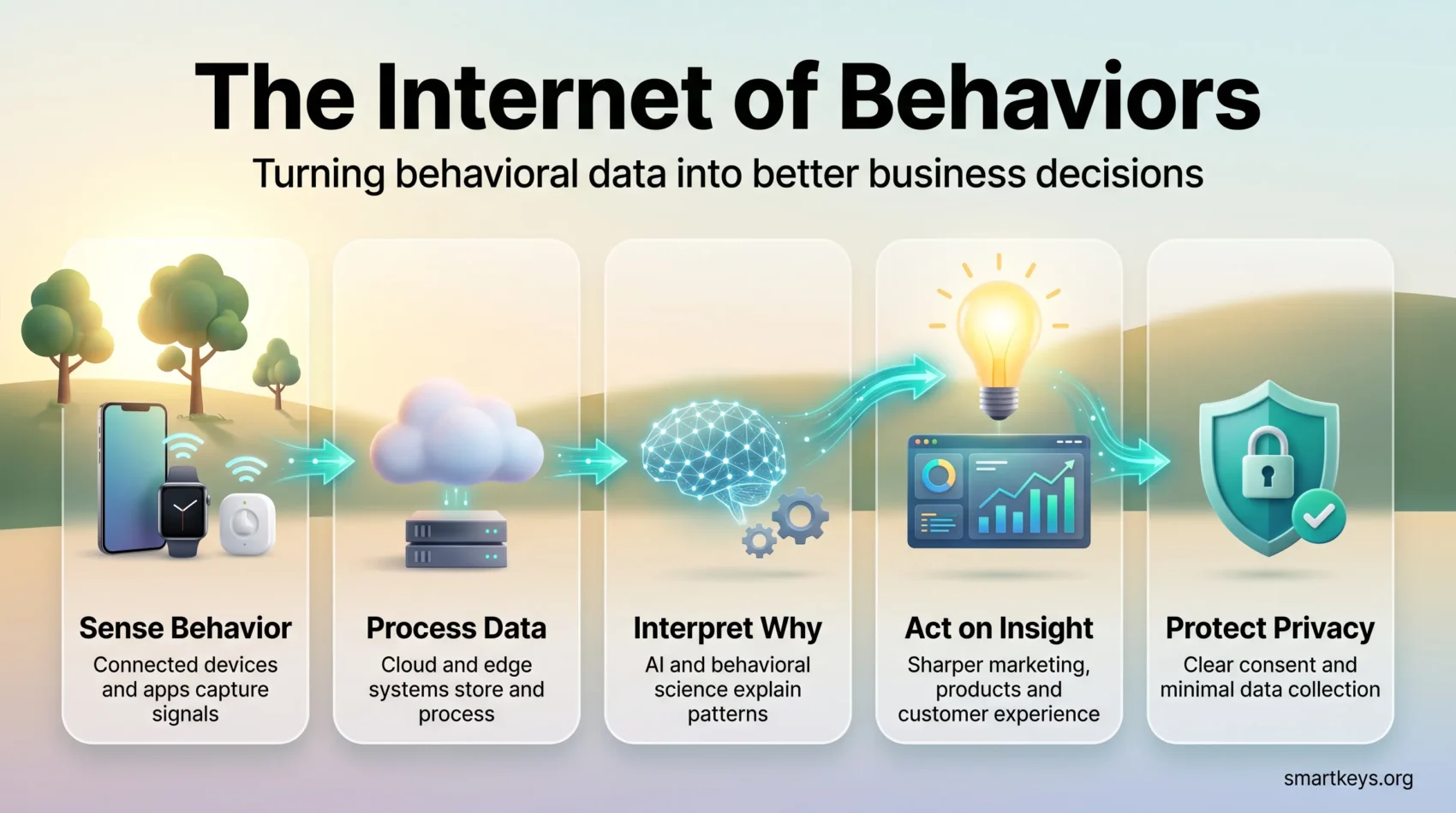
The Internet of Behaviors (IoB) is the practice of joining behavioral data from connected devices, apps and online interactions, then acting on what it reveals. Instead of asking what customers say they want, companies observe when, why and how people actually use their products. That shift turns scattered telemetry into data-driven decision making.
The Internet of Behaviors combines signals from IoT devices, social platforms, point-of-sale systems and support channels into a single picture of consumer behavior. It links analytics with behavioral science to sharpen marketing, improve product launches and design better customer experiences. Used well, businesses can increase profitability by offering solutions that fit real habits rather than assumed ones.
The raw material keeps growing. IoT Analytics counted 21.1 billion connected IoT devices in 2025, up 14% year over year, and expects roughly 39 billion by 2030. Every one of those endpoints is a potential behavioral signal — which is exactly why the legal guardrails have tightened at the same speed.
Key Takeaways
- IoB turns behavioral signals into actionable insight, not just more dashboards.
- IoB technology combines IoT, AI and analytics to explain behavior, not only record it.
- The device base keeps expanding: 21.1 billion connected IoT devices in 2025 (IoT Analytics).
- Regulation now shapes the roadmap — 20 US states have comprehensive privacy laws in force in 2026, and the EU AI Act bans workplace emotion recognition.
- Consent, transparency and data minimisation decide whether an IoB program survives its first audit.
Understanding the Internet of Behaviors (IoB)
IoB captures behavioral data and interprets it through psychology, so teams learn why a pattern exists rather than only that it exists. IoB technology sits one layer above traditional reporting: it connects events across channels and attaches meaning to them.
What Is IoB?
The Internet of Behaviors involves collecting data on human behaviors, preferences and habits through connected devices, apps and digital touchpoints, then using that data to shape products, pricing and communication. Market-size estimates for IoB vary enormously between research firms and rest on inconsistent definitions, so treat any single headline figure with caution. What is measurable is the underlying trend: more connected endpoints, cheaper analytics and rising demand for personalization.
The Evolution from IoT to IoB
The shift from the Internet of Things to the Internet of Behaviors is a shift in ambition. IoT connected devices and generated volume; IoB interprets the resulting patterns to inform decisions. If you want the groundwork, our guide to how IoT is changing business operations covers the infrastructure layer that IoB builds on.
Small companies benefit as much as large ones here, because the analysis no longer requires a bespoke data-science team. Off-the-shelf behavioral analytics platforms cover most of what a mid-sized business needs.

Technologies Driving the Internet of Behaviors
IoB is not one product. It is a stack, and each layer has to work before the next one delivers anything useful.
Internet of Things (IoT)
The Internet of Things is the sensing layer, gathering data from smart appliances, wearables, vehicles and industrial sensors. Coverage matters more than raw volume: patchy sensing produces confident conclusions about the wrong things. The same infrastructure underpins connected healthcare, where behavioral signals carry the most weight.
Artificial Intelligence (AI)
AI is what makes behavioral data legible. Models spot patterns, forecast intent and personalize experiences at a scale humans cannot match. Running inference close to the sensor rather than in a central cloud cuts latency and keeps raw data local — the argument behind edge AI in business. Because these models increasingly influence pricing, credit and service decisions, explainable AI has moved from nice-to-have to audit requirement.
Big Data Analytics
Big data analytics handles the descriptive, predictive and prescriptive work. Modern platforms fold AI into the query layer, which is the promise of augmented analytics, and the value only lands when the findings reach the people who act on them — the case for data democratization.
Cloud Computing
Cloud infrastructure stores, processes and serves the data. It scales with demand, but behavioral workloads are chatty and costs climb quietly, so budget discipline belongs in the design phase. Our overview of cloud computing trends covers where those costs now sit.

Behavioral Science and Its Role in IoB
Behavioral science is what separates IoB from ordinary reporting. It explains why people act as they do, using research on habits, cognitive biases and social context.
Understanding Human Behavior
Behavioral data without interpretation invites bad calls. A drop in repeat purchases can mean price sensitivity, a broken checkout flow or a competitor’s promotion — the numbers alone will not tell you which. Teams that pair analytics with behavioral expertise ask better questions before they build anything. The discipline of neuromarketing shows how far that interpretive layer can go.
Influence on Business Strategies
Behavioral insight shapes targeted campaigns, product decisions and service design. The practical test is whether it changes what a company does, not whether it fills a dashboard. Anticipating needs builds trust; over-reaching erodes it, and customers notice the difference quickly.

Benefits of Implementing IoB Technology in Business
IoB pays off where it shortens the distance between an observed behavior and a decision.
Data-Driven Decision Making
Customer behavior insights sharpen forecasting, segmentation and inventory planning. Behavioral signals also feed risk models — the pattern described in our look at predictive analytics in finance. Speed matters as much as accuracy, which is why teams invest in real-time data pipelines rather than overnight batches.
Enhanced Customer Experience
IoB supports personalized interactions built on observed behavior instead of guesswork. In healthcare, connected devices help track adherence to treatment plans and prompt timely follow-up. In retail, it drives relevant promotions and better-timed communication, without the blanket discounting that trains customers to wait.
How the Internet of Behaviors Influences Business in 2026
IoB is reshaping marketing, but the constraints have changed. Google abandoned its plan to remove third-party cookies from Chrome in April 2025 and retired the Privacy Sandbox initiative in October 2025, so cookies remain in Chrome with no removal timeline (Usercentrics). That reprieve is technical, not legal: consent requirements under GDPR and US state law are unchanged.
Changing Marketing Strategies
IoB marketing solutions support:
- Campaigns targeted at observed behavior rather than declared demographics.
- Real-time reads on preference, so budget shifts before a campaign burns out.
- Personalized content that reflects where someone actually is in their journey.
The payoff is efficiency: fewer wasted impressions and clearer attribution. Consolidating those signals is the job of a customer data platform, and the wider shift is traced in our piece on AI in marketing strategies.
Real-World Applications Across Industries
- Healthcare: tracking treatment adherence and flagging patients who need support.
- E-commerce: recommendations and merchandising based on browsing and purchase history.
- Finance: risk assessment and product fit informed by spending patterns.
- Smart home: routines that adapt to how a household actually uses its devices.
- Retail: phygital store formats that connect in-store movement with online behavior.
Mobile is where most of this behavior now happens, and conversational commerce is turning support transcripts into another behavioral source.

IoB Marketing Solutions: Crafting Effective Campaigns
Behavioral targeting works when the signal is genuine and the use is proportionate. Both conditions are easier to state than to meet.
Targeted Advertising
Targeted advertising built on first-party behavioral data has become more valuable as platform signals grow noisier. Detailed interaction data lets teams identify meaningful segments instead of broad demographics. The limit is relevance: messages that reveal more knowledge than a customer expected read as surveillance, not service, and the backlash is measurable in unsubscribe rates.
Personalized User Experiences
Through behavior data analytics, companies can anticipate preferences and time their messages well. Done properly this lifts satisfaction, loyalty and return on ad spend. Done badly it produces recommendation loops that narrow choice and irritate customers. The useful discipline is to personalize the moment, not the identity — respond to what someone is doing now rather than to an accumulated profile they never agreed to.

Behavior Tracking Tools in Business
Behavior tracking tools are the collection layer. Choosing them well decides how much of the resulting analysis is trustworthy.
Collecting Behavioral Data
- Web and product analytics platforms record interactions across sessions and devices.
- Customer feedback and survey systems capture stated reasons behind observed actions.
- In-store sensors and footfall counters map physical movement in retail spaces.
- Support and chat logs surface intent that never appears in clickstream data.
Faster connectivity has widened what is practical to capture, a point our article on behavior tracking tools and 5G explores in more detail.
Analyzing Consumer Interactions
Collection is the easy half. The analysis has to separate correlation from cause, account for gaps in coverage, and stay honest about small sample sizes. Combining big data with behavioral science is what makes the output decision-grade rather than merely interesting.
One caution specific to 2026: inferring emotional states from faces, voices or biometric signals is now off-limits in significant contexts. Our overview of emotion recognition AI in the workplace covers where that line falls.

Privacy and Compliance: The 2026 Reality
The legal environment has moved faster than most IoB roadmaps. Three developments matter for anyone collecting behavioral data.
US state privacy law. Twenty states have comprehensive consumer privacy laws in force during 2026, with Indiana, Kentucky and Rhode Island joining on 1 January 2026 (MultiState). Most follow the Virginia template: notice, opt-out of targeted advertising and sale, and data-protection assessments for higher-risk processing.
The EU AI Act. Prohibitions under Article 5 have applied since 2 February 2025 and include AI systems that infer emotions in the workplace. Transparency obligations apply from 2 August 2026, while obligations for standalone high-risk systems were pushed back to 2 December 2027 under the Digital Omnibus.
Data location. Where behavioral data is stored is now a design decision, not an afterthought — see our guide to data localization laws.
Security sits alongside compliance. Behavioral datasets are unusually sensitive because they describe habits, not just identities, which is why distributed architectures such as cybersecurity mesh are worth reviewing before you scale collection.
Implementing IoB: Best Practices
A workable IoB program starts small and proves value before it widens.
Integration with Existing Systems
Connect behavioral data to the systems that already run the business — CRM, e-commerce, support — rather than standing up a parallel stack. Define the decisions you want to improve first, then collect only the signals those decisions need. Train the teams who will use the output; unused insight is a sunk cost.
Ensuring Data Privacy and Security
Data privacy is the load-bearing element. Obtain informed consent, state plainly what you collect and why, and make opting out as easy as opting in. Minimise what you keep, set retention limits, and run regular audits. Document the lawful basis for each processing purpose before launch, not after a regulator asks. Handled openly, this protects your reputation and, in practice, improves data quality — people share more when they trust the recipient.
Found this useful?
Make SmartKeys a preferred source on Google, and our articles will surface more often in your Top Stories, AI Overviews, and AI Mode.
Add as Preferred Source