Tools
Tools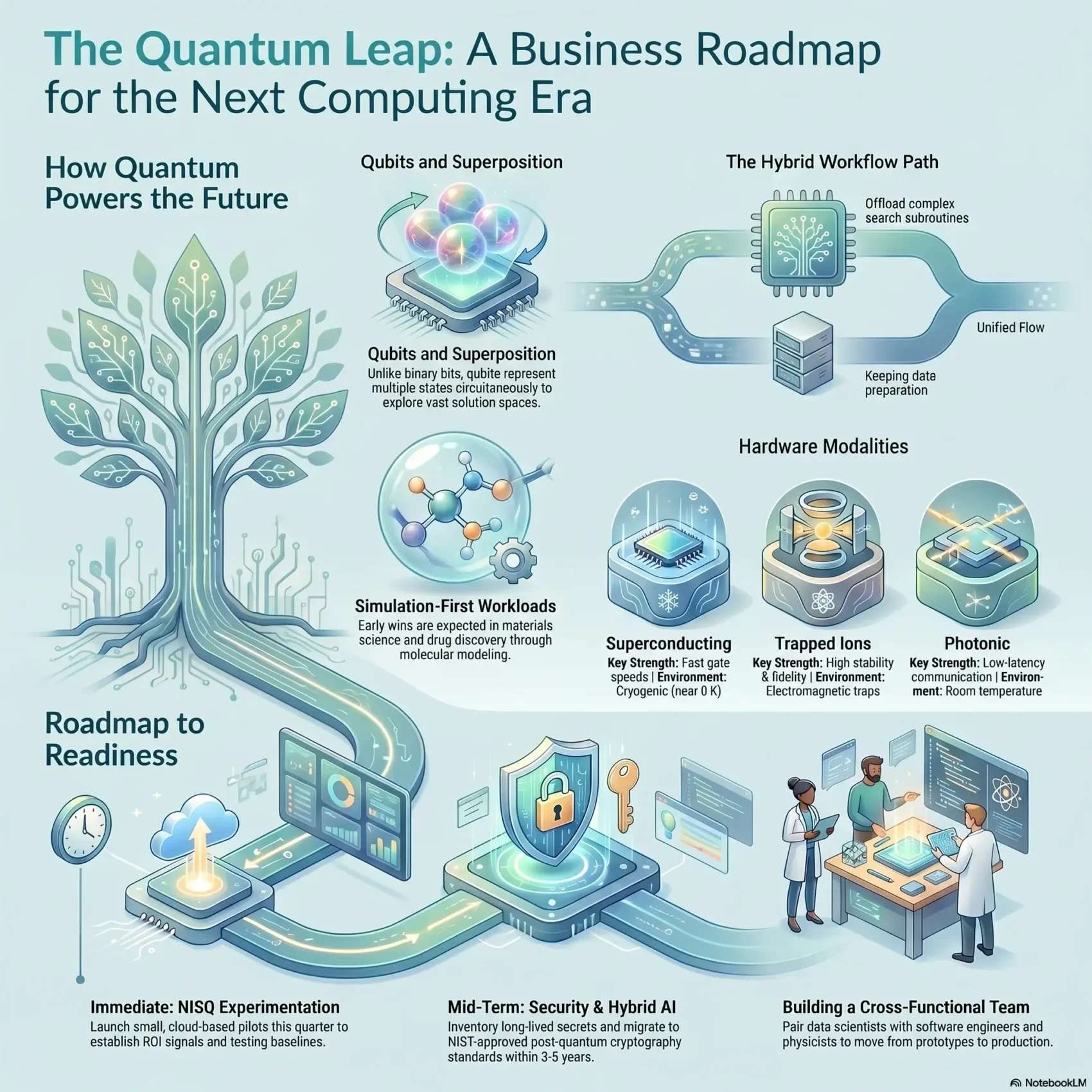
Last Updated on June 12, 2026
Ready to see where the next wave of technology can help your business? This introduction gives a clear, business-first view of quantum opportunities and limits so you can plan practical steps now.
You’ll learn what a quantum computer can and cannot do today, why companies like IBM, Google, Microsoft, Amazon, Rigetti, and IonQ matter, and how early pilots can create real advantage.
We avoid heavy math and translate key physics ideas into plain language. That way your team can discuss risk, timing, and ROI without getting lost in jargon.
This section sets expectations about performance, error and decoherence limits, and the realistic path from research devices to useful cloud services. It shows where hybrid strategies with your existing data, AI, and HPC investments unlock value before perfect hardware arrives.
Key Takeaways
- You’ll get a business-focused overview of opportunities and limits.
- Understand which tasks may benefit first and which remain research-grade.
- Learn how major vendors let you test-drive workloads via cloud services.
- See how to align pilots with ROI, skills, and timelines for your industry.
- Get practical language to explain value to executives without hype.
Why quantum computing matters to your business today
Start here: understand how next‑generation processors can speed work that now stalls your teams.
Modeling physical systems and finding patterns in vast information are two places these systems promise dramatic gains. Tasks that would take classical computers years or longer may shrink to hours on future large‑scale machines.
In the near term, hybrid workflows that combine high‑performance classical hardware with specialized processors are the practical path. That mix lets you test real business problems while your teams learn, without betting everything on unproven hardware.
- Compound advantage in talent, pipelines, and partnerships.
- Faster time‑to‑insight for simulation and pattern discovery problems.
- Vendor relationships that bring credits, roadmap access, and support.
Also consider compliance and cyber risk. Early planning for post‑quantum security and cloud resource strategy helps you move forward confidently without over‑investing.
Search intent decoded: What you’re really looking to learn about quantum
Start here: clear answers about what this tech does, what it doesn’t, and why it could matter to your projects.
At a glance, programs work by controlling states (think vectors) with operations (think matrices). Those building blocks — qubits, gates, circuits and measurement — compose into runnable routines you can test on real hardware today.
What to test first: simulation of materials, small optimization problems, and sampling tasks map well to early pilots. They give measurable baselines and clear ROI signals.
- Hands-on pilots this quarter: SDK trials and cloud access to a test computer.
- Next year: hybrid workflows that mix high‑performance systems and special processors.
- 3–5 years: tighter stacks, scaled experiments, and matured vendor support.
Compare cloud vs on‑prem by cost, latency, and staff skills. Ask vendors about open SDKs and training so you avoid lock‑in. Frame pilots with clear metrics, timelines, and a risk budget to keep executives aligned.
Classical computers vs. quantum computers: How they differ and work together
Understanding how bits and qubits encode data will help you pick the right tool for each task.
Bits in a classical computer are either 0 or 1. They power the deterministic logic your teams use every day.
Qubits hold a superposition of |0⟩ and |1⟩ with complex amplitudes. Measurement collapses that state probabilistically (the Born rule), so results come as samples rather than single deterministic values.
Why scale matters
Each added qubit doubles the state space. That exponential growth makes simulating large devices on classical computers expensive — 100 qubits need 2^100 amplitudes of storage.
Hybrid workflows
In practice, you distribute work across HPC and special processors. Use classical machines for data prep, orchestration, and high‑precision tasks.
- Offload subroutines that search vast solution spaces to a quantum computer.
- Keep optimization, IO, and heavy preprocessing on classical computers.
- Design circuits to defer measurement until the end to preserve useful amplitudes.
Consider resource trade-offs — latency, queue time, and precision — when integrating calls into Python/AI pipelines. That balance decides whether a classical computer or a quantum computer runs each step.
Core quantum mechanics you’ll use: superposition, entanglement, interference, decoherence
Grasping the basic behavior of states and interference will make pilot results easier to interpret. These ideas come from simple physics but they have big practical effects on how you design tests and read outcomes.
Superposition and interference: The engine behind speedups
Superposition lets one qubit represent a linear combination of basis states. That means qubits can encode many possibilities at once instead of a single value.
Interference then steers amplitudes. When amplitudes add constructively, desired outcomes grow more likely. Destructive overlap suppresses wrong answers.
Entanglement for correlated information processing
Entanglement links two or more qubits so measuring one gives information about the other. This correlation is a property classical bits cannot mimic efficiently.
Use entanglement to create coordinated operations and faster pattern discovery across linked states.
Decoherence: Noise, measurement, and why isolation matters
Decoherence occurs when a state couples to the environment. That causes noise and loss of useful amplitudes.
Labs fight decoherence with cryogenics, isolation, and tight control. Managing time, temperature, and precision is essential to keep qubits coherent long enough to compute.
“Well-designed circuits and error-aware workflows deliver more reliable results.”
- You’ll learn how superposition lets qubits encode many possibilities at once.
- You’ll see how entanglement enables correlated processing beyond classical limits.
- You’ll understand decoherence and how to mitigate it in practice.
How a quantum computer computes: gates, circuits, and quantum parallelism
A quantum circuit composes small, reversible steps that together steer probability toward the right result.

Unitary operations, CNOT, and deferred measurement
Gates are unitary matrices that evolve a valid state without losing total probability. Single‑qubit rotations and CNOT (a conditional flip) form a universal gate set you can use to build any routine.
The CNOT flips a target qubit only when a control qubit is |1⟩. That conditional move creates the entanglement and coordination needed for many algorithms. Measurement can be deferred to the end to preserve coherence, though mid‑circuit reads sometimes simplify logic at the cost of extra noise.
From amplitude amplification to useful outcomes
Quantum parallelism prepares superpositions of many inputs so your circuit explores many paths at once. Interference then boosts the amplitudes of good answers and suppresses wrong ones.
- How circuits help your teams: encode data, apply oracles, and read out results as samples.
- Use amplitude amplification to raise success probability without brute force.
- Keep gate counts low and depth shallow to reduce noise on today’s machines.
- Leverage modern toolchains that compile high‑level code into efficient circuits for fast iteration.
“Design circuits to minimize depth and maximize meaningful interference.”
A tour of quantum hardware systems you can use or evaluate
Survey the hardware landscape so you can match business problems to the right physical platform. This helps you pick systems by use case, vendor support, and practical limits.
Superconducting qubits
Superconducting devices rely on Josephson junctions and microwave control. They run near 0.01 K and need large cryogenic rigs.
Pros: wafer-scale fabrication and fast gates. Cons: complex cooling and regular calibration.
Trapped ions
Ion platforms confine charged atoms with electromagnetic fields and use lasers for gates. They offer long coherence and high fidelity.
Gates are slower, but connectivity and stability make them strong for precise simulation tasks.
Photonic processors
Photonic systems manipulate light for processing and long‑distance links. Photons support communication and room‑temperature operation.
They excel at secure links and low-latency communication workflows.
Neutral and Rydberg atom processors
These trap uncharged atoms with light at or near room temperature. Tunable interactions let you program connectivity on demand.
They balance scalability with flexible control for mid‑scale experiments.
Quantum annealers
Annealers evolve an energy landscape toward a ground state for optimization problems. They scale to many qubits but target specialized problem forms.
Use annealers for combinatorial optimization where mapping to an energy model is natural.
“Choose hardware by coherence, gate fidelity, speed, and how well the system maps to your problem.”
- Control methods: microwaves, lasers, and optical circuits; environments: cryogenic vs. room temperature.
- Trade-offs: coherence and fidelity vs. speed and scale drive algorithm choice.
- Practical: check queue times, calibration cadence, cloud access, and vendor roadmaps (IBM, IonQ, Rigetti, Quantinuum, PsiQuantum, QuEra, Xanadu, D‑Wave).
The state of the field in the present: NISQ limits, errors, and quantum advantage
NISQ-era devices can show real effects on narrow tasks, but they come with clear limits you should plan around.
Noise and error rates are the main constraints. Gate noise and short coherence time make many circuits unreliable. Expect variability between runs and between machines.
Noise, error thresholds, and fault tolerance
The threshold theorem says that, above specific fidelity levels, error correction can enable scalable, fault-tolerant computation. That milestone is still a long way off.
Until then, error mitigation, smart compilation, and shallow circuits are practical tactics you can apply now.
Supremacy claims, benchmarks, and practical relevance
Demonstrations like the 2019 supremacy report prove a point about machine capability, not business value. Benchmarks show raw performance for narrow tasks. They do not always predict real-world wins.
- Run classical baselines to measure progress credibly.
- Design pilots for shallow depth, batching, and robust sampling.
- Expect hybrid approaches to dominate near term as research on error correction continues.
“Treat current devices as experimental tools: use them for learning, not full production.”
Quantum algorithms you should know
Understanding a few key algorithms helps you decide which pilots to launch first.
Shor, Grover, and what they mean for risk and reward
Shor’s algorithm factors integers efficiently and directly threatens RSA and Diffie‑Hellman. That creates a clear security timeline you should watch.
Grover’s algorithm offers a quadratic speedup for unstructured search. It does not break public‑key crypto, but it raises costs for brute‑force tasks and index search.
Simulation-first workloads and why they matter
Following Lloyd’s proof, quantum computation can simulate physical systems without exponential overhead. That validates Feynman’s original idea and points to near‑term wins.
Simulation maps naturally to chemistry, materials, and condensed‑matter models. These problems often need fewer qubits and tolerate shallow depth via variational methods.
Building blocks and business fit
- Phase estimation, amplitude amplification, and variational algorithms compose real workflows.
- NISQ devices handle variational and analog approaches; fault tolerance is required for Shor‑scale runs.
- Estimate resources by qubits, circuit depth, and classical baselines before you pilot.
“Match algorithms to hardware and business metrics, not hype.”
High-impact applications across industries
Practical value appears when you match a focused problem to the right simulation or optimization method. That match helps you convert experiments into measurable outcomes fast.
Pharma and life sciences: Molecules and protein behavior
Application examples include molecular simulation for drug discovery and protein folding. These tasks generate combinatorial growth that classical computers often struggle with.
Benefit: richer simulation can shorten R&D cycles and reduce lab iterations.
Energy and materials: Grid optimization and new compounds
In the energy sector, you can use hybrid approaches to optimize grid flow and storage. For materials, simulation helps design compounds with targeted properties.
Benefit: lower costs and faster time-to-market for resilient energy systems.
Finance and logistics: Pattern finding and complex systems
Portfolio optimization, risk aggregation, and routing problems map well to search and sampling methods. Quantum-inspired tools and small test runs can reveal structure classical methods miss.
- Prioritize by impact, feasibility, and time-to-value.
- Integrate outputs into your analytics and AI stacks so data flows into decisions.
- Partner with vendors and universities for domain expertise and faster pilots; see practical guides on quantum computing work.
- KPIs: validation speed, cost per experiment, error reduction, and production-ready throughput.
- Decide if true speedups are needed or if quantum-inspired methods suffice.
“Start with high-value, low-risk pilots that feed live data into your existing workflows.”
Cybersecurity in the quantum era: risks and responses
Modern cryptography faces a new class of threats that change how you protect long‑lived secrets. Plan now so your business avoids costly rework when future machines reach fault tolerance.
Public-key cryptography at risk and post‑quantum migration
Shor’s algorithm threatens RSA and Diffie‑Hellman once large, error‑corrected machines arrive. That risk creates a credible “harvest now, decrypt later” window for sensitive information.
Practical step: inventory crypto dependencies, tag data by longevity, and start a prioritized migration to NIST‑approved post‑quantum algorithms.
Quantum key distribution and quantum-safe roadmaps
Quantum key distribution (QKD) detects eavesdropping via disturbance of quantum states. Today QKD suits short fiber links and high‑value hops; repeaters under research aim to extend range.
Combine QKD pilots with PQC rollout, telecom vendor offers, and a governance checklist that keeps compliance teams aligned.
- Inventory: map where long‑term secrets and keys live.
- Prioritize: protect high‑longevity information first.
- Test: add PQC checks into CI/CD and validate interoperability.
- Pilot: evaluate vendor and telecom quantum‑safe networking options without large capital outlay.
- Governance: assign risk owners and budget for phased migration.
“Treat harvest‑now, decrypt‑later as a measurable risk and budget accordingly.”
Building your quantum stack: software, SDKs, and services
A clear stack of SDKs, middleware, and services makes it practical to test new algorithms on real systems. Design your stack to map ideas into circuits, run them on cloud computers, and capture results for analysis.
Programming models to pick from
Gate-based: universal arrays built from single‑qubit rotations and CNOT gates. Use these for algorithm prototyping and hybrid variational work.
Measurement-based: cluster states and teleportation patterns. Choose this for protocols that favor late measurement and modular logic.
Adiabatic: slow Hamiltonian evolution, useful for annealing-style optimization on specific problem encodings.
Qiskit SDK and middleware: from circuits to execution
Qiskit SDK 1.x helps you write, optimize, and transpile circuits with calibration-aware passes. Middleware then schedules jobs, manages credits, and returns calibrated results at scale.
- Team fit: data scientists use notebooks; physicists tune pulses; engineers build CI for reproducibility.
- Integration: Python, Jupyter, and ML frameworks mean you reuse existing skills.
- Cost control: batch jobs, use simulators, and monitor credits on cloud services.
“Treat software and governance as the fast path from prototype to reliable runs.”
Accessing quantum computers via the cloud
Access models shape what experiments you can run, how fast you iterate, and what compliance steps you must take.
Cloud QPUs give rapid onboarding, global availability, and lower upfront costs. Most modern hardware sits in vendor labs inside a cryogenic system the size of a car while the processor is wafer-scale. That means you can run real jobs without a facility build‑out.
When to pick cloud vs. on‑prem
Choose cloud when you need quick experiments, flexible credits, and integrated SDKs from IBM, Amazon, Microsoft, Google, Rigetti, or IonQ.
Consider on‑prem if you require full control, custom hardware access, or have strict data residency and IP rules. On‑prem setups need facilities, cooling, and skilled staff.
- Balance simulators and limited QPU time to cut costs and learn faster.
- Watch job queues, calibration windows, and runtime constraints — they affect throughput and SLAs.
- Plan hybrid HPC+quantum architectures for orchestration and data flow into your analytics stack.
Quick vendor checklist (first 90 days): validate identity integration, test sample runs, confirm data residency, measure queue time, and set SLAs for turnaround.
“Treat cloud access as the fast path to real results while you build internal skill and governance.”
Talent and team: Skills you need to start using quantum
Build a team that mixes practical data skills and hands‑on lab experience to move projects from idea to testable runs.
The field blends physics, computer science, and engineering. You’ll need people who read papers and also ship repeatable code.
Upskilling paths for data science, physics, and engineering
Start with short, focused courses: linear algebra, noise-aware circuit design, and error mitigation. Use vendor resources—many universities and firms offer free labs and tutorials.
Map career development around paired work: a data scientist partners with a physicist and an engineer on each pilot. That makes learning fast and measurable.
Partnering with vendors, labs, and universities
Engage vendors for training credits and co‑development. Join university programs and lab partnerships to access specialized equipment and talent pipelines.
- Team shape: data science, physics, software, and security roles.
- Curriculum: online courses, Qiskit docs, hands‑on labs, and project sprints.
- Governance: experiment review, IP rules, and data handling.
“Combine practical projects with clear career paths to retain skilled staff.”
Your first pilots: How to select problems and measure ROI
Begin with a single business problem that can be expressed as an experiment. Keep the scope small and the outcome measurable so you can learn fast and show results to stakeholders.
Problem framing: Variational, simulation, or annealing fit
Classify candidate problems as variational, simulation-first, or annealing-friendly. Variational methods suit noisy, short-depth runs. Simulation-first tasks target molecules or materials where classical simulators stall. Annealing fits combinatorial optimization and mapping to energy models.
Benchmarks, baselines, and business value metrics
Define success with accuracy thresholds, speed improvements, or cost savings against classical baselines. Use the same input data and constraints for fair comparisons.
- Plan sampling and run counts to reach statistical confidence within your time and budget.
- Track technical metrics (fidelity, depth, qubits) alongside KPIs like time-to-insight and savings.
- Use simulators for rapid prototyping and QPU bursts for validation to avoid long queues.
- Tie pilots to roadmaps and integration plans to avoid the demo trap.
“Frame pilots as experiments with clear hypotheses, baselines, and go/no-go criteria.”
Choosing technology partners and evaluating vendors
Picking the right vendor starts with measurable device metrics, not marketing claims. Look for reproducible data on qubit quality, coherence, and gate fidelity before you sign anything.
Qubit quality, coherence, gate fidelity, and roadmaps
Hardware differs across modalities — superconducting, trapped ions, photonics, and neutral atom systems — and each shows different properties for coherence and gate speed.
Compare vendors by coherence time, gate fidelity, connectivity, and stability across updates. Those numbers shape what circuits and computation you can run.
Software ecosystems, support, and integration
Evaluate SDKs, middleware, and simulators for fit with your Python and AI stack. Check if a vendor offers calibration telemetry and CI hooks for repeatable experiments.
- Vendor checklist: SLA terms, reserved capacity, pricing model, and compliance standards.
- Negotiation points: early access to new qubits, calibration data, and co‑engineering time.
- Security: data handling, encryption, and audits for regulated workloads.
“Insist on hard metrics, clear roadmaps, and support that maps to your timelines.”
Roadmap to readiness: A pragmatic timeline for adopting quantum
A phased adoption plan reduces risk and shows value at each funding milestone. Use a clear timeline to move from experiments to scaled systems while keeping costs and risk in check.
Near-term NISQ experimentation
Time now is for focused trials on noise-tolerant tasks. Run small pilots that validate inputs, metrics, and classical baselines.
Actions: pick 1–2 pilot problems, set go/no-go gates, and measure fidelity, cost, and business value.
Mid-term hybrid workflows and post-quantum security
As your team gains experience, layer hybrid systems into analytics and AI pipelines. This phase emphasizes integration and security readiness.
- Develop hybrid routines that call QPUs for subroutines while keeping heavy IO on classical servers.
- Align your security roadmap with post‑quantum migration and inventory long‑lived secrets.
- Map staffing and partnerships for steady development and vendor access.
Long-term fault tolerance and scaled deployment
Full fault-tolerant systems remain a long-term target. Track hardware quality, qubit trends, and regulatory signals to decide when to scale.
Signals to expand: consistent device improvements, reproducible benchmarks, and clear cost models. Use those signals to move from pilot to portfolio.
“Phase funding, staff, and partnerships so you scale only when measured value outweighs risk.”
- You’ll get a phased plan: immediate NISQ trials, mid-term hybrid value, and long-term fault tolerance milestones.
- We’ll align security roadmaps with post-quantum migration while R&D explores advantage areas.
- You’ll see how to scale from a single pilot to a portfolio with clear decision gates.
- We’ll map funding, staffing, and partnership needs across each phase to reduce risk.
Conclusion
Wrap up your strategy with clear steps that turn early experiments into lasting capabilities.
You’ve seen how superposition, entanglement, and interference target simulation and optimization problems and how today’s NISQ hardware is mostly cloud‑accessible.
Next, choose one or two high‑value use cases and staff a small cross‑functional team. Run focused pilots on cloud QPUs and build hybrid pipelines that blend HPC and special processors so you learn fast without large risk.
Start post‑quantum security planning for long‑lived data, engage vendors and labs, and track clear technical and business metrics. Keep expectations grounded: NISQ is noisy, but disciplined pilots compound into strategic advantage and complement your classical stack.