You are not imagining it. Most people hit a measurable dip in alertness in the hours after lunch. It is part of how your body clock works, not a character flaw — and it can leave you feeling tired, slower to decide, and reaching for a third coffee when you still have real work to finish.
This guide gives you practical afternoon slump cures you can start today. You will learn why your energy drops on a schedule, and which food, hydration, light, movement, and sleep changes actually steady that curve without sugar or endless caffeine.
We cover the biology behind the dip, what to eat at breakfast and lunch, smarter snacks, caffeine timing, two-minute desk resets, how to schedule your afternoon around the dip instead of fighting it, and the evening habits that make tomorrow easier.
Key Takeaways
- The post-lunch dip is a normal circadian event, amplified by sleep debt, heavy meals, and dehydration.
- Balanced meals and steady hydration flatten the blood sugar swings that deepen the crash.
- Movement and bright light lift alertness within minutes — faster than another coffee.
- Schedule shallow work into the dip and protect your peak hours for demanding tasks.
- A consistent sleep schedule and an active week shrink the slump before it starts.
What Is the Afternoon Slump and Why It Happens
Your body runs on a 24-hour internal clock that shapes alertness, body temperature, hormone release, and sleep pressure. That clock does not produce a flat line of energy across the day. It produces a curve — and that curve has a built-in trough in the early to mid afternoon.
Your internal clock: how circadian rhythm lowers alertness after lunch
Alertness is highest in the late morning, dips somewhere between roughly 1 p.m. and 4 p.m. for most day-active people, then recovers in the early evening. Core body temperature falls slightly during that window and sleep pressure keeps building, which your brain reads as a nudge toward rest.
This is the same rhythm that governs your 90-minute focus cycles. If you want the full mechanics of those shorter waves, our guide to ultradian rhythms explains how to plan work blocks around them.
Cortisol, adenosine, and the hormone curve behind the dip
Three things move together in the afternoon:
- Cortisol peaks shortly after you wake and declines steadily through the day. By mid-afternoon it is well off its morning high, so the natural “get up and go” signal is weaker.
- Adenosine, the molecule that builds sleep pressure, has been accumulating since you woke. The longer you have been awake, the heavier it feels.
- Melatonin is still low at this hour, so the dip is not true sleepiness — it is a gap between falling drive and rising pressure.
Understanding the mechanism matters because it changes the fix. You are not short on willpower. You are working against a predictable low point, which means you can plan for it.
Sleep debt: the hidden multiplier
A mild dip becomes a wall when you are carrying sleep debt. Adults generally need seven to nine hours a night. Fall short by an hour a night across a work week and you arrive at Wednesday afternoon with a five-hour deficit that no snack will cover.
Sleep debt does not just make the dip deeper — it makes it longer and less responsive to the usual tricks. If your afternoons have been rough for weeks rather than days, start with the night, not the afternoon. Our guide to sleep and productivity covers how rest translates directly into daytime output.
Blood sugar swings that turn a dip into a crash
A lunch heavy in refined carbohydrates spikes blood glucose, triggers a large insulin response, and drops you below your starting point an hour later. Add a big portion size and your body diverts effort toward digestion at exactly the wrong moment.
Skipping breakfast makes this worse in a quiet way: you arrive at lunch genuinely hungry, eat more than you planned, and build a bigger spike. The fix is not eating less — it is spreading intake more evenly. See our breakdown of nutrition and productivity for the full picture.
Normal dip vs. a signal worth checking
A light dip is a normal part of the day and feels like a soft wave you can work through. Watch for the difference:
- Normal: reduced focus for 30–90 minutes, responsive to a walk, light, or a change of task.
- Worth checking: falling asleep unintentionally, needing long naps to function, or heavy fatigue every day despite good sleep.
The second pattern deserves a conversation with a physician rather than a better snack.

Build Energizing Meals to Prevent a Midday Crash
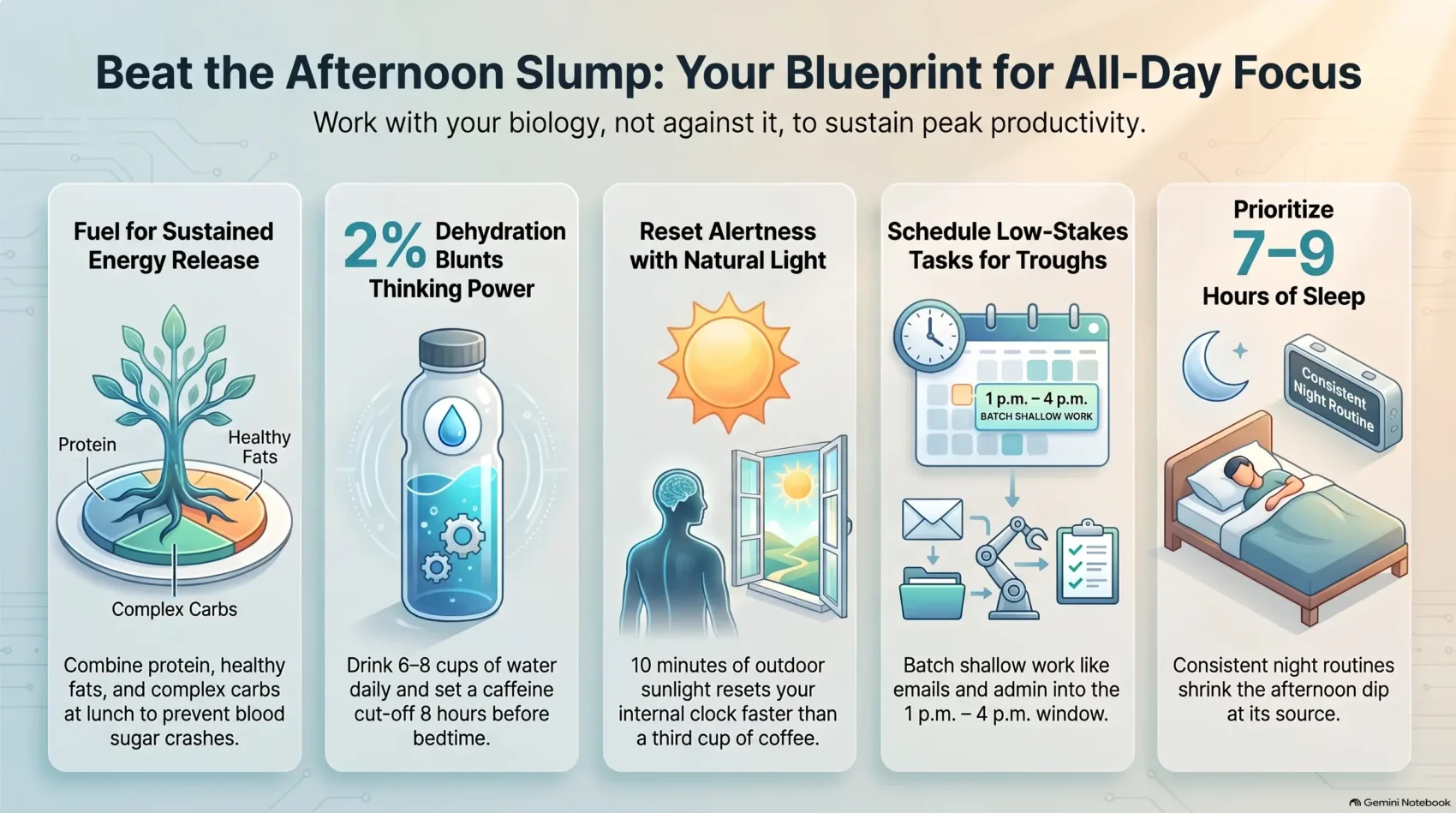
What you eat in the morning and at lunch has a bigger effect on your 3 p.m. self than anything you do at 3 p.m. A balanced plan steadies blood sugar and keeps your energy levels far more even through the afternoon.
Start strong with breakfast
Begin with a meal that blends protein, healthy fats, and complex carbs. This combination slows digestion and blunts the rapid glucose spikes that set up a later crash. Greek yogurt with berries and oats, eggs with whole-grain toast, or a nut butter smoothie all work.
The point is not a perfect breakfast. It is any breakfast that stops you from arriving at lunch ravenous.
Build a smart lunch
Choose whole grains like quinoa or brown rice, lean protein such as chicken, fish, or beans, and plenty of colorful produce. Keep the portion moderate — a very large lunch reliably deepens the dip, regardless of how healthy the ingredients are.
A practical template: half the plate vegetables, a quarter lean protein, a quarter whole grains. If you have a demanding afternoon, lean lighter than usual.
Snack the right way
When you need a boost, reach for protein and fiber rather than sugar:
- An apple with almonds or nut butter
- Greek yogurt or cottage cheese with fruit
- Carrot sticks and hummus
- Whole-grain crackers with cheese
- A small handful of mixed nuts and seeds
“Swap refined carbs for whole grains and add healthy fats to slow glucose release.”
Two small extras that cost nothing: chewing sugar-free gum has been linked to modest gains in alertness, and standing up to eat your snack away from the screen gives you a micro-break at the same time.
Hydration, Caffeine Timing, and Better Beverage Choices
How and when you drink matters for thinking clearly late in the day. Losing roughly 1–2% of body fluid is enough to measurably hurt mood, attention, and short-term memory — and most people cross that line without noticing.
Your daily water target and why mild dehydration hurts focus
Aim for six to eight 8-ounce cups of water across the day, more if you are active or in a warm room. There is no universal number, so use thirst plus urine color as a rough check rather than chasing a target.
- Keep a refillable bottle within arm’s reach so sipping is the default.
- Rotate plain water with unsweetened herbal or sparkling water to avoid added sugar.
- Front-load fluids in the morning and early afternoon so you are not up at night.
- Pair every coffee with a glass of water — it turns one habit into a hydration cue.
Set a caffeine cut-off to protect your night sleep
Caffeine has a half-life of roughly five to six hours, so half of your 4 p.m. coffee is still circulating at 10 p.m. Research on caffeine timing found that a dose taken six hours before bed measurably reduced total sleep time — even when people did not feel wired.
That is the trap: caffeine late in the day patches this afternoon at the cost of tomorrow afternoon.
- Set a personal cut-off roughly eight hours before bedtime, then adjust.
- Swap a late latte for water, herbal tea, or a small protein snack.
- Track a week of intake and sleep quality to find your own line.
The coffee nap: caffeine plus a short rest
If your schedule allows, drink a coffee and immediately lie down for 15–20 minutes. Adenosine clears during the short rest while caffeine takes roughly that long to take effect, so the two arrive together. Keep it under 25 minutes to avoid waking groggy from deep sleep. Our guide to power naps at work covers the timing in detail.
Move, Get Sunlight, and Reset Your Focus
Movement and light are the fastest afternoon slump cures available, and both work in minutes. Short movement breaks improve circulation and cut through drowsiness without adding caffeine to your evening.
Two-minute resets: walking and stretching
When the afternoon lull hits, take a brisk two-minute walk or run through a short stretch routine. Raise your heart rate slightly, open your chest and hips after hours of sitting, and return to the task. These tiny actions sharpen thinking and reset momentum far faster than pushing through.
Stack them on a schedule rather than waiting for willpower. Our guide to movement breaks and the evidence on short breaks and focus both show the compounding effect of doing this consistently.
Light exposure: the strongest signal you are not using
Light is the primary input your body clock uses to set alertness. The gap is bigger than most people assume: a typical indoor office sits around 300–500 lux, while an overcast day outdoors is several thousand and direct sun far higher.
Ten minutes outside at the start of your dip does more for alertness than the same ten minutes at your desk. If you work from home or in a windowless space, move to the brightest room you have, sit near the window, or ask your doctor about a light therapy lamp. Our notes on workspace lighting cover practical setups.
Breathe and reset your nervous system
When fatigue comes with tension rather than true sleepiness, a breathing pattern works better than a walk. Two or three minutes of slow nasal breathing with a longer exhale than inhale calms the stress response and steadies attention. Our guide to breathing techniques for work stress has several patterns you can use at your desk.
Change your environment to re-energize
Your surroundings are a lever most people never pull. Small shifts break the monotony that makes the dip feel worse than it is:
- Change rooms. A brighter spot, a different desk, or a café for an hour resets attention.
- Change posture. Alternate sitting and standing — see our take on standing desks.
- Change the meeting format. Turn a one-on-one into a walking meeting.
- Clear the clutter. A tidy desk lowers visual noise and the friction of starting.
- Use sound deliberately. Upbeat instrumental tracks can lift mood during shallow work — our review of the best music for focused work covers what the research supports.
- Fix the basics. Poor seating and screen height quietly drain energy; see ergonomics and work efficiency.
“Treat two-minute resets like essential maintenance that helps you finish strong.”

Schedule Around the Dip Instead of Fighting It
The most reliable afternoon slump cure is not a hack — it is a calendar decision. You cannot remove the trough, but you can decide what lands in it.
Match task type to your energy curve
Put your hardest thinking — strategy, writing, difficult analysis, anything that needs a cold start — in your peak window, usually late morning. Then deliberately fill the dip with work that survives lower alertness:
- Email triage and replies
- Admin, expenses, and filing
- Routine formatting or data entry
- Check-in calls and low-stakes meetings
- Planning and reviewing, which benefit from a looser mind
Our guide to managing energy, not time covers how to map your own curve over a week.
Batch the shallow work into one block
Rather than sprinkling admin across the day, group it into a single afternoon block. You get through it faster, and it protects your morning from fragmentation. Our playbook on task batching and the case for email batching over real-time checking both apply directly here.
Use shorter sprints when focus is thin
A 90-minute deep work block is unrealistic at 2:30 p.m. for most people. Drop to 25-minute sprints with real breaks between them — see the Pomodoro technique. Shorter commitments lower the activation cost of starting, which is usually the actual obstacle during a dip.
Front-load the decisions
Decision quality falls as the day goes on. Make your important calls before lunch and leave reversible, low-stakes choices for later — our article on decision fatigue explains the mechanism. Choosing tomorrow’s top task the evening before removes one more decision from a tired brain.
Protect the dip from meeting creep
In hybrid and distributed teams, the early afternoon is often the only overlapping window across time zones — so it quietly fills with meetings at exactly your lowest point. If you have any say over your calendar, keep that window for asynchronous work and push live discussion earlier. Our guides to hybrid work productivity and the maker vs. manager schedule cover how to negotiate this with a team.
Sleep and Movement Habits That Shrink the Slump
A reliable night routine and an active week do more than any afternoon tactic. These are the changes that shrink the dip at the source rather than managing it in the moment.
Keep a consistent sleep schedule
Set a regular bedtime and wake time, including weekends. Adults do best with seven to nine hours a night to steady the circadian rhythm and cut daytime fatigue.
- Stay within about an hour of your usual times on weekends to avoid social jet lag.
- Build a short wind-down: dim lights, screens away, cool room. Our evening routine guide has a template.
- Anchor mornings with bright light and movement — see designing a productive morning routine.
- Finish large meals and alcohol well before bed; both fragment sleep quality even when they help you fall asleep.
For a deeper dive on the levers that matter most, read sleep optimization for productivity.
Build an active week, not just active breaks
Regular exercise raises baseline energy and improves sleep quality, which flattens the afternoon dip over time. Standard public health guidance is about 150 minutes of moderate aerobic activity per week plus muscle-strengthening work on two days.
- Brisk walking, cycling, or swimming all count toward the aerobic target.
- Two short strength sessions a week are enough to meet the second half.
- Morning or lunchtime sessions have the added benefit of daylight exposure.
The link runs both ways: our article on exercise and productivity and the research on physical exercise and mental clarity cover the cognitive side.
Manage the stress load
Chronic stress keeps cortisol elevated, degrades sleep, and makes every dip feel steeper. Brief mindfulness practice during the afternoon is one of the cheaper interventions available — see mindfulness for workplace productivity and our practical notes on managing stress for better productivity. Cutting mid-afternoon phone scrolling helps too; our social media detox guide explains why that particular break rarely restores energy.
When to talk to a physician
If heavy tiredness persists despite consistent sleep, hydration, and movement, it is worth a medical conversation. Persistent daytime sleepiness can point to sleep apnea, insomnia, narcolepsy, thyroid issues, anemia, or medication side effects — none of which respond to lifestyle tweaks alone.
Signals worth raising with a doctor include loud or irregular breathing during sleep, unintentionally dozing off, unexplained weight changes, or fatigue that has not shifted in months.
“Track your hours and mid-day energy for two weeks to spot patterns and guide changes.”
Your One-Week Afternoon Reset
Change one thing at a time so you can tell what worked. A simple sequence:
- Day 1–2: Add breakfast with protein and set a caffeine cut-off eight hours before bed.
- Day 3: Move lunch to a moderate portion with protein, vegetables, and whole grains.
- Day 4: Book a ten-minute outdoor walk at the time your dip usually hits.
- Day 5: Move your hardest task to the morning and batch admin into the dip window.
- Day 6–7: Fix the wind-down: consistent bedtime, screens off, cool dark room.
Rate your afternoon energy from 1 to 10 each day. After a week you will know which lever is yours. Our habit tracker template makes the logging trivial.
Conclusion
The afternoon slump is a scheduling problem more than a willpower problem. Your energy curve has a trough in it, and the practical response is to feed it well, hydrate it, light it, move it, and put the right kind of work in front of it.
Start with a balanced breakfast and a moderate lunch so blood sugar stays steady. Keep water close and set a caffeine cut-off that protects tonight’s sleep. Take a two-minute movement break and get outside during the dip rather than pushing through it.
Then make the structural change: hardest work in your peak window, shallow work in the trough. That single adjustment usually outperforms every other tactic on this list.
If heavy fatigue persists despite all of it, talk with a physician — some causes are medical, not behavioral.
Small, consistent habits turn a familiar afternoon slump into a brief pause — and help you finish the day with more clarity.