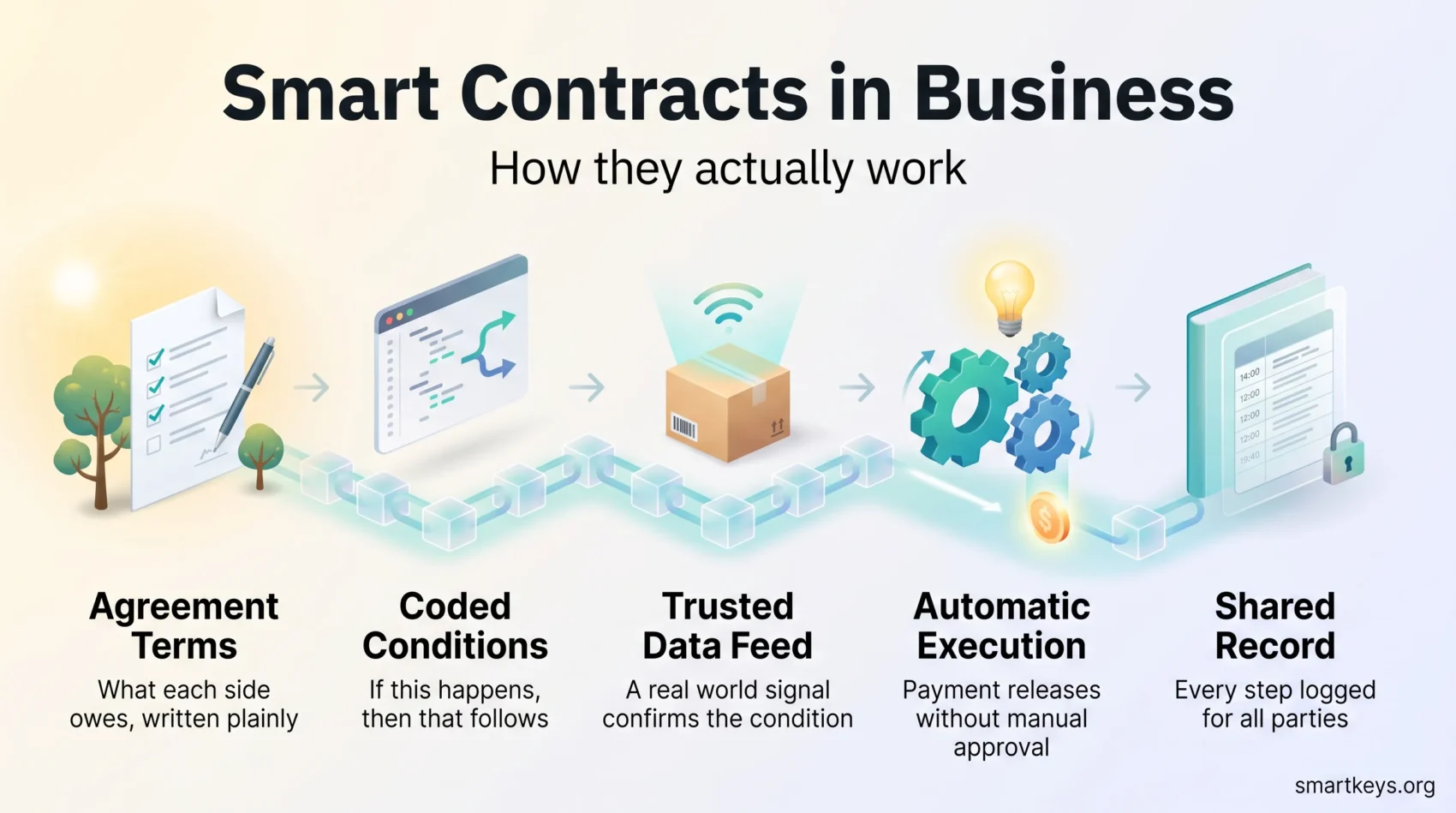
A smart contract is software that holds an agreement and carries it out by itself. The terms live in code on a blockchain, a shared digital record every participant can read and no single party can quietly rewrite. When the agreed condition is met, the code releases the payment or transfers the ownership record. Nobody approves the step by hand.
This matters more in 2026 than it did a few years ago. The technology has moved out of crypto projects and into ordinary payment infrastructure: the biggest US banks are building settlement systems on the same logic, and the EU has written rules specifically for smart contracts. If your company pays suppliers or waits on escrow, this is now a practical question.
Key Takeaways
- A smart contract executes an agreement automatically once its conditions are met.
- The main gains are speed and fewer manual checks, not magic cost savings.
- Everyone involved reads the same record, which cuts disputes about what happened.
- Code errors are expensive because transactions are hard or impossible to reverse.
- Finance, supply chain, procurement and property are the areas furthest along.
What Is a Smart Contract?
Smart contracts are often called digital contracts, which is only half right. A legal contract states what the parties owe each other. A smart contract is the part of that deal you can express as a rule and let software enforce.
A Plain Definition
A smart contract is a program stored on a blockchain that runs when someone triggers it. Because copies of the program and its results sit on many computers, no single participant can change the terms afterwards. That is what gives the arrangement its credibility: you are not trusting the other side to press the button, you are trusting code both sides inspected before it went live.
How Smart Contracts Work
The logic is a chain of “if this, then that” rules. If the shipment scans as delivered, then release the payment. If the tenant pays by the fifth, then mark the month settled. The contract needs a reliable signal that the condition happened. That comes from a data feed, often called an oracle, which pushes real world information onto the chain. Many contracts also require several approved signatures before a large transfer goes through.
Key Components of a Smart Contract
Three elements define every deployment:
- Agreement terms: what each side owes, written plainly before anyone writes code.
- Programmed conditions: the triggers that make the contract act.
- Parties and permissions: who can call the contract, and who can stop it.
Getting the first item right is the hard part. Vague commercial terms cannot be automated, and writing them as code forces a precision most paper contracts never reach.
What Businesses Actually Gain
The benefits are real but narrower than the marketing suggests. Smart contracts help most where a process is repetitive, rule based and slowed down by someone checking paperwork.
Faster Settlement
Traditional settlement waits on business hours, bank cut off times and manual approval. A smart contract does not. A supplier whose invoice clears the moment goods are scanned in gets paid in minutes rather than on 60 day terms, which improves working capital on both sides. That is why supply chain resilience teams pay attention to it.
Lower Transaction Costs
Removing an intermediary removes a fee. Escrow agents charge for holding funds and confirming conditions; banks charge for checking trade documents. Automating those checks cuts the fee, but not to zero: you still pay network fees to run the code and the upfront cost of writing and auditing it. The savings show up on high volume transactions, not one off deals.
A Record Both Sides Can Check
Every execution is logged and timestamped on the shared ledger, so a dispute starts from one version of events rather than two sets of emails. This is the quiet benefit finance and legal teams value most, and it connects to broader work on digital trust in business relationships.
Automating Agreements in Practice
Smart contracts change how agreements are managed day to day, not only how they settle.
Cutting Out Manual Steps
A finance clerk matching purchase orders to delivery notes is doing work a rule can do. Moving that step into code removes rekeying errors and frees the clerk for exceptions, where human judgement actually pays. The same logic drives ordinary task automation projects that never touch a blockchain.
Where the Time Is Saved
The time saving is in the waiting, not the doing. A property sale is quick to sign and slow to complete, because funds sit in escrow while conditions are verified. A claim is quick to submit and slow to pay, because a person reads it. Automating verification compresses the timeline.

The market is still small in absolute terms. Fortune Business Insights values it at USD 2.69 billion in 2025 and USD 3.39 billion in 2026, projecting USD 16.31 billion by 2034 at a 26.3% compound annual growth rate. North America held roughly 33% of the market in 2025.
The more telling signal is who is building. In 2026 JPMorgan Chase, Citigroup, Bank of America and Wells Fargo agreed to develop a shared tokenized deposit network, run by The Clearing House, letting bank money move around the clock on blockchain rails. Reporting by The Wall Street Journal put the target launch in the first half of 2027, with no vendor chosen yet. Tokenized deposits are bank balances represented as tokens on a ledger, and moving them on conditions is exactly what smart contracts do. That is a different scale of commitment from the pilots of the past decade, and it sits alongside the growth of digital wallets in work payments and open banking.
How Blockchain Fits In
Smart contracts do not work without the ledger underneath them. The blockchain is what makes the code tamper resistant and the results checkable.
Why the Ledger Matters
A distributed ledger stores the same record on many machines. Altering a past transaction would mean altering it on most of them at once, which is impractical on a large network. That is the whole security argument, and its limit matters: the ledger protects the record, not the logic. A badly written contract executes its bad logic perfectly.
What Decentralized Protocols Do
Protocols are the shared rules deciding how transactions get validated and in what order. They let parties with no relationship transact without a middleman deciding who goes first. The practical effect is real time confirmation instead of end of day reconciliation, the same shift driving interest in real time data across operations.

Where Smart Contracts Are Used Today
Adoption is uneven. Four areas have the clearest working examples.
Supply Chain and Logistics
The appeal is automatic payment on verified delivery, with scan events or sensor data as the trigger. Progress has been slower than early announcements promised. The best known project, the IBM and Maersk platform TradeLens, was discontinued after the partners announced its end in late 2022, having failed to attract enough carriers: these systems only work when most of the trading network joins. Narrower deployments inside a single supply chain have fared better, as covered in our guide to blockchain in logistics. Linking contracts to sensor readings also depends on solid connected device infrastructure.
Procurement and Supplier Contracts
Purchasing is the most common business to business use. A purchase order, a delivery note and an invoice all have to agree before finance releases payment, and someone usually checks that match by hand. A smart contract can hold those three conditions and pay the supplier the moment they line up, which removes the rekeying and the chasing. Framework agreements fit well too, because volume discounts, rebate tiers and late delivery penalties are arithmetic. The contract can apply them as each order closes instead of leaving them to a quarterly reconciliation. The limit is the same one supply chains hit: your counterparty has to be on the same system, so most companies start with a handful of large, regular suppliers rather than the whole vendor list. Conventional digital procurement software already automates much of this without a blockchain, so settle one question first: do you need a payment record the other side cannot dispute, or just a faster approval queue?
Property Transactions
Smart contracts can hold funds and release them once the agreed conditions are recorded, replacing part of the escrow process. Rent collection and deposit returns are simpler wins, because the conditions are unambiguous. Legal recognition of a digital ownership record varies by country, so most property technology deployments still run alongside the official land registry rather than replacing it.
Finance and Banking
This is where the technology is furthest along. Smart contracts handle collateral, interest accrual and repayment in decentralized finance, and they sit under the tokenized settlement work described above. Companies holding digital assets on the balance sheet face a related set of controls, which we cover in crypto treasury management, and the wider picture sits in our overview of cryptocurrency in business.
What Goes Wrong
Three problems keep smart contracts from spreading faster. None of them is solved.
Systems That Do Not Talk to Each Other
Different blockchains use different standards, and a contract written for one often cannot read data from another. Bridges between chains exist but have been a repeated target for attackers. Until standards settle, committing to one platform risks your counterparties committing to another.
Legal and Regulatory Uncertainty
The law is catching up unevenly. The EU Data Act, applicable since September 2025, sets requirements for smart contracts that execute data sharing agreements: they must resist manipulation, include a way to stop or reset execution, allow the transaction history to be archived, and match the underlying agreement. In November 2025 the European Commission proposed removing that article in its Digital Omnibus package, arguing the scope was unclear and the rules premature. Parliament and Council were still negotiating the package through 2026, so the article remains in force until they finish. Companies in the EU should track it rather than assume either outcome. Regulated firms should read this alongside broader EU compliance obligations and the tooling covered in regulatory technology.
Bugs You Cannot Take Back
Immutability cuts both ways. A flaw in deployed code cannot simply be patched, and a transfer sent to the wrong place is usually gone. Chainalysis put total crypto theft in 2025 above USD 3.4 billion, concentrated in a few large breaches. Stolen keys and social engineering account for much of that, not contract flaws, but the figure shows the size of the target. The practical answer is an independent audit before deployment, a documented pause mechanism and strict key control. Treat it as part of your security programme, not a blockchain side project.
What Is Coming Next
Two developments are worth watching if you are planning a deployment.
Contracts That React to Real World Data
Connecting contracts to sensors widens what can be automated: a shipment that logs its own temperature breach, a machine that triggers a service payment when it reports a fault. Processing that data closer to where it is produced, an approach known as edge AI, reduces the delay between an event and the contract reacting to it. Verifiable digital credentials are the other missing piece, which is why decentralized identity work matters here.
Scale, Standards and Security
Market estimates vary widely between research firms, so treat any single forecast as an indication. What most agree on is direction: adoption is growing from a small base, and cross chain standards are the bottleneck. Longer term, the cryptography protecting these ledgers will need replacing as computing advances, which puts quantum safe encryption on the roadmap for anyone building infrastructure meant to last. For the wider context, see our overview of blockchain trends in business.

The Role of Ethereum
Ethereum is still the platform most smart contracts run on. The idea is older than the technology: the computer scientist Nick Szabo described smart contracts in 1994, but there was no general purpose way to run them until Ethereum launched in 2015.
Why Ethereum Became the Default
Ethereum was built to run programs, not just record payments. That head start gave it the largest pool of developers, tools and audited code libraries. Lending protocols such as MakerDAO and Compound have run business logic for years without a central operator. For a company the practical advantage is hiring: it is far easier to find someone who can review Ethereum code than code for a niche chain.
What This Means for Your Business
You do not have to choose a public chain at all. Many companies run smart contracts on a permissioned network where every participant is known, trading openness for control and predictable costs. Whichever you pick, start with one repetitive, high volume process rather than your most complex contract. The first automated process is a test of your data and your paperwork as much as your technology.
Found this useful?
Make SmartKeys a preferred source on Google, and our articles will surface more often in your Top Stories, AI Overviews, and AI Mode.
Add as Preferred Source