Tools
Tools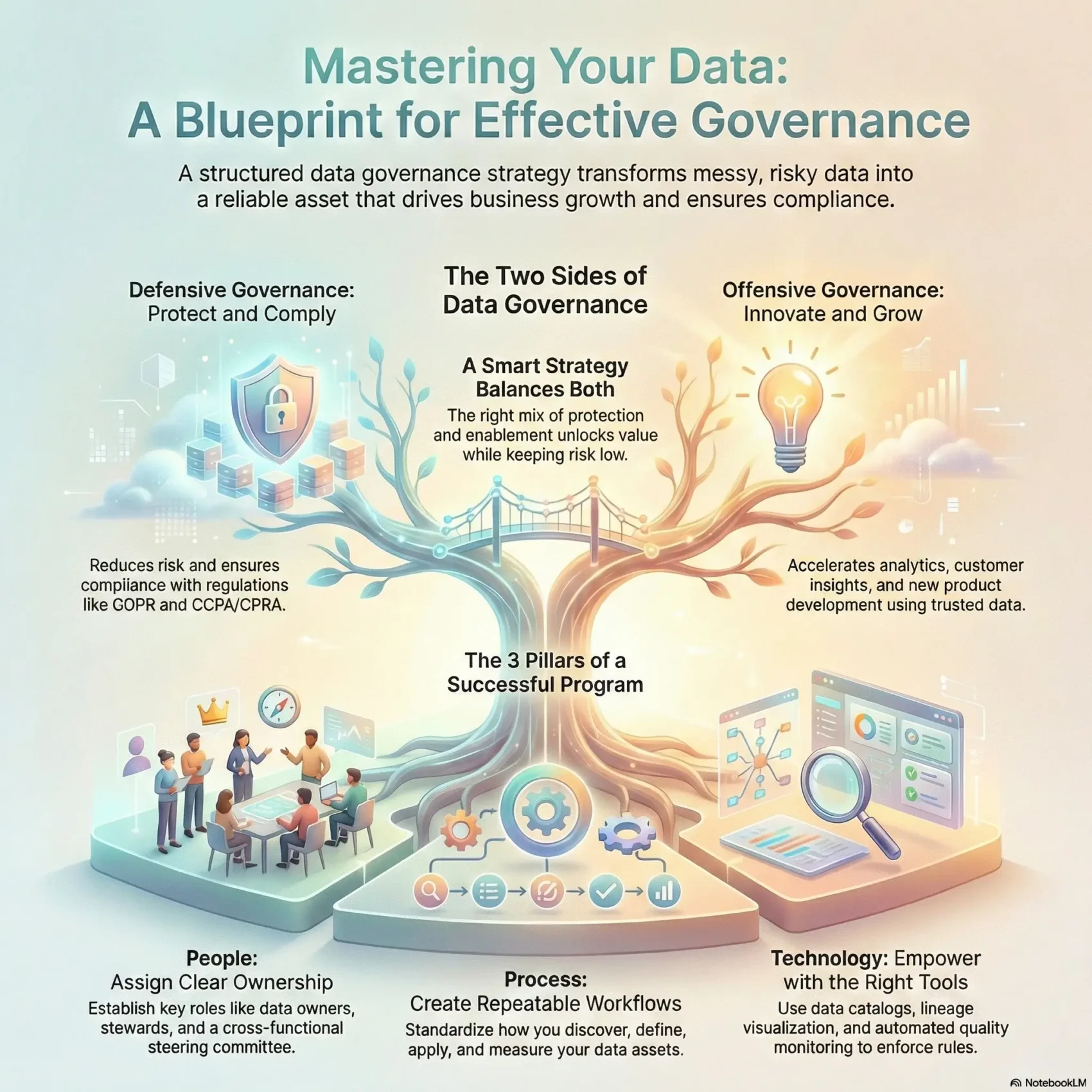
Last Updated on March 9, 2026
You rely on trusted information to run your business. Modern firms collect large volumes of records, and that scale brings complexity and risk. A clear data governance strategy maps who does what, sets rules, and assigns accountability so your teams can act with confidence.
When you treat facts as an asset, a simple framework keeps them accurate, protected, and easy to use. That leads to faster, better decisions, smoother collaboration, and fewer surprises during audits or reviews.
Skip governance and you risk fines, brand harm, and bad analytics. A practical program ties people, processes, and tech together so quality and compliance become part of daily work, not a one-off project.
By the end of this section, you’ll see how a focused plan reduces risk, boosts insight, and sets measurable goals for success.
Key Takeaways
- You’ll learn how an operating model links roles, rules, and accountability to business outcomes.
- A clear framework keeps information consistent, protected, and accessible for faster decisions.
- Strong controls reduce risk from regulations like GDPR and CCPA/CPRA.
- Embedding policy in workflows drives adoption and real-world quality improvements.
- Starting now limits compounding problems and speeds transformation across teams.
Why your business needs a governance strategy now
Unchecked growth across clouds, apps, and warehouses makes it hard to trust what you see. You spend too much time finding, fixing, and reconciling sources instead of acting. A focused plan fixes that and frees your teams to move faster.
From sprawl to trusted decisions: the present-day challenge
You’re juggling scattered records and mixed definitions, which slows decisions and risks accuracy. A clear data governance approach makes assets findable and understandable so teams can make trusted choices.
Key business outcomes: agility, innovation, collaboration
With the right governance in place, your teams access the right sources quickly, cutting time-to-insight and speeding launches. Clean, well-described sets become reusable building blocks for analytics and new products.
- Privacy and security controls reduce breaches and exposure.
- Consistent glossaries improve cross-team collaboration and reduce rework.
- Proactive compliance with GDPR and CCPA/CPRA shrinks audit risk and fines.
Start small, prove value fast, and scale so the program grows with your business needs and saves you time and risk.
What a data governance strategy is (and how it differs from management)
A clear operating model turns rules and roles into repeatable practices that people actually follow. A data governance strategy defines who owns what, which policies apply, and how standards are enforced across systems.
Think of governance as the plan: it sets responsibilities, naming rules, retention, and access requirements. Management is the day‑to‑day work that applies those rules through tools, tickets, and platform operations.
Operating model for people, processes, and technology
Good programs map roles—owners, stewards, approvers—and link them to decision rights and escalation paths. They also map processes for discovery, definition, application, and measurement.
Technology then enforces policy: catalogs, workflows, and quality checks embed rules where people work. This mix keeps definitions, classification, and naming consistent across the organization.
Connecting policy to day-to-day practices
Make rules actionable by folding them into tickets, catalogs, and analytics tools. When users see standards in their workflows, compliance and quality become part of normal work.
“Practical frameworks win when they are measurable, auditable, and easy to use.”
- Align owners to business requirements and clear decision rights.
- Embed policy into tools so processes are repeatable.
- Use a simple framework to keep controls practical and verifiable.
How data governance supports your broader data strategy
Clear rules and ownership turn scattered records into reliable assets that drive outcomes. When your teams agree on ownership, labels, and lineage, you unlock faster, safer work across the business.
Aligning to business goals: revenue, efficiency, and risk reduction
Link policy and ownership to the outcomes executives care about: more revenue, lower costs, and less regulatory risk.
Operational efficiency improves when records are consistent and discoverable. That cuts rework and speeds decisions.
Revenue grows when analytics and product teams build on trusted assets instead of fixing surprises.
Balancing offensive and defensive initiatives
Plan offensive work—analytics, customer insights, and new products—on top of well‑curated, documented sources.
At the same time, fund defensive controls like privacy, lineage, and audit trails so innovation doesn’t create exposure.
- Prioritize quick wins that reduce time‑to‑insight and save costs.
- Protect sensitive records with clear tagging and monitoring.
- Measure success by business outcomes and by reduced rework for analytics teams.
Defensive vs. offensive governance: finding the right balance
A smart mix of protection and enablement keeps risk low while unlocking value. You want safeguards that satisfy regulators and enable teams to build useful products.
Defensive focus: privacy, compliance, lineage, and controls
Defensive work protects privacy and proves compliance with laws like GDPR, CCPA/CPRA, and HIPAA. Build lineage so you can trace a record’s journey during audits.
Practical controls include masking, encryption, and least‑privilege access. These reduce exposure while letting approved users do their jobs.
Offensive focus: analytics acceleration, customer insights, and products
Offensive efforts speed analytics and surface customer signals that drive growth. Curating and certifying sources makes teams reuse trusted pieces instead of rebuilding them.
Linking customer records across channels improves targeting and retention without unsafe access patterns.
Real-world triggers in the United States: GDPR, CCPA/CPRA, HIPAA, and beyond
Regulations and high‑profile fines show the stakes. The Meta GDPR fine is a clear example of how weak privacy controls can cost millions and harm your reputation.
- Define defensive rules that meet audit and regulatory needs.
- Prioritize offensive work that delivers measurable business value.
- Revisit the balance as new regulations appear and products evolve.
Use a simple prioritization model so compliance milestones don’t block innovation. For a practical playbook on aligning protection with growth, see data governance for business.
Core components: people, process, technology
Effective oversight begins with named leaders and simple, repeatable workflows. You need clear roles, standard processes, and modular tools so your program scales without chaos. Keep each part aligned to business needs and measurable outcomes.
People and roles: who does what
Map the people side with a Chief Data Officer to lead operations, a governance manager to run daily practices, and a cross‑functional steering committee to set priorities.
Name owners who approve access, stewards who define terms and monitor quality, and custodians who implement masking, encryption, and integrations.
Anchor accountability with a RACI/DACI matrix and encourage users with recognition for active stewards.
Processes that scale: discover, define, apply, measure
Standardize four repeatable processes: discover assets, define terms and policies, apply controls in workflows, and measure or monitor results.
Use automated profiling and alerts so issues route to the right role for fast remediation.
Technology enablers: catalogs, lineage, quality, access
Centralize metadata in a catalog that holds business terms, lineage, and certifications so users can find and trust assets.
Complement catalogs with lineage visualization, quality tooling that scores and alerts, and access controls enforcing least privilege and approvals.
“People, process, and tools must work together; one without the others slows progress.”
- Pick modular tools that match your capabilities and integrate with existing stacks.
- Route quality issues to named owners and measure remediation time.
- Make policies actionable in workflows to drive adoption across teams.
Choosing your governance model and framework
Choose a model that matches how your teams work today and where the business needs to go. Start by weighing centralized and federated options against your regulatory pressure, domain autonomy, and available skills.
Centralized models concentrate decision rights in one group. They enforce uniform standards and make audits simpler.
Federated models push authority to domains so teams move faster and adapt locally. Modern hybrids let you mix central controls with domain-level freedom.
- Evaluate your organization’s needs and pick a model that meets compliance and delivery requirements.
- Define clear decision rights and escalation paths so roles don’t overlap.
- Adopt or adapt a framework like DAMA and use maturity models to benchmark progress.
- Set baseline standards for definitions, lineage, and controls while allowing domain tailoring.
- Document daily practices, review the model regularly, and modernize for AI and multi-cloud realities.
Data governance strategy
Start by defining what success looks like so each rule ties back to real outcomes. Translate business goals and regulatory obligations into a short set of objectives you can measure.
Inventory, classify, and curate assets with active metadata in a central catalog. Automate discovery, sensitivity tagging, and lineage capture so your catalog stays current without heavy manual work.
Set clear objectives tied to business value and compliance requirements
Define targets for risk reduction, time-to-insight, and audit readiness. Use simple KPIs so teams can see progress and leaders can justify investment.
Inventory, classify, and curate assets with active metadata
Centralize business glossaries and records in a catalog that shows lineage and usage. Curated, certified assets become reusable building blocks for analytics and products.
Define policies and standards for quality, access, and privacy
Write enforceable rules for naming, sharing, retention, and quality measurements. Set thresholds for completeness, accuracy, and timeliness and send alerts when they fall short.
Embed governance into workflows to drive adoption
Integrate approvals and checks into ticketing, pipelines, and BI tools so rules match how people already work. Automate tagging, conformance checks, and usage metrics to prove adoption.
“Clear objectives and embedded controls turn policy from paperwork into daily practice.”
- You’ll map objectives to measurable business value and regulatory needs.
- You’ll keep active metadata in a central catalog and automate lineage capture.
- You’ll codify roles so each process has a named owner and response path.
- You’ll iterate from pilot domains to enterprise coverage while proving value.
Policies that make governance real
Policies should be short, testable, and implementable in tools so they actually work. Your manual and automated rules must align so teams know what to do and platforms can enforce it.
Data quality, lineage, and classification standards
Set measurable quality standards for precision, completeness, consistency, and timeliness. Define thresholds, how metrics are captured, and who fixes issues.
Require active data lineage capture so every transformation is traceable from source to report. Classify records by sensitivity and business value to guide handling.
Access, security, retention, and disposal policies
Codify access rules: authentication, role-based authorization, encryption, and monitoring. Specify retention windows and defensible deletion steps tied to legal needs.
Sharing, integration, backup and recovery, and compliance policies
Standardize sharing and integration rules to ensure consistent transformation and reconciliation. Require tested backup and recovery plans with RPO/RTO targets.
Embed periodic audits and compliance checks so you can prove adherence to regulations and internal standards. Align controls and management so policy intent matches platform behavior.
“You’ll document policies that map directly to rules your tools can enforce.”
- You’ll document a manageable set of policies that translate into enforceable rules.
- You’ll set quality standards, capture lineage, and classify by sensitivity.
- You’ll codify access, security, retention, sharing, backup, and audit requirements.
Tooling and architecture to power your program
Modern stacks should favor modular services so teams can add capabilities without big rewrites. Start with cloud-first platforms that scale compute and users elastically. That lets you handle spikes and run hybrid controls from a single console.
Cloud-first, microservices, and connectivity considerations
Choose microservices over monolithic designs for modular growth and faster releases. APIs and standardized patterns make it simple to onboard new apps and data sources with minimal custom work.
Connect essential apps early so critical records flow into your catalog and tools from day one. This reduces integration debt and speeds adoption for users across analytics and operations.
Automation with AI for discovery, cataloging, and quality monitoring
Automation cuts manual effort and speeds results. Use AI to discover assets, tag sensitivity, capture lineage, and surface quality scores. Automated alerts route issues to named owners for quick fixes.
Building a reusable metadata repository for segmentation and controls
Centralize metadata in a reusable repository so you can segment domains like “customer” and apply precise access controls. Align access workflows with identity providers and approval chains to enforce least privilege at scale.
- You’ll design a cloud-first, microservices architecture that scales modularly and integrates quickly.
- You’ll centralize metadata for segmentation and consistent access policies.
- You’ll automate discovery, tagging, lineage capture, and quality monitoring with AI.
- You’ll prioritize tools offering lineage visualization, quality scoring, and policy publishing.
Roadmap, use cases, and sponsorship
Start with a practical project that proves value in weeks, not months. Pick a first use case with clear owners—finance reporting, privacy compliance (GDPR/CCPA), or customer records. These areas have ready sponsors and measurable outcomes.
Start where value is provable
Measure both tactical and strategic impact. Track analyst efficiency, error reduction, and time-to-insight alongside business outcomes like faster closes or fewer privacy incidents.
Secure executive sponsors and create momentum
Identify a senior leader with authority to remove blockers and publicly back the initiative. Their support creates a “bowling‑pin” effect: one visible win unlocks adjacent teams and funding.
Funding, skills, and toolkit alignment for scale
Map funding sources—compliance budgets, transformation programs, or product investments. Match skillsets to tasks and upskill the team where gaps exist.
“Pick a first project with measurable ROI and scale tooling components across initiatives.”
- Reuse catalogs, quality rules, and lineage patterns to speed later work.
- Formalize roles for ongoing operations, not just pilots.
- Set clear gates, timelines, and retrospectives to prove program success.
Measuring success and continuous improvement
Measure what matters: track how rules are followed and how quickly teams turn source facts into usable insight.
Pick a small set of KPIs that show progress and value. Focus on policy conformance, usage growth, consistent quality scores, and reduced time-to-insight.
KPIs that prove progress
- Policy conformance rates and automated alerts for breaches.
- Usage and adoption of certified assets to show trusted decisions.
- Quality scores and trend lines for remediation planning.
- Measured time reductions for analytics cycles and reporting.
Adapting to new rules and risks
Review regulations like CPRA and GDPR regularly and update controls and access rules with minimal disruption.
Automate monitoring, run health checks on lineage and access, and use sponsor dashboards so leaders see business impact in real time. For practical alignment to business needs, see data governance for business.
“Continuous improvement is an operating habit, not a one-time cleanup.”
Conclusion
,
Close the loop by turning policy, roles, and tools into repeatable habits that everyone follows. This is how you make a data governance strategy deliver real value across your teams.
Keep the balance between protection and enablement so controls support analytics and growth. Tie measures to business outcomes and use clear KPIs to prove progress.
Scale from a focused pilot to enterprise coverage by reusing models, owners, and automation. Adopt cloud-first, connected tools and keep refining policies as rules and risks change.
Do this and your organization will convert quick wins into steady momentum, ensuring your decisions are fast, reliable, and aligned for long-term success.