Tools
Tools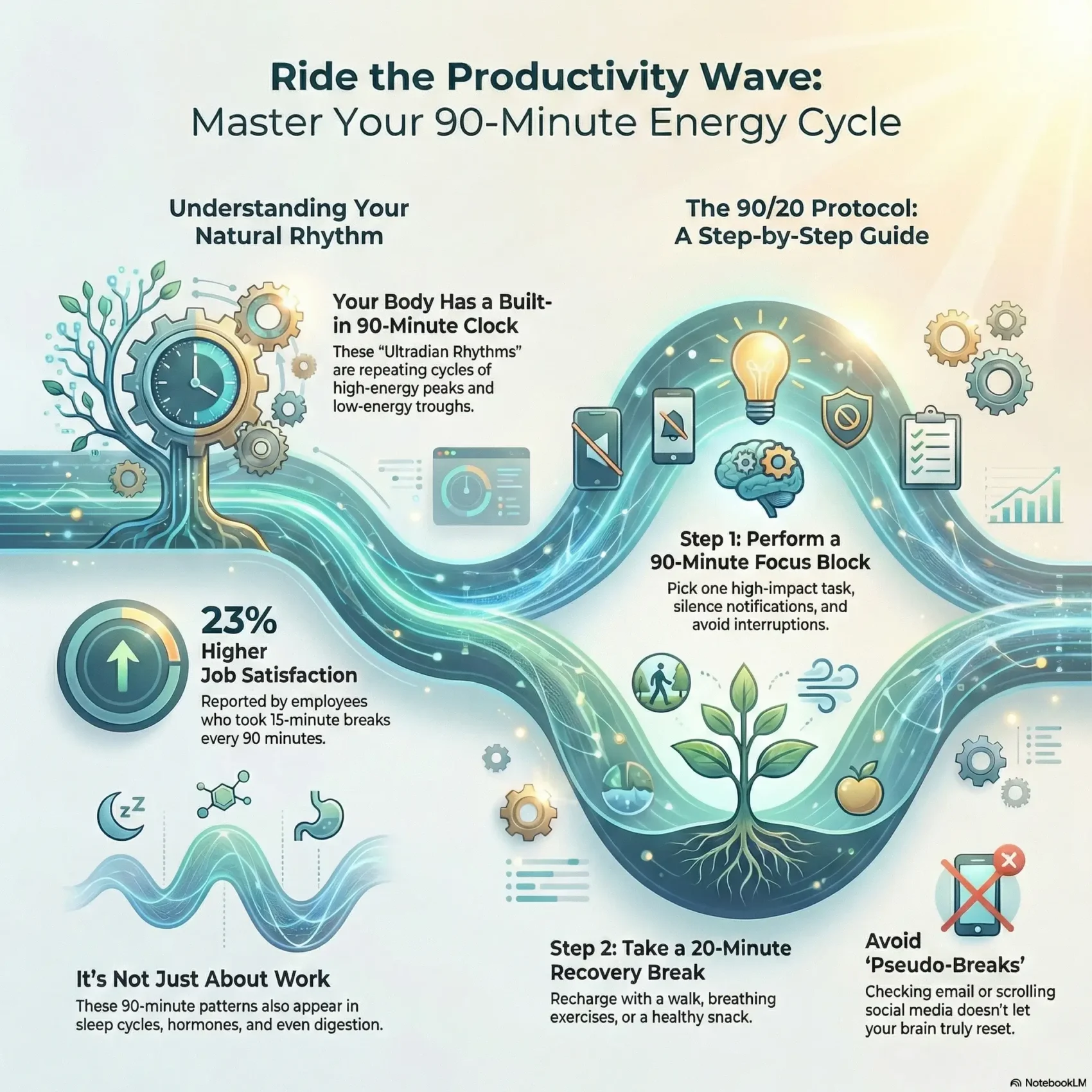
Last Updated on February 13, 2026
You can boost productivity by working with your body’s natural 90-minute cycles. These cycles include a peak of alertness followed by a short dip that helps your brain recover. Understanding this pattern helps you plan focused work blocks and short breaks instead of forcing long, tiring stretches.
Science shows these cycles appear across sleep, heart rate, hormones, digestion, and breathing. They are different from circadian rhythms, which follow a 24-hour clock tied to light and night. When you time deep work to match a peak, your focus and energy last longer through the day.
This guide gives a practical roadmap: use 90-minute focus windows, watch for signs that your concentration is dropping, and take recovery breaks that protect your energy. Small schedule and light changes can make big differences in productivity and sleep quality.
Key Takeaways
- Work in 90-minute focus blocks to align with natural cycles.
- Short breaks after peaks prevent sudden drops in focus and energy.
- These patterns differ from circadian rhythms tied to day and night light.
- Timing tasks to peaks helps your brain do better work in less time.
- Adjust light, environment, and schedule to support steady productivity.
- Better timing at work often improves sleep and overall energy levels.
Why 90-Minute Cycles Boost Your Productivity Right Now
When you schedule deep work in 90-minute windows, your focus naturally climbs to a peak. Typical ultradian rhythms run 90–120 minutes of higher activity, then a 20–30 minute trough. That clear cycle affects alertness and performance throughout the day.
You get more done in less time by bundling demanding tasks into one focused period. Your body builds toward a peak, then eases off. Honor that pattern and your energy and output surge without extra effort.
Research from the Journal of Applied Psychology (2024) found employees who took 15-minute breaks every 90 minutes reported 23% higher job satisfaction and 17% lower stress than those who worked long, uninterrupted hours.
- Reduce stress: short breaks after a peak stop the predictable dip.
- Boost performance: single-tasking in one cycle lowers switching costs.
- Feel it fast: higher focus, fewer crashes, and steadier energy across periods.
Start now: set a 90-minute timer, silence notifications, and plan a 15–20 minute break. Small time changes can shift your productivity levels all day.
Ultradian rhythm
Think of your day as a series of short work pulses that rise and fall every 90–120 minutes. In plain terms, an ultradian rhythm means your body runs multiple repeating periods under 24 hours that steer focus, energy, and recovery.
The pattern runs quietly through wakefulness and sleep. It shapes brain waves, hormone pulses like cortisol and growth hormone, and other processes that set your alertness levels.
You get better results when you cooperate with these cycles instead of forcing long marathons. Respecting one cycle often beats grinding through fatigue.
- Notice your own peaks: mark when you feel switched on versus foggy.
- Use those markers to plan focused work and a short recovery period.
- Remember: a well-timed break restores focus far faster than pushing on.
Ultradian vs. circadian vs. infradian: how your body’s clocks differ
Your body runs multiple clocks at once, and each one shapes different parts of your day. Knowing which clock governs a task helps you plan focus blocks, sleep, and longer-term health steps.
Short, repeatable cycles under 24 hours
Ultradian rhythms recur several times per day. These 90–120 minute cycles drive peaks of alertness and the short dips that signal a need to rest.
The 24-hour anchor
Circadian rhythms act as your day-night clock. The suprachiasmatic nucleus in the brain ties this clock to light, which sets your wake/sleep timing and overall alertness across the day.
Longer-than-a-day patterns
Infradian cycles run across days or weeks, like the menstrual cycle. These periods shape broader health trends and planning needs beyond short work periods.
- You’ll notice sleep architecture blends the 24-hour clock with 90-minute stages.
- Use morning light to tune your circadian clock while you honor short work windows.
- Understanding these patterns helps you design a day that matches your natural times.
The science behind your peaks and troughs
The nervous system cycles through bursts of high attention and brief recovery windows roughly every 90–120 minutes. This Basic Rest-Activity Cycle (BRAC) produces peaks of high-frequency brain activity followed by 20–30 minute troughs that let you reset.
The Basic Rest-Activity Cycle: 90–120 minute peaks, 20–30 minute troughs
The BRAC explains why you often feel a surge of focus, then a natural dip. Spotting the end of a peak helps you pause before quality drops.
HPA axis, autonomic nervous system, and hormone pulses
Regulation involves the HPA axis and the autonomic system. Pulsatile hormones like cortisol and melatonin rise and fall in short bursts. Those hormone shifts nudge your alertness and energy levels during each period.
Neurotransmitters and alertness
Dopamine and serotonin affect motivation and calm. Their changing levels help explain why you feel more driven at one moment and more tired the next.
Physiology examples
These cycles show up in REM sleep stages, heart rate variability across one to two hours, digestive contractions, and breathing changes. Seeing the same 90–120 minute pattern across systems makes working with these cycles feel less like a hack and more like natural timing.
- Understand BRAC: notice when a peak ends so you don’t waste your next block.
- Follow biological cues: restlessness or falling focus are signs to pause.
- Protect peaks: set boundaries so your high-quality time keeps paying back in calm consistency.
Benefits you can feel: focus, energy, and less fatigue throughout the day
When you respect your natural work periods, focus and energy become more reliable. Short, predictable breaks change how you feel and what you finish each day. They cut stress and protect your performance across long hours.
From burnout to better output: why breaks reduce stress
Real-world data shows the payoff. A 2024 Journal of Applied Psychology study found that 15-minute breaks every 90 minutes raised job satisfaction by 23% and lowered stress by 17% versus long, uninterrupted stretches.
A large tech trial in 2024 recorded a 12% rise in project completion and a 9% drop in reported burnout when teams scheduled work to match natural periods. Those gains come from steadier energy and fewer crashes.
- Sharper focus: you match effort to a peak and step back before stress compounds.
- Sustained energy: brief resets keep you productive across the day and cut fatigue.
- Better mental health: regular pauses lower stress load and reduce burnout risk.
- Improved function: clearer thinking, steadier mood, and more reliable output over hours.
“Short strategic breaks protect your capacity to perform throughout long work periods.”
Start simple: plan focused blocks, take brief recoveries, and notice how your levels of attention and energy change. You’ll see productivity improve and fewer late-afternoon slumps when breaks stop being optional.
Your 90/20 protocol: a step-by-step way to work with natural cycles
Adopt a simple 90/20 protocol to structure your day into predictable windows of focused work and recovery. This way you plan when to push hard and when to rest, so your energy stays steady and your productivity improves.
Plan
Block 90-minute focus windows on your schedule. Put the most demanding task into the first block of the day when your body and mind are fresher.
Perform
Single-task inside each block: pick one high-impact task, silence notifications, and protect that time from interruptions. Companies like Buffer use 90-minute sessions for deep work on “Masterpiece Days.”
Recover
Take a 15–30 minute break after each period. Move, get fresh air, or do a short calm practice. These minutes reset attention so the next block starts with more focus.
Adjust
Personalize cycle length based on your signals. If your focus fades at 80 minutes, stop there. If you can go 100, use that and then recover. Batch shallow tasks separately so they don’t bleed into prime blocks.
- Map your day into 90-minute blocks and set clear boundaries.
- One high-impact task per block; no multitasking.
- Schedule 15–30 minute recoveries to reset attention systems.
- Use a simple checklist: objective, start time, no-distraction plan, break plan, review.
“Many teams see gains by matching work and break periods to natural cycles.”
What to do on breaks: recovery that actually recharges you
How you spend each pause dictates whether you return refreshed or more drained. Pick actions that lower mental load and restore your energy so the next cycle of work starts strong.
Active rest: walks, light exercise, and fresh air
Move for five to fifteen minutes. A short walk outside or gentle mobility loosens tension and raises circulation. This simple example beats scrolling and resets your focus fast.
Calm the system: meditation and breathing
Even three minutes of breathing or a brief guided meditation calms your nervous system. You return centered and less reactive to distractions.
Short naps and when to use them
Try a 20–30 minute nap only when you truly need one. That window boosts alertness without deep grogginess and fits a mid-day period of lower energy.
Refuel smart: snacks that stabilize energy
Choose nuts, yogurt, or a banana to keep glucose steady. Skip sugary hits that spike and crash your levels before the next work time.
What not to do: pseudo-breaks and task-switching traps
- Avoid inbox dives or quick tasks that keep your brain in work mode.
- Set a timer so breaks end on schedule and don’t eat into your next block.
- Mix active rest, calm practices, and smart refueling across the day for best results.
Sleep and REM: building better days starts at night
Sleep frames your day: the quality of your night shapes how sharp your next work peak will be.
Sleep unfolds in repeating ~90-minute cycles that alternate REM and non-REM stages. When you align bedtime to finish full cycles, you cut the chance of waking mid-REM and feeling groggy.
Aligning bedtime with 90-minute sleep cycles
Aim to schedule sleep in multiples of about 90 minutes. That means choosing bed and wake times that favor complete cycles so you wake nearer the end of a period, not in the middle of REM.
Consistency, light exposure, and morning alertness
Get natural light within an hour of waking. Morning light strengthens your circadian rhythms and raises cortisol gently to boost alertness and energy for the day ahead.
- Protect nights: target bed and wake times that favor full sleep cycles.
- Rise with light: morning sun helps set the body clock and primes your first daytime peak.
- Avoid abrupt alarms: stepping out near a cycle end reduces groggy awakenings.
- Keep hours steady: consistent sleep times across weekdays and weekends stabilize patterns and daytime levels.
Hormone cycles — melatonin falling at night and cortisol rising in the morning — shape the brain’s readiness for focused work. Create a short wind-down routine so your body glides into deeper stages and each period of sleep becomes more restorative.
“Protecting your nights gives you clearer days.”
Scheduling your day around ultradian peaks
Plan your day so high-value work lands when your alertness naturally peaks. Many people feel strongest mid-morning and again in the early afternoon. Use those windows for your most demanding tasks to protect quality and speed.
When to schedule deep tasks, meetings, and admin
Put deep work in peak windows and move meetings or admin to lower-alertness periods. Time-block two to three focused blocks per day and leave short buffers between them so you can recover and reset.
Examples: mid-morning and early afternoon peaks
For example, reserve mid-morning for creative or analytical work and use early afternoon for a second deep block if you can. Slot collaborative calls and inbox time into dips so they don’t steal your best hours.
- Try a template: repeat reliable windows across the week to defend prime time.
- Track and adapt: use apps like RescueTime or Toggl to confirm when your output climbs.
- Cluster collaboration: group meetings in lower-alertness slots to keep focus blocks intact.
- Adjust for change: shift your schedule when sleep, travel, or seasons move your energy levels.
“Protect your best hours and you’ll get more done with less effort.”
Lifestyle factors that shape your rhythm
Simple lifestyle moves can make each work period more predictable and productive. Tightening basics around sleep, stress, food, and movement helps your body and mind show up for each focused block.
Stress, diet, and exercise: the big three
Consistent sleep and stress management protect hormonal balance so peaks stay sharp and troughs stay short. Chronic stress blunts peaks and deepens dips.
Eat balanced meals that steady blood sugar and plan fueling around work blocks so energy doesn’t crash mid-period.
Match exercise to your time of peak focus: light movement before deep work and harder sessions after a focused block if that fits your day.
Light, temperature, and your environment
Morning light anchors your clock and improves alertness for early blocks. A cool, well-ventilated workspace sharpens attention during high-demand periods.
- You’ll tighten the basics—consistent sleep, smart meals, and movement—to make each ultradian period steadier and more productive.
- You’ll use morning light and a cool, well-ventilated space to support your clock and improve alertness in early blocks.
- You’ll reduce chronic stress to prevent flattened peaks and sluggish dips, keeping daily patterns clear and reliable.
- You’ll plan fueling around blocks so blood sugar levels don’t sabotage your best window.
“Small environmental tweaks often deliver the biggest gains in daily focus.”
For practical tools on syncing habits with work windows, see energy management and productivity.
Tools and trackers: using tech to support your cycles
Tech can make it easier to spot your best hours and protect them on the calendar. With a few apps and a short log, you turn vague feelings into repeatable data and clear action.
Time-blocking and focus apps
Use apps like RescueTime and Toggl to surface productive hours and confirm when your output peaks. Forest and similar focus timers give a concrete start and end to each work period so distractions stay out.
Wearables and smart lighting: promise and limitations
Many wearables claim to show readiness or activity signals. Treat these as supportive cues, not definitive measures of personal cycles.
Smart lights can shift color temperature to boost alertness for work blocks and then warm down for wind‑down. They help, but they don’t replace good sleep or consistent routines.
Self-tracking: what’s validated
Simple logs often win. Capture two weeks of start time, task, perceived focus, and energy levels. That low-tech record maps your repeatable cycles better than over‑complex setups.
- You’ll use time-blocking and tracking to lock in your best windows.
- You’ll try a focus timer (example: Forest) to protect each block.
- You’ll treat wearables as helpful signals and log your own observations for final validation.
“Pick a simple tool stack that helps you start on time, protect the block, and recover fully.”
Flow vs. breaks: when to ride the wave
Flow can feel like a wave—learning when to ride it and when to step off keeps your day balanced. When you notice deep absorption, effortless progress, and time dilation, the sensible move is often to continue until the session naturally eases.
Recognizing a flow state and choosing to continue
Watch for signs: you feel fully present, ideas come easily, and work feels almost automatic. In that moment, extending a block past the usual 90-minute mark can preserve momentum and yield better results.
Still, log how long a typical flow lasts for you. That data helps you plan buffers so one extended period doesn’t wreck your whole day.
Returning to cycles after flow ends
Once flow fades, return to your next planned period and take a true recovery. Real breaks detach you from work; task-switching or checking email usually fails to reset attention.
- You’ll learn the signs of flow—deep absorption, effortless progress, and time dilation—and when to skip a scheduled break.
- You’ll ride flow while it lasts, then reset with a proper recovery so the next period isn’t compromised.
- You’ll avoid calling task-switching a “break,” giving your brain real distance to recharge.
- You’ll log flow length to plan buffers without blowing up your day.
- You’ll balance artistry with structure: use these rhythms to get into flow more often and use breaks to return ready for another great block.
“Ride a flow session when it gives you clear gains, then honor the next cycle with a real break.”
Ultradian rhythms at work: policies, spaces, and culture
Designing office policies around natural work cycles helps teams stay productive and less stressed. You can set simple rules that protect deep focus and make short recoveries normal.
Meeting design and break policies
Limit meetings to blocks that avoid prime focus time. Schedule collaborative calls in known troughs so deep tasks stay protected.
Adopt break policies that normalize 15–20 minute recoveries after intense periods. This reduces interruptions and lowers reported stress.
Focused zones and relaxation areas
Create quiet zones for concentrated work and separate, inviting spaces for genuine rest. A short walk or a calm spot beats an inbox dive.
Team norms for cycle-aware collaboration
Try “Masterpiece Days” like Buffer did: coordinated 90-minute sessions with breaks. Set norms to evaluate performance by quality per block, not hours logged.
- Protect prime windows on shared calendars so tasks don’t get fragmented.
- Make rhythms visible in team tools so everyone works with the same cadence.
- Set realistic expectations that reward output and reduce chronic stress.
“Policies and spaces that match how people actually concentrate make productivity sustainable.”
Evidence, impact, and healthy skepticism
Evidence is accumulating that short, planned breaks change how you perform on hard tasks. Several recent studies and real-world pilots point to clear benefits, but the picture has nuance.
What recent studies suggest about breaks and performance
The 2024 Journal of Applied Psychology found 15-minute breaks every 90 minutes raised job satisfaction 23% and lowered stress 17%.
A 2023 University of Illinois study showed 50/10 work-break cycles improved cognitive task performance versus continuous work.
Economic upside and adoption across countries
The World Economic Forum (2024) estimated up to $1.3T in annual productivity gains by 2030 if these patterns scale. Pilots vary: nap rooms in Japan, Sweden’s 6-hour trials, German break laws, and growing U.S. and China interest.
Critiques, privacy, and ethical considerations
Critics note many gains may come from regular breaks, not precise ultradian rhythm timing. You should weigh the promise against practical factors like job type and culture.
Be cautious if employers start tracking biometric cycles. Privacy, consent, and fair use policies must guide any monitoring or data use.
“Even skeptics agree: regular, genuine breaks help. Framing them by cycles simply gives structure.”
- You’ll see where evidence is strong and where more data is needed.
- You’ll balance economic claims with local realities and ethical risks.
- You’ll prefer transparent, consent-based approaches when tracking is used.
Conclusion
,Make one small change: schedule focused windows and honest breaks, and you’ll notice steadier energy fast.
Work in 90–120 minute blocks, then take 15–30 minute recoveries. This approach traces back to Nathaniel Kleitman and was popularized by Ernest Rossi. Modern pilots report measurable gains and less burnout.
Personalize your plan by watching for cues and protecting high-value tasks during peaks. Improve sleep and daylight habits so each daytime cycle becomes more reliable.
Treat breaks as essential maintenance, not indulgences. Use light tracking tools to refine what works. Over time this way of working honors your body, raises focus levels, and boosts productivity.