Polywork means holding more than one paid role at the same time: a main job plus freelance clients, a small business, or a second employer. The word is recent. The practice is old, and it used to go by names like portfolio career, moonlighting or simply having a second job.
What changed is the friction. Remote work removed the commute, cloud tools made a second role runnable from the same laptop, and high living costs gave people a reason to want one.
This guide covers what the data actually shows, what a second role realistically pays, the contract and tax rules that catch people out, and how to run one without damaging the job that pays your rent.
Key Takeaways
- Polywork is holding more than one paid role at once, whether employed, freelance or a mix.
- About 5.4% of employed Americans held multiple jobs in August 2026, roughly 8.8 million people.
- Side income is usually modest. Bankrate put the median side hustle at $200 a month.
- Exclusivity clauses, confidentiality terms and combined retirement limits matter more than most people expect.
- Recovery time, not ambition, decides whether a second role lasts.
What polywork actually is
Polywork covers any arrangement where you earn from more than one source at once: a salaried job plus evening consulting, two part-time employers, or a day job alongside a weekend shop.
It is not the same as freelancing full time. A freelancer has many clients but one working identity. A polyworker keeps a primary job, with its salary and benefits, and adds something on top.
Where the idea came from
The management writer Charles Handy described the “portfolio career” in the late 1980s: work built from several income strands rather than one employer. Freelance marketplaces, and later remote contract work, turned that into something ordinary people could try.
The newer label reflects a shift in attitude more than in behaviour. People now say out loud what they used to keep quiet. Our overview of the gig economy 2.0 traces the same shift from the platform side.
How common it really is
The most reliable US measure comes from the Bureau of Labor Statistics, which counts multiple jobholders every month. In August 2026, 5.4% of employed Americans held more than one job, about 8.8 million people. That is well short of the “half the workforce” figure that circulates online.
Survey numbers look larger because they ask a looser question. Bankrate’s June 2025 survey found 27% of US adults had a side hustle, the lowest share since 2017. The gap is mostly definitional: the BLS counts jobs, surveys count any paid activity, including one-off gigs.
The honest summary: polywork is real, growing slowly, and nowhere near universal. Broader shifts in independent work are covered in our pieces on freelancing trends and the global gig economy.
Why more people are adding a second role
Three forces push in the same direction, and none looks likely to reverse soon.
Money is the main driver
Most people add work because their first job does not stretch far enough. In Bankrate’s survey, 35% of side hustlers used at least some of the money for regular living expenses such as housing and food. That is a different motive from building a business, and it changes what success looks like: covering a bill counts.
A second income also spreads risk. If one employer cuts headcount, something still comes in. That logic runs through the wider shift toward contract-based work.
Remote work removed the friction
A hybrid schedule gives back commuting time and, more importantly, control over when you work. Our look at how remote work settled into a stable pattern explains why that time is unlikely to be handed back.
AI tools add to this. Drafting and summarising take less time than they did two years ago, which frees capacity inside an existing workload. That also makes polywork easier to hide, and it is why some employers have become more watchful.
Skills compound faster across two roles
A second role teaches things the first one cannot. Someone in corporate marketing who runs a small e-commerce shop learns pricing, logistics and customer service directly rather than through a report. That range is what employers say they want, as our summaries of future job skills and upskilling both describe.
What polywork costs
The upside is easy to picture. The costs arrive later and get underestimated.
The income is smaller than the stories suggest
Bankrate found side hustlers earned $885 a month on average, but the median was $200. The gap is the whole story: a few high earners pull the average up, while the typical person earns a modest supplement.
Plan around the median, not the average. If a second role has to replace a salary, it is a career change, not a side project.
Recovery is the real constraint
Two jobs do not simply add hours. They add context switching, and every switch costs attention. An evening spent on client work is an evening not spent recovering, and fatigue accumulates quietly over months.
This is where most polywork arrangements fail. Our guides to structured downtime, stress management and burnout at work all point to the same conclusion: recovery has to be scheduled, or it disappears.
Your employer may be less relaxed than you think
Some managers see the outside experience as a plus. Others see a distraction risk, particularly if your side work touches the same market. The test most employers apply is simple: has your performance changed? Missed deadlines get noticed long before anyone finds your second contract.
The contract and tax rules to check first
This is the part people skip, and the part that causes real damage.
Read your employment contract before you accept anything
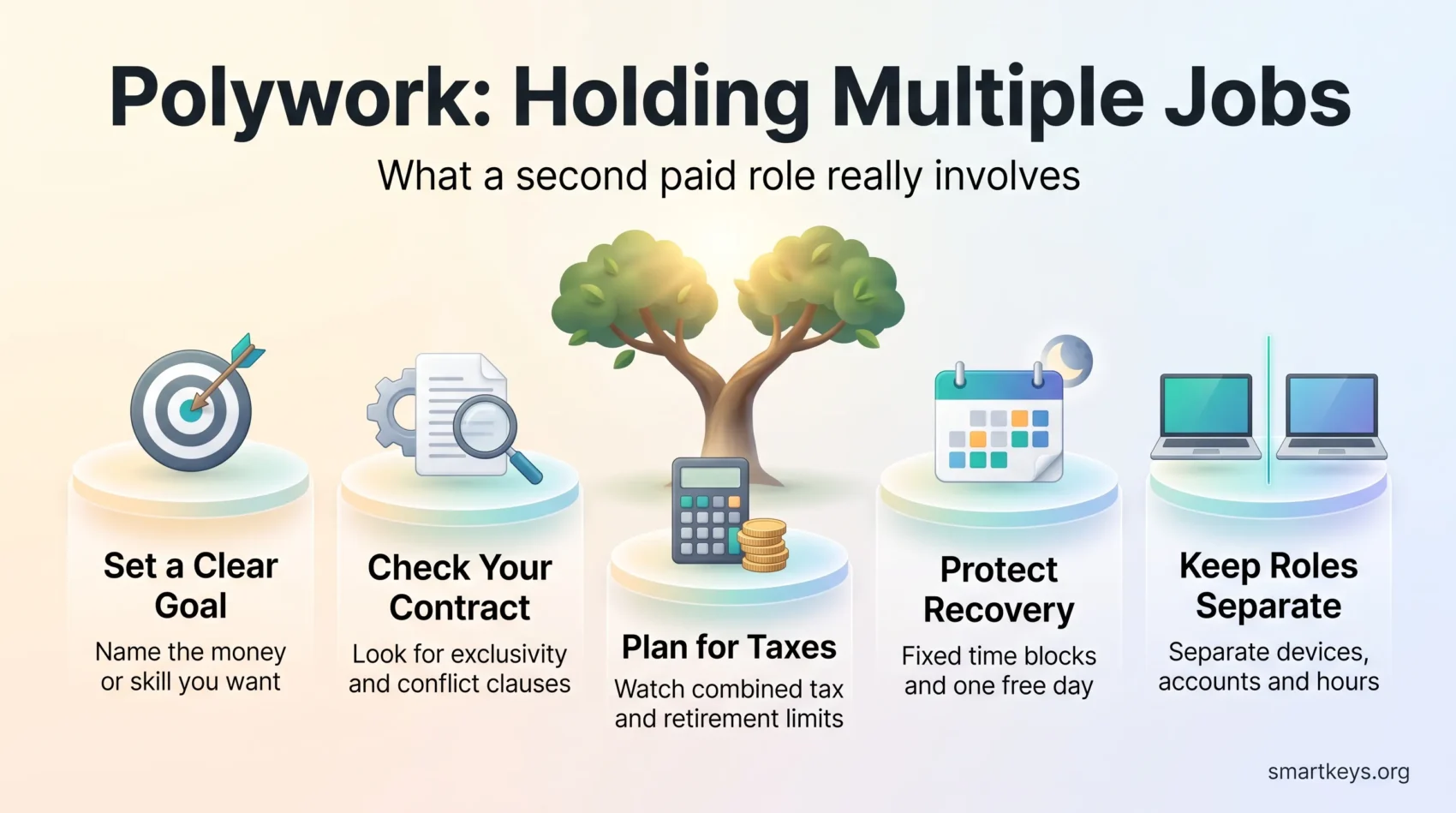
Look for three clauses. Exclusivity terms may prohibit outside paid work or require written approval. Conflict-of-interest terms usually block work with competitors. Confidentiality and intellectual property terms may claim ownership of anything you create using company time, equipment or information.
Noncompete clauses need a note of their own. The Federal Trade Commission’s 2024 rule banning most noncompetes never took effect: a district court blocked it in August 2024 and the FTC moved to dismiss its appeal in September 2025. Enforceability still depends on your state. If a clause is unclear, ask an employment lawyer rather than guessing.
Two employers can mean too much Social Security tax
Social Security tax applies to wages up to an annual cap, $184,500 for 2026. Each employer withholds against that cap independently, so combined wages above it mean you overpay. The excess comes back as a credit on your federal return, but only if you notice it.
Retirement limits apply to you, not to each job
The 401(k) elective deferral limit is $24,500 for 2026, with an extra $8,000 catch-up from age 50 and $11,250 for ages 60 to 63 where the plan allows it. That limit belongs to you personally, not to each employer, so two plans mean you must split the total rather than double it. Exceeding it creates a correction problem in the following tax year.
Self-employed side income adds quarterly estimated payments and self-employment tax. Once the work grows past pocket money, an accountant usually costs less than a correction.
How to run a second role without wrecking the first
Treat this as an experiment with an end date, not a permanent commitment.
Start with one question
Name what the extra work is for: a specific amount of money, a specific skill, or a product you want to test. A goal like “more income” is too vague to tell you when to stop. Writing it as a measurable target, in the style of our guide to personal OKRs, keeps the review honest.
Set a review point at 90 days. If the money, the learning or the enjoyment is not there, stopping is a result, not a failure.
Give the second role fixed hours
Put the side work in your calendar as blocks rather than fitting it into gaps. Fixed blocks protect both jobs: the second role gets real attention, and the first is not quietly eroded. Our guides to time blocking and managing energy rather than hours cover how to match those blocks to when you actually think well.
Keep one full day a week clear. Protecting it means declining things, and our piece on saying no is a practical starting point.
Keep the two roles physically separate
Use separate devices, accounts, email addresses and storage. This is partly about focus and mostly about protection: if your employer ever asks whether company resources were involved, a clean separation ends the conversation.
Never run side work on employer hardware or during contracted hours. That one rule prevents most disputes.
Conclusion
Polywork is a real and slowly growing pattern rather than a workforce revolution. Around one in eighteen employed Americans holds more than one job, and for most of them it is a supplement, not a second salary.
That makes it reasonable if you go in with clear eyes: know what the extra work is for, check your contract first, plan for the tax consequences, and treat recovery as a fixed cost. Our guidance on work-life balance covers the wider trade-off, and if you are the one hiring rather than moonlighting, managing freelancers covers the other side of the arrangement.
Start with one role, run it for 90 days, and judge it honestly. That is a smaller decision than it feels like, and it is easy to reverse.
Found this useful?
Make SmartKeys a preferred source on Google, and our articles will surface more often in your Top Stories, AI Overviews, and AI Mode.
Add as Preferred Source