A wave of “how to be productive” advice promises quick fixes. Much of it sounds convincing, then falls apart the moment you try it on an ordinary Tuesday.
Part of the problem is that the advice is usually one person’s routine dressed up as a rule. Benjamin Franklin set himself a strict daily timetable and admitted in his autobiography that he never managed to keep it. Copying someone else’s schedule ignores your job, your energy and the interruptions you cannot control.
This article takes nine popular productivity claims, checks each one against the evidence, and gives you something concrete to do instead.
Key Takeaways
- Most popular tips are a single person’s habit, not a tested method.
- Hours are a poor measure of output. Protected attention is a better one.
- Switching between tasks and apps has a measurable cost in time and errors.
- Willpower does not drain like a fuel tank: a 36-lab study found almost no effect.
- Each myth below comes with one practical alternative you can test this week.
Why productivity myths survive
Weak advice sticks around because it is easy to repeat. Three things keep it alive.
Survivorship bias. That is the habit of drawing lessons only from the people you can see succeeding. We hear about the founder whose 4 a.m. start “worked” and never about the thousands who tried the same start and got nowhere. One visible winner looks like a rule when it is a sample of one.
Slogans travel further than evidence. “Eat the frog” fits in a headline. The conditions under which it actually helps do not.
Most tips treat time as the scarce resource. In practice, attention is scarcer. Microsoft’s 2025 Work Trend Index report on the “infinite workday” found that employees are interrupted roughly every two minutes by a meeting, email or chat message, and that the most heavily connected workers take around 275 of those hits a day. No scheduling trick survives that unless it also protects attention.
So before you adopt any tip, ask two questions. Does it remove friction, or does it add another thing to manage? And could you still do it in a bad week?
A plain routine you can repeat beats a clever one you abandon in March.
Myth 1: More hours mean more results
The claim: if the work is not finished, stay longer.
What actually happens: beyond a few hours of concentrated effort, quality falls before quantity does. A developer who codes for twelve hours often ships work that needs a day of bug fixing, which cancels the extra hours and then some. The same pattern shows up in writing, analysis and design: the last two hours produce work that the next morning gets rewritten.
Hours are easy to count, which is exactly why they get counted. Output is harder to measure and matters more.
Try this instead. Pick one or two blocks of 60 to 90 minutes a day and put your hardest task inside them, at the hour when you are usually sharpest. Time blocking means assigning each block to a named task in your calendar rather than leaving the day open. Close the day with a five-minute review so unfinished work is written down instead of carried home. If you are new to the idea, deep work is the term Cal Newport uses for exactly this kind of protected, undistracted stretch.
Myth 2: Being busy means being effective
The claim: a full calendar and a long list are proof of progress.
What actually happens: a crowded day is often a sign that nobody decided what mattered. Tony Crabbe, author of Busy, argues that when goals are vague, people default to activity because activity feels like an answer. You end the day tired and cannot name what moved.
Try this instead. Before you open email, write down one to three outcomes that would make the day count. Dan Sullivan’s version of this is three important items and nothing more. The Ivy Lee method and the 80/20 rule are two established ways to pick them, and a short weekly planning session makes the daily choice much faster.
Then protect those items. That usually means saying no to requests that do not connect to them, and batching the small stuff after you have shipped one real outcome. A to-do list works when it reflects what you can realistically finish, not everything you might one day do.
Myth 3: Multitasking saves time
The claim: handling several things at once gets more done.
What actually happens: your brain does not run two demanding tasks in parallel. It switches, and each switch costs a reorientation. This is called context switching, and the cost is measurable.
Researchers Rohan Narayana Murty, Sandeep Dadlani and Rajath B. Das tracked 137 people across 20 teams at three Fortune 500 companies and reported the results in Harvard Business Review in 2022. Their participants toggled between applications about 1,200 times a day. The time spent reorienting after those toggles added up to just under four hours a week, roughly 9% of working time.
The fragmentation has been growing for years. Gloria Mark’s research at UC Irvine found that office workers stayed on one screen for about two and a half minutes in 2004. By the late 2010s the average had fallen to 47 seconds. Her work on attention span is the clearest picture we have of how thin the average working hour has become.
Try this instead. Sequence your work rather than interleaving it: outline, then draft, then revise, each in its own block. Turn off notifications you do not need, since managing notifications removes the interruptions you can actually control. Group similar small tasks so you enter a mode once instead of ten times. Single-tasking is not a personality trait; it is a setup.
One protected focus window beats a whole day of switching.
Myth 4: The right app stack will fix your workflow
The claim: the friction is in your tools, so add a better tool.
What actually happens: every tool you add creates another place where the truth might live. You then spend time reconciling them, which is the same switching cost as before, only self-inflicted.
Elaborate filing has a similar problem. A study by Steve Whittaker and colleagues at IBM Research looked at 345 email users and about 85,000 attempts to find a message again. People who invested heavily in folders were no better at finding messages than people who simply searched, and they took marginally longer.
Try this instead. Decide your priorities away from the screen, then open the smallest set of tools that lets you execute. One task manager, one calendar, one place for notes. Use consistent, searchable names instead of deep folder trees. If you want a starting point, this list of productivity apps is a reasonable shortlist, and batching your email into set slots will do more for your day than any new inbox plugin. Judge a tool by the steps it removes, not by the features it advertises.
Myth 5: Rewards are what keep you going
The claim: bonuses, titles and streaks are what sustain effort.
What actually happens: external rewards work well for short bursts and poorly for long stretches. Intrinsic motivation, meaning interest in the work itself rather than in what it earns you, is the better predictor of progress over years.
The evidence here is unusually clean. Kou Murayama and colleagues followed 3,530 students in Bavaria from grade 5 to grade 10 and published the results in Child Development in 2013. Intelligence strongly predicted where a student started. It did not predict how much they improved. Intrinsic motivation and study strategies did. As the authors put it, the determinant of growth is not how smart you are but how motivated you are and how you study.
There is a second effect worth knowing: adding a reward to something a person already enjoys can crowd out the original interest. Researchers call this motivational crowding.
Try this instead. Attach your habit to the verb, not the noun. Not “become a writer” but “write for 50 minutes, five mornings a week.” Habit stacking and small, repeatable micro-habits both work on this principle, and they hold up better than motivation on its own when the work gets dull. If your problem is starting rather than continuing, procrastination usually needs a different fix from motivation.
Myth 6: Willpower is a tank that runs empty
The claim: self-control is a finite daily supply, so protect it and expect to run out by evening.
What actually happens: this idea comes from ego depletion research, and it has not held up. In 2021, Kathleen Vohs, Brandon Schmeichel and around a hundred co-authors ran a preregistered test across 36 laboratories with 3,531 participants and published it in Psychological Science. The confirmatory analysis found an effect of d = 0.06, which is close to nothing, and the Bayesian analysis favored no effect at all. Their conclusion was that depletion is not as reliable or robust as previously assumed.
That does not mean fatigue is imaginary. It means self-control is shaped by context, habit and rest rather than by a tank you drain.
Try this instead. Make the right action the easy one. Lay out the document, the clothes or the file the night before so starting takes no decision. Build small routines that run without deliberation, which is what self-discipline looks like in practice. Schedule real recovery: short breaks, movement during the day and enough sleep do more for tomorrow’s focus than any amount of gritting your teeth today.
Myth 7: Visualizing success makes it happen
The claim: picture the finished result vividly enough and you will be pulled towards it.
What actually happens: Gabriele Oettingen’s research on positive fantasies found the opposite of the popular version. Vividly imagining a good outcome can lower the energy you bring to pursuing it, because part of the satisfaction arrives early. It also makes the first setback land harder, since your mental rehearsal contained no setbacks.
Try this instead. Use imagination for the obstacles, not the trophy. Name the two or three things most likely to derail the plan, then write an if-then response for each: “if the client review slips past Thursday, I move the draft to Friday morning.” Psychologists call these implementation intentions, and they turn a wish into a decision you have already made. Pair them with a realistic schedule; the planning fallacy describes how reliably we underestimate how long our own work will take.
Myth 8: You can keep it all in your head
The claim: writing things down is overhead; a good memory is enough.
What actually happens: memory is fine until the day gets busy, which is the day it matters. Missed commitments and forgotten decisions usually trace back to something that was never written anywhere.
Try this instead. Capture in one place and review once a day. A brain dump at the start or end of the day clears what is circling; a short decision log stops you relitigating the same question next week. Write entries that your future self can act on: who, what, by when, and the next step. Then close the notes app while you execute and reopen it during the review. Keeping a work journal adds a second benefit, which is that you can see over weeks which changes actually helped.
Myth 9: You have to be Type A, or watch every detail
The claim: productive people are naturally rigid, detail-obsessed and up at dawn.
What actually happens: people of very different temperaments produce excellent work. What they share is a system that fits how they actually operate, not a personality.
Two related myths ride along with this one. The first is that checking everything guarantees quality; in practice, micromanagement slows a project and pushes people towards burnout. The second is that routines kill creativity. A rigid schedule can, but a loose framework, a reliable start and open slots for creative bursts, usually helps.
Try this instead. Write down how the recurring work should be done once, so others can run it without you. That is all a standard operating procedure is, and good SOPs are the difference between delegating and hovering. Hand work to people by strength rather than by whoever is free, which is the core of effective delegation. Then keep your own routine flexible at the edges.
The short version
If you only take one line per myth:
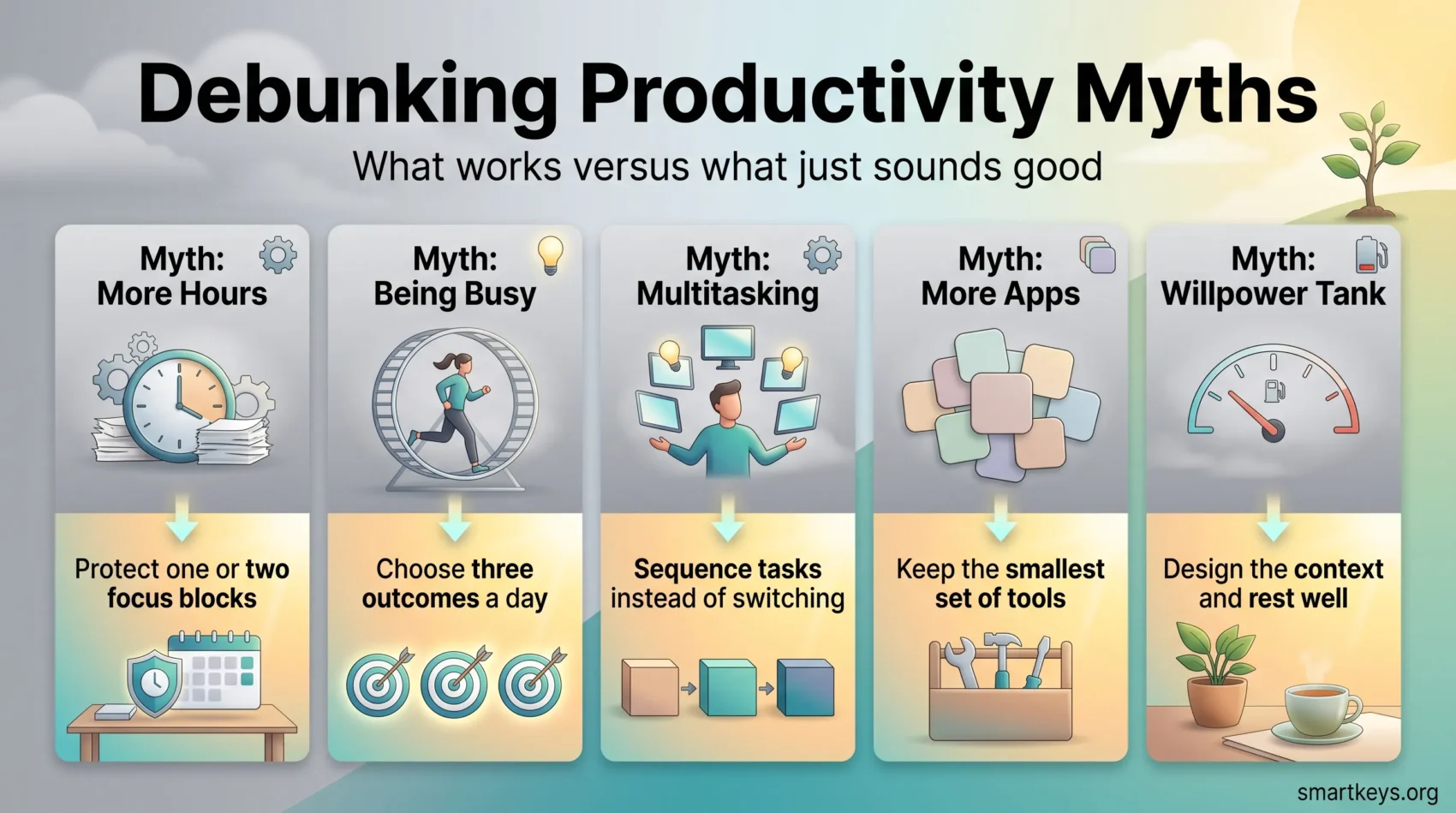
- More hours: quality drops before the clock does. Protect one or two focus blocks and measure output.
- Busy equals effective: busyness hides missing priorities. Choose three outcomes a day.
- Multitasking: about 1,200 app switches a day cost just under four hours a week. Sequence instead.
- More apps: each tool adds reconciliation work. Consolidate and judge by steps removed.
- Rewards: they carry short bursts, not years. Build the habit around the daily action.
- Willpower: a 36-lab study found almost no depletion effect. Design the context and rest properly.
- Visualization: rehearse the obstacles, not the trophy.
- Memory: capture and review beats trying to hold it all.
- Personality: systems beat temperament. Write the SOP and delegate by strength.
Conclusion
Nothing on this list requires a new app or a personality transplant. It requires deciding what matters before the day starts, protecting a couple of hours for it, and writing down enough that you are not running the whole operation from memory.
Treat every tip you read, including these, as a two-week experiment rather than a rule. Pick one metric you care about, whether that is shipped work, hours of undisturbed focus or how you feel on Friday afternoon. Run the change, then keep it or drop it. That is the difference between working smarter and collecting advice.
Measure success by what you finished and what you learned, not by hours logged.
Found this useful?
Make SmartKeys a preferred source on Google, and our articles will surface more often in your Top Stories, AI Overviews, and AI Mode.
Add as Preferred Source