Most American businesses are tiny. Not small in the “under 500 employees” sense that government programs use, but genuinely tiny: one person, a laptop, and a customer list. Micro-entrepreneurship is the name for that model, and it now describes the majority of businesses in the country.
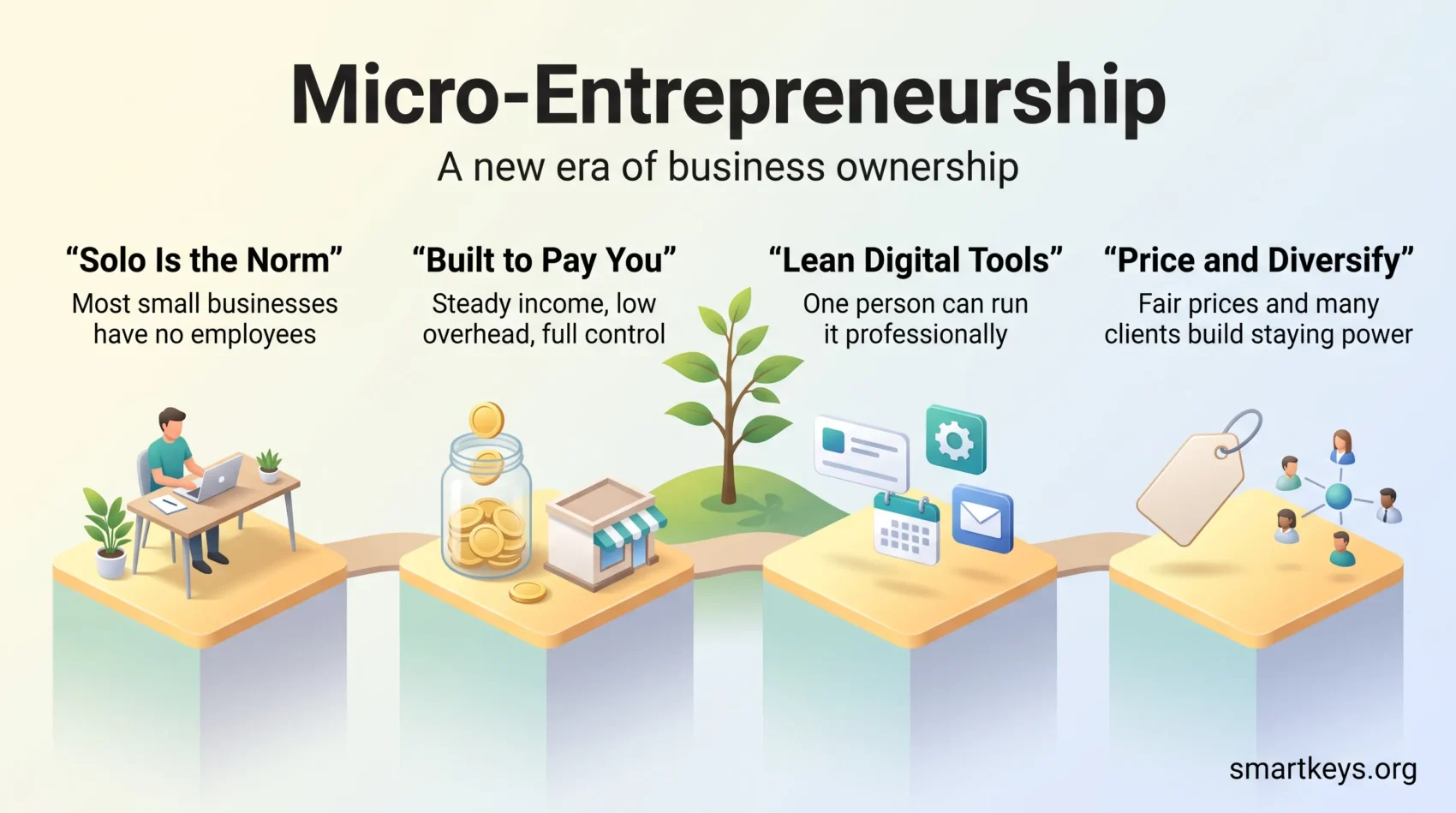
The numbers make the point. The U.S. Small Business Administration’s Office of Advocacy counts 36.2 million small businesses in the United States, and 29.8 million of them, about 82%, have no employees at all beyond the owner. Those are called nonemployer firms, and they are the statistical footprint of micro-entrepreneurship.
This article explains what a micro-business actually is, what the current data shows about how many exist and how they perform, where the realistic opportunities sit in 2026, and what tends to go wrong. If you are weighing up whether to start one, the goal here is to give you the honest version rather than the motivational one. For the wider context, see our overview of small business trends.
Key Takeaways
- About 82% of U.S. small businesses have no employees, so solo ownership is the norm, not the exception.
- A micro-business optimizes for a steady income and low overhead, while a startup optimizes for growth and outside funding.
- Business formation stayed near record levels through 2026, with 578,926 applications filed in July alone.
- Roughly half of new employer businesses are still trading after five years, so survival is realistic but far from automatic.
- SBA microloans go up to $50,000, but the average is closer to $13,000.
- Local networks and mentoring matter more for micro-businesses than for funded startups, because there is no team to fall back on.
What Micro-Entrepreneurship Actually Means
A micro-business is a very small firm, usually run by one person or a handful of people. There is no single official U.S. definition, which is worth knowing before you read any statistic about the sector. In practice, two working definitions are used.
The first is headcount: fewer than ten employees. This is the definition most business writers and the European Union use, and it is the one this article follows.
The second is the government’s own accounting category. The Census Bureau and the SBA separate “nonemployer” firms, which have no paid staff, from “employer” firms, which have at least one. That split is the cleanest available proxy for solo business ownership, and it is where the 82% figure comes from.
You will also see a revenue threshold quoted, often “under $250,000 a year”. Treat that as a rule of thumb rather than a legal line. It is a useful shorthand for the scale of business we are discussing, not an official cutoff.
The practical difference is not the paperwork. It is what the business is for. A micro-business is built to produce a reliable income for its owner at low cost and low risk. A freelance designer, a two-person bookkeeping practice, a local bakery, an online store run from a spare room: these are all micro-businesses, and none of them is trying to become a large company.
How Many Micro-Businesses Are There?
The most reliable count comes from the SBA Office of Advocacy, whose January 2026 FAQ summarises Census data. It reports 36,207,130 small businesses in the United States. Of those, 29,811,495 are nonemployer firms and 6,395,635 have staff. Small businesses make up 99.9% of all U.S. firms.
Those figures describe the whole small business population, not only micro-businesses. But since more than four in five have no employees, the small business economy is overwhelmingly a micro-business economy.
Small businesses employ 62.3 million people in the private sector, about 46% of private employment, and account for roughly 43.5% of U.S. GDP. Between 1995 and 2024 they generated 20.7 million net new jobs, which is 61% of all net job creation over that period. In the most recent year measured, March 2023 to March 2024, small businesses accounted for about nine in ten net new jobs.
New Businesses Keep Being Formed
Formation activity has stayed high. The Census Bureau’s Business Formation Statistics recorded 578,926 business applications in July 2026 on a seasonally adjusted basis, up 8.1% on June. Of those, 151,857 were classed as high-propensity applications, meaning they show characteristics associated with actually hiring staff later.
The gap between those two numbers is the story of micro-entrepreneurship in one line. Most new applications are not attempts to build a company with employees. They are individuals registering a business for themselves.
Micro-Business or Startup: The Difference That Matters
People use “startup” loosely, and it causes real confusion when someone is choosing a path. The distinction is not size at the beginning. Both start small. The distinction is the goal and the funding model.
A startup is designed to grow fast and is usually built on outside capital: angel investment, venture capital, or accelerator funding. The founders accept years of losses and dilution of ownership in exchange for a chance at a large outcome. If you want the full picture there, see our guide to startup funding trends.
A micro-business is designed to pay its owner. It usually starts with savings, a first client, or a small loan. Growth is welcome but not the point, and the owner keeps full control.
Choosing wrongly is expensive. Chasing investors for a business that will never scale wastes months. Bootstrapping a business that genuinely needs capital to reach its market leaves it underfunded. Decide which one you are building before you make funding decisions, not after.
What Is Driving Micro-Entrepreneurship in 2026
Three forces are doing most of the work.
Independent Work Has Become Normal
MBO Partners, which has surveyed the U.S. independent workforce for fifteen years, reported in 2025 that more than 72 million Americans work independently in some form. That figure includes people who freelance part-time alongside a job, so it is broader than the number of registered businesses, but it shows how mainstream the arrangement has become.
The higher end has grown fastest. MBO counted a record 5.6 million independent professionals earning more than $100,000 a year, up 19% on 2024 and 86% on 2020. Independent work is no longer only a fallback for people between jobs. For a wider look, see our coverage of freelancing trends and the gig economy’s next phase.
The Tooling Gap Has Closed
A solo owner in 2026 can run payments, invoicing, scheduling, email marketing, and a storefront on subscriptions that cost less than a single day of an employee’s wages. The same MBO research found 74% of independents now use generative AI to speed up their work, most commonly for drafting, research, and admin.
That is the concrete version of the vague claim that “technology levels the playing field”. It does not mean a one-person shop can outcompete a large firm on scale. It means the fixed cost of looking professional and operating properly has fallen far enough that one person can carry it. Our guide to AI in business operations covers what these tools deliver and where they disappoint.
Customers Buy Small Deliberately
Demand for local, specialised, and clearly sourced products gives small sellers something large competitors struggle to copy: a direct relationship with the buyer. That is the same dynamic behind direct-to-consumer brands and social commerce.
One caution. Survey research on sustainable buying consistently finds a gap between what people say they will pay more for and what they actually buy. Our piece on what consumers reward in sustainability sets out where the claims hold up.
Where the Realistic Opportunities Are
Some categories genuinely suit a one-person operation, because they need expertise rather than capital or inventory:
- Professional services. Bookkeeping, design, copywriting, consulting, and technical work. Low startup cost, and revenue starts with the first client.
- Niche software and tools. Small paid products serving a specific trade or workflow, the model covered in our guide to micro-SaaS businesses.
- Specialist retail and e-commerce. Narrow product ranges where a large retailer has no reason to compete.
- Teaching and coaching. Courses, workshops, and one-to-one training in a skill you already have.
- Local services. Repair, care, food, grooming, and trades, where being nearby is the advantage.
Two practical notes. First, service businesses reach profitability faster than product businesses, because you are not funding stock. Second, the ceiling on a solo service business is your own hours, which is why many owners eventually add a product, a retainer, or a small team.
Funding a Micro-Business
Most micro-businesses start with the owner’s own money and revenue from early customers. When outside funding is needed, the amounts are small and the sources differ from startup finance.
The SBA microloan program lends up to $50,000 through nonprofit intermediary lenders. The maximum is not what most borrowers get: the average microloan is around $13,000. Terms run up to seven years, and interest rates are typically in the 8% to 13% range, set by each intermediary.
Beyond that, the usual routes are community development lenders, local and state grant programs, credit unions, and increasingly the payment and accounting platforms a business already uses. That last route is part of a broader shift towards embedded finance, where lending is offered inside the software a business already runs on rather than at a bank. Newer settlement and payments technology sits alongside it; our overview of blockchain in business covers what has actually reached production there.
Whatever the source, the discipline that matters most is unglamorous. Know your monthly costs, invoice promptly, and keep a buffer. Our guide to cash flow management covers the mechanics.
What Actually Goes Wrong
The honest survival picture comes from SBA Advocacy, averaged across businesses opened between 1994 and 2022. Roughly 68% of new employer businesses survive two years, 49% survive five years, and 34% survive ten. These figures track firms with employees, so they are not a perfect match for solo ventures, but they are the best long-run data available.
Half of new businesses still trading after five years is neither the disaster nor the triumph it is often presented as. What separates the two halves is usually mundane.
Underpricing. New owners quote what feels comfortable rather than what covers their costs and unpaid hours. Raising prices later is much harder than setting them correctly. Our guide to building a pricing strategy works through this.
Client concentration. If one customer is 60% of revenue, you do not have a business, you have a job with worse protection. Spread the base early.
Doing everything personally. A solo owner is delivery, sales, admin, and support at once. The fix is not working longer hours but automating or dropping the low-value work, which our guide to business automation covers.
No marketing habit. Revenue arrives in waves when marketing only happens between projects. A small, consistent effort beats occasional pushes; see our overview of digital marketing, and our notes on customer retention, since keeping a client costs far less than finding one.
Support Systems That Help
Micro-entrepreneurs have no colleagues to check their thinking, which makes outside networks unusually valuable.
Practical options include Small Business Development Centers, which offer free advising in every state; SCORE, which runs volunteer mentoring; chambers of commerce and trade associations; and peer groups of owners at a similar stage. Online, work regularly comes through freelance talent platforms and through referral relationships, which our guide to building a partner ecosystem explains.
Classification rules deserve attention too. Whether a worker counts as an employee or a contractor affects tax and benefits, and the rules keep moving; our summary of gig economy regulation tracks the changes.
If location independence is part of the appeal, the visa and tax questions are real, and our guide to digital nomads covers them.
The Outlook
Micro-entrepreneurship is not a passing trend to be evaluated. It is already the default shape of American business ownership, and the formation data suggests that is not changing. The interesting question is no longer whether people will start solo businesses, but how many of them build something durable.
The conditions favour those who treat it as a business rather than an experiment: price properly, spread the client base, keep a cash buffer, and use the cheap tooling instead of grinding through admin by hand. For the wider workplace context, see our coverage of the future of work for small businesses and gig economy trends.
Found this useful?
Make SmartKeys a preferred source on Google, and our articles will surface more often in your Top Stories, AI Overviews, and AI Mode.
Add as Preferred Source