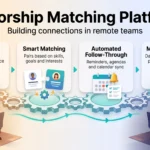
An internal talent marketplace is your company’s own platform for matching the people you already employ to the work that needs doing. That work can be a full role, a short project, a mentoring relationship, a rotation into another team or a training course.
The everyday problem it solves is simple. A manager needs someone who can build a pricing model in Python for six weeks. Somewhere in the company that person exists, but nobody knows who they are, so the job goes to an agency instead. A marketplace makes that person findable.
The second problem is retention. Employees who cannot see a route forward inside a company tend to find one outside it. The Conference Board, in a 2024 report produced with the platform vendor Gloat, put the case plainly: staff with a clear career path and visible options for moving stay longer, and filling a role internally is faster, cheaper and less risky than hiring from outside.
This guide covers what these platforms actually do, what the published evidence supports, how to run a pilot that proves something, and which rules now apply when software helps decide who gets which work. If you are weighing internal capacity against external help, our guide to crowdsourcing talent for workforce flexibility covers the other side of that choice.
Key Takeaways
- A marketplace matches employees to roles, projects, mentoring and learning based on skills rather than job titles.
- Unilever redeployed more than 8,000 employees and 300,000 hours of work through its FLEX platform during the pandemic, according to Deloitte.
- Manager resistance is the main obstacle. Deloitte found 46% of managers push back on internal mobility.
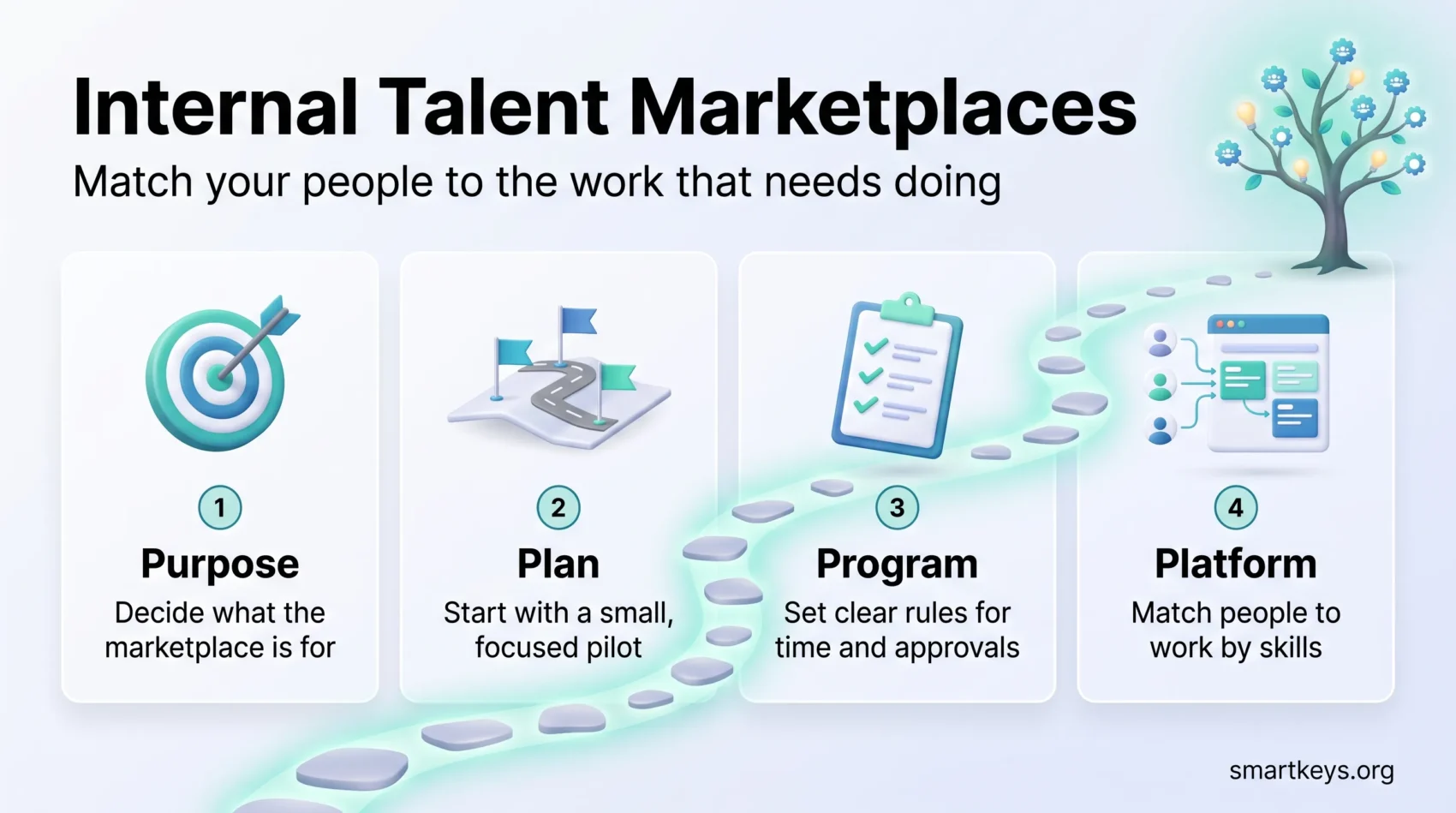
- Deloitte’s four Ps (Purpose, Plan, Program, Platform) remain a workable route from pilot to full rollout.
- From 2026, AI used in employment decisions carries notice, documentation and non-discrimination duties in several US states.
What an internal talent marketplace is
A marketplace is a single place inside your company where employees keep a skills profile and see work they could take on. A skills profile is a structured record of what someone can do: technical skills, languages, tools, past projects, certifications and the kind of work they want next. It is deliberately not a CV, because a CV describes jobs held rather than capabilities held.
Software then compares those profiles against openings and suggests matches in both directions. Employees see opportunities they would never have heard about. Managers see people they would never have thought to ask.
What it covers beyond open jobs
The scope is wider than recruitment. A well-built marketplace lists full-time roles, short projects, part-time gigs, mentoring pairs, rotations into other teams, volunteer work and training courses in one searchable place.
That breadth is the point. Most career growth does not happen through promotions. It happens through work that stretches someone slightly beyond what they have done before. Our guide to the career lattice and lateral career moves explains why sideways steps often build more capability than upward ones.
How it differs from an internal job board
An internal job board lists vacancies. Someone reads the list, decides whether they qualify and applies. Everything depends on the employee noticing the posting and on a recruiter reading the application.
A marketplace works the other way round. It starts from skills and pushes suggestions to people. Three differences matter in practice:
- It surfaces work you would not search for. Recommendations reach people who had no idea the opening existed.
- It handles small units of work. A job board cannot advertise a 30-hour project. A marketplace can.
- It applies the same criteria to everyone. Consistent matching reduces the advantage held by people with the best internal networks.
Where it sits in your systems
A marketplace is not a standalone island. It needs to read from and write to the systems you already run: the HCM, meaning the core HR system that holds employee records; the ATS, or applicant tracking system, which manages job applications; and your learning platform.
Without those connections, profiles go stale within months and people stop trusting the matches. If your company already runs an employee experience platform, the marketplace often sits alongside it and shares the same identity and profile data.
Why companies are building them now
Three pressures push in the same direction: skills change faster than hiring cycles, external hiring is expensive, and employees expect visible options.
Skills change faster than job architectures
Job titles are updated every few years. The skills behind them shift continuously. A marketplace tracks capability at the level that actually changes, which lets you spot gaps before they become hiring emergencies. A structured digital skills gap analysis is the usual first step, and the marketplace keeps that picture current afterwards.
Internal hiring is cheaper and faster
Filling a role internally removes the advertising spend, the agency fee and most of the ramp-up time. The person already understands your products, systems and customers. The Conference Board notes that marketplaces can free up thousands of working hours a year across a large organization.
Unilever is the most documented case. Deloitte reported that the company’s FLEX Experiences platform moved more than 8,000 employees and 300,000 hours of work during the pandemic, when demand shifted between business units almost overnight. That research dates from 2020, so treat it as evidence that rapid redeployment is possible at scale rather than as a current benchmark.
Career paths are a retention issue
LinkedIn’s 2025 Workplace Learning Report found that 44% of organizations run an internal mobility program, and that 88% are concerned about retention. The same report found that only 15% of employees said their manager had helped them build a career plan, down five percentage points from the previous year.
That gap is the opening a marketplace fills. It does not replace a manager conversation, but it means an employee is not dependent on one to see what is available. For the wider picture, see our overview of talent retention strategies for 2026.
How the matching actually works
Strip away the vendor language and the mechanism has four parts.
Profiles become structured data
Employees enter skills, past projects, interests and goals. Good platforms also infer skills from work history, completed courses and project records, then ask the person to confirm or correct them. Inference without confirmation is where accuracy problems start.
A skills graph connects the dots
A skills graph is a map of which skills exist in the company and how they relate. It records, for example, that someone who knows SQL is closer to learning Python than someone who has never written a query. That adjacency is what lets the system suggest a stretch assignment rather than only an exact match.
Openings get ranked, not just listed
Managers post roles, projects or gigs with the skills required and the hours involved. The system ranks candidates and shows why each one appeared. Ranking is useful only if the reasoning is visible, which is covered below.
Work gets broken into pieces
Fractional work means splitting a role into separate tasks that different people can pick up alongside their main job. A six-month analyst vacancy might become three 40-hour projects. Each one is low risk for the employee and quick to staff for the manager. It is the same logic that makes job sharing workable, applied to projects instead of roles.
What a marketplace needs to work
A shared skills language
Every role, course and project has to describe skills the same way. If one team writes “data analysis” and another writes “analytics,” matching quietly fails.
The fix is a taxonomy: an agreed list of skill names, each with defined proficiency levels. Most companies start from a vendor’s library and edit it rather than writing one from scratch. Managers should validate levels for their own teams, because self-assessment alone drifts.
Matching that people can question
Employees will accept being ranked below someone else. They will not accept being ranked below someone else for no visible reason.
So the system needs three things: an explanation of why each match appeared, a route for correcting a profile, and a human decision at the end. Regular checks on who gets suggested and who gets selected matter too. The same failure modes that affect recruitment tools apply here, and our guide to AI hiring bias and algorithmic fairness covers how they show up and how to test for them.
Analytics that answer a real question
Dashboards are easy to build and easy to ignore. Useful ones answer specific questions: which skills are in short supply next quarter, which teams post gigs and which only consume them, and whether people who take internal projects stay longer than those who do not. Tools for predictive analytics in employee management can extend that view, though the forecast is only as good as the underlying profile data.
Three use cases that prove value fast
Start with work that is genuinely useful, short enough to finish inside a pilot and visible enough that people hear about it.
Internal gigs and stretch assignments
Post short projects that need 10 to 20 percent of someone’s week for a fixed period. A marketing analyst joins a pricing review. A support lead helps write onboarding documentation. The employee gains experience without changing job, and the manager staffs the work in days.
Mentoring and coaching
Skills-based matching works well for pairing people, because the criteria are concrete: the mentee wants a specific capability, the mentor has it. Mentorship matching platforms already do this as a standalone product, and a marketplace can run the same logic against a larger pool.
Cross-functional rotations
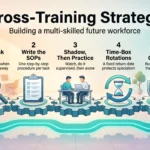
Rotations move someone into another team for a defined period, usually three to six months. They are the slowest of the three to show results and the most valuable, because they build the internal understanding that makes people effective in senior roles later. A cross-training strategy gives rotations a structure rather than leaving them ad hoc.
Designing the program: Deloitte’s four Ps
Deloitte’s 2020 research on internal talent marketplaces set out a four-part design approach that vendors and HR teams still use. It is a sequence, not a checklist.
Purpose
Decide what the marketplace is for before choosing software. Deloitte found that 58% of the organizations it interviewed framed the purpose around deployment, meaning getting people to work that needs doing. About half used the language of mobility and careers. Roughly a quarter described something broader: breaking down silos and widening access to opportunity.
Those are different goals and they lead to different designs. Pick one as primary and write down the measures that go with it.
Plan
Run a minimum viable pilot rather than a full launch. Map what an employee and a manager each have to do, find the friction, fix it, then widen the scope by team or function.
Program
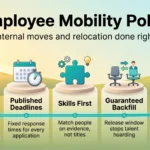
This is the rulebook: who is eligible, how much time someone may commit, who approves it, what happens to their existing work, and how a manager’s release of a person is recognized. Skipping this step is the most common reason pilots stall. A marketplace without mobility rules collides with every existing policy, which is why it should be read alongside your employee mobility policy.
Platform
Choose the technology last, once the first three answers exist. Judge vendors on integration quality, the transparency of their matching, security and the ability to export your own skills data if you leave.
Managers decide whether this works
The hardest part of a marketplace is not technical. Deloitte found that 46% of managers resist internal mobility, and the reason is rational rather than obstructive: a manager who releases a good person loses capacity and may wait months for a replacement.
Four things reduce that resistance:
- Backfill commitments. Agree in advance how quickly a released role or gig gets covered.
- Time caps. Limit gig commitments, commonly to one day a week, so core work is protected.
- Recognition that counts. If developing and releasing people never appears in a manager’s review, it will not happen. Continuous performance management makes that easier to reflect than an annual cycle does.
- Playbooks. Give managers a template for splitting a role into well-scoped projects with clear outcomes and hours.
Treat manager adoption as the metric that predicts everything else. If managers are not posting work, employees see an empty marketplace and stop returning.
The rules that now apply to AI matching
A marketplace that ranks people for assignments, training or promotion is making employment decisions. Several jurisdictions now regulate that directly.
United States
Illinois HB 3773 took effect on 1 January 2026. It bars discriminatory use of AI in employment decisions and requires employers to notify workers when AI is used. The scope is broad: recruitment, hiring, promotion, selection for training or apprenticeship, discipline, discharge and the terms and conditions of employment. A marketplace that recommends who gets a development project sits inside that definition.
Colorado’s AI Act, which adds impact assessments and disclosure duties for high-risk systems, was postponed to 30 June 2026. In California, regulations under the Fair Employment and Housing Act took effect on 1 October 2025. They confirm that existing discrimination law applies to automated decision systems and require employers to keep automated decision data for four years rather than two.
European Union
The EU AI Act classes AI used in employment and worker management, including systems that allocate tasks or evaluate people, as high risk. Under the Digital Omnibus agreement reached in 2026, obligations for these standalone high-risk systems were deferred to 2 December 2027. The duties were postponed, not removed.
What this means in practice
Keep three records from day one: what the system recommended, what a human decided, and what the employee was told. Our guides to AI hiring tools and what the law requires, data privacy rules for employee data and AI ethics in the workplace go further into each of these obligations.
Running a pilot
A useful pilot is narrow, time-boxed and measured. Ninety days in one business unit with an executive sponsor beats a company-wide launch with no owner.
Scope and metrics
Pick a unit with a real staffing problem. Set two or three measures before you start: time to staff a project, hours redeployed, and the share of posted gigs that get filled. Add a simple satisfaction question for both employees and managers.
Integrations and data
Sync profiles, roles, learning completions and the org chart. Confirm before purchase that the vendor supports role-based access, encryption, audit logs and data export. Decide how long profile and matching data is retained, and document it. Employees are more willing to fill in a profile when they know who can see it.
Communication and training
Managers need a short session on posting work and releasing people. Employees need help writing a profile, because sparse profiles are the most common cause of poor matches in the first months. Treat the launch as a change project, not a software rollout, and apply the same discipline as any other change management strategy.
Measuring success
Keep the scorecard short enough that leaders read it.
- Adoption: profile completeness, active users, gigs posted, applications per posting.
- Speed: time from posting a project to someone starting it.
- Mobility: internal fill rate and the number of people who moved role or team.
- Capability: proficiency changes and completed learning that is tied to actual work.
- Retention: turnover among marketplace users compared with a similar group who did not use it.
- Access: who sees opportunities and who wins them, broken down by team, level and location.
Comparing users with non-users is not a controlled experiment, since motivated people join first. Say so when you present the numbers rather than claiming more than the data supports. If you need a defensible model for the learning side, our guide to measuring upskilling ROI sets out how to build one.
Conclusion
An internal talent marketplace is a matching engine wrapped in a set of rules about who may move, how far and how often. The software is the easy part. The rules and the manager behaviour decide whether anything actually happens.
Start narrow. Pick one business unit with a staffing problem, run internal gigs for a quarter, publish the results honestly and expand from there. Keep the skills taxonomy small enough to maintain, keep a human in every decision, and keep records of what the system recommended and who acted on it.
Do that and the marketplace becomes what it is supposed to be: the fastest route between work that needs doing and people who could do it. For the wider context on which capabilities are worth building, see our overview of the skills most in demand in 2026 and our guide to upskilling and reskilling.
Found this useful?
Make SmartKeys a preferred source on Google, and our articles will surface more often in your Top Stories, AI Overviews, and AI Mode.
Add as Preferred Source