Tools
Tools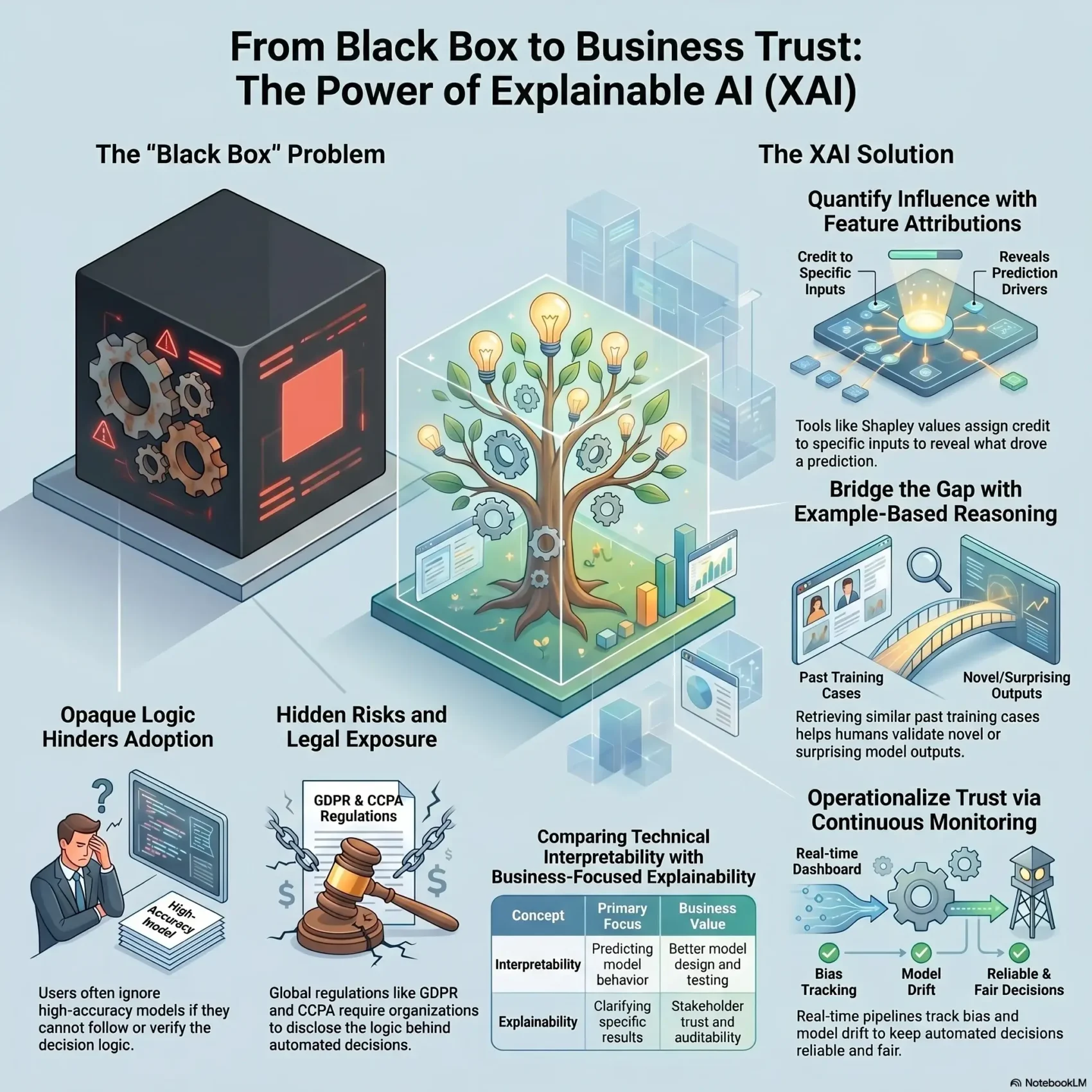
Last Updated on June 2, 2026
Your organization needs clear answers when systems make choices that affect customers, operations, and risk. This guide shows how transparent artificial intelligence can turn a mysterious model into a tool your team trusts and uses.
Black box models often deliver accurate results but fail when people cannot follow the logic. You will learn why trust and transparency matter more than raw scores, and how clarity boosts adoption across functions.
We’ll map practical steps so you can move from opaque systems to accountable workflows. Expect clear guidance on aligning models with governance, validating outputs, and keeping your machine-driven process reliable in production.
Key Takeaways
- Transparent systems build stakeholder trust and speed adoption.
- Accuracy alone won’t help if users can’t trust model results.
- Explainability improves auditability and reduces compliance risk.
- Simple tools and practices can reveal what’s inside your models.
- Clear processes link explainability to better business decisions.
What Is Explainable AI and Why You Need It to Trust Your Models
Trust in automated decisions starts with knowing how your models make choices. When a system gives an output that affects customers or operations, you must understand why it did so. That clarity turns a black box into a manageable process you can verify and govern.
From “black box” to clarity: understanding model decisions and outputs
Some machine learning models produce accurate results but offer little insight into their logic. You get an output, but not the reasons behind it. Explanations reveal which inputs and data influenced a decision so you can test accuracy and spot errors.
Interpretability vs. explainability: how you predict versus how you explain
Interpretability is about whether you can predict a model’s behavior. Explainability goes further: it shows how the model reached a specific result. Both matter — one helps design models, the other helps you verify and communicate results to stakeholders.
Trust, transparency, and accountability in your systems
Clear processes and meaningful explanations support audits, reduce risk, and improve adoption across teams. Neural networks and complex models especially benefit from targeted XAI tools that translate technical behavior into business-friendly insights.
- Auditability: You can trace decisions to data and features.
- Governance: Explanations support policies and documentation.
- Adoption: Users accept systems they understand.
For practical guidance on using these concepts in business workflows, review this resource on integrating intelligent systems into operations: AI in business.
Why Explainability Matters Now: Accuracy, Fairness, and Compliance in the Present
When people on the floor can’t follow how a model reached a result, adoption stalls even if the score looks great. You need clarity so teams accept outputs and act on them. Transparency reduces friction between a machine-based system and the workers who rely on it.
Business impact and adoption: when your users don’t trust the model
In one production case, a high-accuracy model saw low adoption because operators could not see why it made certain decisions.
Adding clear explanations raised trust and usage. Teams then used the model to guide work, which improved monitoring and response times.
“Visibility into model logic turned skepticism into engagement on the shop floor.”
Regulatory and ethical requirements in the U.S. and beyond
Today, rules matter. The EU’s GDPR asks for “meaningful information about the logic involved” in automated processing, and CCPA requires disclosure of inferences and the data used.
Meeting these requirements lowers legal risk and supports fairness by making it easier to find bias in data and fixes in models before harm occurs.
- Explainability increases accuracy in practice — oversight helped teams boost results and profits in industry reports.
- Clear explanations speed root cause analysis when a decision surprises users, cutting operational risk.
- Prioritize xai tools that document logic, track data lineage, and map decisions to governance needs.
Explainable AI Methods and Techniques You Can Use
You can use a small set of methods to show which features and examples matter most to a model.
Feature-based attributions
Feature attributions quantify how much each feature contributed to a model’s output. Shapley-value approaches assign proportional credit to features; sampled Shapley speeds this up for non-differentiable models.
Use aggregated attributions to spot bad data and to get reliable model insights quickly.
Example-based reasoning
Nearest-neighbor explanations retrieve similar training items to justify a prediction. These example methods help you find outliers and guide active learning by showing concrete cases.
Model-agnostic vs. model-specific
LIME builds local surrogate models to explain a prediction for any classifier. DeepLIFT traces neuron activations to a reference to give detailed contributions in deep networks.
Integrated gradients and XRAI
Integrated gradients follow a path from a baseline to the input and work well for differentiable models. XRAI builds on that to highlight image regions by segmenting and ranking salient areas.
Choosing the right technique
Match techniques to model types: use gradient-based methods for differentiable networks and sampled Shapley for non-differentiable setups. As a post step, corroborate multiple explanations and verify they match domain knowledge before you act.
Operationalizing Explainability: Monitoring, Risk, and Lifecycle Governance
A production-ready system pairs live monitoring with clear explanations to protect users and business outcomes. You need continuous checks that watch inputs, features, and outputs so bias and drift do not silently erode performance.
Detecting bias and model drift
Stand up pipelines that track data distributions and feature importance in real time. Alerts should flag shifts from training to production data and surface explanations for surprising predictions.
Model risk management and auditability
Document decisions and explanations so audits show why a model acted and what countermeasures ran. Build notification rules that trigger when risk or performance drops below your requirements.
Lifecycle automation and multicloud readiness
Automate retraining, evaluation, and post-deployment checks across hybrid systems. Use fairness scanners, drift detectors, and explanation reporting tools to keep transparency consistent as you scale.
- Continuous monitoring: catch bias early by tracking data and behavior.
- Audit trails: link explanations to decisions for regulators and teams.
- Multicloud patterns: deploy models with observability that travels with workloads.
For practical templates and operational assistants, see this guide on integrating operational assistants into your workflows.
Real-World Use Cases: Healthcare, Financial Services, and Criminal Justice
Across hospitals, lenders, and courts, seeing why a model acted changes how teams respond. Practical cases show how transparent logic turns a confusing output into actionable understanding.
Healthcare: diagnostics, image analysis, and patient-centered explanations
Clinicians gain clarity when models highlight which features influenced a diagnosis. Saliency maps make it clear which image regions drove a result.
This helps you validate models against medical expertise and support shared decision-making with patients.
Financial services: transparent credit decisions and fraud insights
In lending, clear reasoning reduces disputes and speeds approvals. Analysts can audit high-risk decisions and find actionable insights for underwriting and fraud teams.
Anti-bias controls paired with explanations help maintain fairness and meet regulatory checks.
Criminal justice: risk assessment, bias detection, and oversight
Courts and agencies use transparent systems to flag bias in training data and to defend decision paths. Clear explanations improve oversight and public confidence.
- Ground decisions in data and features you can defend.
- Use explanations to speed forensic and population analyses.
- Balance operational efficiency with accountability.
Tools and Platforms to Build Explainability Into Your ML Workflow
Pick tools that make model behavior visible so your team can act with confidence. Start with platforms that attach feature attributions and example context to each prediction. These outputs give you the credit each input received and a clear path to debug and improve models.
Vertex Explainable AI: attributions and example-based context
Vertex offers sampled Shapley, integrated gradients, and XRAI to quantify which features drove a prediction. These methods work across AutoML and custom models and reveal issues like reliance on artifacts in images.
Nearest-neighbor retrieval surfaces similar training examples so you can interpret novel data and flag anomalies. Use these examples to guide active review and improve your training set.
Governance solutions for fairness, drift, and compliance
Operational platforms combine fairness monitoring, drift alerts, and lifecycle reporting so you meet internal and external requirements. They bundle explanations with model logs for audit-ready reporting across hybrid and multicloud environments.
- Pick integrated methods to match your networks: integrated gradients for differentiable networks and sampled Shapley for non-differentiable ensembles.
- Visual tools chart feature influence on tabular data and saliency on images for fast triage.
- Embed explanations into review workflows so humans can triage, prioritize checks, and close the loop on model updates.
Conclusion
Close the loop: convert model signals into simple, actionable insights that your team can use every day.
Start with one high-impact model and enable explanations so reviewers can verify post-deployment behavior. Embed explanations into governance and your review processes to keep transparency and trust strong.
Explainability plus feature attributions and example-based context help you find root causes faster and improve results. Use tools and small pilots, then scale what works across models and business units.
Pick a model, turn on explanations, and run regular reviews. That single step moves artificial intelligence from a black box to a reliable partner in decision making.