Tools
Tools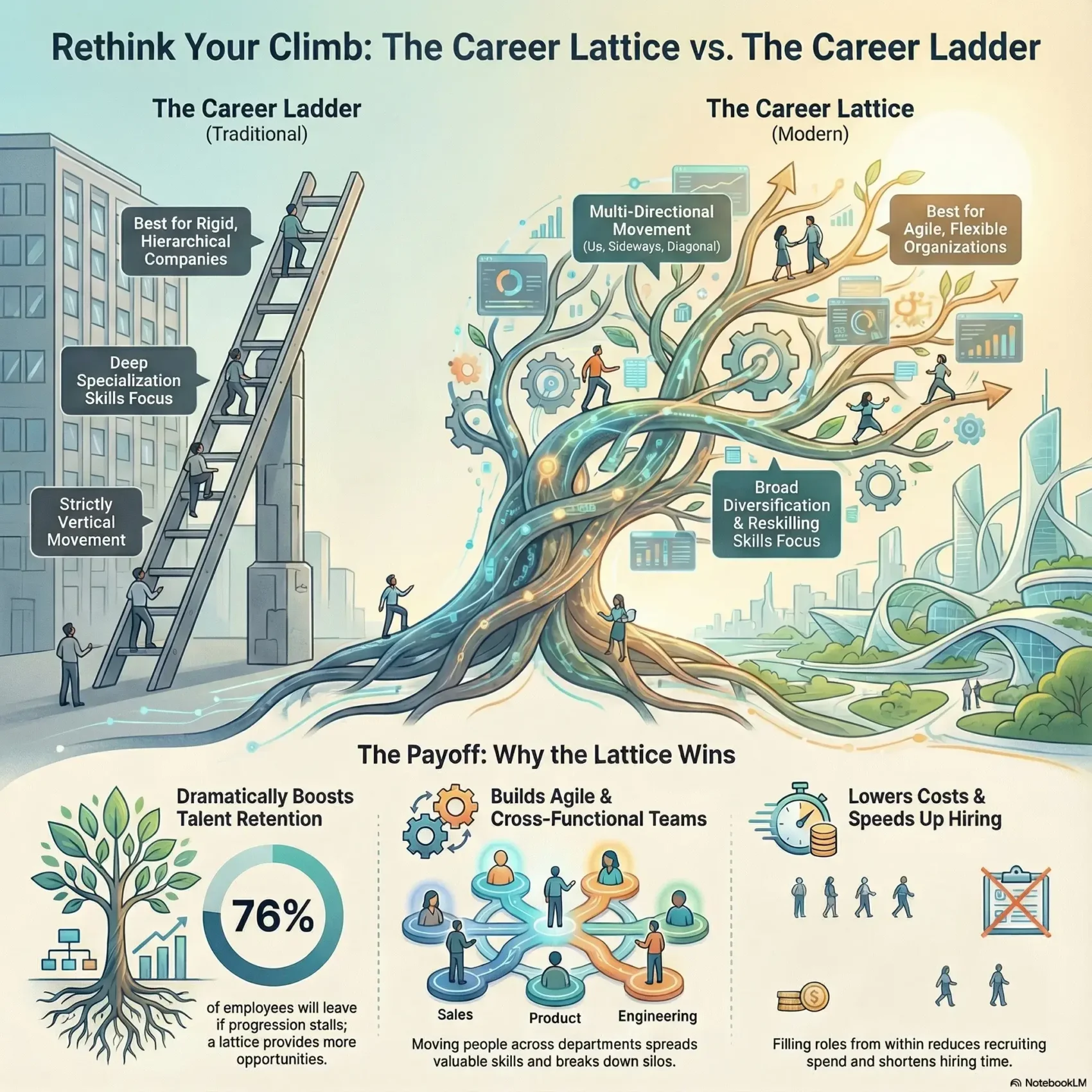
Last Updated on January 9, 2026
You are probably juggling plans, goals, and the everyday demands of work. This introduction shows why a lattice view can change how you think about progress and learning.
The lattice idea treats advancement as multidirectional—up, sideways, and diagonal—so you can map out options across teams and functions.
Data show this matters. Many employees say they’d leave if growth stalls, and most workers value ongoing learning. Companies like W.L. Gore, Buffer, Spotify, and Deloitte have made this model practical at scale.
This approach helps you explore new roles and skills inside your organization without forcing a single track. It also boosts retention, internal mobility, and faster upskilling for the whole company.
Key Takeaways
- The lattice reimagines progress as multidirectional, not just upward.
- Employees expect ongoing development and internal opportunities.
- Real companies have operationalized this model to keep people engaged.
- A lattice-style approach supports smarter talent deployment and retention.
- This guide will move from “why” to “how” so you can act quickly at your company.
Why the career lattice matters now in the United States
Rising job churn and a hunger for learning are rewriting how people expect to move at work.
Americans hold about 12 jobs by age 55, and nearly half of employees say they might change jobs this year. At the same time, 91% value ongoing learning. Those numbers mean you must make growth visible and doable within organization if you want to keep talent.
A rigid career ladder limits options and drives people out. When 33% who quit cite lack of advancement, internal mobility becomes a retention tool.
Give employees multidirectional opportunities and managers a role in guiding moves. That reduces time-to-fill, lowers recruiting costs, and builds pipelines across functions.
- Business impact: fewer open seats and faster hiring.
- People impact: stronger engagement and skill growth.
- Management benefit: shared knowledge and better succession.
Use these U.S.-specific signals to make a case for flexible progression. The rest of this guide gives tools and frameworks to act on this shift.
What is a career lattice? A 360-degree model for career progression
Imagine your path at work as a map with many routes: vertical, sideways, and diagonal. This model treats progression as a set of options across functions and teams.
Defining vertical, lateral, and diagonal moves
The career lattice model supports three move types. Vertical moves add seniority. Lateral moves deepen breadth across roles or departments. Diagonal moves mix skill-building and new responsibilities.
“Diagonal growth builds a well-rounded understanding of the company,” says Jessica Lim.
How this differs from rigid job architectures
Traditional job maps focus on titles and a narrow promotion path. A lattice emphasizes skills, outcomes, and mobility. It allows employees to try new roles without leaving.
- Employees gain cross-functional experience.
- Managers and HR match skills to projects in real time.
- The approach supports flexible progression that fits life stages and goals within organization.
Career ladder vs. career lattice: key differences that shape your path
Which model you pick shapes how you move, learn, and get noticed at work. A traditional career ladder points up inside a single function. It rewards deep specialization and steady title changes.
By contrast, the career lattice supports multidirectional moves across departments. That opens more paths and faster skill variety.
Direction of movement and internal mobility across departments
The ladder mostly promotes vertical moves. You climb within one team and gain depth.
The lattice model lets you move sideways, diagonal, or up. You can take roles in other groups and build cross-functional credibility.
Skills development: specialization versus diversification, reskilling, and upskilling
Ladders reward deep expertise and long-term specialization.
A lattice rewards breadth: reskilling and upskilling for new roles. That makes your skillset more portable and resilient.
Best-fit environments: hierarchical ladder models vs. flexible organizations
Rigid firms with clear reporting lines often fit a ladder approach.
Flatter, agile companies benefit from a lattice that offers gigs, job swaps, and dual tracks for makers and managers — examples you see at Buffer, Spotify, and Deloitte.
- Trade-off: depth versus breadth.
- For employees: choose the path that matches your goals — deep expertise, broader scope, or management.
- Decision lens: if growth stalls on a ladder, a lattice-style move can unlock new progression.
Business and employee benefits of the career lattice model
Giving employees room to switch roles and learn saves money and sparks new ideas. That simple shift affects retention, costs, and how fast your teams can respond to needs.
Retention and recruiting savings through internal mobility
When 76% of people say they’ll leave if progression stalls, you can see why internal moves matter. Filling roles from inside cuts recruiting spend and shortens time-to-fill.
Upskilling and reskilling lower hiring costs because employees already know your systems and culture. Leaders report real retention gains after adopting mobility practices.
Skills transfer, cross-functional collaboration, and knowledge sharing
Moving people across departments spreads skills and fresh perspectives. Cross-functional projects speed innovation as employees apply diverse experience in new roles.
Knowledge sharing also reduces silos and helps teams solve problems faster.
Personalized paths for different life stages and ambitions
Offer paths that fit everyday realities: a lateral stretch, a diagonal shift, or a role with different hours. Personalized development keeps employees learning and less likely to look elsewhere.
Building agile, well-rounded teams
A mobility model helps you build adaptable teams that match business needs. Managers who hold regular career conversations and show visible opportunities keep talent engaged.
“We kept top people by enabling moves instead of hoarding talent,” says Hosea Chang.
- Quick wins: lower costs, faster hiring, stronger pipelines.
- People wins: more learning, clearer growth, higher retention.
- Business wins: agile teams that meet changing company needs.
Common challenges with a lattice approach—and how you overcome them
Many organizations hit the same roadblocks when they try to make multidirectional moves routine. Fixing those problems turns the idea into daily practice.
Talent hoarding and misaligned incentives
Talent hoarding happens when managers guard people to protect short-term delivery. That raises turnover and blocks internal mobility.
Set internal hiring targets and reward managers for development outcomes. That aligns management with moves that build bench strength.
Poor visibility into opportunities
When portals list only open jobs, gigs and short projects stay hidden. Expand listings to include secondments and microprojects so employees can find options fast.
Unclear roles and weak career data
Ambiguous job architecture confuses success signals. Document roles, levels, and compensation clearly.
Use platforms that centralize reviews, goals, and skills so employees gain self-insight and managers coach smarter moves.
- Normalize movement with governance and fair processes.
- Modernize success metrics to include autonomy and meaning.
- Provide templates and tools so managers support, not block, growth.
How to adopt a career lattice approach within your organization
Start by linking the mobility plan to measurable business goals so leaders see clear ROI. Frame the approach around retention, faster time-to-fill, and productivity gains. That makes it easier to secure executive support and funding.
Secure executive buy-in and align strategy
Show short, tangible wins: internal hires filled faster, reduced recruiting spend, and higher engagement. Use a pilot with one division and track results.
Map skills to work
Build a shared skills taxonomy and model job architecture so you can match people to feasible next roles. Collect skills data from assessments and performance records.
Create visibility and match talent
Launch an internal careers site and a talent marketplace. Tools like Gloat or Skyhive scale matching across projects and roles, improving opportunity discovery.
Enable employees and support managers
Offer mentorship, job swaps, short gigs, and data-driven coaching to make moves low-risk and structured. Give managers simple playbooks for career conversations.
Set governance and measure momentum
Define internal hiring targets, fair selection rules, and SLAs so mobility becomes routine. Track mobility, retention, and time-to-fill and publish success stories to show what works.
“We improved access to gigs and internal roles by pairing skills data with a talent marketplace,”
Career lattice examples you can learn from
You can borrow tested tactics from high-performing firms to build your own mobility playbook. These examples show how clear roles, simple rules, and visible paths lower friction for employees who want new moves.
Buffer: dual tracks for makers and managers
Buffer separates Makers (ICs) and Managers with clear levels and steps. That lets people advance without being forced into management.
Takeaway: define level-based expectations so a role progression feels fair and measurable.
Spotify: gigs, job swaps, and career mapping
Spotify runs short gigs, swaps, and a dedicated internal job board plus coaching and Career Week. Those options help employees test new roles and build transferable skills.
Deloitte: mass customization across departments
Deloitte’s approach scales lateral and diagonal moves across departments. It ties skills data to personalized paths so organizations keep momentum while employees grow.
- Make opportunities visible within organization and easy to apply for.
- Document skills and role families so recommendations feel fair.
- Start small: pilot mentorship, step-based recognition, or an internal gig listing.
For more on skills and trends that support internal mobility, read the upskilling trends guide.
Career lattice playbook: practical steps, tools, and metrics
Start by assembling a simple toolkit that turns mobility ideas into daily actions across teams. Use platforms and dashboards to match people to roles and visualize adjacent skill gaps. That makes movement feel practical and low risk.
Design your internal mobility toolkit: platforms, dashboards, and analytics
Pick a talent marketplace like Gloat or Skyhive to surface opportunities and map skills to jobs. Build dashboards that show available paths, adjacent skills, and learning steps.
Visual maps help employees see where they can move and what to learn next.
Measure what matters: retention, internal moves, skills growth, and time-to-fill
Track four core metrics: retention, number of internal moves, measured skills growth, and time-to-fill for key roles. Tie results to ROI—faster fills and lower hiring spend.
Use the APA insight that 91% value learning and the fact that 33% leave due to stalled progression to prioritize these measures.
Share success stories to normalize lateral and diagonal moves
Publish short, data-backed stories that show real moves, outcomes, and learning paths. Use manager coaching and nudges in calendars and 1:1s to promote openings.
Run quarterly reviews to refine your model and keep momentum across the organization.
Conclusion
Flexible development paths let people build skills that power both individual growth and business results. This model helps your organization retain talent, boost engagement, and adapt faster than a rigid ladder. It makes progress visible and gives teams the flexibility they need.
Action steps: secure executive sponsorship, map skills, make openings visible, and track mobility and retention. Start with small pilots—mentorships, short gigs, and clearer role maps—to prove value quickly.
Use data and real examples from Buffer, Spotify, and Deloitte to win buy-in. For practical trends and learning ideas, see our upskilling trends guide.
When you support movement, employees keep learning and contributing. That strengthens performance, culture, and long-term growth for your company.