Tools
Tools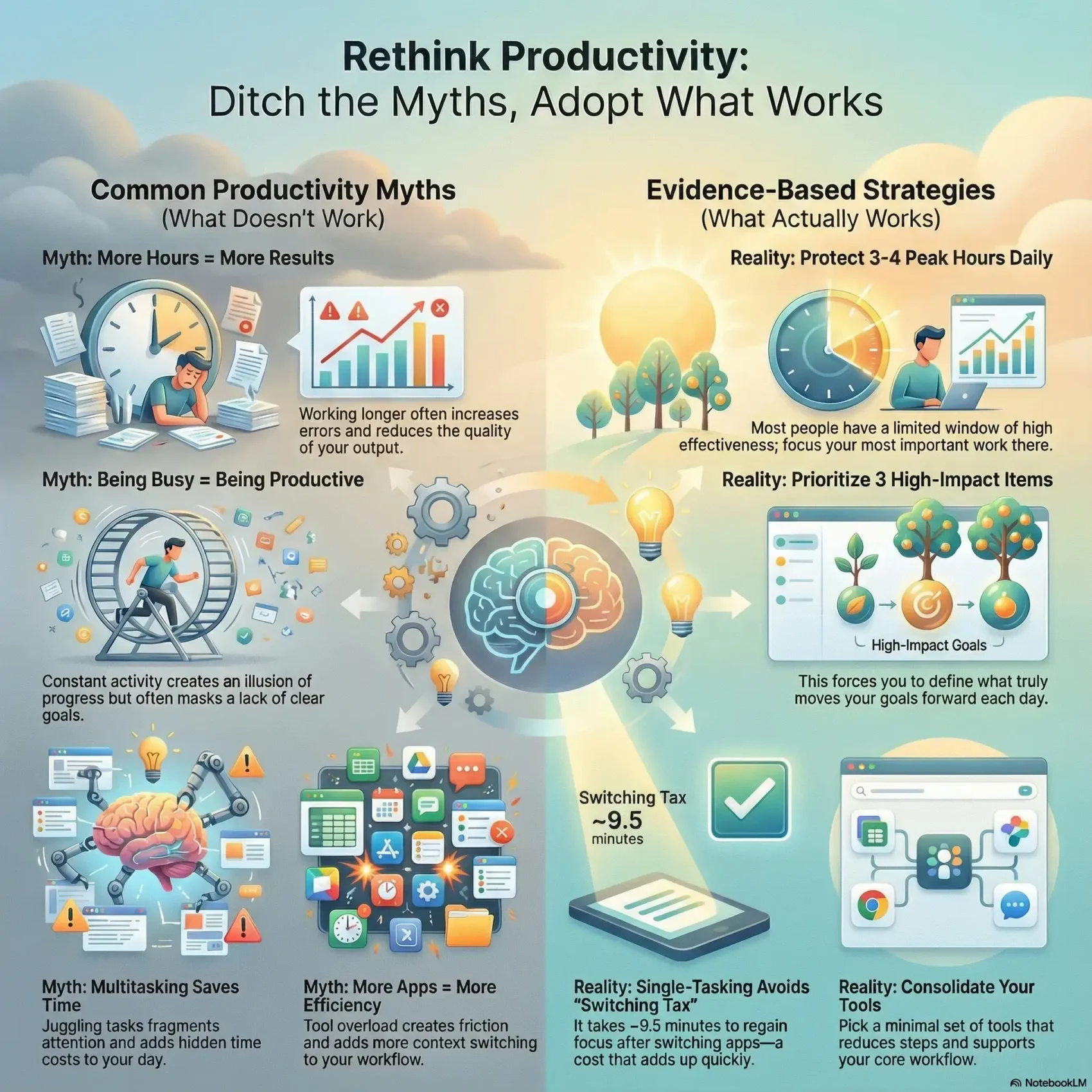
Last Updated on December 26, 2025
A wave of “how to be productive” articles promise quick fixes, yet many tips sound good and fail when you try them. Habits take time to build, and some advice can actually derail your focus.
Putting famous people on a pedestal can backfire. Even Benjamin Franklin struggled to follow a rigid timetable. Idolizing one person’s routine ignores your context, goals, and the tasks you face each day.
Research shows most people have only 3–4 highly effective hours per day. The smarter way is to protect your peak windows, concentrate effort, then disconnect and sleep enough.
This article will sort the noise from the signal. You’ll see persistent myths paired with facts and simple “try this” steps so you can shape a sustainable way to work that fits your life.
Key Takeaways
- Many articles sell quick fixes; habits need time and testing.
- Don’t copy a famous person’s routine without adapting it to your context.
- Focus on peak hours—quality beats sheer hours.
- Expect clear facts and practical steps paired with each myth.
- Prioritize tasks that move your goals forward, not flashy ideas.
Why these productivity myths persist today—and what you actually need
Many tips survive because they promise a single, neat routine that ignores how varied your day and energy really are.
Survivorship bias makes success stories loud. People spotlight outliers, so a rare habit looks universal. Even Benjamin Franklin struggled to keep a strict timetable.
Simple slogans compress complex research into catchy lines. That feels helpful, but it often strips away the nuance about your rhythms, environment, and habits.
You need attention management as much as time management. Focus on fewer, high-impact priorities instead of cramming more hours into your day.
- Test ideas against your schedule and energy, not a headline.
- Ask: does this lower friction or just add more information to manage?
- Pick a few priorities you can finish to build momentum.
“A repeatable, simple plan beats a flashy routine you can’t sustain.”
Bottom line: use research as a starting point, experiment, and favor rules that support your life and real work.
More hours mean more results? Rethinking time management and sustainable productivity
Long days on the clock don’t guarantee better results—your brain has limits.
Myth: Longer workdays boost output.
Fact: research shows people deliver most high-value work in a few focused hours. After that, errors rise and quality drops. A common example: a developer who codes twelve hours often creates buggy work that needs rework, canceling any gains.
Try this: protect 1–2 deep blocks for important tasks in your morning or afternoon peak. Use time blocking and short breaks to reset attention.
- Schedule energy-based blocks so hard tasks land in your best hours.
- Use a 60–90 minute focus window, then step away to avoid mistakes.
- Close the day with a quick review to prevent spillover and support recovery.
“Work less by design; ship more by focus.”
Shift from raw hours to attention management. This keeps your work sustainable and helps habits that support consistent, high-quality output.
Busy versus productive: How to set priorities and stop chasing every task
Being busy often feels like progress, but it usually masks a scattered day. You can protect meaningful work by deciding what truly counts before you dive into emails and meetings.
Myth: Being busy equals being effective
Busy-ness creates an illusion of progress. People confuse motion with impact when goals are vague. A swollen to-do list often hides unclear outcomes and fuels a bias for action, as Tony Crabbe warns.
Fact: Clear goals beat a bloated to-do list
Define what productive work looks like. Dan Sullivan’s idea of three important items per day forces you to set priorities and finish what moves your goals forward.
Try this: Three-impact-items per day and scheduling deep work
Start each morning with a short intention: pick one to three items that matter. Block a deep-work window and protect a one-hour electronic blackout, a tactic recommended by Thomas J. DeLong, to reduce multitasking and reactive switching.
- Set priorities by mapping daily items to weekly goals.
- Use a firm “thoughtful yes” or a ready “no” for requests that don’t align with those priorities.
- Batch small tasks after you ship one major outcome to keep focus high and decision fatigue low.
“You’ll trade overwhelm for clarity by designing your day around fewer, bigger moves.”
Multitasking, context switching, and why your brain hates it
Every time you flip between apps or duties, you pay a hidden time toll. Context switching creates cognitive overhead that quietly lengthens your day and wrecks your focus.
Myth: Doing many things at once saves time.
Fact: Context switching increases errors and hours
Research shows software people take roughly 9.5 minutes to regain a good workflow after switching apps. Those minutes add up fast across a project or a busy day.
- Hidden switching tax: multitasking fragments attention and forces your brain to reorient on each new task.
- Higher error cost: juggling work raises mistakes, which often require more time to fix than you think.
- Simple structure to try: plan your day the night before, then sequence single-task blocks—outline → draft → revise—so you stay in one mode until completion.
- Practical rules: turn off nonessential notifications, cluster similar tasks, and use checklists for repeated steps.
“Protecting a single focus window beats constant switching every time.”
Productivity apps, inbox zero, and the trap of optimizing the wrong things
Chasing the perfect stack of apps can turn strategy time into setup time. You add tools to fix friction and end up reconciling several sources of truth. That multiplies context switching and eats your best hours.
Fact: Tool fatigue and ornate filing systems rarely move big goals. IBM researchers found that people who use folders don’t retrieve email faster than those who search. Dan Ariely also observed that ticking many small items encourages quantity over impact.
Try this
First, set priorities offline. Clarify outcomes on paper, then open a minimal set of tools to execute. Consolidate apps to reduce reconciliation work and lower the learning curve.
- Pick tools that support task capture, calendar sync, and simple collaboration.
- Limit elaborate filing—use consistent tags and search-friendly names.
- Use time tracking as an example of learning, not punishment: spot patterns and adjust.
“Measure success by shipped outcomes, not by the number of apps you connect.”
Want a quick place to start? Try one curated list of productivity apps and remove any tool that doesn’t shave time from real work. You’ll reduce noise and protect your focus for project-critical things.
Intrinsic motivation beats external reward for long-term progress
When the work itself hooks you, you keep going through slow stretches. That kind of drive matters more than prizes or titles for steady growth.
Myth: External reward drives consistent performance.
Fact: Intrinsic motivation sustains habits and mastery
Research supports this. A 2013 study of about 3,500 German schoolchildren found interest and mastery predicted better long-term outcomes than chasing grades. Introducing an external reward can crowd out inner drive, a phenomenon called motivational crowding.
Try this: Focus on the verb, not the noun; process over outcomes
Shift your focus to daily action—write, code, design—rather than titles or perks. Time-block a small, repeatable habit, such as 50 minutes of words five days a week. That simple pattern trains your identity: “I do the work.”
- You’ll trade chasing perks for built-in drive that carries you through the hard middle.
- You’ll measure success by consistent action, not only by distant goals.
- You’ll pair brief reflection with the next step so motivation stays fresh and tied to real progress.
“Focus on doing the work; the rest follows with time and steady practice.”
Willpower isn’t a tank: Beliefs, habits, and culture shape your self-control
Your self-control shifts based on context, culture, and what you tell yourself. That simple change in view makes a big difference in how you plan your day and work.
Myth: You just run out of willpower every day
It feels like willpower drains like a battery. But that idea comes from old readings of ego depletion that recent research has struggled to replicate.
Culture and belief matter. A cross-country study showed people in India and the U.S. differ in persistence. And those who believe willpower is unlimited show fewer depletion effects.
Fact: Motivation, beliefs, and context shift your capacity
Willpower is variable and trainable. Small habits change the starting line for each task. Morning routines like Julia Cameron’s morning pages make action automatic.
Self-affirmation also helps. A 2009 study found it can boost self-control under stress. Rest and play reset attention so you have more sustainable focus over time.
Try this: Small habits, self-affirmation, and realistic rest
- Build tiny, repeatable habits to reduce reliance on will in the moment.
- Use brief self-affirmation before hard tasks to buffer stress.
- Design cues—launched documents, laid-out clothes—to lower start friction.
- Schedule short breaks and clear shutdowns so recovery becomes part of life.
“Change what you believe about self-control and you change how you perform.”
Measure success by weekly habit consistency, not one perfect day. Over time this rewires how you approach time, motivation, and lasting work.
Visualization alone won’t save the day: From fantasy to action
Imagining a perfect outcome feels good, but it often replaces the work that actually gets you there. Positive fantasies about idealized futures can sap energy and make setbacks hit harder than they should.
Myth: Positive visualization guarantees success
Just picturing success can make you feel accomplished without doing the hard steps. That feeling reduces the drive to take real action.
Fact: Critical visualization prepares you for obstacles
Use visualization as rehearsal, not reward. Anticipate likely blockers and map if‑then moves so your image becomes a plan.
- You’ll swap feel-good fantasies for a practice that triggers concrete action.
- Follow research that shows idealized imagery can lower the energy to act and raise risk of sharper disappointment.
- Practice critical visualization: list blockers, set trigger actions, and map backup paths for your goals.
- Translate images into steps and timelines so the idea lands in your calendar, not only in your head.
- Plan for partial wins and quick reviews to turn feedback into forward motion instead of letting one failure stall you.
“Treat visualization as rehearsal for resilience, not a guarantee of smooth sailing.”
Your brain is not a perfect hard drive: Notes, lists, and information hygiene
Your head isn’t a reliable filing cabinet; a few simple capture habits save you time and stress. When fatigue or interruptions hit, people overestimate memory and drop commitments.
Myth: You can keep it all in your head
It feels tidy to rely on memory, but that approach creates failure points. Missed meetings and forgotten decisions often come from trusting short-term recall.
Fact: Documentation and daily reviews prevent failure points
Capture decisions and actions as they happen. Use a short notes-plus-list system, then run a quick review every day to assign tasks and archive what’s done.
- You’ll stop relying on memory by keeping a running to-do list and a decision log.
- Minimize filing—search often wins over folders—so you spend time acting, not organizing.
- Batch email processing and turn key threads into tasks to avoid re-reading messages.
- Write clear words: who, what, when, and the next step so future you can move fast.
- Close your notes app while you execute, then reopen for a focused review block.
“Simple capture plus a daily review beats trying to remember everything.”
Adopt these habits and you’ll free up mental space for the few things that matter. Better information hygiene improves your time use and keeps your day from slipping away. Use these steps to make your productivity stick.
You don’t need to be Type A, a micromanager, or a routine robot to be productive
Effective work comes from systems that fit your style, not from copying a single ‘ideal’ temperament. You can design simple structures that support your strengths and keep creativity alive.
Myth: Productivity is for Type A personalities
Fact: People of many temperaments deliver great outcomes. You don’t have to be rigid to get things done. Mindful approaches help introverts and extroverts alike.
Myth: Micromanaging every task ensures quality
Micromanagement often slows a project and raises burnout. Clear SOPs and delegated, strengths-based roles raise quality without constant oversight.
Myth: Rigid routines kill creativity
Rigid schedules can stifle ideas, but loose frameworks can boost them. A flexible routine gives you a reliable start and room for creative sprints.
Try this: Delegate strengths-based work and keep flexible routines
- Drop the one-size myth: design a system for how you like to work, not how you think you must work.
- Create simple SOPs so others handle tasks without your constant review.
- Build a routine with flexible edges—blocks to start and open slots for creative bursts.
- Swap harsh self-talk for supportive prompts that protect long-term habits and reduce anxiety.
- Protect short, focused time each day for deep work and quick reviews so small wins compound.
“Let structure serve your strength, not replace it.”
The essential listicle: Top productivity myths to ditch right now
You likely feel overwhelmed by tips that promise instant improvement but deliver little. This short list names common false beliefs and gives quick counters you can use today.
Myth: More hours, better results
Reality: Longer time often increases errors and lowers quality. Protect 1–2 focused blocks and measure output, not clock time.
Myth: Busy equals productive
Busy hides unclear goals. Pick three high-impact items per day so your tasks map to real progress.
Myth: Multitasking works
Switching costs you about 9.5 minutes to regain focus. Use single-task blocks to finish faster and with fewer mistakes.
Myth: More apps solve everything
Tool overload breeds friction. Consolidate apps and judge tools by how they cut steps, not how many features they add.
- Intrinsic beats extrinsic: rewards can crowd out long-term drive.
- Willpower is trainable: small habits and rest matter more than brute force.
- Document, don’t memorize: notes plus daily reviews stop things from slipping.
- Flexible routines win: delegate and use SOPs to scale without burning out.
“Trade busy hours for clear items and focused work—that’s how you get real results.”
Conclusion
Sustainable change starts with a few reliable habits, not a long list of tactics. Align a couple of peak hours with your top goals and build tiny routines that you can keep every day. This is how you create real sustainable productivity without burning out.
Use plain time management: protect deep blocks in the morning or your best hours, keep productivity apps lean, and let intrinsic motivation lead while keeping external reward in perspective. Document key decisions so the work on a project moves forward and people stay aligned.
Focus on priorities, small habits, and simple management rules. Say no to noise, expect obstacles, and plan for quick fixes so a single failure doesn’t derail progress.
Measure success by shipped work and weekly learning, not hours logged. Choose the way that fits your life and keep refining it as you go.