Tools
Tools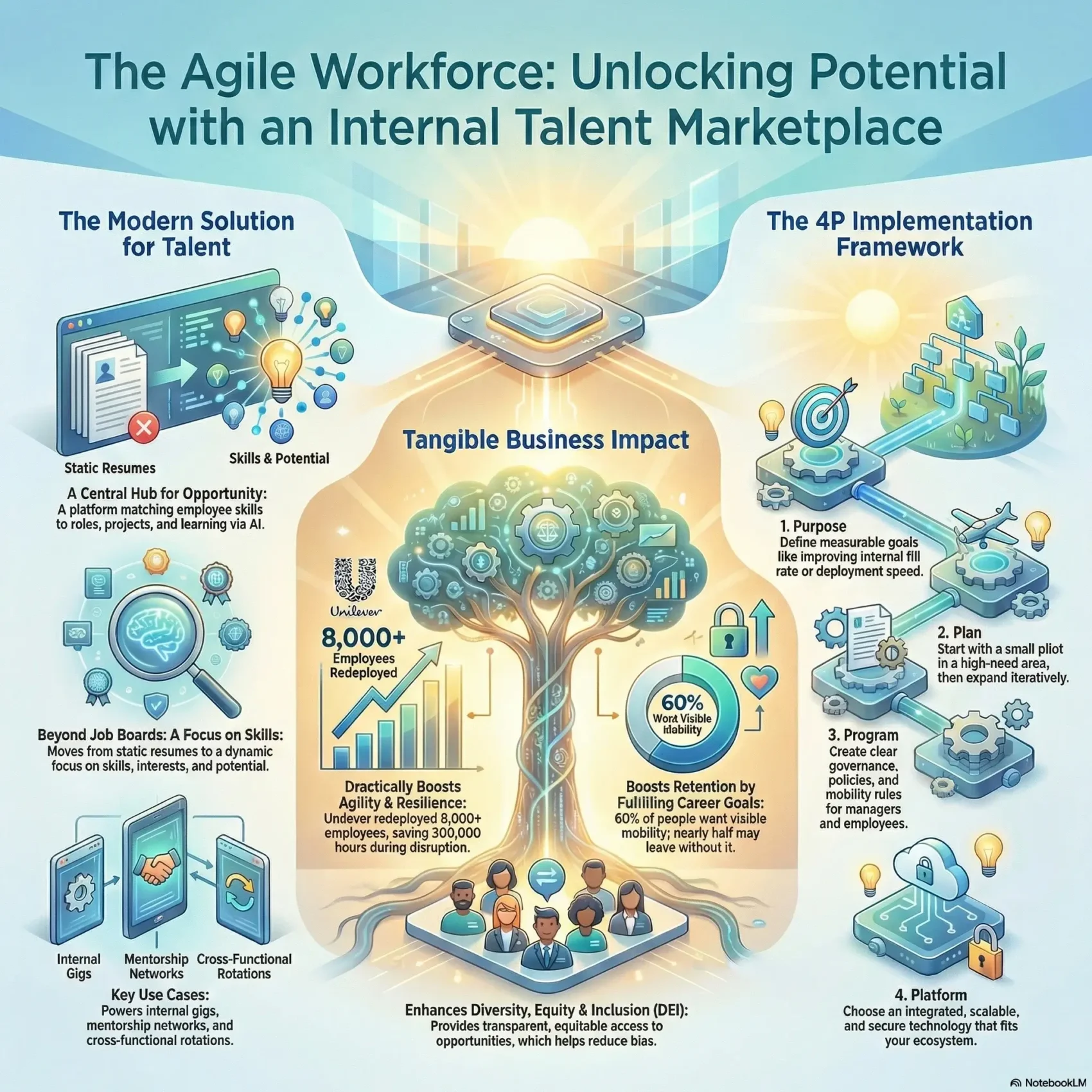
Last Updated on March 9, 2026
You’re about to get a clear, practical intro to how an internal talent marketplace can change the way your company finds and uses skills. This approach connects employees to gigs, projects, mentoring, and roles so work gets done faster and people grow.
Deloitte shows next‑gen platforms match people to full roles, gig work, rotations, and innovation experiences. Unilever’s FLEX Experiences redeployed over 8,000 employees and 300,000 hours during COVID‑19, proving fast redeployment boosts resilience and productivity.
You’ll see how the four Ps—Purpose, Plan, Program, Platform—help move from pilot to scale. Manager engagement is key: when leaders supply gigs, you avoid hoarding and unlock more opportunities for employees.
We’ll also show how a skills‑first approach gives better data and visibility, improves engagement, and supports career development. For practical examples and a crowdsourcing angle, explore crowdsourcing talent.
Key Takeaways
- What an internal talent marketplace does and why it matters to your business.
- How AI matches people to roles, projects, and learning in real time.
- Unilever’s FLEX case proves speed and scale during disruption.
- The four Ps guide a path from pilot to enterprise adoption.
- Manager buy‑in and skills data are critical to measurable benefits.
What is an internal talent marketplace?
Think of a single digital space where your workforce builds profiles and gets matched to work and learning opportunities.
A concise definition: an internal talent marketplace is a company platform where employees create skills-based profiles and AI matches them to roles, short projects, mentorships, rotations, and learning aligned to business needs.
Clear definition and scope inside your organization
The scope goes beyond jobs. This hub centralizes full-time roles, short-term assignments, coaching networks, and curated learning so an employee can navigate a career inside your company.
It aggregates job postings, project openings, training, and volunteer options in one searchable place. That visibility helps employees discover options they might not see through traditional channels.
How it differs from traditional management and job boards
Unlike static job boards or HR systems focused on requisitions and resumes, this model centers on skills, interests, and potential.
- Employees get personalized recommendations and clear paths for development.
- Managers find fast matches for project needs and can tap existing workforce skills.
- AI and skills graphs create objective, scalable matching that boosts internal mobility and fairness.
Where it sits in your tech stack: the platform integrates with HCM, ATS, and L&D systems so data stays synchronized and change is easier to manage.
Why you need this now: intent, outcomes, and business case
Rapid change means your workforce must shift roles and skills in days, not months. That urgency makes a clear business case: you need a system that connects people to the right work fast.
Aligning to agility, productivity, and growth in the present
Deloitte finds these platforms improve acquisition, mobility, and management, boosting performance and productivity. When demand shifts, you can redeploy staff quickly—Unilever moved 8,000+ employees and 300,000 hours with FLEX Experiences during COVID‑19.
That speed reduces time‑to‑staff, preserves institutional knowledge, and lowers hiring costs.
Linking employee career development to company strategy
Sixty percent of people want visible internal mobility and nearly half say they’d leave without career paths. You can close that gap by using skills data to match aspirations to strategic needs.
- Prove quick wins with pilots in high‑change areas.
- Use fractionalized work to staff projects in days, not weeks.
- Surface opportunities equitably to boost retention and DEI.
The bottom line: you lower turnover risk, improve engagement, and align workforce development with company strategy—delivering measurable benefits today.
How an internal talent marketplace works
A modern skills hub converts employee profiles into live recommendations that power faster staffing and growth.
AI-driven skills mapping reads profiles you build—skills, experiences, interests, and goals—and creates a searchable skills graph. Algorithms compare those signals to business needs and highlight best-fit pathways.
Matching to roles, gigs, and short projects
Managers post short projects, part-time assignments, or full roles. The system ranks matches so you can source people quickly across teams.
Fractional work breaks larger roles into tasks. That speeds project launch and gives employees low-risk ways to gain experience.
Integrated learning pathways
The platform suggests targeted learning—courses, mentoring, or on-the-job tasks—to close gaps for a specific role or project. That links development to real work.
Real-time visibility for HR and leaders
Dashboards show capabilities, availability, and trends so your HR and leaders plan staffing and development proactively.
- Profiles power personalized recommendations.
- AI maps strengths to opportunity and career paths.
- Integrations with HCM, ATS, and LXP keep data aligned.
The core components of a modern talent marketplace
To scale mobility, you need reliable skills signals, adaptive algorithms, tailored experiences, and strong insights. These components work together so your people find the right opportunities fast and your managers staff work with confidence.
Skills assessments and proficiency frameworks
Build a common language: create an ontology and taxonomy so every role and course maps to the same skill definitions. Use self‑assessments plus manager validation to keep levels consistent.
Tie proficiency to outcomes by linking levels to roles and project requirements. That makes development measurable and useful for management and HR.
AI technology, personalization, and differentiation
Use semantic analysis and continuous learning to match profiles to openings. Algorithms should learn from user behavior to raise relevance and reduce bias.
Personalization surfaces tailored learning and stretch assignments for employees. At the same time, keep differentiated experiences by function or level so you avoid one‑size‑fits‑all approaches.
Analytics and insights for workforce planning
Dashboards matter. Track usage, movement, gig completion, and skills growth so leaders see supply, gaps, and trends.
- Align the solution to your learning ecosystem and Talent Acquisition data.
- Prioritize upskilling investments with real usage and outcomes data.
- Choose technology with security, scalability, and clean integrations.
High-impact use cases you can launch first
Start small and move fast. Launch low‑risk projects that solve business needs and give employees clear ways to build skills and show results. These cases prove value, speed adoption, and create momentum across your organization.
Internal gigs and stretch assignments
Post short projects and tasks so people can contribute part‑time while gaining experience. Fractional work lets you staff quickly and helps workers earn visible outcomes without a full role change.
Mentorship and coaching networks
Pair employees with experienced guides focused on specific skill goals and career moves. Structured coaching accelerates growth and keeps learning tied to real work.
Cross-functional rotations
Rotate people through different teams to build agility and business acumen. Rotations fill immediate needs and create a pipeline of versatile talent for future roles.
- Use manager playbooks to scope gigs, set hours, and approve work.
- Blend on‑the‑job experiences with targeted learning to speed new skills acquisition.
- Track wins with marketplace analytics and spotlight successes to scale adoption.
Benefits that move the needle for your organization
When you give people clear paths and visible openings, retention and engagement rise quickly. A skills-first system makes career options obvious and meaningful for employees.
Retention, engagement, and performance improvements
Make staying a smart choice. Deloitte finds these platforms lift workforce performance and help leaders form nimble teams. That drives faster project delivery and better outcomes.
Quantify wins: higher internal fill rates, shorter time-to-staff, and lower regrettable turnover translate to clear business ROI.
Bridging skills gaps with a skills-first approach
A skills-first model deploys talent by capability, not title. That closes gaps faster and boosts organizational agility.
Fractional work and targeted development let employees practice new skills on real projects. You accelerate growth while reducing hiring lag.
Advancing diversity, equity, and inclusion with transparency
Transparent access to opportunities helps level the playing field.
“Sixty percent of people want visible internal mobility; nearly half consider leaving without career paths.”
Clear visibility into openings and skills reduces bias, expands mobility for underrepresented groups, and strengthens DEI efforts.
- Workforce planning: use marketplace data to predict shortages and prioritize development.
- Employee experience: fairer matching, relevant learning, and more say in career direction.
- Business outcomes: measurable gains in engagement, performance, and growth across the company.
Designing your marketplace with the four Ps
Start by linking outcomes to business priorities so the effort drives clear value. Use a simple framework—Purpose, Plan, Program, Platform—to keep design focused and measurable.
Purpose: set measurable outcomes and use cases
Define what success looks like. Pick a primary goal: rapid deployment, improved mobility, or a holistic future-of-work model.
Set KPIs from day one: redeployment hours, internal fill rate, or learning-to-role conversion. Tie those to a business case so leaders can see impact.
Plan: adopt iterative steps and pilot to scale
Start with an MVP pilot and map user journeys for employees and managers. Gather feedback, fix friction, then expand in cycles.
- Choose initial use cases aligned to strategy, like digital initiatives.
- Measure, iterate, and widen scope by cohort or function.
Program: policies, processes, and mobility rules
Create governance: eligibility, approvals, time caps, and manager responsibilities. Add incentives and performance measures that reinforce mobility.
Platform: build an integrated, secure HR tech ecosystem
Pick a platform that integrates with HCM, ATS, and LXP, and scales securely. Assign cross‑functional owners—HR tech, L&D, Talent Acquisition, and business leaders—to speed adoption.
Prudential-style ecosystem teams or a Head of Talent Digitization role can help operationalize the solution and keep the program accountable.
Data, skills intelligence, and AI you can trust
Think of your skills hub as a pulse: it should reflect real-time activity and surface hard-to-see capabilities. Strong foundations let you trust matches and make fair, fast staffing decisions.
Building a real-time skills hub with strong data foundations
Start with clean sources and governance. Host data securely, keep historical records, and ensure interoperable architecture so the platform talks to HCM, ATS, and LXP.
Ingest profile updates, course completions, and project outcomes as live events. Use user interactions—clicks, applications, completions—to tune recommendations over time.
Skill ontology and taxonomy to create a common language
Define a shared ontology so roles, projects, and learning map to the same skills vocabulary. Add external labor signals and semantic analysis of work history to infer adjacent capabilities employees might not list.
Ethical AI, bias reduction, and transparent matching
Document algorithms and keep human oversight. Run regular bias checks, explainable scoring, and clear criteria so managers and employees trust suggestions. Dashboards give leaders visibility into supply, demand, and hotspots.
- Secure integrations and data retention policies.
- Feedback loops for profile corrections and manager validation.
- Public AI documentation and easy appeal paths.
Managers as marketplace champions, not talent owners
Managers shape how work gets done when they treat roles as flexible projects rather than fixed assignments. You need them to champion mobility so the company moves faster and people grow.
Overcoming talent hoarding with visibility and incentives
Deloitte reports 46% of managers resist internal mobility. You can lower that resistance by giving clear visibility into who can fill gaps and by partnering with Talent Acquisition for supply data.
Use incentives and light controls—service-level expectations for backfilling, recognition for sharing staff, and time caps to protect core work. Prudential-style visibility calms refill anxiety and improves performance when change happens.
Playbooks for fractionalizing work into projects
Provide simple playbooks that help managers split a role into well-scoped projects. Show how to estimate hours, set outcomes, and measure delivery.
- Templates for role-to-project decomposition and measurable outcomes.
- Manager enablement sessions that dispel myths and show quick wins.
- Communities of practice where managers share examples of what good looks like.
The result: managers staff needs in days, employees gain new skills, and your organization builds a more agile workforce.
Change management and culture shifts that unlock mobility
Change efforts win when you connect the new system to a clear story about career growth and business outcomes. That narrative helps employees see why mobility matters and how it supports company goals.
Communications, training, and leadership sponsorship
Start with leaders. Sponsors must tell stories, celebrate moves, and model participation so managers feel safe to share people.
Provide short, role-focused training for managers and employee profiles, matching, and balancing gigs with core work. Use pilots to create early wins and build credibility.
Breaking silos and enabling cross-team collaboration
Design structures that make collaboration routine: cross-team projects, communities of practice, and rotation pathways.
Set norms—time caps, shared accountability, and clear approval paths—so home and host teams coordinate without friction.
“Use feedback loops—surveys and listening sessions—to learn fast and course-correct.”
- Craft a clear change narrative that ties the platform to strategy and people growth.
- Define leader roles from sponsorship to storytelling and celebration.
- Align performance management so mobility, mentoring, and gig work count in reviews.
- Equip HR partners to coach teams and clarify policies for safe participation.
Measure milestones—adoption, gig completion, and manager engagement—and use them to keep momentum. With clear communications and simple rules, you turn policy into everyday practice and unlock lasting mobility across your organization.
Implementation roadmap for the United States context
Start your U.S. rollout with a tight proof-of-concept that proves value fast and wins leader support. Pick one business area with urgent need, clear metrics, and an executive champion to accelerate decisions.
Pilot design, technology selection, and integrations
Design a 90-day pilot with measurable KPIs: time-to-staff, redeployment hours, and skills match quality. Keep scope small so you can learn quickly and show wins.
Choose a platform that offers AI recommendations, an intuitive UX, and robust APIs to sync with HCM, ATS, and LXP. Confirm the vendor supports historical data retention and scalable hosting.
- Sync profiles, roles/projects, learning completions, and org charts for accuracy.
- Plan enablement, communications, and quick success stories to build trust.
- Outline budget, resourcing, and vendor partnership terms that support rapid iteration.
Security, data privacy, and interoperability considerations
Ensure US regulatory expectations guide your controls. Use encryption, role-based access, and detailed audit logs so leaders and employees trust the solution.
Validate interoperability across your HR stack to remove manual work and keep data current. Strong data governance and defined retention rules are essential.
- Run a proof-of-concept under six months if your skills management maturity exists.
- Set governance for approvals, time allocation, and manager participation from day one.
- Implement feedback loops and analytics reviews to improve matching and content relevance.
Scale-up blueprint: expand use cases, audiences, and regions based on measured outcomes and repeatable processes. For broader learning context, see this upskilling trends resource.
Measuring success: metrics that prove ROI
Measuring success means pairing clear KPIs with dashboards that show who moves, how fast, and what they learn. That visibility turns pilot wins into repeatable programs and helps you justify investment.
Mobility, speed, and project outcomes
Define a compact scorecard with leading and lagging indicators: internal mobility rate, time‑to‑staff, project delivery metrics, and internal fill percent. Use these to benchmark progress and set realistic targets.
Engagement, skills growth, and DEI visibility
Track engagement and retention for employees who use the system versus a control group. Measure skills growth through proficiency changes, learning completions tied to roles, and milestones from gigs or rotations.
Monitor equity: who sees opportunities and who wins them. Dashboards should surface participation by group so you can act on gaps.
- Adoption: profile completeness, active users, postings, applications, acceptance rates.
- Productivity: cycle time and throughput on projects staffed via the platform.
- Predictive signals: forecast capability demand to guide upskilling investments.
Set targets from benchmarks (Natixis saw a ~60% lift in internal recruitment) but adapt goals to your company. Establish regular reviews with leaders and capture employee stories and manager testimonials to round out the data and show real value.
Conclusion
When you pull strategy, data, and culture together, your system becomes a fast lane for skills and opportunity.
The case is simple: an internal talent marketplace helps your employees find work faster, boosts fairness, and drives measurable business growth. Deloitte’s four Ps give you a repeatable roadmap, and Unilever’s FLEX shows agile redeployment at scale.
Focus on strong data, trustworthy AI, manager enablement, and clear metrics. Start with gigs, mentorship, or rotations to prove value. Measure mobility, time‑to‑staff, engagement, and DEI impact so you can iterate and scale.
Design a small pilot, engage champions, and you’ll unlock new skills, clearer career paths, and practical ROI for your company and workforce.