Tools
Tools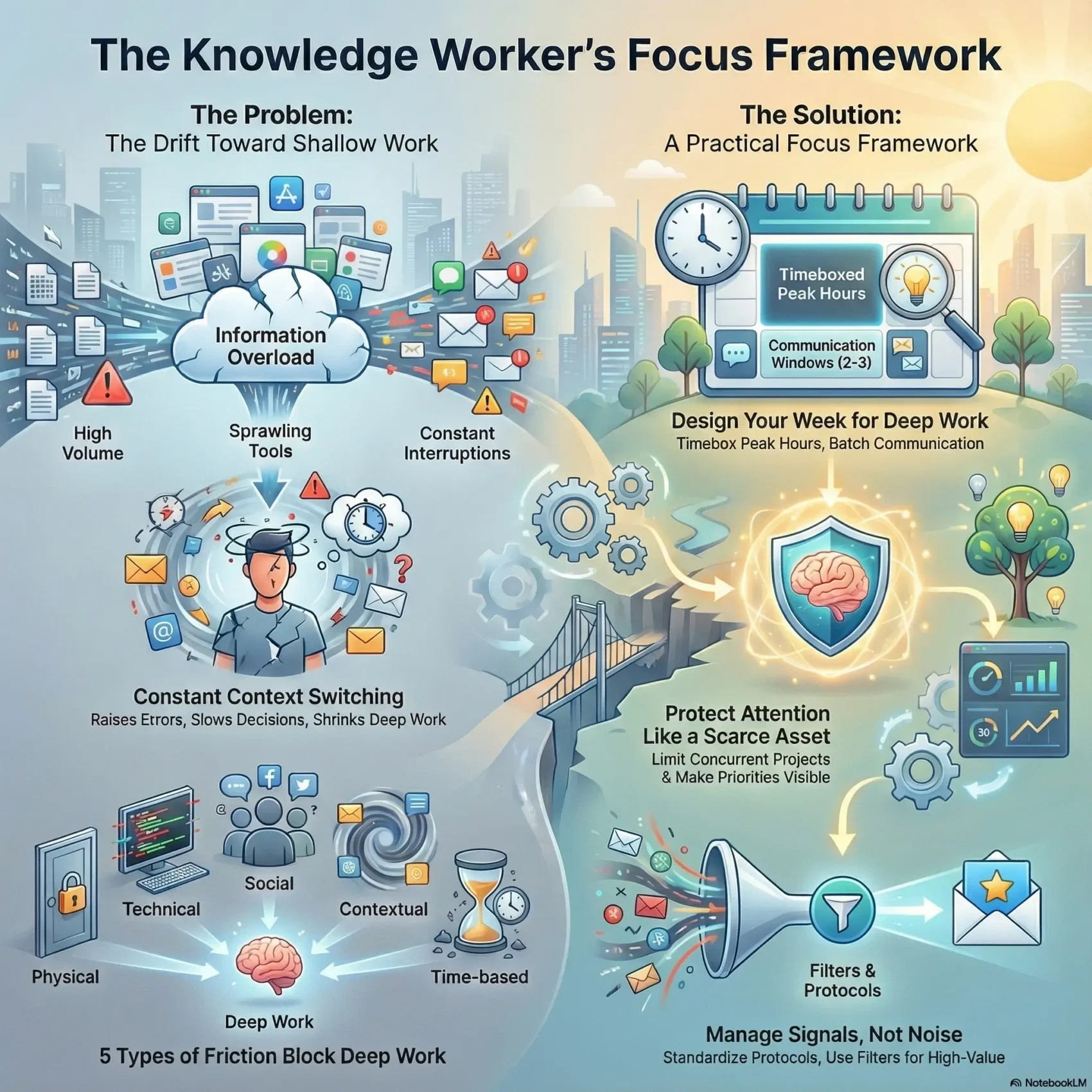
Last Updated on December 21, 2025
You face a flood of messages, tools, and tasks every day. As a knowledge worker, your main asset is thinking well under pressure. This intro shows a clear path to protect your attention and ship high‑value work.
In this guide, you’ll learn practical steps to tame information overload and build deep work as a habit. You’ll see how simple rituals and smart management choices cut noise and boost productivity.
We’ll define what makes knowledge workers different from routine workers, outline common challenges like constant interruption and tool sprawl, and give a compact framework you can apply to your day, week, and team rituals.
By the end, you’ll have a playbook to protect your cognitive peaks, turn information into insight, and deliver real value without burning out.
Key Takeaways
- Protect attention with routines that enable deep work.
- Reduce information overload by cutting noisy tools and notifications.
- Prioritize high‑impact tasks that deliver measurable value.
- Apply simple management practices to align calendars with focus time.
- Use a few habits and systems to turn insight into outcomes.
Start here: Why your productivity as a knowledge worker hinges on focus
Your ability to focus determines whether your day creates real value or just feels busy.
Shifting between apps, feeds, and tabs fragments your time and energy. Each switch adds hidden costs that cut into deep thinking and lower overall productivity.
The most important business outcomes — strategy, decisions, and problem solving — need long, uninterrupted stretches to connect data and spot patterns. Without those blocks, people drift into reactive tasks that feel urgent but deliver little.
“Protecting focus is not a luxury; it is a management decision that shapes how real work gets done.”
Set clear rules for when and how information reaches you. Use automation and conversational AI to reduce the distance between questions and answers, freeing minutes that compound into hours of deep work each week.
- Limit context switching by batching communication.
- Design calendar rules that reserve focus blocks.
- Empower teams and companies to normalize quiet time.
What a knowledge worker is—and how your role differs from an information worker
At its core, this role asks you to solve novel problems with both logic and imagination. You produce ideas, analysis, and decisions rather than repeatable outputs. That framing changes how you plan days, collaborate, and protect focus.
Definition and core traits
You think for a living: your primary output is insight, not routine tasks. Tasks require convergent reasoning and divergent creativity. You must search, evaluate, and apply information quickly to deliver value.
Examples across today’s economy
Concrete roles include engineers, architects, analysts, pharmacists, lawyers, designers, and academics. These people generate new knowledge, design products, and shape decisions rather than execute fixed processes.
Exploration vs. exploitation
Some staff focus on exploitation—applying proven methods for efficiency. You, by contrast, drive exploration: experimenting, discovering, and inventing options the company needs to stay competitive.
A brief history
The phrase “knowledge work” appeared in 1959 and Peter Drucker later coined “knowledge worker” in 1966. He argued that this type of output would become a top asset in the modern economy.
- Core ability: turn information into outcomes.
- Work style: high autonomy, distributed teams, high responsibility.
- Risk: burnout if attention and workload aren’t protected.
The knowledge economy today: environments, expectations, and challenges
The modern economy rewards people who turn complex signals into clear decisions and new product ideas. As roles shift from repeatable tasks to exploration, your daily work centers on running experiments, synthesizing findings, and creating new knowledge that guides strategy.
Exploration-driven work
You are expected to test assumptions, iterate quickly, and document outcomes. That learning becomes the raw material for future products and business decisions.
Distributed reality
Teams now span home offices, airport lounges, and different time zones. The environment must support asynchronous handoffs, shared documentation, and clear response norms so employees do not stall.
Autonomy, “gold collars,” and burnout
High autonomy and pay bring high expectations. Without guardrails, fuzzy priorities and long hours raise burnout risks.
- Set norms for response windows and meeting-free focus time.
- Invest in reliable collaboration technology for engineers, designers, and analysts.
- Level workload by measuring learning velocity and decision impact, not just activity.
The problem you face: information overload and the drift toward shallow work
Information arrives faster than you can act, and that surplus quietly turns deep projects into busywork. You end up replying to pings instead of pushing meaningful work forward.
Where overload comes from
Three forces combine: raw data volume, tool sprawl, and constant interruptions. Too many apps and dashboards create screen hopping that breaks focus.
The real cost to productivity
Context switching raises errors and slows decisions. Deep work windows shrink to short fragments, leaving you exhausted and less effective.
Five friction categories to watch
- Physical: distance and time zones that delay handoffs.
- Technical: fragmented technology and glitchy tools.
- Social/cultural: weak norms that reward instant replies.
- Contextual: silos and conflicting goals across teams.
- Temporal: not enough uninterrupted time for creative thinking.
Treat overload as a management issue. Reduce meetings, consolidate tools, codify response windows, align goals, and reserve clear focus blocks. A simple system that standardizes where decisions live can return hours to deep work.
For a practical approach to protecting focused time, see deep work creativity.
A practical Focus Framework for deep work in knowledge work
Create routines that make deep thinking the default part of your week. Structure matters: a few clear rules cut noise and make it easier to finish meaningful projects.
Principles
Protect attention like a scarce asset. Limit concurrent projects to lower switching costs. Make priorities visible so teams align without constant check‑ins.
Design your week
Timebox deep work in your peak hours. Batch communication into two or three windows. Agree on shared collaboration hours that respect time zones.
Task shaping
Turn vague ideas into clear problem statements. Add a testable hypothesis and a definition of done. This helps your team move from concept to action fast.
Signal management
- Standardize inbox and chat protocols.
- Set quiet hours and escalation paths.
- Use filters to keep only high‑value notifications.
Review cadence
Run a short daily triage, a weekly plan session, and bi‑weekly retros. Track small experiments: define assumptions, capture data, and record learning so value compounds.
“Small, consistent rules beat big willpower when protecting focus.”
Systems and tools that help you manage information, not the other way around
Choose systems that amplify your thinking so tools aid decisions instead of creating noise. The right stack cuts search time and lets you focus on high‑impact work.
Generative AI as a thinking partner
Use generative AI to speed research, draft options, and run enterprise search. Platforms like IBM watsonx.ai can surface documents, automate rote steps, and provide context so you save precious time.
Business analytics and data integration
Leverage analytics dashboards to turn raw data into clear signals. Invest in data integration so your organization shares one trusted source and decisions move faster.
Content and collaboration platforms
Standardize on a content management system as a single source of truth. Add intranets, wikis, and shared canvases so teams co‑create with less chaos and a navigable record for others.
- Automate routine steps and keep context next to action.
- Prioritize integrations and low switching costs so teams stay in flow.
- Choose systems that are easy to govern so value endures.
Managing knowledge workers: create value by balancing autonomy and structure
Managing high-autonomy teams means giving people clear outcomes and the room to reach them. You want results, not timecards. Set measurable goals so employees know what success looks like without constant oversight.
Set role clarity and outcome metrics, not minute-by-minute oversight
Define each role with a short list of responsibilities and three outcome metrics. Use weekly check-ins to unblock work, not to micromanage. This gives managers space to coach and people the freedom to focus.
Knowledge management practices
Build a simple system to capture decisions, templates, and lessons. A central repository reduces single-point dependencies and shortens onboarding. Make the system searchable and part of daily routines.
Skills and training
Invest in communication, creativity, and cross-functional fluency. Short workshops and paired projects raise the team’s problem-solving ability. Training keeps expertise inside your company and helps employees grow.
Example workflows: adaptive case management
Use adaptive case management for non-routine work: define goals, guardrails, and escalation paths. Let people choose methods while the organization keeps clear decision rights.
“Set outcomes, protect focus, and teach people to share what matters.”
- Align projects with expertise and interests.
- Standardize tools so people spend time on work, not on finding information.
- Encourage managers to model deep work and sustainable pace.
From ideas to implementation: a step‑by‑step roadmap for your organization
Move from concept to impact by staging small pilots, measuring outcomes, and scaling what works. Start with a clear snapshot of tools, data flows, and distraction hotspots so you know where time and attention leak away.
Assess current state
Inventory your tools and map how information travels across teams. List the top distraction hotspots that pull people from deep work. Capture where single points of failure live and where data is duplicated.
Pilot deep work practices
Run a four to six week pilot with one team. Timebox focus blocks, batch communications, and measure changes in cycle time and output quality. Use AI to summarize context and automate routine steps so employees spend more time on high‑value work.
Scale with governance
Create playbooks, templates, and lightweight standards that protect autonomy. Add decision logs and a single source of truth. Teach scoping, problem statements, and simple experiments as routine training.
“Match people to work that fits their strengths to raise value for the company.”
- Track leading indicators: fewer interruptions, shorter cycle times, higher decision confidence.
- Share example wins and iterate on playbooks.
- See practical SOPs for team productivity: SOPs for team productivity.
Conclusion
Protecting attention is the highest‑leverage move for anyone who must turn information into decisions. Drucker argued that productivity from a knowledge worker is the most valuable asset in modern institutions, and that still holds true.
By diagnosing friction, simplifying tools, and committing to deep‑work rituals you reclaim time. That time converts raw information into clear choices that move your business forward.
Good management balances autonomy with clarity so people do their best work and stay well. Use the framework here to shift from reactive tasks to purposeful efforts that compound into better outcomes and stronger teams.
Keep refining your operating system: review, learn, and iterate so your best ideas get the space they need to develop fully.