Tools
Tools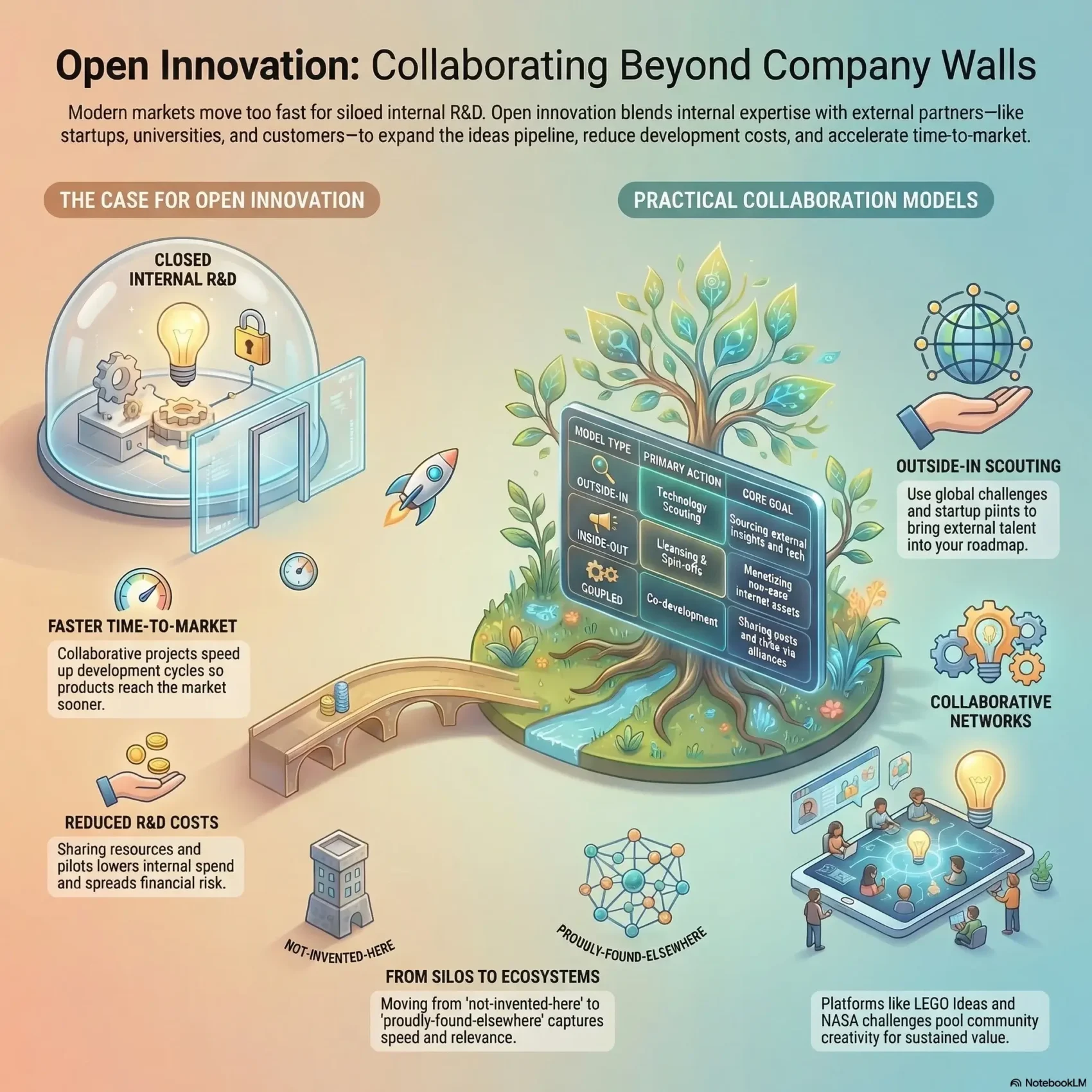
You don’t have to invent everything inside your company to win in today’s market. Since Henry Chesbrough coined the term in 2003, the idea of using external and internal ideas together has helped companies speed development and cut costs.
Think of it as a practical roadmap. By blending your team’s strengths with partners such as universities, startups, customers, and even competitors, you expand your ideas pipeline and scale product development faster.
The core promise is simple: share knowledge across boundaries and tap a wider ecosystem to discover and test concepts sooner. Real examples, from LEGO Ideas to NASA challenges, show how community creativity and partner expertise deliver results you can measure.
This section previews models, tools, and governance tips you can use today so your strategies align with legal and business needs while keeping pace with shifting industry technologies.
Key Takeaways
- You’ll get a clear roadmap for collaborating beyond your walls to move faster and reduce costs.
- Combining internal talent with external partners expands your ideas pipeline and development capacity.
- Sharing knowledge across boundaries speeds discovery, testing, and time-to-market.
- Practical models, tools, and governance tips help manage risk without slowing progress.
- Expect benefits like faster launches and access to new technology, plus challenges around IP and coordination.
Why Closed Innovation Is No Longer Enough in Today’s Market
Relying only on internal labs and teams now leaves many firms lagging behind rapid market shifts. Closed innovation slows cycles, raises costs, and risks producing tech that is outdated by the time it ships.
From internal R&D silos to ecosystem collaboration
From internal R&D silos to ecosystem collaboration
When you keep projects inside your walls, you limit the pool of ideas and talent. That makes development longer and more expensive.
By contrast, working with universities, startups, customers, and even competitors brings in external knowledge that accelerates learning and broadens capability.
Speed, flexibility, and diversity as competitive necessities
Speed, flexibility, and diversity as competitive necessities
- Faster time-to-market: Collaborations cut development time so you reach the market sooner.
- Flexible approaches: Staged partnerships let you test concepts without heavy up-front investment.
- Diverse perspectives: Different teams reduce blind spots and spark better solutions.
- Managed risks: Careful governance handles IP, coordination, and cultural challenges.
“Companies that move from ‘not-invented-here’ to ‘proudly-found-elsewhere’ capture speed and relevance.”
What Is Open Innovation? Core Definition and Principles
Blending in-house skills with partner knowledge creates more paths to useful products. The term combines internal teams and external sources so your r&d benefits from broader ideas and tech without replacing your core labs.
This approach has two main modes. Inbound work means you scout and adopt solutions from universities, startups, and research centers. Outbound work means you license, spin out, or co-develop your own IP so it creates value beyond your walls.
- Definition: A strategy to use both internal and external ideas, technologies, and resources for product and technology development.
- Inbound: Acquire tech, information, and methods from external sources to speed development.
- Outbound: Share or commercialize internal IP to gain revenue and learning.
Sharing knowledge across organizational boundaries speeds iteration. Short feedback loops with customers and partners let you test fit and adjust fast.
“Working with diverse partners multiplies learning while keeping risk manageable.”
To succeed, map processes, set lightweight agreements on IP and data, and pick collaboration modes that match your goals. For practical trends and partner examples, see this startup trends guide.
Open Innovation Models You Can Use Right Now
Different collaboration models give you clear paths to source, scale, and monetize new ideas. Pick one or combine several to match your goals, risk appetite, and capability gaps.

Outside-in: scout technologies and customer insight
Bring external talent and signals into your roadmap. Use scouting programs, global challenges, and pilots with startups to add promising technologies and real customer insight fast.
Inside-out: license, spin off, commercialize
Turn non-core assets into revenue. Licensing and spin-offs let your organization scale solutions while freeing internal teams to focus on core value.
Coupled models: co-development and alliances
Form alliances, joint ventures, or co-development deals to share costs and speed execution. Align milestones, governance, and IP terms up front.
Collaborative networks: platforms and communities
Use platforms and maker communities to pool ideas and feedback. Examples like LEGO Ideas, P&G Connect + Develop, and GE FirstBuild show how ecosystems produce sustained value.
“Match each model to your goals and build a staged path from exploration to scale.”
- Combine models to close capability gaps and move solutions from test to production.
- Define partner roles, including how competitors can join pre-competitive work.
- Measure pilots quickly and scale what proves repeatable.
Tools and Platforms: Software That Powers Your Innovation Process
Software platforms turn scattered ideas into repeatable workflows you can manage and measure. Use three categories of software—idea management, technology scouting, and trend management—to create a single system for sourcing and maturing concepts.
Idea management: capture, evaluate, implement
Capture submissions from employees, partners, and customers with a platform that triages ideas using transparent criteria.
Route winners to funded development, assign project owners, and track status with analytics and workflow automation.
Technology scouting: find and assess partners
Operationalize scouting by tracking signals from conferences, research labs, and startup ecosystems.
Use tools to score technologies and record partner interactions so companies and organizations become visible, comparable sources for collaboration.
Trend management: turn market signals into priorities
Monitor market information and forecasts to turn trends into prioritized bets for your roadmap.
Integrate these platforms with your development stack and PM tools so approved concepts move into delivery smoothly.
“Centralize communication and analytics so ideas become measurable projects, not lost notes.”
- Define clear processes and roles—moderators, reviewers, owners—to keep the innovation process moving.
- Set access controls and data policies that protect sensitive information while enabling timely collaboration.
- Measure adoption, idea quality, and cycle time to prove value and improve platforms over time.
Advantages and Challenges: Balancing Opportunity with Risk
Working with outside teams can cut time to market, yet it changes how you protect and share knowledge. You gain clear advantages but also face concrete challenges that must be planned for.
Advantages
- Faster time-to-market: Collaborative projects speed cycles so your products reach the market sooner.
- Reduced r&d costs: Sharing resources and pilots lowers internal r&d spend and spreads financial risk.
- Broader pool ideas and access to expertise: You tap external technology and skills that strengthen your pipeline of innovations.
Challenges
- IP protection and knowledge control: Manage inbound and outbound licensing with clear contracts and NDAs.
- Partner coordination: Define roles, decision rights, and staged gates to keep momentum across companies and organizations.
- Culture change: Reward idea sharing, train teams on collaboration norms, and align external contributions to strategy.
“Many organizations keep speed by using staged approaches, sharing non-core assets, and aligning legal early.”
Practical steps: set acceptance criteria, run technical reviews, pilot technology before scale, and track benefits openly so stakeholders see how advantages balance with challenges.
How to Launch and Scale Your Open Innovation Program
Start by defining clear, measurable goals so your program delivers business value from day one.
Begin with a short plan that names outcomes, selection criteria, and who decides. Communicate those goals across the organization so contributors know what problems to solve.
Set goals, governance, and processes that align business and legal
Build a simple process map: intake, triage, validation, pilot, scale. Attach selection criteria and expected milestones.
Embed legal early to align IP, data rights, and contracts with your business model and risk posture.
Engage stakeholders and build trust-based partnerships
Invite partners, startups, and internal teams into workshops. Give transparent feedback and timely decisions.
Run targeted initiatives—challenges and hackathons—to attract solutions that fit your roadmap and market needs.
Use analytics to measure progress and continuously improve
Track idea count, quality, implementation rate, time-to-market, and financial impact. Use tools and platforms for submissions, reviews, and portfolio tracking.
“Measure pipeline health and reward wins to keep momentum.”
- Set explicit goals and selection criteria so contributors know how ideas advance.
- Create governance with legal involved from day one.
- Apply analytics to the innovation process and document lessons in playbooks.
Measuring Performance: Metrics That Prove Impact
Good metrics let you prove progress and decide which bets to scale. Build a compact scorecard so teams and leaders see concrete outcomes from collaboration.
Idea volume, quality, implementation rate, and time-to-market
Track how many ideas enter the pipeline and how many become real work. Score ideas on feasibility, customer value, and strategic fit to separate noise from winners.
Measure implementation rate and time-to-market for each stage. Use benchmarks so you know where your processes speed up or stall.
Financials, participation, and platform engagement
Quantify financial performance—cost savings, new revenue, and ROI—so leaders see clear value tied to specific products and pilots.
Monitor participation across companies and organizations. Track satisfaction, contributor diversity, and recognition to keep partners engaged.
Analyze platform engagement: submission frequency, review cycle times, and tool usage reveal friction you can fix.
- Track ideas submitted, evaluated, and approved to gauge pipeline health.
- Combine quantitative and qualitative information in dashboards for fast decisions.
- Run quarterly reviews that turn insights into process updates and resource shifts.
- Publish short success stories that link metrics to outcomes and attract new collaborators.
“Measure what matters and iterate the measurement itself.”
Conclusion
A deliberate program that pairs your teams with startups and research partners makes experimentation repeatable and valuable.
,
Open innovation gives you access to a broader pool of ideas and technologies so your teams move faster and cut cost. When you align business, legal, and data early, collaboration converts into real products and measurable gains.
You combine internal strengths with startups, research partners, and communities to expand your range of solutions while managing risk. Use focused pilots, clear metrics, and the right platforms to turn experiments into repeatable wins.
Start small, measure outcomes, and scale what works. You’ll keep learning faster than the market and turn opportunities into products customers love.