Updated August 2026 with the 2026 Gartner Magic Quadrant results, current market sizing, and the US privacy rules now in force.
Customer data platforms stopped being a marketing experiment and became infrastructure. The global CDP market was worth roughly $3.3 billion in 2025 and is projected to pass $4 billion during 2026, growing at close to 20% a year. North America accounts for about 60% of that spend.
A CDP unifies fragmented records from web, mobile, offline and cloud systems into one profile you can act on. When you break down data silos, marketing, product and service teams finally work from the same view of the same person.
What changed recently is the architecture. The debate is no longer “should we buy a CDP” but “where should the profile live” — inside a vendor’s system, or inside your own data warehouse with the vendor reading from it. That single decision drives cost, lock-in and time-to-value more than any feature checklist.
This guide gives you practical steps to collect, unify and activate profiles in 2026: how to compare architectures, prioritize pilots, meet the current privacy rules, and prove ROI fast.
Key Takeaways
- Unify records to create one reliable view for marketing, product and service.
- The 2026 market split is packaged vs. composable — decide where the profile lives before you shortlist vendors.
- Warehouse-native and zero-copy designs cut egress fees and manual ETL, at the cost of some built-in sending.
- Third-party cookies survived in Chrome, but first-party data still won on quality, consent and durability.
- Twenty US states now enforce comprehensive privacy laws — build consent and deletion into the pipeline, not around it.
- Prioritize two or three quick wins and prove uplift before you scale.
What Changed in the CDP Market in 2026
If your last CDP evaluation was more than a year old, the shortlist you built is probably out of date. Three shifts matter.
Platformization vs. agentification
Gartner’s 2026 Magic Quadrant for Customer Data Platforms, published in January, describes the market as splitting in two directions. Platformization means the CDP becomes the data foundation of a broader application suite — the pattern at Adobe, Oracle and Salesforce, where higher-order apps run natively on top of the profile store. Agentification means the CDP becomes the governed context layer that AI agents read from and act on.
For buyers, the practical question is which of those two jobs you actually need. A retailer running orchestration inside one suite has a very different requirement from a company that wants a clean, governed profile that many AI systems can query.
The cookie reversal — and why first-party data still won
Google confirmed in April 2025 that it would not deprecate third-party cookies in Chrome, and shut down most Privacy Sandbox APIs in October 2025. Only a few pieces (CHIPS, FedCM, Private State Tokens) survive.
That reversal changed less than the headlines suggested. Safari, Firefox and Brave still block third-party cookies by default, so a meaningful share of traffic is cookieless regardless of what Chrome does. Consent obligations under GDPR, ePrivacy and US state law never depended on cookie type in the first place. The case for a first-party data strategy rests on signal quality and consent durability, not on a browser deadline that never arrived — and the same logic applies to zero-party data that customers hand you deliberately.
Consolidation reshaped the vendor list
The standalone CDP is a shrinking category. Uniphore acquired ActionIQ, Rokt acquired mParticle for around $300 million, and Contentstack acquired Lytics. Salesforce renamed Data Cloud to Data 360. In Gartner’s 2026 quadrant, Hightouch, Oracle and Uniphore appeared for the first time, Tealium moved from Leader to Challenger, and ActionIQ, mParticle, Redpoint Global and Zeta Global dropped off entirely after failing updated inclusion criteria.
“Check that every vendor on your shortlist still exists as an independent product before you write the RFP.”
What Is a Customer Data Platform?
A CDP centralizes signals from web, mobile, offline and cloud systems into one authoritative profile you can act on. It collects event streams and transactions, then stitches identifiers so every team shares the same story about a person.
Single customer view and unified profiles
Identity resolution matches emails, device IDs, hashed phone numbers and account records into a single customer view. That record becomes the basis for segmentation, personalization and accurate reporting.
Breaking data silos for a 360-degree view
CDPs remove silos by standardizing events and attributes into a consistent schema. That makes it easier to feed downstream tools — ad networks, email platforms, support desks — without rebuilding the join logic every time. A working data governance strategy is what keeps that schema from drifting six months in.
- Plain-English definition: software that centralizes many touchpoints into one authoritative customer profile.
- What a profile holds: behaviors, transactions, support interactions and enrichment attributes.
- Why it matters: unified profiles improve targeting, reporting accuracy and cross-channel activation.
Why a CDP Now: The 2026 Business Case
Personalization and privacy have to coexist, and the gap between what customers expect and what teams can produce has widened.
Rising expectations, constrained output
Salesforce reported in 2026 that around 75% of marketers now use AI in some form, while 78% say they need more personalized content than they can currently produce. Adobe’s 2026 trends research points the same way: customers expect experiences that are relevant and anticipatory in real time.
That gap is a data problem before it is a content problem. Without a unified profile, an AI system generates plausible copy aimed at the wrong person. See our broader take on AI-powered personalization and where it delivers.
The measurable return
Published 2026 figures put average CDP return at roughly $2.70 per dollar invested, with first-party data programs converting several times better than third-party alternatives. Those numbers vary by source and by how narrowly each firm defines a CDP, so treat them as direction rather than a forecast — then build your own baseline before the pilot starts.
First-party data as a durable asset
Centralizing consented profiles reduces waste and improves signal quality. Predictive scores — churn risk, purchase likelihood, discount affinity — let you prioritize the audiences worth spending on, which is the same discipline behind good customer retention strategies.
“Centralizing consented information turns fragmented touchpoints into reliable signals you can act on.”
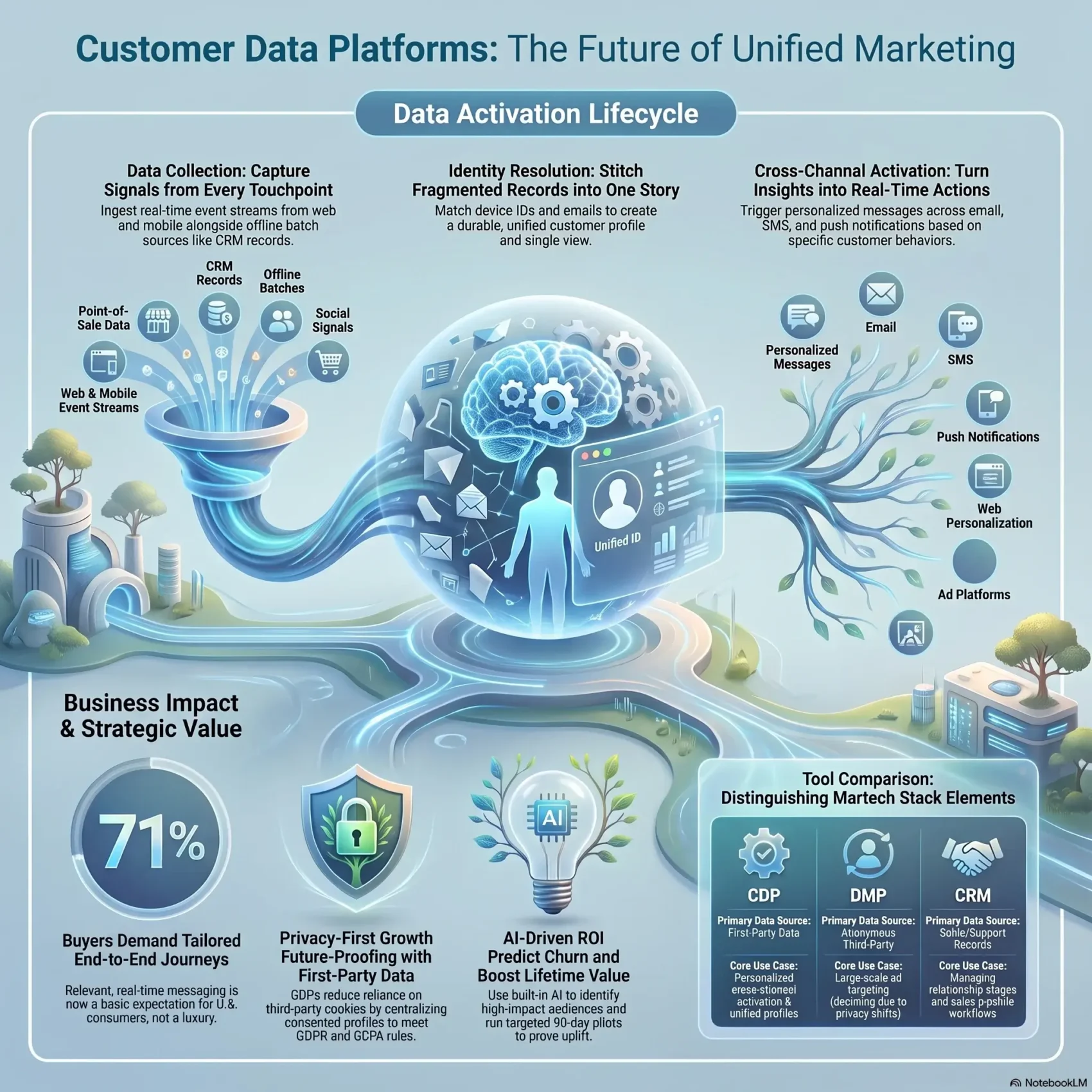
How a CDP Works Across the Data Activation Lifecycle
Think of the lifecycle as capture, stitch, act — ideally in minutes, not days.
Collection: web, mobile, offline and cloud sources
You instrument web and mobile to capture events, clicks and identifiers you can lawfully use. You also ingest batch sources — CRM exports, POS records, support logs — so offline behavior joins the same profile.
Unification: identity resolution and profile stitching
Identity resolution stitches emails, device IDs and account records into a durable profile. Ask vendors to prove match rates on a sample of your own data, not on their reference dataset.
Activation: turning insight into cross-channel experiences
Activation pushes segments to email, SMS, push and ad platforms, or runs orchestration inside the platform itself. Triggers fire on product views, cart events or support interactions. Coordinating those touchpoints well is a discipline of its own — our guide to omnichannel strategies covers the sequencing.
Real-time and historical data
Streaming powers immediate personalization. Historical stores support cohort analysis, attribution and fallback logic when live signals are missing. You need both; vendors that are strong at one are often weak at the other.
In practice:
- Instrument web and mobile to capture clean events and identifiers.
- Ingest offline batches so records join into one profile.
- Use frequency capping and suppression rules to reduce fatigue.
CDP vs DMP vs CRM: What’s the Difference?
Not every tool in your stack serves the same role, and overlap is expensive. Use this to match use cases to systems.
- CDP: unifies first-party data for segmentation, personalization and cross-channel activation. Examples: Salesforce Data 360, Adobe Real-Time CDP, Hightouch, Twilio Segment.
- DMP: anonymized third-party audiences for ad targeting. A shrinking category as identifiers degrade and privacy law tightens.
- CRM: relationships, pipeline stages and contact records. Deep on sales and service workflow, thin on behavioral event data.
The practical pattern: the CDP centralizes profiles, sends segments to ads and email, enriches CRM records, and triggers sales tasks on high-intent behavior. For how the CRM side of that has evolved, see CRM trends and vendor shifts.
“Keep common IDs across systems to avoid fragmentation and maximize match rates.”
Types of CDP: Packaged, Composable, and Everything Between
The old four-way split (data, analytics, campaign, delivery) still describes capabilities. But in 2026 the decision that actually matters is architectural.
Packaged CDPs
Packaged platforms collect, store and activate from one system. They deliver fast, ship with connectors and built-in channels, and suit teams without dedicated data engineering. The trade-off is a second copy of your customer data living in a vendor’s system, plus processing fees that scale with volume.
Composable and warehouse-native CDPs
Composable platforms run on top of Snowflake, BigQuery, Databricks or Redshift and activate directly from there — no duplication, no migration. That preserves one source of truth, removes egress costs, and keeps governance inside infrastructure you already audit. It assumes you have a warehouse worth building on and someone to maintain the models. If you are still shaping that foundation, our hybrid cloud strategy guide covers the placement decisions.
Capability tiers within each
Data CDPs excel at collection and unification. Analytics CDPs bundle modeling and predictive audiences. Campaign CDPs orchestrate journeys. Delivery CDPs add native sending for email, SMS and push. Most vendors now claim several of these; verify which are mature and which shipped last quarter.
“Match vendor strengths to your must-have capabilities to avoid costly mismatches.”
Essential CDP Capabilities to Evaluate
Map the technical and human capabilities you need before you compare products. That keeps vendor conversations focused on outcomes rather than demos.
Data integration and schema management
Evaluate ingestion breadth — web, mobile, POS, CRM — and insist on tracking plans that keep events clean. Strong schema governance prevents messy joins and saves engineering time later.
Identity resolution and a single customer view
Check how the product stitches identifiers. You want deterministic matching as the backbone, with probabilistic methods clearly labelled and controllable.
Segmentation, prediction and personalization
Look for real-time audiences and built-in models for churn, lifetime value and affinity. These speed up testing rather than replacing it — the same caution applies as in any predictive analytics program.
Activation across channels
Confirm native sends for the channels you actually use, plus suppression, frequency capping and journey logic that adapts to behavior. For commerce teams, check how it handles on-site and in-app surfaces — see e-commerce personalization for what good looks like.
Reporting, attribution and analytics
Demand funnel analysis, cohorting, multi-touch attribution and executive dashboards. Also check role-based access, audit logs, latency SLAs for real-time triggers, and export APIs for BI and warehouse syncs.
AI readiness
New for 2026: ask how the profile is exposed to AI systems. Which agents can read it, under what permissions, and how are those queries logged? If the CDP is going to be your context layer, governance of that access is a procurement question, not an afterthought.
“Buy proof of scalability and references from peers with similar volumes before you commit.”
Customer Data Platform Vendor Landscape in 2026
Choosing among vendors means balancing speed-to-value, feature depth and long-term control. The names below reflect the market after the 2025–2026 consolidation wave.
Enterprise platforms
Salesforce Data 360 (formerly Data Cloud) has been named a Gartner Leader three years running and fits organizations already deep in Salesforce. Adobe Real-Time CDP suits stacks centered on Adobe Experience Manager and Analytics. Oracle Unity connects customer data to ERP, supply chain and service. In each case the value comes from removing the integration tax within an ecosystem you already run.
Composable and warehouse-native
Hightouch entered the Gartner quadrant for the first time in 2026, activating directly from your warehouse with no data copy. Uniphore (which absorbed ActionIQ) pursues the same zero-copy model across Snowflake, Databricks, BigQuery and Redshift. These fit teams with real data engineering capacity and strict sovereignty requirements — relevant if you are navigating data localization laws.
Vendor-neutral data infrastructure
Twilio Segment remains the largest integration catalog in the category and the most developer-friendly starting point, though Twilio’s focus on communications raises fair questions about long-term CDP investment. Tealium sits between packaged and composable and slipped to Challenger in the 2026 quadrant.
Commerce and engagement specialists
Bloomreach targets ecommerce teams where search relevance and merchandising tie directly to revenue. Insider and similar engagement-first platforms bundle unification with multi-channel sending, which shortens time-to-value for lean marketing teams.
- Match vendors to the channels you use most and the sources you ingest.
- Weigh complexity, cost and learning curve against time-to-value.
- Score demos against three to five real use cases, not a generic feature grid.
Evaluation Criteria and RFP Checklist
Start with a short list of must-have use cases and validate them with sample traffic. Map each requirement to a measurable outcome so vendors respond with realistic plans and costs.
Use cases, data sources and volume
Rank use cases by impact and feasibility. List web, mobile and offline sources with current volumes and growth projections, then test ingestion cost at that scale rather than today’s.
Governance, tracking plans and quality
Require a tracking plan and schema enforcement to reduce rework. Ask for proof of match rates on your own records under NDA.
Total cost of ownership and portability
Quantify TCO beyond license fees: implementation, integrations, processing, storage and headcount. Scrutinize contract length, data portability and exit clauses. Ask explicitly what leaving costs.
Security, compliance and control
Verify access controls, audit logs, encryption and deletion forwarding to downstream tools. Request references at similar volumes and a sandbox to validate SLAs. A documented privacy compliance framework makes this section far easier to write.
Data Privacy, Security and Compliance in 2026
Compliance belongs inside the activation workflow, not bolted on afterwards.
The US patchwork: twenty state laws and counting
Twenty US states now have comprehensive consumer privacy laws in force. Indiana, Kentucky and Rhode Island joined on 1 January 2026. Twelve states — including California, Colorado, Texas and New Jersey — require businesses to honor the Global Privacy Control signal, so the defensible engineering posture is to respect it for every US visitor rather than gating on geo-IP.
California moved furthest. New CCPA regulations on risk assessments and cybersecurity audits became operative on 1 January 2026, while the automated decision-making technology rules — pre-use notices, opt-out rights and access requests — apply from 1 January 2027. The Delete Act’s DROP platform also went live in January 2026 for registered data brokers. Our overview of data privacy trends tracks how the rest of the patchwork is moving.
GDPR, consent and preference management
Connect preference centers to ingestion rules so you only collect what consent allows. Browser behavior does not change legal obligation: ePrivacy consent requirements apply regardless of whether a cookie is first- or third-party.
Deletion forwarding and access control
Implement deletion forwarding so removal requests propagate to every system that received a record. Use role-based access, encryption in transit and at rest, and separate environments to limit exposure.
- Use tracking plans and schema validation to avoid collecting fields you cannot justify.
- Document data flows and keep them auditable.
- Plan incident response before you need it.
“Privacy-by-design improves trust while keeping activation goals intact.”
Implementation Roadmap: From Pilot to Scale
Pick one metric everyone will rally around — conversion rate, average order value or lifetime value — then set supporting KPIs and a reporting cadence.
Days 1–30: measurement plan and data collection
Define the North Star and how each test moves it. Implement tracking plans and SDKs to capture clean events from web, mobile and offline systems. Run a short validation window before scaling ingestion.
Days 31–60: identity resolution and validation
Configure matching rules and test match rates on representative cohorts. Validate a sample profile end to end before expanding to broader segments.
Days 61–90: quick wins and orchestration
Run a controlled pilot on one or two high-impact use cases — cart recovery or browse abandonment are the usual first choices. Layer suppression and next-best-channel logic once the baseline holds.
- Do this first: prove uplift on a clear use case before wide rollout.
- Document governance, access controls and QA for new events and journeys.
- Build a small center of excellence to share templates, tests and results.
“Phased rollouts and clear metrics beat big-bang launches every time.”
Use Cases That Drive ROI
Practical activations focus on moments that move revenue: browse, cart and post-purchase. Pick two or three tests you can measure cleanly.
Journey orchestration
Triggered journeys for browse and cart abandonment, product drops and price alerts. Real-time triggers plus templates let you run fast A/B tests without engineering support.
Analytics and attribution
Cohort analysis and multi-touch attribution show which touchpoints actually influenced a sale, so you can reallocate spend with evidence rather than instinct.
Churn prediction and lifecycle programs
Predictive audiences — churn risk, purchase likelihood, discount affinity — let you tailor offers and timing. Welcome, retention and win-back programs compound lifetime value over quarters, not weeks.
- Personalize on-site and in-app recommendations using real-time and historical signals.
- Connect support signals to marketing so a frustrated customer gets service, not a promotion.
- Enforce suppression and frequency rules to protect deliverability.
- Package results into executive dashboards to sustain investment.
Industry Fit: B2C, B2B and Regulated Sectors
Your vertical dictates which signals matter and how you measure success. Retail and ecommerce lead CDP adoption, which is unsurprising given how much of the buying journey now happens on a phone — our mobile commerce trends guide covers that shift in detail.
High-scale retail and ecommerce
Retailers rely on on-site personalization, merchandising and omni-channel activation to raise average order value. Track SKU-level events and replenishment cycles; integrate commerce engines and POS. Measure margin protection, AOV lift and repeat purchase rate.
B2B pipelines and account-based motions
Route high-intent signals to sales and enrich CRM records for account-based plays. Map account hierarchies rather than individuals and use lead-to-opportunity velocity as the north star. This pairs directly with a coherent account-based strategy. Worth noting: several vendors that lead B2C analyst rankings do not make the equivalent B2B cut, because account-level data models are a genuinely different requirement.
Healthcare and regulated stacks
Regulated sectors need strict access controls, audit logs and PHI-safe practices. Warehouse-native architectures often make HIPAA alignment easier because the sensitive data never leaves infrastructure you already control.
Build vs Buy: Choosing Your CDP Path
This choice affects speed, control and long-term cost more than any feature comparison.
Off-the-shelf options deliver fast activation and prebuilt connectors, reducing early engineering overhead. They can also create data lock-in, higher processing fees and limited export flexibility.
Warehouse-native control and extensibility
Warehouse-native designs centralize profiles in your cloud store, giving you reuse for BI and machine learning and lowering long-term vendor risk. They demand engineering capacity you may not have today.
Hybrid strategies
A hybrid approach pairs a warehouse-native core with best-of-breed channel tools, balancing fast activation against open APIs, reverse ETL and exportable event streams. In practice this is where most mid-market teams land.
- Weigh time-to-value against lifecycle cost and lock-in.
- Evaluate interoperability: open APIs, event streams, reverse ETL.
- Benchmark SLAs for latency, uptime and support responsiveness.
- Confirm residency, access controls and data lineage.
“Design for migration paths now so you can switch vendors or bring work in-house without losing history.”
Building the Internal Business Case
A one-page vision links profile unification to a measurable business goal. Write a short statement covering how the system will unify profiles, activate audiences and improve one North Star metric.
Align teams early by mapping responsibilities against CRM, analytics and marketing automation. That prevents overlap and stops the CDP becoming shelfware.
Set concrete 90-day expectations: data readiness checks, a pilot on one or two use cases, and weekly reporting. Improving how these results circulate matters as much as the results themselves — see data democratization for how to make insight usable beyond the analytics team.
- Governance: enforce schema rules, consent and retention.
- Integrations: prioritize connectors that unlock early wins with minimal engineering.
- Communication: tie every win back to the North Star to build momentum.
Total Cost of Ownership and Proving Value
A defensible TCO ties spending to uplift: license, storage, processing, integration and headcount. List it plainly so stakeholders see where budget goes.
Licensing, processing and integration
Itemize license tiers, ingestion and storage fees, and integration work. Include one-time setup and ongoing operations. Warehouse-native options often shift cost from vendor fees to internal engineering — that is a real cost, not a saving.
Time-to-value and enablement
Build a plan with pilot milestones and measurable lifts. Budget training so marketing, product and analytics teams actually adopt the tool.
Attribution and executive reporting
Implement attribution linking journeys and channels to revenue. Dashboards should show revenue impact, efficiency gains and risk reduction, which is also the foundation of better customer experience decisions across the business.
- Compare architectures: packaged vs. composable, including exit cost.
- Track unit economics: CAC, AOV and LTV before and after.
- Report wins: cohort and funnel analyses that justify continued resourcing.
“Quantify costs and tie every spend to a KPI so budget flows to the tactics that work.”
Conclusion
Align teams around one North Star and a short pilot.
Decide where the profile lives before you shortlist vendors — packaged or composable is the decision that shapes everything downstream. Then centralize profiles so you can test high-impact use cases quickly, and keep the pilot scope tight enough to measure.
Compare enterprise platforms, warehouse-native options and commerce specialists through an RFP and TCO lens that includes exit cost. Document privacy and governance rules as you build, not after. Show early wins, expand what works, and you will scale a better customer experience without losing control of the data underneath it.
Found this useful?
Make SmartKeys a preferred source on Google, and our articles will surface more often in your Top Stories, AI Overviews, and AI Mode.
Add as Preferred Source