Thinking about a shorter week for your team? You are in good company. What started as a pandemic-era experiment now has peer-reviewed evidence behind it and a growing list of governments running their own pilots.
In July 2025, Nature Human Behaviour published the largest study of a four-day workweek so far. It tracked 2,896 employees at 141 companies across six countries for six months, and compared them with 12 control companies that changed nothing. Participants reported less burnout, higher job satisfaction, and better mental and physical health. Roughly 90% of the companies kept the schedule when the trial ended.
A shorter week still is not a universal fix. Coverage-heavy industries, hourly payroll rules, and customer expectations all complicate it. The strongest evidence also comes from companies that volunteered to take part.
This 2026 guide gives you the current data, the honest caveats, and a 90-day pilot framework you can run without betting the company on it.
Key Takeaways
- The 2025 Nature Human Behaviour study is the strongest evidence to date: lower burnout, stable output, and around 90% of firms continuing afterwards.
- A 32-hour week, a 4×10 compressed week, and a shorter daily schedule are three different products with different outcomes. Name yours precisely.
- Adoption is real but uneven: 22% of US employers offered some four-day option in 2024, up from 14% in 2022.
- Larger hour cuts produce larger well-being gains. Half-measures tend to produce half-results.
- Redesign comes before reduction. Teams that drop a day without cutting meetings end up more tired, not less.
Where the four-day workweek stands in 2026
The five-day week was itself a reform. Henry Ford moved his factories to it in 1926, and the US Fair Labor Standards Act made 40 hours the standard in 1940. The current debate is about whether the next step is due, and whether your operating model can absorb it.
Early company tests set the tone. New Zealand’s Perpetual Guardian gave its 240 staff a paid day off each week for eight weeks in 2018; the share reporting good work-life balance rose from 54% to 78%. Iceland ran public-sector trials from 2015 to 2019, and today roughly 86% of Icelandic workers have shorter hours or the right to negotiate them.
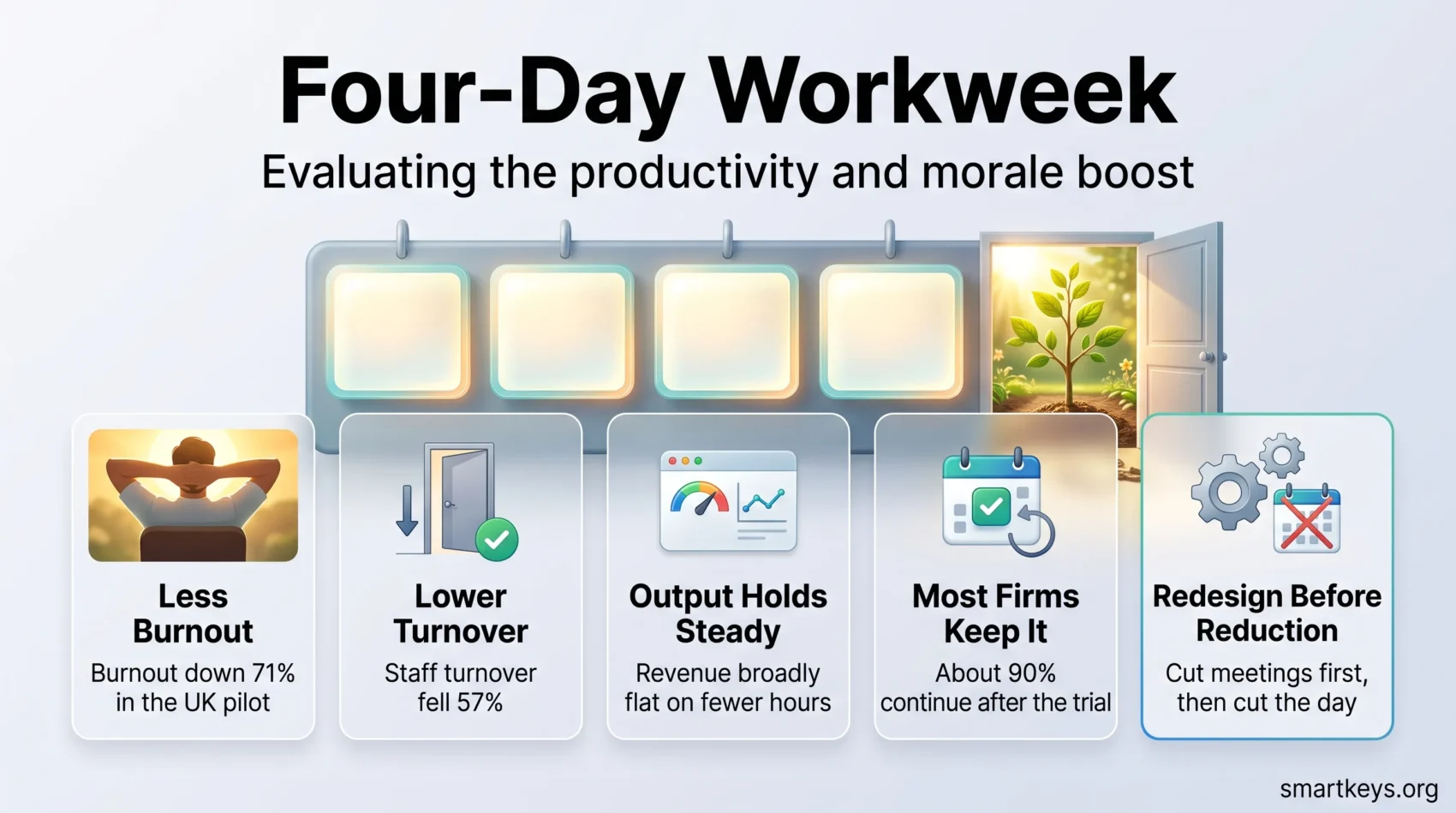
The UK pilot of 61 companies followed in 2022. Revenue held broadly steady, turnover fell 57%, burnout dropped 71%, and 92% of participants continued afterwards. A smaller follow-up by the 4 Day Week Foundation, starting in November 2024, went further. All 17 companies kept a shorter schedule: 12 as a four-day week and five as a nine-day fortnight.
The UK pilot recorded a 71% fall in burnout and a 57% drop in turnover, with revenue broadly flat.
Governments have since moved from observing to testing. Belgium has given employees the right to request a compressed four-day week since 2022. Tokyo’s metropolitan government opened a four-day option to around 160,000 staff in April 2025. Poland started a government-run pilot in January 2026 that lets employers test a four-day week, shorter daily hours, or extra days off, with results expected in 2027. Our overview of future of work legislation tracks how these rules are developing.
Employer uptake is slower than employee demand. American Psychological Association survey data puts US employer adoption at 22% in 2024, up from 14% in 2022. Around 81% of full-time workers say they would prefer a four-day schedule, but most refuse any pay cut to get it. That gap explains most of the friction. Employees want the 100-80-100 deal (full pay, 80% of hours, 100% of output), and that is the expensive version for employers.
- Flexibility is the draw: less commuting, more recovery time, better work-life balance.
- Employer brand: firms running credible pilots see stronger applicant flow and higher employee engagement.
- Still not universal: operations, shift coverage, and client expectations differ sharply across sectors.
What a shorter week really means (and what it does not)
Three quite different schedules get filed under “working less”, and the one you choose largely decides how the change lands with staff and clients. Be exact before you set expectations.

32-hour week, 4×10 compression, or a shorter day
A 32-hour week cuts total hours and usually keeps pay and benefits intact. Less time on the job is what actually reduces fatigue, which is why this version drives the well-being numbers in the research.
4×10 compression keeps the same 40 hours and packs them into four longer days. People get a three-day weekend, but daily load rises, so the recovery benefit shrinks when hours simply move rather than disappear.
A shorter workday keeps five days but cuts each one to six or even five hours. Roles built around short tasks, such as support, admin, or scheduling, adapt well to it. Project work that needs long, uninterrupted thinking usually suits a shorter week better, because a five-hour day can be too short to get deep into a hard problem.
One pattern from the trials is worth flagging: the burnout reduction is dose-dependent. Employees whose own hours fell the most gained the most. A policy that shortens the week on paper while people quietly keep the old hours delivers little.
Pay, benefits, and the 100-80-100 rule
Pay is what makes the change feel fair or feel like a cut. Most successful pilots use the 100-80-100 model: full salary, 80% of the hours, and an explicit commitment to hold output steady. Others compress hours instead, which keeps payroll unchanged but delivers a smaller well-being effect.
Most employment paperwork is written in hours, so check holiday accrual, overtime thresholds, benefits eligibility, and any contractual definition of full-time work. Hourly and shift-based teams need extra attention, because wage rules and collective agreements often decide what is legally possible before culture enters the conversation.
Scope: pilots, opt-in, or company-wide
Most companies begin with a team pilot or an opt-in program so coverage stays manageable. Staggered days, rotating off-days, and follow-the-sun scheduling keep service running across time zones without closing the business for a day.
- Roles matter: frontline and regulated roles need different tactics than project teams.
- Measure results, not hours: shift to outcome-based work before you shorten the week.
- Plan exceptions: allow temporary deviations for launches and seasonal peaks.
The evidence: what recent trials actually found
The research base has improved substantially since 2022. Here is what holds up.
Productivity and output. The Nature study found no drop in self-assessed performance across six months, and revenue in the UK pilot stayed broadly flat. Microsoft Japan’s 2019 test reported a 40% productivity gain and a 23% cut in electricity costs. It ran alongside shorter meetings and more async work, though, so it was not a schedule change alone.
Where the time comes from. People do not suddenly type faster. The hours come out of work that was already wasted. Microsoft’s 2025 Work Trend Index report on the “infinite workday” found the average employee is interrupted about every two minutes during core hours. The same worker receives around 117 emails and 153 Teams messages a day. Nearly half say their work feels chaotic and fragmented. Each interruption also costs time to get back on track, as our piece on the modern attention span explains. Cut the hours and the standing status meeting and the reply-all thread are the first things to go.
Well-being and burnout. This is where the effects are largest and most consistent. The Nature authors traced most of the improvement to three things: people felt more able to do their job, slept better, and were less fatigued. The UK trial also recorded a 39% drop in stress and a 37% improvement in physical health.
Talent and retention. Turnover fell 57% in the UK pilot. Companies running credible pilots consistently report stronger applicant flow, which is why the schedule is increasingly treated as a talent retention lever rather than a perk. Our guide to managing employee burnout covers the related interventions worth pairing with it.
Cost. Lower turnover, fewer commutes, and reduced facility use all show up on the ledger. Whether that offsets holding pay flat at 80% of hours depends on your margins and how much low-value work you can actually remove. Sweden shows the other side. Gothenburg’s Svartedalen care home ran a two-year six-hour day for 68 nurses on full pay. Staff were healthier and sick leave fell, but covering the wards meant hiring 17 extra people at about 12 million kronor, and the city declined to make it permanent.
The drawbacks and risks you need to weigh
What looks like a simple schedule change creates real trade-offs for staff and customers. Map how it shifts work, coverage, and costs before you commit.
Work intensity and hidden overtime
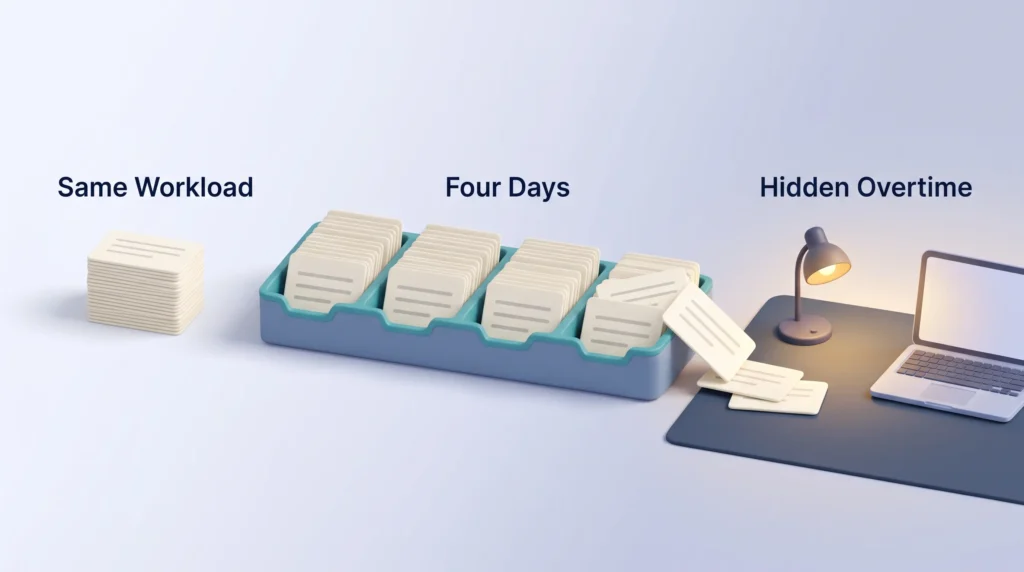
Delivering the same output in fewer days raises pace and pressure. Compression without redesign is the most common failure mode: teams cram the same obligations into fewer hours and finish more tired than they started. In the Nature study, participating companies spent roughly eight weeks restructuring workflows before the trial began. That preparation phase is not optional.
The quieter failure is hidden overtime. The schedule changes, the workload does not, and people finish it in the evening. Cap the workload, not just the calendar, and treat evening logins and weekend messages as a design fault rather than dedication.
Inequity across roles and teams
Shift-based and frontline staff in support, healthcare, and manufacturing often cannot simply drop a day. When a bed, a phone line, or a machine must be staffed continuously, cutting hours means hiring, as the Swedish care home showed. An arrangement that benefits office workers while leaving those teams untouched signals that flexibility is a perk rather than a value. Intelligent shift scheduling and job sharing are the practical tools here.
Customer service, collaboration, and scheduling
Closing a day without staggering coverage slows response times and multiplies missed handoffs. Tell customers before you change, not afterwards, and give urgent requests a named route through. Collaboration also suffers when teammates share fewer overlapping hours, so strong asynchronous work habits are close to a prerequisite.
What the research still cannot tell you
Be honest about the limits. No study so far has randomized which companies adopt a shorter week. Every trial used self-selected participants, a caveat the Nature authors flag themselves, and those firms may simply start with healthier cultures. Productivity is also largely self-reported. Manufacturing, where output ties directly to hours on the floor, remains the hardest case and the thinnest evidence base.
How to pilot a four-day workweek without losing productivity
You can test this without risking delivery. A short, controlled pilot produces real data in one quarter.
Weeks 1 to 4: listen and redesign. Run surveys and focus groups to learn what your team wants and what constraints they face. Then do the unglamorous work: run a meeting audit, give every remaining meeting an owner and an agenda, move status updates into writing, and automate routine approvals. Our guide to effective meetings covers the details. If the calendar does not change, the schedule cannot.
Set outcome-based goals and a baseline
Define success by results, not hours, and record your baseline first. Write down the weekly outcomes each role owes and who signs them off. Then agree on a small dashboard covering throughput, quality or error rates, service SLAs, and how strained people say they feel. Our guide to measuring team productivity covers which metrics survive contact with reality.
Design coverage that holds
Staggered days, rotating off-days, and protected focus time keep customers covered while protecting deep work. A three-month trial in one department is the standard low-friction starting point. Anything much shorter mostly measures novelty.
- Keep rules explicit to limit change fatigue.
- Coach leaders to model boundaries and respect off-days. A right to disconnect policy helps make that stick.
- Decide in advance what evidence would make you stop.
Iterate, then decide in the open. Use check-ins to adjust coverage windows, rotate off-days, or move between compressed and reduced hours. At the end, publish the results, including anything that got worse, and say whether you are keeping, adjusting, or stopping the model. A pilot that quietly fades out damages trust more than one that ends with reasons.
Is this right for your business? A decision framework and alternatives
Start by mapping who must be available, when, and to whom.

Fit by industry, coverage, and profitability
Tailor by role. Client-facing and healthcare teams usually need rotations rather than closures. Project, engineering, and R&D teams are the natural candidates for a genuine 32-hour model.
- Assess coverage windows, client expectations, and cross-team dependencies.
- Model the finances: headcount, overtime exposure, tooling, and margin impact.
- Define decision criteria up front: employee sentiment, customer satisfaction, output stability, margin.
- Roll out in phases, starting with predictable functions, and document your exit ramp.
Smart alternatives to consider
If a full four-day week does not fit, several options deliver much of the benefit at lower risk. Consider a nine-day fortnight, 9/80 schedules, shorter daily hours, flexible PTO, company-wide no-meeting days, staggered rotations, or broader flexible work schedules. In many organizations, removing low-value work delivers more relief than changing the calendar ever will.
Conclusion
Success comes from design, not slogans. The six-country study, the UK pilots, and Iceland’s programs all point the same direction: when teams redesign how work happens, output holds and people recover.
The failure modes are just as predictable. Compression without redesign, hidden overtime, vague success metrics, and plans that quietly exclude frontline staff turn a promising pilot into a resented one. And in coverage-bound work, someone has to be paid to fill the gap.
Pick the model that fits your customers and your teams. A reduced-hours week, a shorter day, a 4×10 schedule, or a hybrid alternative can all work. Track output, SLAs, well-being, and turnover against a proper baseline, choose a pilot group, and decide by data rather than by headline.
Found this useful?
Make SmartKeys a preferred source on Google, and our articles will surface more often in your Top Stories, AI Overviews, and AI Mode.
Add as Preferred Source