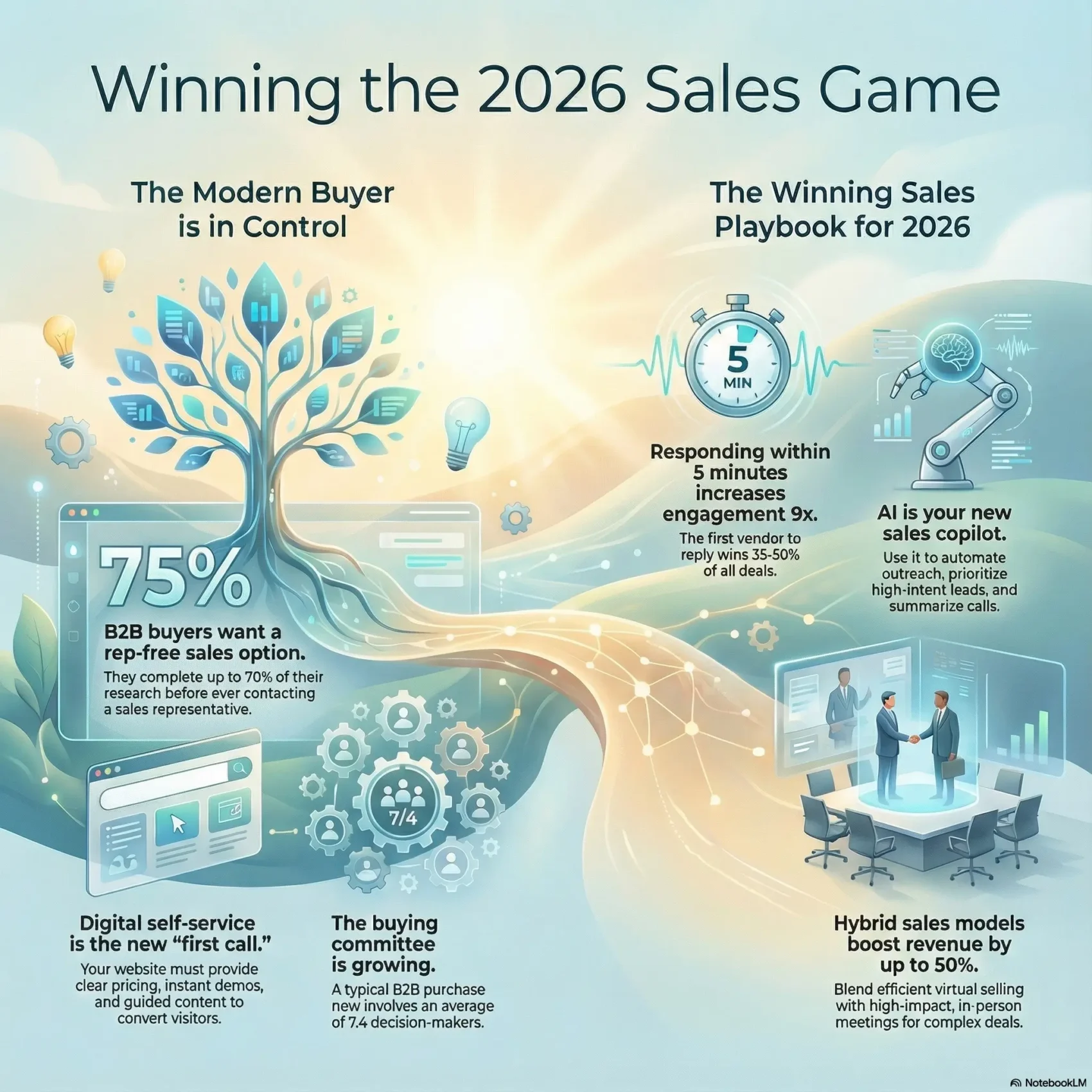
B2B selling in 2026 is buyer-led. Two thirds of business buyers now say they would rather complete a purchase without talking to a sales rep. In a Gartner survey of 646 B2B buyers, published in March 2026, 67% preferred a rep-free experience, up from 61% a year earlier.
That single number changes how you prospect, demo and follow up. Buyers research on their own, often with generative AI. They call a seller only when they need something a website cannot give them: validation, lower risk and a clear next step.
This article covers the sales trends that matter in 2026 and what each means for a working sales team, from AI and automation as everyday copilots to self-service buying, hybrid selling, response speed and referrals. Every figure is sourced. Older sales statistics that circulate online but could not be verified have been left out.
Key Takeaways
- Most B2B buyers prefer to research and buy without a rep, so your website now does the work a first call used to do.
- AI is no longer a separate tool. In Salesforce’s 2026 State of Sales survey, 87% of sales organizations already use AI and 54% of sellers have used AI agents.
- Buyers do not trust AI blindly. Gartner found 69% want a sales rep to validate what AI told them, which is where consultative selling earns its keep.
- Speed still wins. Responding to an inbound lead within an hour makes a qualifying conversation about seven times more likely than responding an hour later.
- Referred customers are worth more. A long-running Wharton study put their value at least 16% above comparable non-referred customers.
Why 2026 Matters: A Snapshot of Sales in a Buyer-Led, AI-Powered Market
The 2026 playbook starts from one fact: buyers do most of the work before your team hears from them. The window in which a seller can influence a decision has shrunk. That changes how you build pipeline and how you coach reps.
What changed since 2024 and 2025
Three shifts stand out. First, the preference for rep-free buying keeps rising: Gartner measured 61% in mid-2025 and 67% in early 2026. Second, buyers now use generative AI as part of the purchase. In the same survey, 45% had used AI during a recent purchase, mostly to research vendors and products, and buyers consulted an average of seven information sources. Third, buying groups remain large. Gartner’s research on the B2B buying journey puts the typical buying group for a complex purchase at six to ten decision makers.
For your pipeline, this means qualification starts earlier, often from website behavior rather than a discovery call. It also means “multithreading”, building relationships with several people in the same account instead of relying on one champion, is now standard practice.
Treat the numbers as benchmarks, not laws. A five-figure software subscription and a seven-figure equipment contract will not follow the same path. Use the data to ask better questions about your own funnel: where buyers stall, how fast you respond, and what they read before they talk to you.
AI and Automation Move From Tools to Copilots
AI in sales has moved from background automation to an active assistant that suggests each rep’s next step. It now sits inside the CRM and email apps your team already uses. (A CRM, or customer relationship management system, is the database where contacts, deals and activities are recorded.)
The adoption numbers are no longer a forecast. Salesforce’s State of Sales report, published in February 2026, surveyed 4,050 sales professionals in 22 countries. It found that 87% of sales organizations use AI in some form, for prospecting, forecasting, lead scoring or drafting emails. More than half of sellers (54%) had used AI agents, and top performers were 1.7 times more likely than underperformers to use prospecting agents. For a broader view, see our guide to AI-powered assistants at work.
From task automation to next-best-action
Keep AI practical. The use cases that pay off first are unglamorous: ranking inbound leads, drafting a first email from account data, summarizing a prospect’s background before a call, and writing call notes. Sellers in the Salesforce survey expect agents to cut prospect research time by 34% and email drafting time by 36%. Tools such as Clay combine enrichment, research and drafting in one workflow, and most CRMs now ship their own copilots.
Workflow integration and guardrails
Integrate AI with your CRM so it can trigger routing, reminders and handoffs rather than living in a separate window. Then set two rules. First, a human checks AI-written messages for tone and accuracy before they reach a buyer. Second, disclose when a buyer is talking to a bot. Since 2 August 2026, the EU AI Act’s transparency rules require that people are told when they interact with an AI system such as a chatbot. Our EU AI Act compliance guide explains what that means for customer-facing tools.
“Give managers AI dashboards that highlight coaching moments, not just metrics.”
- Auto-enrich accounts and surface buying signals such as pricing-page visits and job changes.
- Measure time saved, first-touch speed and pipeline created every week, so the AI budget is tied to results.
Sales Trends You Can’t Ignore: Digital Self-Service and Buyer Control
Digital-first buyers want quick answers and clear options so they can decide at their own pace. Gartner’s 2026 survey found 70% of B2B buyers prefer a completely digital, self-service buying experience.
Rep-free preferences and self-directed journeys
Your website often replaces the first call. If two thirds of buyers would rather not speak to a rep, your pricing page, product tour and comparison content are doing the discovery work. That does not remove the seller. Gartner’s May 2026 research found 69% of buyers still want a rep to validate AI-generated insights, and buyers rated AI and reps almost equally likely to mislead them (51% versus 49%). The seller’s job has shifted from presenting information to confirming it. For the wider picture, see our overview of customer experience trends in 2026.
Designing self-service that converts
- Clear options: publish pricing, packaging and instant demo access. If you sell a product-led motion, our comparison of product-led and sales-led growth shows where self-service should stop.
- Guided paths: product tours, ROI calculators and role-based flows that qualify visitors without a form wall.
“Offer interactive FAQs and on-demand demos so buyers control the pace without waiting on a calendar slot.”
An AI chatbot can answer routine pricing and integration questions around the clock and hand off to a person when a question turns commercial. For deeper reading on digital commerce options, see e-commerce trends and channel strategies.
Inside, Outside, and Hybrid: How Winning Teams Blend Channels
Winning teams mix remote touchpoints with selective in-person moments. “Hybrid selling” means a rep works most of the pipeline by video, phone and email. Travel is reserved for meetings that need a room: executive alignment, complex negotiation or a hands-on technical demo.
McKinsey made the case for this model in its 2022 research on hybrid B2B sales: remote reps could cover up to four times as many accounts and generate up to 50% more revenue, and more than 90% of enterprises planned to keep their hybrid structures. The same research described buyers’ preferred mix as a “rule of thirds” of in-person, remote and self-service contact.
When virtual works, and when to go onsite
Remote meetings are the default for discovery and follow-up. Switch to in-person for multi-stakeholder negotiations, custom pricing or demos that need equipment. Make every trip measurable: define the outcome before booking and tie the visit to a forecasted deal. Our guide to running remote sales teams covers the tooling and rhythms in detail.
How to staff and structure coverage
- Virtual-first coverage: inside reps book first meetings and keep momentum between milestones.
- Field focus: outside reps secure executive sponsorship and close complex deals.
- Hybrid hiring: recruiting beyond commuting distance of headquarters widens the talent pool.
- Standardized handoffs: shared playbooks, meeting templates and one collaboration tool keep notes and next steps in the CRM.
“Track revenue by channel and role so leaders can see where an extra onsite unlocks stalled opportunities.”
Joint pipeline reviews keep inside and field reps working the same account plan instead of competing for it.
Prospecting Reality Check: Multichannel Outreach That Works
Modern prospecting blends email-first logic with timely phone and social touches. Buyer tolerance for generic outreach is low, so the answer is not more volume. It is fewer, better-targeted sequences that match how each buyer prefers to be contacted.
Email first, phone still matters
Lead with a short, specific email that references something true about the account. Then call when engagement shows: a reply, a click or a return visit to your pricing page. Contact data quality decides whether the call ever connects, which is why teams pay for enrichment tools such as ZoomInfo or Lusha.
LinkedIn and social selling
Social selling means using LinkedIn to build credibility before you ask for a meeting. Comment on a prospect’s posts, share a useful observation about their industry, and only then send a concise message. Buyers check an average of seven sources before buying, so your profile is part of their research whether you take part or not.
Close the persistence gap
Most first meetings come after several attempts across channels, yet many reps stop after two or three. Set a baseline of six to eight touches over two weeks, mixing email, LinkedIn and phone.
- Sequence: email, then a LinkedIn touch, then a phone call, then a voicemail, then a follow-up email.
- Timing: call after a click or reply, and propose two short meeting slots rather than “let me know when works”.
- Measure: log attempts, connects and conversion rates in your CRM for weekly coaching.
For accounts that justify it, an account-based strategy coordinates these touches across sales and marketing so the whole buying group hears one consistent story.
Consultative Selling in Practice: From Pitching Products to Solving Problems
Consultative selling means diagnosing the buyer’s problem before recommending anything. Buyers now arrive with AI-generated shortlists. The seller who adds the most value can say which findings are right, which are out of date, and what the buyer has not considered. That is the validation role Gartner’s 69% figure describes.
Using intent and industry insights to be proactive, not pushy
Lead with intent. “Intent data” is any signal that an account is actively researching a problem: search behavior, content downloads, job postings, repeat visits. Use it to frame the exact issue the buyer is working on.
Then share one short benchmark or peer example tied to a KPI they care about: hours saved, risk reduced or revenue gained.
Content-led conversations buyers prefer over ads
- Share a short article or case study that maps to their industry and role.
- Replace feature lists with value narratives tied to measurable outcomes.
- Map the stakeholders (finance, IT, end users) and present a simple plan that reduces adoption risk for each.
“Turn objections into collaboration: reframe risks and co-create a low-friction plan.”
Close with a mutual action plan. Document next steps, owners and dates so the whole buying group can see the path to value. Gartner found confident buyers are twice as likely to report a high-quality deal, and a written plan is the simplest way to build that confidence.
Data-Driven Selling: Let Insights Set Your Priorities
Let data, not guesswork, decide where your team spends its next hour. Clear signals surface the accounts most likely to close, so reps stop working the list from the top down.
Lead scoring, enrichment and intent signals that cut through noise
“Lead scoring” assigns points to a lead based on fit (company size and industry), intent (what they are researching) and engagement (what they did on your site or with your emails). Build one model that blends all three.
Set service-level agreements (SLAs) so a high-intent signal, such as a pricing-page view, triggers an alert within minutes. Data hygiene matters here. In the Salesforce survey, 79% of high-performing sales organizations prioritize it, against 54% of underperformers. A first-party data strategy is the foundation for all of this.
From gut feel to revenue impact: dashboards leaders actually use
Give leaders dashboards that show stage conversion, cycle time and forecast accuracy, not vanity metrics such as email volume. Standardize definitions across teams so every report tells the same story. Our article on RevOps tools for forecasting goes deeper on the data layer behind reliable forecasts.
Close the loop by logging call outcomes consistently; that feedback improves routing rules over time. If you are choosing a CRM, our Salesforce vs HubSpot comparison covers the two biggest options, and our overview of CRM trends explains how AI pricing is changing the bill.
Velocity Levers: Follow-Up Speed, Email Performance and Call Cadences
Speed decides whether a lead becomes a conversation or a cold record. Response time is the cheapest lever in sales because it needs process discipline rather than budget.
The evidence on response time
Respond fast. The best-known study, published in Harvard Business Review in 2011, audited 2,241 US companies. Firms that contacted a lead within an hour were about seven times as likely to have a meaningful qualifying conversation as those that waited even an hour longer. Yet only 37% of companies responded within an hour, and 23% never responded at all. An earlier 2007 study of call data found the odds of reaching a lead fell roughly 100-fold between a five-minute and a thirty-minute response. Both studies are old and measure odds rather than revenue, but nothing since has contradicted the direction: minutes matter.
Route inbound leads straight to live reps where you can. Where you cannot, use automated scheduling so a prospect can book a slot the moment they submit a form. Test which call windows work for your buyers rather than copying a generic list.
Email that gets opened on a phone
- Subject lines: four to seven words, specific, and personalized by role or company.
- Body: short, skimmable and outcome-focused, with one clear call to action and one linked asset.
- Cadences: alternate channels and message angles, and space touches so you stay relevant without becoming noise.
“Automate instant sequences for off-hours submissions and escalate SLAs when high-intent actions appear.”
Track reply and meeting rates by step, prune what underperforms, and change one variable at a time so you learn what moved the rate.
Nurture What You Win Later: Lead Nurturing, Qualification and Handoffs
Leads rarely arrive ready to buy; most need education and a clear path forward. “Lead nurturing” means staying useful to not-yet-ready prospects with relevant content until interest turns into intent.
Why most leads aren’t ready, and how to mature them
A whitepaper download or a webinar registration is a research signal, not a buying signal. Treating it as one burns both the rep’s time and the buyer’s goodwill.
Use automation to deliver content by persona and stage: a comparison guide for the evaluator, a business case template for the budget holder, an implementation checklist for the IT reviewer. Watch for the behavior change that signals intent, such as a pricing-page visit or a second person from the same company showing up.
Qualification standards and response-time discipline
Agree with marketing on what makes a lead sales-ready. The usual terms are MQL (marketing qualified lead: matches your target profile and has engaged) and SQL (sales qualified lead: a rep has confirmed a real need and timeline). Write the criteria down so handoffs are predictable, and apply the same response-time SLAs to handed-off leads as to fresh inbound ones.
- Score: combine fit, intent and engagement, and trigger an alert when a threshold is hit.
- Route: send high-score leads to reps immediately and move the rest into nurture tracks.
- Validate: train reps to confirm need quickly, agree a next step and log the outcome.
Marketing and sales alignment: automations that move buyers faster
Automate handoffs; do not abandon them. Workflows should push behavior-based alerts to the sales team and place “not-ready” prospects into distinct nurture streams. A shared go-to-market strategy keeps both teams working from the same definitions and targets, and a monthly review keeps scoring rules current.
“Celebrate wins from nurtured sources. They prove the long game and keep pipeline predictable.”
Trust Multipliers: Referrals, Community and Social Proof
Referrals and customer communities turn satisfied users into a predictable source of warm leads. The economics hold up under scrutiny. Schmitt, Skiera and Van den Bulte tracked roughly 10,000 customers of a German bank for nearly three years in a study published in the Journal of Marketing in 2011. Referred customers had higher margins and higher retention, and were worth at least 16% more than comparable customers acquired through other channels.
Formalize the ask. Train the team to ask after value has appeared: after onboarding, after first results, or at a renewal. Make it effortless with a short message template and a one-click link.
- Track referred deals separately to show their conversion rates and cycle times.
- Showcase named quotes and quantified results to lower perceived risk for new buyers.
- Build community through user groups and open Q&A sessions so customers become advocates.
- Close the loop: thank referrers and tell them what happened.
Conclusion
Focus your resources on the few actions that reliably create momentum: speed, signal and proof.
The sales trends of 2026 favor teams that make buying simple and fast for self-directed buyers. Use AI and automation for the routine work so reps spend their time validating, advising and closing, which is what buyers still want from a human. Keep most touches online, go onsite only when it moves a buying group toward commitment, and codify the velocity levers so small wins compound into pipeline.
Pick three plays from this article, assign owners, set deadlines and review progress weekly.
Found this useful?
Make SmartKeys a preferred source on Google, and our articles will surface more often in your Top Stories, AI Overviews, and AI Mode.
Add as Preferred Source