Performance-based pay, usually shortened to pay for performance, adds money on top of a fixed salary when someone reaches an agreed target. The fixed part pays for the job. The variable part pays for the result.
Here is what that looks like in practice. A support team agrees that resolving 90 percent of tickets within one working day earns every member a quarterly bonus. The number is set before the quarter starts, and everyone can see it while the quarter runs. Nobody has to argue about it afterwards.
That last point separates a plan that works from one that just costs money. This guide covers the five models companies use, how to pick metrics people can influence, how much of the package should be variable, and where these schemes go wrong.
Key Takeaways
- Performance pay works when the target is measurable and the employee can really influence it.
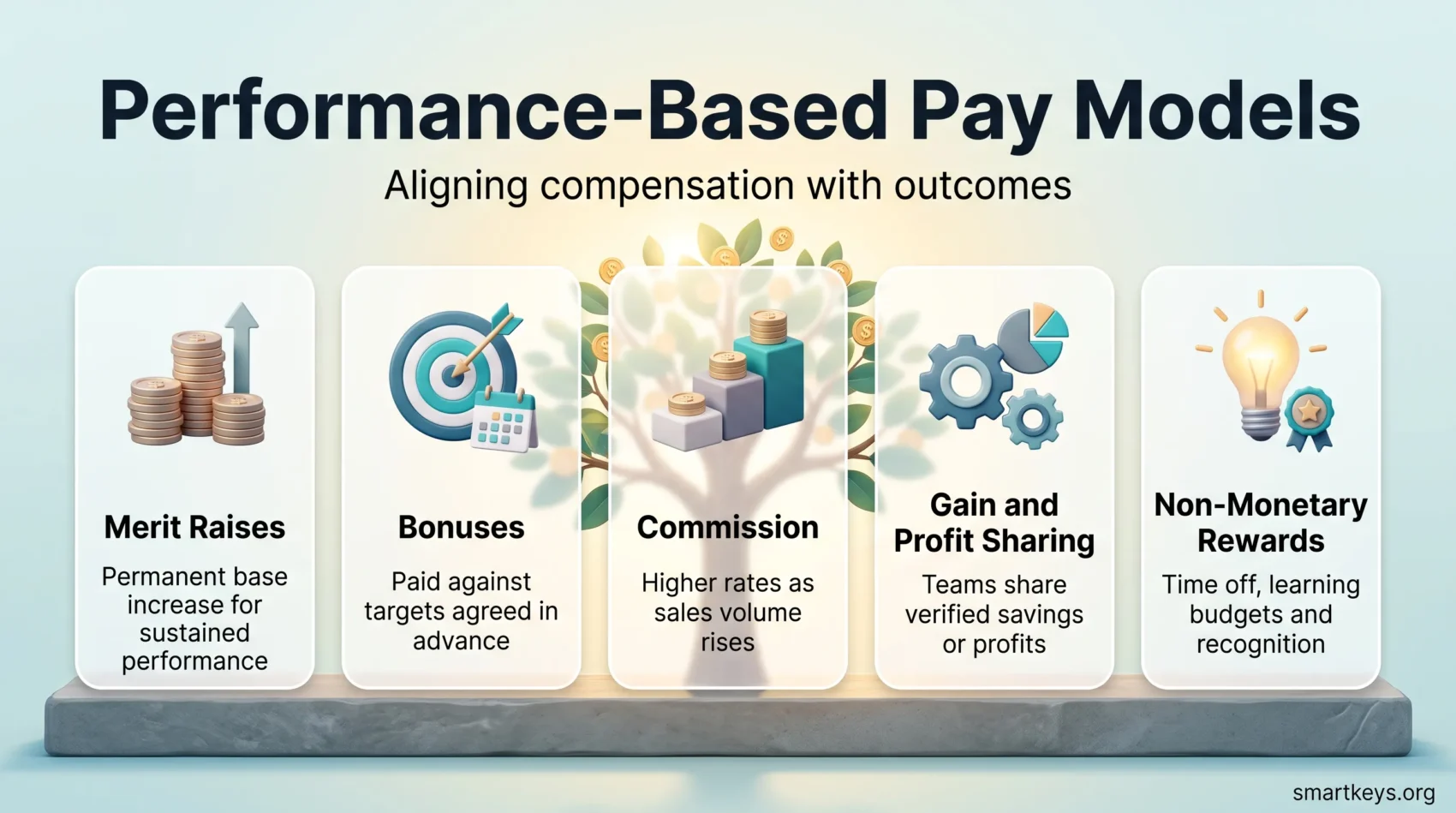
- Five vehicles cover almost every plan: merit raises, bonuses, commissions, gainsharing or profit-sharing, and non-monetary rewards.
- Mercer’s October 2025 survey of 1,013 US employers put 2026 merit budgets at 3.2 percent and total increase budgets at 3.5 percent.
- Pay has moved to the top of the list of reasons people stay, so the variable part now carries real retention weight.
- Write the rules down before the period starts: who qualifies, how the payout is calculated, what the cap is, and how to appeal.
What performance-based pay means, and why it matters now
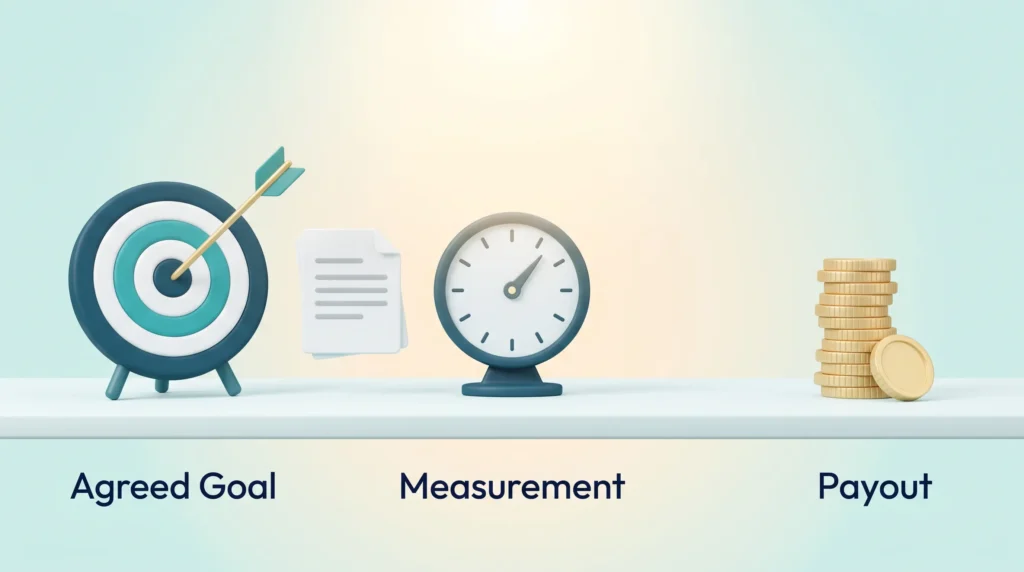
Treat the plan as a short contract. You agree the goal, how it is measured, and what gets paid if it is met. The employee then knows exactly what the extra money is for.
Why the topic is back on the agenda
Two things changed at the same time. Pay budgets stopped growing, and pay became the main reason people stay in a job.
Mercer surveyed 1,013 US organizations in late October 2025. Employers planned merit budgets of 3.2 percent and total salary increase budgets of 3.5 percent for 2026, essentially flat against 2025. WorldatWork’s 52nd annual Salary Budget Survey, completed by 1,774 organizations, reported 3.7 percent actual increases in 2025 and 3.6 percent projected for 2026.
Flat budgets mean the same money has to do more work, which pushes companies to differentiate rather than spread increases evenly.
Meanwhile, McKinsey’s HR Monitor 2026 surveyed roughly 1,300 HR professionals and 5,500 employees in January 2026. Compensation had become the number one reason employees stay, named by more than half of respondents, a rise of 24 percentage points year on year. It displaced job security at the top. If pay is now what keeps people, the design of the variable part belongs in any serious plan for retaining talent.
Where the approach fits best
It fits wherever the result is visible without an argument. Sales is the obvious case, measured by revenue, units sold or renewals. Distributed teams made that harder to observe informally, which is one reason remote and hybrid sales teams lean so heavily on shared pipeline data.
Operations roles can use cycle time, defect rate or on-time delivery. Service roles can use CSAT, the customer satisfaction score collected right after a support contact. Project roles can use milestone quality and delivery dates.
It fits badly where output is slow, shared across many hands, or hard to attribute. Research, design and long-cycle strategy work usually need team-level measures, or no variable pay at all.
The five core models, and when to use each
Match the vehicle to two questions. How clearly can you measure the result? How much does the work depend on other people? Check too that the target describes an outcome rather than an activity, the same discipline behind outcome-based work.
Merit raises
A merit raise permanently increases base salary in return for sustained performance. Use it when someone’s contribution is stable and measurable over a full year.
Plan against the 3.2 percent merit budget Mercer reports for 2026. That is the average pot, not the average award. Differentiating means some people get well above it and some get nothing.
Bonuses and variable pay
Bonuses split into two kinds, and the difference has legal consequences in the United States.
Discretionary bonuses are decided after the fact. A spot award for rescuing a launch weekend is discretionary. Non-discretionary bonuses are promised in advance against stated criteria. Most performance bonuses fall into this second group, which is why the criteria have to be written down.
Commission
Three structures cover most sales roles: straight commission, salary plus commission, and tiered commission that pays a higher rate as volume rises.
A tiered plan might pay 5 percent on the first $50,000 of quarterly revenue, 7 percent up to $80,000, and 10 percent above. Treat those numbers as an illustration, not a benchmark. Your rates depend on gross margin and on how long a new hire needs to reach full productivity.
Gainsharing and profit-sharing
Gainsharing shares a measured operational improvement with the team that produced it. Suppose a line reduces the cost of making a unit and finance verifies the saving. A gainsharing plan returns an agreed slice of that saving to the team. It rewards collaboration, because no individual can move the number alone.
Profit-sharing distributes a portion of company profit. Some plans pay cash. Others pay into a retirement account, which delays the benefit and therefore supports retention. Neither works as a substitute for a competitive base salary.
Non-monetary rewards
Extra paid time off, a learning budget, conference travel, visible recognition and equity all belong in the mix. They cost less than cash and reach motivations money does not. Recognition in particular is cheap and often underused. The mechanics are covered in our guide to positive reinforcement at work, and progress-based rewards borrow directly from gamification in the workplace.
Is your organization ready?
Not every role benefits from an incentive. Start by sorting roles, not by designing a formula.
Map roles to measurable output
List each role and ask one question: can this person materially move a number you already track? If yes, the role is a candidate.
For softer work, use fair proxies. Milestone quality, stakeholder satisfaction and on-time delivery all work for project roles. Document the measure per role, so nobody is judged on a target they only half control.
Watch the team effects
Incentives change behavior, and not always in the direction you intended. Individual targets can quietly discourage people from helping each other, and ambiguous goals are the clearest early warning sign.
Managers decide whether this works: they set targets, judge evidence and handle disputes, which is why manager capability keeps surfacing in current leadership trends. Targets that were never realistic are also a reliable route to burnout, so pilot the scheme with one team first.
Designing metrics and scorecards that hold up
A scorecard is the short list of measures a payout depends on. Keep it short enough to remember without looking it up.

Start with SMART goals
Each goal should be specific, measurable, achievable, relevant and time-bound. That is the SMART checklist, and it exists to stop vague targets like “improve quality” from reaching a payout formula. Our guide to setting goals you actually reach covers the mechanics.
Pick three to five KPIs
A KPI is a key performance indicator, the single number that stands in for a result. Three to five is enough. More than that and people optimize whichever one is easiest.
Balance the set so it cannot be gamed. If revenue is one KPI, put defect rate, churn or CSAT next to it. That is the point of a balanced scorecard.
Calibrate before you pay
Calibration is a meeting where managers compare their ratings against each other before anything is finalized. One manager’s “exceeds expectations” should mean roughly what another’s does.
Bring evidence to that meeting: objective data first, manager judgment second, peer input third. Regular check-ins through the year make this far easier, which is the argument for continuous performance management over a single annual review.
Setting the pay mix
The pay mix is the split between fixed salary and variable pay. It trades the stability an employee needs against the upside the business can afford. Weight the fixed part heavily where results are slow, shared or invisible. Weight the variable part more heavily where results are fast, individual and clearly attributable, such as field sales.
Plan mechanics to write down
- Eligibility: who qualifies, and what happens to new hires and leavers.
- Period: monthly, quarterly or annual, and when the money actually arrives.
- Formula: thresholds, tiers, accelerators and the maximum payout.
- Clawback: when a payout can be reclaimed, for example a deal that cancels inside 90 days.
- Appeals: who an employee talks to if they think the calculation is wrong.
Budget for the likely case
Model three scenarios before approving anything: worst, likely and best case. Check the best case is still affordable, because a plan that overshoots still has to be paid.
Then make administration boring. Automate data capture, standardize the calculation and keep an audit trail. Writing the process down as a procedure, in the way we describe for standard operating procedures, stops the plan depending on one person’s spreadsheet. Across several countries, the calculation usually has to live inside your global payroll system rather than beside it. And do not load the whole scheme onto one manager, because delegating work well applies to running the plan too.
Rollout: communication, fairness and compliance
How you launch the plan matters as much as what it rewards. A scheme people do not understand cannot change behavior.
Explain the plan in plain language
Publish a one-page document per plan. State eligibility, metrics, formula, timeline and the appeals route, with one worked example of a payout calculation. Then keep people updated during the period. A target nobody can track is just a surprise at the end of the quarter.
Compliance: transparency rules and overtime
Two areas catch employers out.
The first is pay transparency. A growing number of US states and cities require salary ranges in job adverts or on request, and the rules differ by state and by employer size. In the European Union, Directive 2023/970 set a transposition deadline of 7 June 2026 and obliges employers to share pay range information with candidates and explain the criteria behind pay progression. Most member states missed that deadline, so the practical position varies country by country. See our overviews of pay transparency rules, global pay parity and future of work legislation.
The second is overtime. Under the US Fair Labor Standards Act, non-discretionary bonuses have to be included in the regular rate used to calculate overtime for non-exempt employees. Truly discretionary bonuses can generally be excluded. Because most performance bonuses are non-discretionary by design, this is a payroll question you settle before launch, not after.
The tools you need
You need three things: a reliable source for each metric, somewhere to store the evidence behind a rating, and a calculation that feeds payroll without manual re-entry. Most companies already own the first. CRM data covers sales, service desks cover support, project tools cover delivery. The gap is usually the link to payroll. People analytics platforms, covered in our guide to workforce analytics tools, close part of it, and predictive analytics for employee data can flag turnover risk before a payout cycle ends.
Be careful how far the tracking goes. Metrics that quietly turn into surveillance damage the trust the plan depends on, a trade-off set out in our piece on AI in employee monitoring.
Benefits, failure modes and fixes
Done well, these plans make the link between daily work and reward visible. That raises effort, focuses attention on the outcomes the business cares about, and helps keep the people you least want to lose. Done badly, they fail in three recognizable ways.
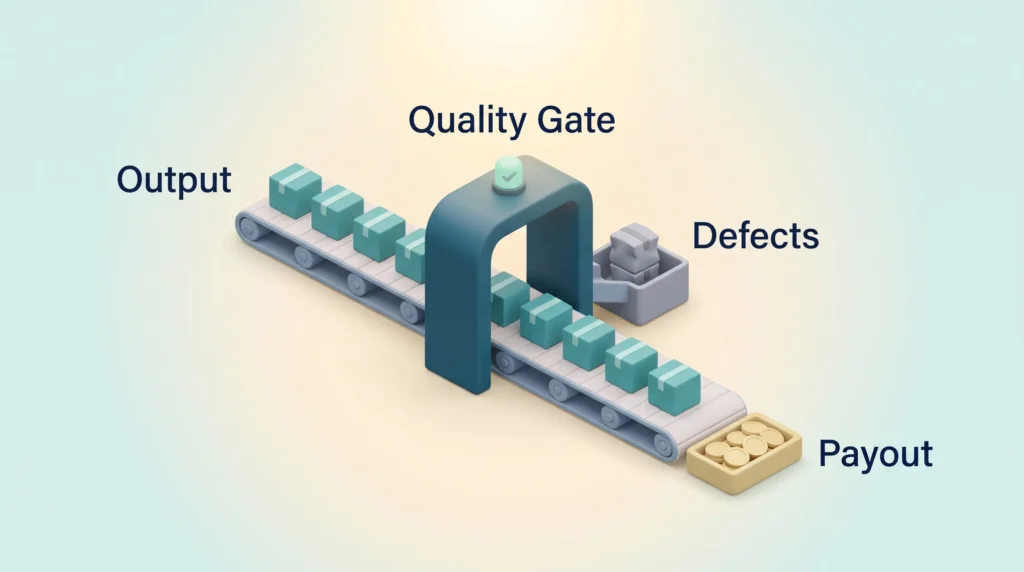
Quantity beats quality. A team hits the volume target and the defect rate climbs. The fix is a balanced scorecard, with a quality gate that has to be passed before any volume payout applies.
Competition replaces cooperation. People stop sharing leads, information or help. The fix is to blend individual and team components, so nobody wins by letting a colleague fail.
The process feels unfair. Ratings look arbitrary and the same performance is rewarded differently across teams. The fix is calibration, documented evidence standards and a real appeals route.
Measure the plan rather than assuming it works. Track retention among your strongest performers, the output metrics the plan targets, and total compensation cost as a share of revenue. Pair those with sentiment data such as an employee net promoter score. If engagement falls while the numbers rise, the plan is buying short-term output at a cost, a pattern worth reading against current HR trends.
Conclusion
Performance-based pay is not complicated, but it is unforgiving of vagueness. Clear targets, measures people can influence, and rules written down in advance do most of the work.
Start small. Pick one team, define three metrics, run a single quarter and publish the results honestly. Keep the base salary competitive, because incentives layered on top of underpayment do not fix underpayment.
Then review the plan once a year. A scheme nobody has revisited is usually rewarding last year’s priorities.
Found this useful?
Make SmartKeys a preferred source on Google, and our articles will surface more often in your Top Stories, AI Overviews, and AI Mode.
Add as Preferred Source