You’ll quickly see how modern support devices reduce strain and help meet safety goals. In the United States, overexertion tied to lifting, overhead work, and repetitive tasks causes millions of injuries and many lost production days each year. Today’s industrial exoskeleton solutions aim to cut fatigue and improve health while fitting into daily work routines.
In this guide, you’ll learn how exoskeletons can improve comfort and performance on common tasks like lifting and assembly. We show practical steps for assessing fit, pilot length, and what to measure so you can make solid implementation decisions.
Expect clear examples from brands such as Toyota, IKEA, and Boeing and straightforward advice on translating technology choices into a usable device shortlist for your workers. By the end, you’ll have a plan to test, measure, and scale solutions that truly support safety and productivity over time.
Key Takeaways
- Passive support systems can cut fatigue on overhead and lifting tasks.
- Comfort and natural tracking affect adoption and long‑term use.
- Pilot tests with clear metrics help justify implementation.
- Look for proven deployments and ergonomics-led training.
- Align device selection with safety goals, not just novelty.
Why now: the present state of exoskeleton technology and workplace safety
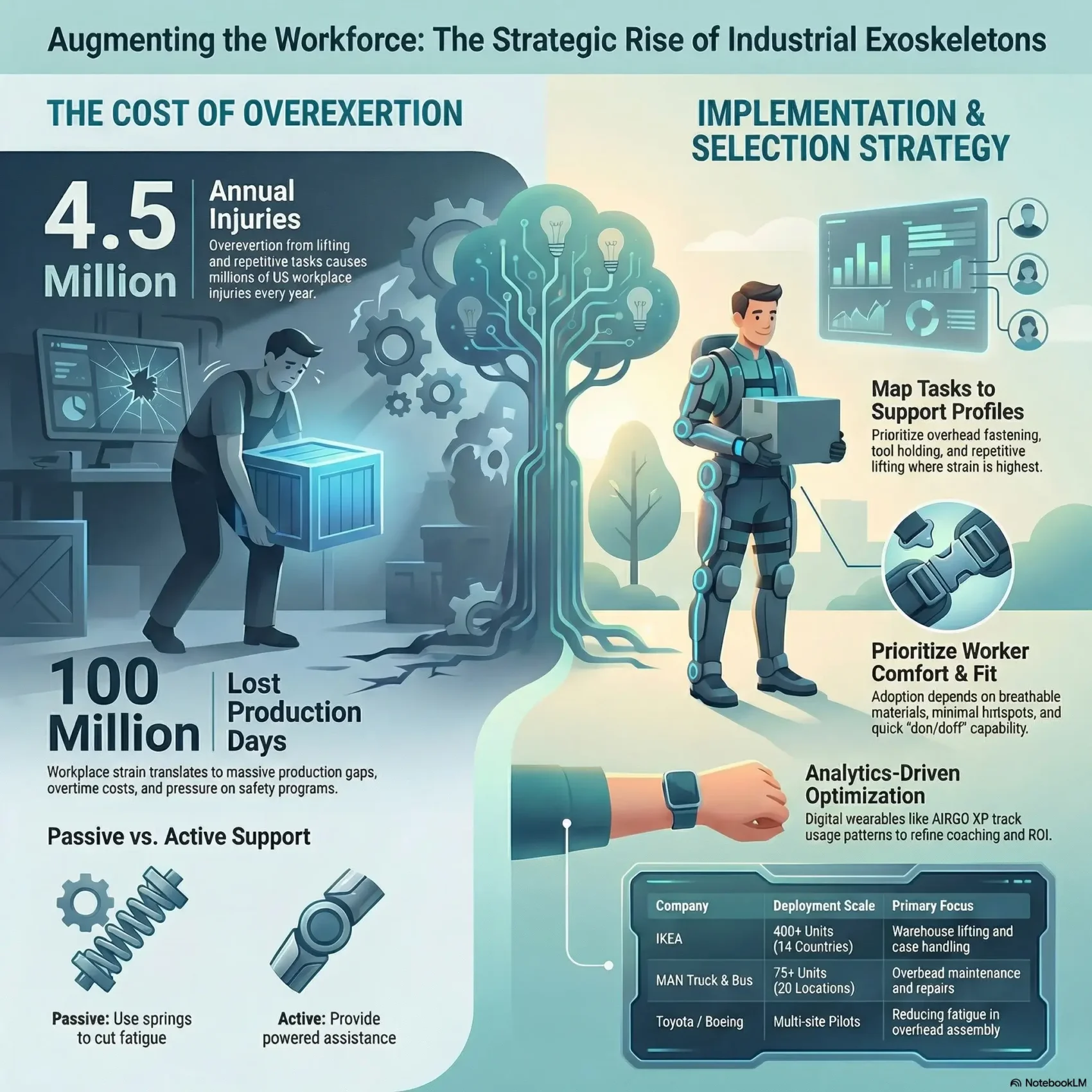
Far beyond novelty, today’s supportive wearable tech addresses real injury trends and measurable costs on the job. You’re up against roughly 4.5 million overexertion injuries and more than 100 million lost production days tied to overhead work, lifting, and repetitive tasks.
Injury and lost days: overexertion from overhead work and lifting
Those numbers translate to overtime, temporary hires, and pressure on your occupational safety programs. Targeted shoulder and back strain drives much of the time away from work. Tracking activity and discomfort helps you pinpoint where interventions matter most.
Today’s opportunity: reducing fatigue while boosting performance
Advances in passive, naturally tracking upper-body systems let workers offload muscle effort during repetitive tasks while keeping range of motion for dynamic work.
- Real example: Ekso Bionics’ Ekso EVO is a lightweight, low‑touch device built for construction, warehousing, and similar settings.
- Start smart: Pilot where lifting and repetitive tasks cluster, measure fatigue and time on task, and tie results to safety and productivity goals.
Exoskeleton workforce: aligning your goals with commercial intent
Start by turning your commercial goals into measurable outcomes that matter on the shop floor. Pick 2–3 clear targets such as minutes saved on critical tasks, fewer discomfort reports, and lower assistance needs during peak tasks. This makes any implementation easier to justify.
What you want to achieve: productivity, safety, and worker comfort
Map tasks to expected gains. Focus pilots on repetitive or static overhead work where reduced muscle load drives real performance improvements.
Confirm device-task fit by mapping job steps. If a job needs frequent kneeling or turning, choose models that preserve mobility and avoid pressure points that cause discomfort.
- Set safety metrics up front: fewer reports of discomfort, lower perceived strain, and reduced need for assistance.
- Engage workers early to define comfort thresholds and build a shortlist of devices that suit your industry.
- Pilot in short cycles, coordinate with supervisors, and document early wins so leaders see business value and workers feel ownership.
Communicate intent clearly: you want to reduce physical effort on targeted tasks, not push faster work at the expense of safety. That builds trust and keeps adoption steady.
Quick buyer snapshot: who benefits most in your industry
Target steady, high-load tasks first to capture measurable health and productivity gains.
You’ll see the strongest ROI in physically demanding, repetitive settings where case handling, overhead assembly, or frequent load repositioning make up daily work.
The logistics sector is a clear example. IKEA deployed 400+ exoskeletons across 14 countries to ease daily lifting and handling in warehouses and stores.
Vehicle maintenance and industrial service groups also gain value. MAN Truck & Bus rolled out shoulder and back units at 20 locations with ergonomics training to cut strain during sustained overhead tasks.
- Where to start: pick tasks with steady cadence so workers can wear a device through high-load steps.
- Buyer priorities: comfort, fast don/doff, adjustability for multi-shift use, and low-maintenance support for mixed settings.
- Implementation tip: add ergonomics coaching and benchmark logistics applications to set realistic deployment size and expectations.
Exoskeleton types explained: passive vs active and body regions supported
Before you pilot gear, learn how passive and powered designs affect comfort, fit, and task performance.
Upper-body and shoulder support for overhead tasks
Upper-body systems use springs or elastic elements to share arm and shoulder loads. They help when you reach or hold tools above shoulder height.
Example: Ekso EVO is a passive exoskeleton that tracks natural motion with large armholes and minimal touch points to preserve your range of motion.
Back-support devices for lifting and repetitive tasks
Back units offload the spine and guide safer posture during lifts and repeated bends. Models like IX BACK AIR reduce spinal compression without batteries, keeping the body free to move.
Range of motion and naturally tracking designs
Look for technology that follows your motion and avoids pressure points. Quick donning, multiple sizes, and PPE compatibility ease implementation in construction and other industry settings.
- Prioritize shoulder systems that don’t interfere with headroom or harnesses.
- Plan use windows so workers wear devices for high-load steps and remove them for other work.
- Watch for discomfort from heat or rubbing and consider analytics-enabled accessories later.
Where exoskeletons shine: applications by task and setting
Pick predictable, high-repetition steps and you’ll see the fastest gains. Supportive devices perform best when tasks demand sustained arm elevation, repeated bending, or steady lifting. Match the device to the job and you cut cumulative physical strain without changing core processes.
Overhead work, assembly, and construction
In construction and assembly, sustained arm elevation drives increased muscle activity and fatigue. Passive, naturally tracking units let you hold tools and fasten parts for longer without extra effort.
Tip: Favor models that keep hard hat and harness compatibility so crews can stay safe and mobile.
Logistics, warehouse, and fulfillment workflows
In logistics, shoulder and back support reduce perceived effort during frequent lifting and case handling. Use devices for peak picks and replenishment to smooth time on task and limit fatigue.
Healthcare and perioperative use cases
Arm-support systems help during long procedures where steady posture matters. Choose devices that meet sterile protocol needs and preserve fine motion for precise work.
- Target: repetitive tasks like overhead fastening, tool holding, and part positioning.
- Watch for: fit, thermal comfort, and limits in highly dynamic settings.
- Pilot advice: schedule wear windows for high-load steps rather than all-day use.
Market landscape: leading industrial exoskeleton equipment you can buy today
The current market mixes passive and powered options that suit different tasks and industries. You can pick proven gear for overhead, lifting, and repetitive steps based on task needs and comfort goals.
Ekso Bionics Ekso EVO: passive, lightweight upper-body support
Ekso Bionics’ Ekso EVO is a passive exoskeleton built to cut fatigue and protect neck, shoulder, and back. It stays lightweight and naturally tracking so crews keep mobility during assembly and overhead work.
IX series: back and shoulder options for varied loads
The IX lineup covers back-intensive and overhead applications. IX BACK AIR offers non-electric spinal relief, while IX BACK VOLTON brings stronger, powered back support with Bosch AmpShare.
IX SHOULDER AIR is the lightest shoulder option, using the body’s motion to ease sustained arm elevation without extra maintenance.
Digital wearables and accessories: AIRGO XP and CX Series
AIRGO XP adds analytics so you can track time in task and comfort trends. CX Series accessories let you tailor support per role, avoiding one-size-fits-all deployments.
- Shortlist Ekso EVO for passive upper-body needs in construction and logistics.
- Match IX models to back or shoulder demands and confirm PPE compatibility.
- Plan phased implementation with vendor fit services and warranty support.
Evidence that matters: ergonomics, muscle activity, and occupational safety
Cited trials and a 2023–2024 scoping review show clear patterns: when you match the right device to steady job steps, you can reduce muscle activity and perceived strain in manufacturing and perioperative care.
What studies show on reduced muscle activity and strain
EMG and field data commonly report lower muscle activation during repetitive or static tasks. That effect is strongest where tasks are consistent and the support does not fight natural motion.
Note: not every model suits every task — pilot devices for both overhead holds and frequent lifting to see which lowers strain most in your settings.
User comfort, fit, and thermal considerations in real workplaces
Discomfort, poor fit, and thermal load are the main reasons workers stop using a device early.
Plan iterative fitting, brief training, and worker feedback loops so comfort improves and adoption follows. Social norms and supervisor support also lift sustained use.
- Measure muscle activity and collect comfort reports.
- Tie outcomes to task durations and health trends.
- Use real-world data to refine your implementation plan.
ROI and total cost of ownership: building your business case
When you tie reduced strain to minutes saved on core tasks, the math for adoption becomes straightforward. Quantify avoided injury costs and lower first‑aid visits, then model how those savings recur over years.
From injury reduction to productivity and time-on-task
Start by mapping specific tasks where support lowers back and shoulder load. Use pilot data to record time per task and changes in discomfort reports.
Example: IKEA’s 400+ deployments and MAN Truck & Bus programs paired devices with ergonomics training to show measurable reductions in strain and lost days.
Training, maintenance, and equipment lifecycle costs
Budget for initial implementation and refresher training so workers use the device correctly. Include fitting services, spares, warranties, and field support in your TCO.
Compare models on maintenance needs: passive options often require less upkeep and still boost performance. Track ROI as adoption scales and align results with insurer and safety program priorities.
- Measure: task time, discomfort reports, and first‑aid visits.
- Include: fitting, training, spares, and multi‑year service costs.
- Engage: supervisors and workers early to protect your investment.
Selection criteria: how to choose the right industrial exoskeleton
A clear selection path keeps your implementation focused on measurable gains. Start by listing the high‑value tasks you need to improve and the support profile each step requires. This helps you narrow options fast.
Match to tasks and range of motion
Map task demands: prioritize overhead fastening, tool holding, and lifting where sustained effort creates strain. Choose devices that preserve your required range of motion and follow natural motion to avoid work slowdowns.
Fit, comfort, and adjustability for diverse workers
Evaluate comfort during real shifts. Models with fewer touch points and large armholes, like Ekso EVO, reduce hotspots and extend wear time.
Test multiple sizes and quick adjust features so one device fits many body types without long changeovers.
Durability, support levels, and PPE compatibility
Confirm equipment durability for your settings. IX BACK AIR favors freedom of motion without electric parts, which can cut maintenance in construction and harsh environments.
- Verify helmet and harness compatibility before purchase.
- Pilot more than one device in dynamic settings to compare usability.
- Score vendors on service, training, and parts to protect long‑term implementation.
Pilot to scale: implementation, training, and change management
Begin small: run a tightly scoped pilot where tasks repeat and data is easy to collect.
Structured pilots, metrics, and worker feedback loops
Set clear metrics up front: time in task, perceived effort, comfort, and first‑aid or assistance events.
Collect daily notes on hotspots, tool interference, and don/doff ease. Use short feedback cycles so you can adjust fit protocols fast.
- Choose pilot settings where tasks are concentrated and repeatable.
- Rotate devices among crews to capture fit and performance variation.
- Share early wins with leadership to justify scale.
On-the-job training and ergonomics coaching
Train workers on donning, doffing, and fine adjustments during real shifts. Pair hands‑on coaching with supervisors to reinforce correct use.
“MAN Truck & Bus paired deployments with personal ergonomics training across 20 locations to cut strain in maintenance.”
Plan refresher sessions and expand slowly. For additional learning tools, consider on-the-job VR training to speed practical coaching and keep momentum.
Integrating with safety programs: OSHA-aligned ergonomics and PPE
Integrating device-based support into daily safety checks reduces confusion and speeds adoption. Begin by mapping devices to tasks with known overexertion risks and add clear use criteria to job hazard analyses.
Treat each unit like task-specific PPE. Add the device to standard work for defined settings, confirm compatibility with harnesses, hard hats, and eyewear, and document that in your procedures.
Codify implementation details: required training, periodic fit checks, and maintenance schedules. Capture ergonomics metrics such as reduced discomfort reports and fewer early fatigue events on your safety dashboard.
- Coordinate policy with safety committees and union reps to secure worker buy-in.
- Use targeted coaching to reinforce correct donning, adjustments, and safe work practices.
- Keep records aligned with occupational safety reporting and log near misses tied to device use.
“Make clear that these devices supplement mechanical aids and safe lifting methods — they do not replace them.”
Conduct periodic reviews by setting to verify the device-task match still works as tools or workflows change. For implementation resources and practical examples, see robotics in workplaces.
What workers say: social acceptance, identity, and comfort in daily use
Workers judge new gear first by how it affects pride in their craft and day-to-day comfort.
Social signals matter. When peers and supervisors treat a device as a smart tool, you get far better buy-in. Position supportive gear as something that protects capability, not a replacement for skill.
Addressing discomfort, thermal burden, and usability limits
Acknowledge discomfort directly. Use transparent fit checks, quick adjustments, and clear rules for when to wear support during specific tasks. Let crews choose when to deploy gear so autonomy stays with the user.
- Fit and comfort: run short fitting sessions and rotate sizes so hotspots are fixed quickly.
- Thermal load: schedule wear windows in cooler parts of the day, pick breathable designs, and rotate devices on hot shifts.
- Usability limits: map tasks that include kneeling or crawling and avoid models that hinder motion.
“Reduced end-of-day shoulder fatigue and steadier tool holding were the most-cited wins on our pilot crews.”
Build social proof with crew champions, collect fast feedback, and celebrate small wins in toolbox talks. This keeps implementation flexible and protects long‑term comfort and safety.
Vendor evaluation checklist: support, service, and data insights
Choosing the right partner matters as much as picking the right device. Look beyond specs and test how vendors support fit, field service, and data-driven follow up in real settings.
Fitting services, warranties, and field support
Require vendor-led fitting services so your teams get the correct configuration for tasks and settings. Real fittings cut early discomfort and save time during rollouts.
Compare warranties and parts availability. Ask about repair turnaround and on-site spares to protect uptime and performance.
Include training packages with on-the-job coaching and refreshers to boost correct use and long-term adoption by workers.
Analytics options and health insights with digital wearables
Evaluate analytics tools such as AIRGO XP to track time in support, usage, and early discomfort signals. Use data to target coaching and refine implementation.
Confirm device portfolios cover your task mix—from overhead relief to lifting—so you can scale with consistent technology and service standards.
- Verify PPE and tool compatibility with demo workflows.
- Use a performance scorecard: fit success, comfort satisfaction, and adoption by setting.
- Prioritize vendors with pilot playbooks, change management help, and quick adjustment options for discomfort hotspots.
- Negotiate trial periods with measurable outcomes before committing to large orders.
Proven applications: logistics, automotive, and construction case highlights
Case highlights from logistics, automotive, and construction show the practical benefits of well-chosen support gear.
IKEA logistics: hundreds improving daily lifting
IKEA deployed 400+ units across 14 countries to support frequent lifting and case handling in stores and warehouses.
Result: crews sustained activity and time on task with fewer fatigue complaints during peak shifts.
MAN Truck & Bus: reducing physical strain in maintenance
Since July 2024, MAN introduced more than 50 shoulder and 25 back devices across 20 locations.
They paired the rollout with ergonomics expert training so maintenance teams saw lower physical strain during overhead and awkward repairs.
Voice of industry: Toyota, DB Schenker, and Boeing on overhead work and fatigue
Leaders report reduced end-of-day fatigue from targeted shoulder and back support. DB Schenker is exploring formalizing units as PPE for certain tasks.
- Benchmark logistics success with IKEA, where exoskeletons used daily aid lifting and case handling.
- In automotive maintenance, MAN targets shoulder and back support to cut strain, backed by structured training.
- Construction lessons transfer: choose shoulder support for overhead fastening and back support for repeated lifting while preserving freedom of motion.
- Validate your industrial settings through pilots; what works in stores may need tweaks for field shops.
“Reduced end-of-day fatigue and steadier tool holding were the most-cited wins on pilot crews.”
Tip: document tasks helped, capture worker feedback, and track first-year time and injury trends to prove sustained benefit.
Future-ready features: from passive support to smart analytics
New device design is moving fast. You can now combine lightweight passive help with data tools that track use and comfort.
Lightweight assist, natural tracking, and freedom of motion
Choose designs that preserve natural motion. Options like the Ekso EVO show how large arm openings and minimal touch points keep your range of motion free.
Non-electric models, such as the IX series, favor freedom of movement and lower maintenance in rough construction and varied settings.
Digital health tools to monitor performance and discomfort
Expect analytics to be standard. Platforms like AIRGO XP bring activity and time-in-task data so you can spot discomfort trends early.
Use those insights to tune fit, target coaching, and compare human performance across teams. That prevents problems instead of just adding more devices.
- Future-proof: pick modular components and clear upgrade paths so devices adapt as tasks evolve.
- Measure: combine simple activity metrics with comfort reports to guide training and maintenance.
- Prioritize: lightweight designs where freedom of motion matters most, such as construction or dynamic assembly.
Build a roadmap that starts with passive deployment and grows into analytics-driven optimization. Choose vendors who invest in R&D and offer clear upgrade paths so your program improves with the technology and protects long-term health and performance.
Conclusion
Finish by anchoring decisions in task data, worker feedback, and repeatable pilots. Start small: run focused trials in the most physically demanding settings and measure time on task, fatigue, and strain.
Match devices to specific tasks and confirm fit, comfort, and PPE compatibility so workers wear support during peak lifting and overhead steps. Use vendor training and analytics to tune performance and sustain adoption.
Scale where results show fewer injuries, steadier work output, and clear worker buy‑in. With a flexible roadmap and ongoing feedback loops, you can make exoskeletons a targeted tool that improves occupational safety and supports long‑term industry goals.