Hybrid work means splitting your working week between the office and somewhere else, usually home. It is no longer an experiment. In the United States it has settled into a stable pattern, and the interesting question has moved on: not whether to do it, but how to structure a week so that both halves actually work.
This guide answers that. You will learn how to decide which tasks belong in the office and which belong at home, how to agree office days with your team instead of guessing, and how to stay visible when you are not in the room. It is written for the person planning their own week and for the manager planning everyone else’s.
Key Takeaways
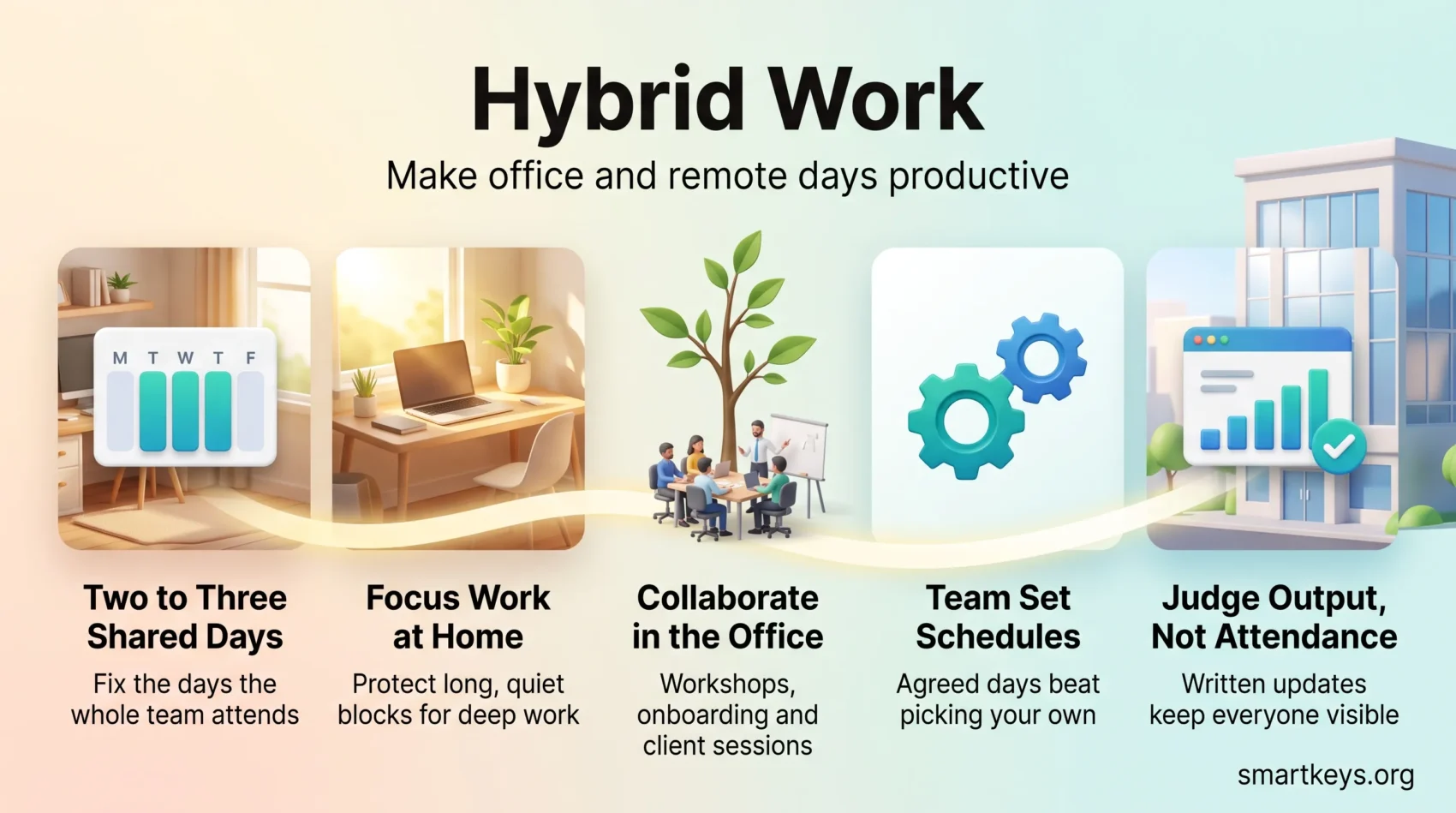
- Group collaboration on shared office days and keep deep focus work at home.
- Let the team agree its office days. The evidence says that beats everyone picking their own.
- Protect visibility with regular written updates so your work is seen from either location.
- Match each task to the setting that suits it rather than splitting the week arbitrarily.
- Judge output, not attendance. That is what keeps a hybrid team fair.
What hybrid work looks like in 2026
Hybrid stopped moving several years ago. Roughly a quarter of paid full days in the US were worked from home in May 2026, according to Stanford’s Survey of Working Arrangements and Attitudes, against about 5% before the pandemic. That share has barely shifted since 2022.
The numbers have settled
Among employees whose jobs can be done remotely, Gallup’s May 2025 panel found 51% working hybrid, 28% fully remote and 21% fully on site. Hybrid workers spend about 46% of the week in the office, which works out at roughly 2.3 days.
This stability is useful. When the pattern holds from month to month, you can build routines that survive contact with a real calendar, and managers can set norms that stay fair. Constant renegotiation is what makes hybrid exhausting, not the arrangement itself.
Who decides which days you come in
Gallup found responsibility split almost three ways: about 34% of employees choose their own days, 35% follow a team or manager plan, and 31% follow a company-wide policy. Which of those three applies to you changes everything about how you should plan, so it is worth asking directly if nobody has told you.
How many office days actually help
Two to three shared days is the range most research and most employers land on. Gallup links that range to higher engagement and lower burnout than either extreme. A practical version: fix two days that the whole team attends, and keep a third flexible for workshops, onboarding or client sessions.
- Make the days predictable so the office is neither packed nor empty.
- Review the pattern each quarter using attendance data and team feedback.
- If your employer leaves it open, propose a clear norm rather than waiting for one. See our guide to flexible work schedules for the options.
What you gain and what you give up
Hybrid buys you a choice of environment, and that is where the value sits. Concentration is cheap at home and expensive in an open office. Spontaneous problem-solving is the reverse. Used deliberately, the split lets you put each kind of work where it costs least.
Focus, retention and time back
The strongest evidence comes from a randomised trial at Trip.com run by Stanford economist Nicholas Bloom and colleagues, published in Nature in 2024. About 1,600 employees in engineering, marketing, accounting and finance were assigned by birthday to either five office days or three, with two at home. Resignations in the hybrid group fell by 33%, with the largest drops among women, non-managers and people with long commutes. Performance reviews, code output and promotion rates showed no difference between the two groups.
The practical gain is smaller and more immediate than that suggests. A commute you do not make on Tuesday is an hour you can spend on the report that has been slipping, or on your children. Reserve mornings at home for deep work, the long uninterrupted stretches that complex tasks need, and the arrangement starts paying for itself within a week.
The friction: meetings, visibility and blurred boundaries
Three problems recur. The first is meeting quality. Small calls of two to four people work fine on video; large sessions with a mixed room and remote crowd tend to stall, because the people dialling in cannot read the room or interrupt cleanly. Our guide to hybrid meeting etiquette covers how to run those without losing half the participants.
The second is visibility. If your manager mostly sees the people physically nearby, your contribution can quietly go unrecorded. That is proximity bias, and it is the single biggest fairness risk in a hybrid team.
The third is the day that never ends. Without a commute to mark the boundary, work leaks into evenings. Setting explicit boundaries, such as a fixed shutdown ritual, does more for this than any app. Left unaddressed, it feeds straight into employee burnout.
Choosing a schedule model that fits your team
Start from the work, not the calendar. List the tasks that genuinely need people in the same room, then build the week around those.
The four common models
At-will lets each person pick their own days. Split-week fixes the same days for everyone, for example Tuesday to Thursday. Manager-scheduled means the team lead sets anchor days, the recurring days everyone is expected in. Policy-driven means the company mandates a minimum. Most teams end up with a blend, but only one model should be the default, and everyone should be able to name it.
Sales teams often anchor Tuesday to Thursday for pipeline reviews and client meetings. Engineering teams tend to prefer two anchor days for design sessions and pairing, keeping the rest clear for build work. Support teams with shift coverage usually need staggered attendance and one weekly sync.
Why team-set days beat pick-your-own
This is where the data is unusually clear. Gallup found that employees on team-determined schedules reported the same sense of fairness as those who chose their own days, around 91%, but with less burnout and better work-life balance. Individual choice sounds generous and produces offices where nobody overlaps with the colleague they needed.
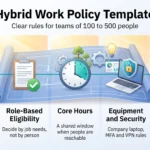
Bloom has made the same argument repeatedly: uncoordinated days undermine the collaboration that justified coming in at all. If you are writing this down formally, our hybrid work policy template covers the clauses worth including.
Avoiding crowded Wednesdays and empty Fridays
- Coordinate centrally so teams do not all pick midweek and abandon Monday and Friday.
- Write a light policy: core days, core hours, meeting standards. Two pages, not twenty.
- Tie desk and room booking to anchor days, and revisit the pattern quarterly.
- Give managers explicit responsibility for setting days, protecting focus time and enforcing meeting hygiene.
If your office is chronically half empty, the question may be about space rather than schedules. The future of workspaces looks at the cost side of that decision.
Structuring your own week
Whatever model your team uses, you still control the shape of your days. The goal is long protected stretches at home and high-contact time in the office.
Match the task to the place
Block your focus time on the calendar rather than hoping for it. Mornings at home suit writing, analysis, coding and anything that takes more than 40 minutes to get into. Time blocking is the simplest way to reserve those stretches, and a team-wide focus time policy makes them stick when your calendar is shared.
Turn off non-essential alerts during those blocks and batch your messages instead of reacting to each one. Our guide to managing work notifications has the settings worth changing. Meanwhile, save office days for the things that are genuinely better in person: workshops, onboarding a new colleague, difficult conversations, customer sessions. A well-set-up home office matters more here than most people expect, because it is where the demanding work now happens.
Meeting rules that hold across locations
Keep small meetings small. Two to four people, a written agenda, a stated decision to reach. Reserve large gatherings and kickoffs for days when most of the group is already in the building.
- Leave buffers between calls and write decisions into a shared document, not just chat.
- Move routine status updates to asynchronous work, meaning written updates people read when it suits them rather than live check-ins.
- Protect at least one meeting-light day a week, and say which one it is.
- Check the basics before office days: booked desk, headset, stable connection.
Share your weekly shape with your manager and team so nobody has to guess when you are reachable. Then watch which arrangement actually produces your best work and adjust. The pattern that suits a project manager rarely suits an engineer.
Managing a hybrid team: trust, fairness and visibility
Managers set the temperature. Most hybrid problems that look structural turn out to be management habits that were never updated for a split team.
Four manager habits that build trust
Gallup points to four practices that hold mixed-location teams together: communicate the same information to everyone regardless of location, keep team rituals alive, hold people accountable for outcomes rather than hours, and give equal access to feedback and development.
The last two carry the most weight. Managing by results instead of hours removes the incentive to perform busyness for whoever is watching. Equal access to development is what stops the office group quietly accumulating advantages. If you lead remotely, our guide to remote leadership skills goes further into the day-to-day mechanics.
Proximity bias: what the evidence actually shows
The classic warning comes from Bloom’s earlier experiment at the Chinese travel company Ctrip, published in 2015. Call centre staff who worked from home four days a week were 13% more productive and half as likely to quit, but their promotion rate was almost 50% lower than that of office-based colleagues.
The pattern is not inevitable. In the 2024 hybrid trial, where employees were in the office three days a week, promotion rates were the same for both groups.
The difference between those two results is worth sitting with. Near-total remote work with no deliberate correction produced a career penalty. A structured hybrid arrangement, with regular shared days, did not. Visibility is a design problem, and it can be designed away.
- Publish promotion criteria and judge against them, in writing.
- Rotate who runs meetings and who presents to leadership.
- Document decisions and name who contributed, so credit does not depend on memory.
- Hold one-to-ones and coaching at the same frequency for everyone, whatever their location.
Employees can act here too. Advancing a career from a distance is largely a matter of making your work legible: short regular summaries, visible demos, a record of what you shipped. And engagement data on remote teams is a useful early warning when something is drifting.
Tools and workspace tactics that make hybrid work
Good tools make office days predictable. That is their whole job. If people arrive and cannot find a desk, a room or a colleague, the trip was wasted and the next one gets skipped.
Booking, wayfinding and workplace analytics
Reserve desks and rooms before you travel in. Wayfinding, meaning digital signage or an app that shows where people and free rooms are, saves the ten minutes usually spent wandering. Workplace analytics, the utilisation data your building systems already collect, tells you which days are overloaded and how much space you actually need.
Use that data to right-size the office rather than to monitor individuals. If you need to turn it into a budget decision, our remote vs office cost comparison sets rent, productivity and retention side by side. The moment attendance figures start appearing in performance conversations, trust evaporates and people game the badge readers.
Keeping status visible without more meetings
One shared calendar showing who is in and when solves more coordination problems than any chat integration. Add agreed norms for response times, focus blocks and end-of-day notes, and most of the guessing disappears. A well-run digital headquarters makes that the default rather than something individuals maintain by hand. Some teams go one step further and run a virtual office for hybrid teams, a shared online space where colleagues can see who is around and drop in, as long as it never turns into a presence monitor.
- Connect the systems: booking, calendar and chat should update each other automatically.
- Invest in room cameras, microphones and shared whiteboards so remote participants are heard, not tolerated.
- Write a short playbook with concrete examples: workshops in the large room, quiet zones for focus, lounges for cross-team conversation.
The tools that keep in-office and remote staff in sync are worth reviewing before you buy anything. Involve IT and facilities early so the result is secure and usable rather than one or the other.
Conclusion
Hybrid work rewards structure and punishes improvisation. Build a weekly plan with two or three shared office days for collaboration, and keep protected stretches at home for the work that needs quiet.
Favour team-agreed days over individual choice. Keep large gatherings in person and small tactical sessions on video. Book what you need before you travel in, and make your work visible with short regular updates rather than hoping someone notices.
None of this is finished. Watch what genuinely helps your team, ask them regularly, and keep judging outcomes rather than attendance. For the wider picture of how work settled into this shape, see the evidence on hybrid workspaces and wellbeing.
Found this useful?
Make SmartKeys a preferred source on Google, and our articles will surface more often in your Top Stories, AI Overviews, and AI Mode.
Add as Preferred Source