Tools
Tools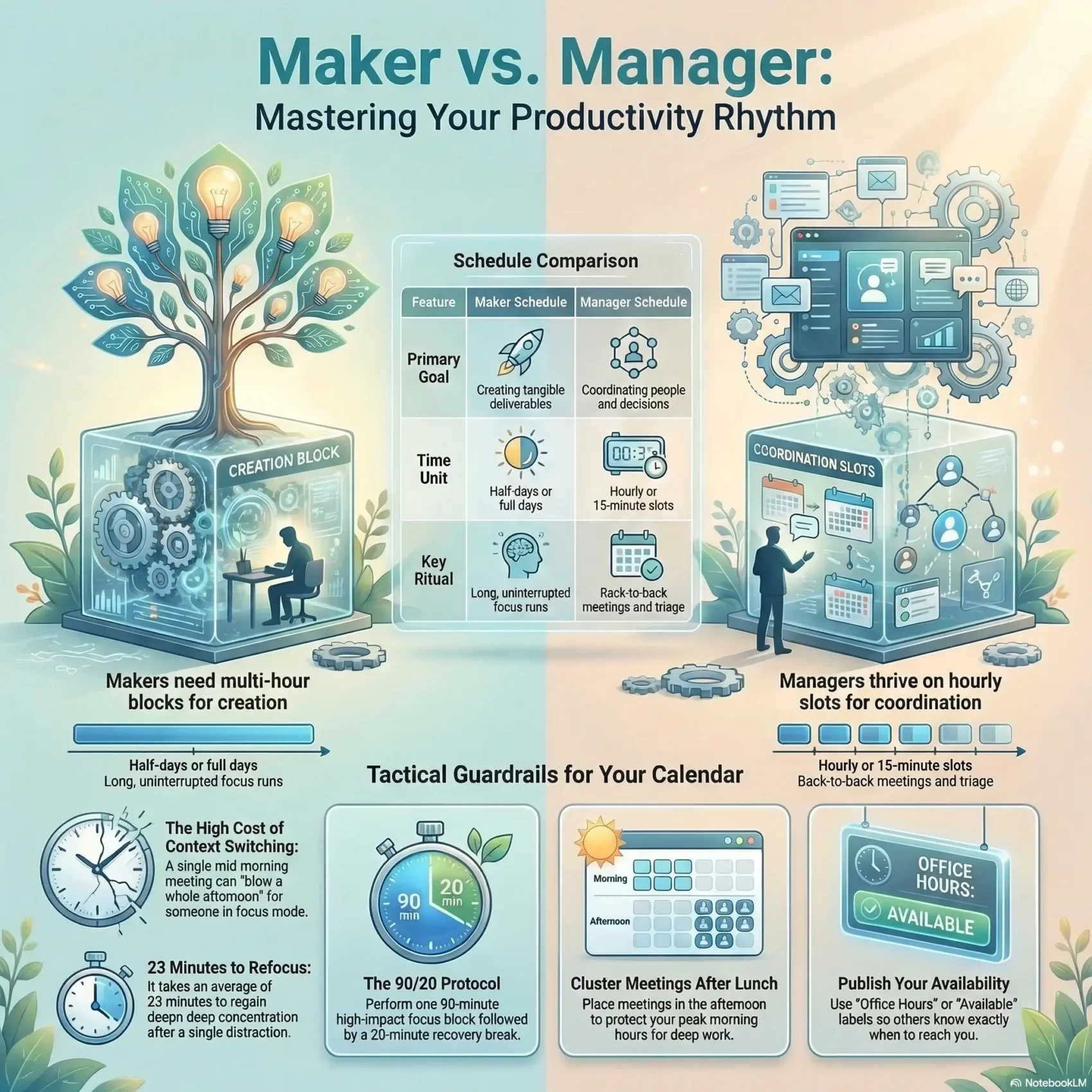
Last Updated on April 2, 2026
You juggle a lot each day, and a small change in timing can shift your output a lot.
Paul Graham described two ways people shaped their day: one that favors long, uninterrupted blocks and another built around back-to-back meetings. Meetings can eat an afternoon and break deep focus. Other times, meetings are the very medium of your work.
This short guide helps you match your schedule to the kind of work you do. You’ll see how to protect focused hours, use Do Not Disturb slots, and add “available for meetings” windows so people know when to reach you.
Learn practical, friendly tactics—like after-lunch meetings and strict time-boxes—that let your week and day support deep work without sidelining teamwork. The goal is simple: get the right things done, reduce context switching, and make time work for you.
Key Takeaways
- Two main rhythms exist: long focus blocks and meeting-driven hours.
- Protect deep work with Do Not Disturb and time-boxes.
- Use after-lunch slots and clear availability to balance calendars.
- Small scheduling changes can improve quality and reduce burnout.
- Align your week and day to match how you actually create value.
What You’ll Learn: Choosing the Right Schedule for Your Work and Week
Pick a schedule that fits how you produce value each week—not one you inherited by habit. You’ll learn to tell whether a manager schedule or a maker schedule matches your core work, and how to plan with intention.
Simple compromises—like published availability, a few planned meetings, and Do Not Disturb slots—give you predictability without shutting people out.
- You’ll carve protected time for deep work while keeping space for essential meetings.
- You’ll set clear windows for collaboration so your day doesn’t get chopped into tiny pieces.
- You’ll test after-lunch meeting blocks and short office hours to support people without losing long focus runs.
- You’ll use weekly reviews to tweak time use, spot wasted slots, and make small improvements that add up.
- You’ll adopt team habits—like sharing schedules—that reduce back-and-forth and respect everyone’s best hours.
Defining the Two Schedules: From Paul Graham’s Essay to Today’s Office
First, identify the cadence you live in: rapid, hour-by-hour coordination or extended blocks for deep creation. Paul Graham noted the split in 2009: one rhythm treats a single meeting as just another hour, while the other needs half a day or more to make progress.
Manager schedule: this rhythm runs on hourly slots. Meetings are the medium for quick decisions and for unblocking teams. Andrew Grove argued that fast coordination is how many leaders move work forward in an office.
Maker schedule: this pattern needs long, uninterrupted time to hold complex ideas in your head and finish hard work. For a person on this schedule, one short meeting can “blow a whole afternoon.”
- Why meetings feel different: what’s trivial on an hourly schedule fragments deep work into pieces too small to complete major tasks.
- In many workplaces, the default cadence favors managers, which can unintentionally tax makers’ attention and output.
- Neither schedule is inherently better; each optimizes for different outcomes—speed of decision or quality of output.
“A single meeting can blow a whole afternoon.”
Use this framing to start clear agreements with your team: publish when you’re for decisions and when you need protected time. That shared language reduces friction and makes calendars more respectful of both rhythms.
Real-World Routines: Murakami, Gary Vee, and Asimov on Time and Focus
Concrete days from notable creators show how consistent hours shape what you produce. These routines make it easier to decide which parts of your own schedule deserve protection.
Haruki Murakami’s strict morning writing blocks
Murakami began writing at 4am and kept five to six hours for work. He exercised and read afterward, then aimed for an early bedtime. That discipline protected deep writing hours and shows how a maker schedule preserves long stretches for craft.
Gary Vaynerchuk’s tightly sliced, meeting-heavy day
Gary Vaynerchuk starts around 6am and fills his day with short meetings, calls, and social posts. His approach is high-velocity: rapid decisions and constant communication let him leverage people and momentum across the day.
Isaac Asimov’s relentless daily output
Asimov worked daily for years, even on holidays and in hospital stays. His steady hours and refusal to skip days show how small, repeated effort compounds into massive output over time.
What these contrasting days teach you about scheduling
You’ll see that copying someone’s wake time won’t help unless the work matches your energy. A writer who shines in long blocks should guard those mornings. A person who coordinates teams benefits from tightly sliced hours.
- Protect your best hours for the tasks that need them.
- Match your day to whether you create or orchestrate.
- Commit to consistency—lean on repeatable rhythms for years, not bursts.
For practical steps to build better time habits, try a simple weekly review and publish your availability like a mini office policy. Learn more about improving your calendar at better time habits.
“Consistency, not intensity, drives the biggest returns.”
Mindset Matters: How Makers and Managers Think, Decide, and Deliver
The way your mind holds a project changes what kind of calendar helps you finish it. Some people keep an evolving mental model of the thing they’re building. Interruptions force them to rebuild that model from scratch.
Protecting your working model means guarding long chunks of uninterrupted time so complex ideas survive the day. When you keep that thread intact, you finish harder tasks faster and with fewer mistakes.
Other roles require rapid context switching. That approach excels at removing blockers and making quick decisions across people and projects. It trades long uninterrupted runs for momentum and effective coordination.
- Keep the model intact: block dedicated hours for deep work and label them clearly.
- Reduce switching costs: use rituals (pre-work checklists, short summaries) to jump back in faster.
- Balance standards: decide when “good enough” beats perfect to meet deadlines and keep teams moving.
- Set meeting guardrails: short slots for coordination, big blocks for building, and published availability so people know when to reach you.
“Don’t let meetings chip away at the mental model you need to finish complex stuff.”
Learn practical ways to lower interruption tax and improve your calendar with a short read on task switching and productivity.
maker vs manager
Your calendar often reveals whether you’re expected to create deliverables or to keep people aligned. The core difference matters because it determines what kind of time you must defend.
The core difference: creating tangible value vs. coordinating people
Makers need long, uninterrupted runs to produce tangible outputs. They hold complex ideas in their heads and finish work best in multi-hour blocks.
Managers often build progress by coordinating people, making quick decisions, and using meetings to unblock teams.
The hidden costs: attention residue, switching costs, and interruptions
A short meeting can leave attention residue that costs more time than the meeting itself. Paul Graham warned a single mid-morning slot can “blow a whole afternoon.”
Ray Ozzie’s four-hour rule says serious work usually needs four clear hours. Studies cited by Susan Cain show top programmers had far fewer interruptions and far higher output.
The office reality: why conflict happens and how to reduce it
Many offices default to meetings, which tilts calendars toward coordination and creates friction with people who need deep focus.
- Align expectations: publish availability windows so others know when you are open for meeting requests.
- Batch discussions: cluster meetings later in the day and reserve morning focus hours for big tasks.
- Protect focus: use privacy, quiet spaces, and clear Do Not Disturb signals to lower interruption rates.
“A single meeting can blow a whole afternoon.”
Make the tradeoffs visible. Coach leaders to ask if a meeting must be live or if an async update will do. When both sides share their preferred windows, the office problem of conflicting calendars drops—and business output improves.
Blending Roles Without Burnout: Partitioning Your Day and Week
You can protect deep work and still stay reachable by partitioning your day into clear modes. Set simple rules that keep long creative runs intact while giving people predictable slots for coordination.
Elon Musk’s split
Use very short manager slots for rapid decisions and triage. Elon separates five-minute leadership bursts from large engineering blocks.
Paul Graham’s office hours
Paul Graham clusters meetings into late-day office hours so morning focus stays uninterrupted. Block an “available for meetings” window and defend the rest.
Adam Grant’s batching
Batch work across seasons. Teach or consult during one quarter and reserve the next for deep research. Use autoresponders and set expectations for email and emails during focus stretches.
- Split your time: short coordination bursts, long build blocks.
- Time-box decisions to 5–15 minutes to protect following hours.
- Mark calendar labels: “focus” vs “available” so people know when to reach you.
Design Your Calendar: Weekly and Daily Tactics That Actually Work
Treat your calendar like a contract: set firm focus hours and clear windows for people to book time. When you make those rules explicit, you cut ad hoc interruptions and protect real progress on important tasks.
Block Do Not Disturb windows and stick to time-boxes
Block daily focus windows and honor them as if they were meetings. Use a visible status in the office and on chat so people know not to interrupt unless it’s urgent.
Keep time-boxes strict: start and end on time. Short meetings that overrun steal from the next block and fragment your day.
Place meetings after lunch; avoid mid-afternoon bisection
Put most meetings after lunch to keep mornings for deep work. That simple shift prevents a mid-afternoon split that wrecks momentum for creative or complex tasks.
- Share weekly availability: publish when you’re open so your team can plan instead of sending ad hoc requests.
- Batch similar things: cluster reviews, emails, and approvals to cut switching costs.
- Add agendas and pre-reads: make every meeting shorter and more useful by preparing ahead.
- Schedule knowledge lunches: replace many one-off pings with a single focused session.
- End with a five-minute review: reset your task list and protect tomorrow’s most important work.
“A clear calendar reduces interruptive friction and makes deep work possible.”
Team Agreements: Make Meetings Worth It—and Fewer
Set clear ground rules so every meeting you host earns the team’s time back. Use a short agreement your people can follow: purpose, prep, and strict time-boxing.
Start with purpose-first agendas. If a meeting has no clear decision or conversational need, cancel it and free up time for focused work.
- Require an agenda: list outcomes (decision, risks, blockers) before you book a meeting.
- Ask participants to prepare: use pre-read notes so the meeting time is for alignment and decisions, not status updates.
- Respect time-boxes: end on time and capture follow-ups as clear action items.
- Cluster shared windows: group meetings after lunch so your team can plan deep focus blocks in the morning.
- Measure impact: track which meetings actually produce outcomes and trim the rest.
Encourage managers to protect makers and honor a simple team “do not disturb” signal unless something is urgent.
“Scrum events aren’t meetings but opportunities for a conversation.”
Normalize replies like, “Not now — propose a slot in our meeting window,” so fewer interruptions hijack the day. Over time, these agreements will reduce wasted time and make decisions faster.
Tools, Metrics, and Signals: How You Know Your Schedule Works
Measure how your calendar affects real output, not just how full it looks. Use simple tools and clear signals so your schedule becomes a living strategy for better work.
Practical steps: create morning and late-afternoon email windows to stop inbox splinters. Batch similar tasks and decisions so you reduce context switching. Publish “available for meetings” slots so people can book predictably and your focus blocks stay intact.
Track the right metrics
- Deep work hours: log weekly hours of uninterrupted work and aim to raise or stabilize that number.
- Decision velocity: measure how fast key decisions happen and remove bottlenecks.
- Interruption rate: count unplanned interruptions and test signals or quiet zones to lower them.
Keep a lightweight dashboard or weekly scorecard. Review which meetings produce outcomes and sunset the rest. Align this schedule strategy with business goals so your time and tasks support what matters most.
“Small metrics reveal big schedule wins.”
Conclusion
End by picking one scheduling change that will compound into real time gains.
Match your day to the core of your job: protect key hours for deep work and open clear windows for quick decisions. Paul Graham’s framing shows conflict when rhythms collide; small compromises cut that friction.
Adopt simple rules: after-lunch meetings, strict time-boxes, and published availability. These shifts give your team predictable slots to reach you and preserve long focus runs that produce things.
You’ll waste less time by ending weak meetings, moving routine stuff async, and guarding a few hours each week. Do this and your schedule will serve your work and your business, not the other way around.