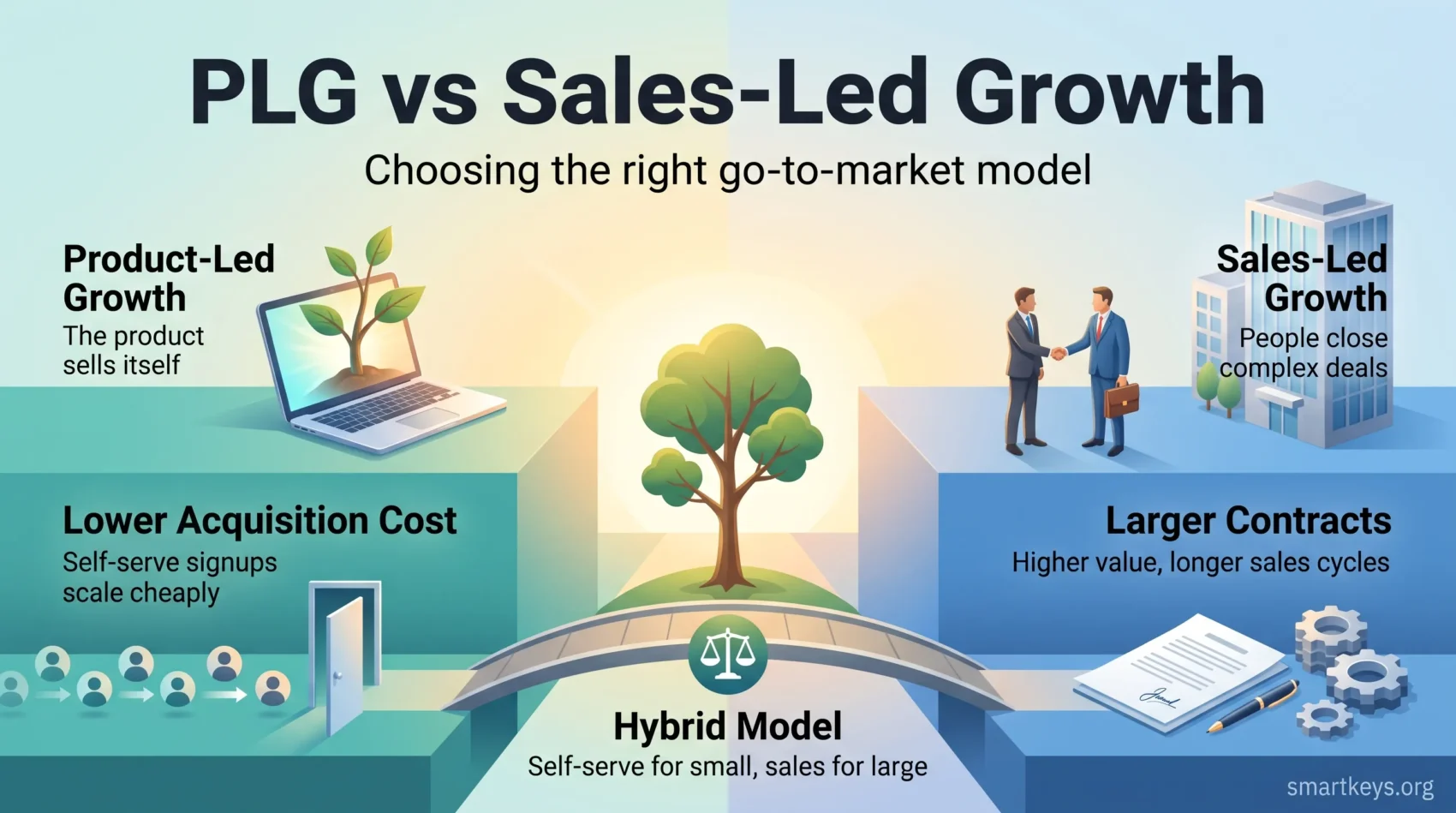
Your go-to-market model decides how people first meet your product and how money reaches your account. Two models dominate. In product-led growth, people sign up, try the product and pay for it without ever speaking to a salesperson. In sales-led growth, a sales representative runs the process from first call to signed contract.
Most software companies now run at least some product-led motion. In a 2025 benchmark survey of more than 600 B2B software businesses, ProductLed found that 58% had a product-led motion in place. That does not make it the right answer for everyone, and the buyer data from 2026 shows why.
This guide compares both models and the hybrid path most companies end up on: where self-serve signup works, where a sales team is unavoidable, and which signals tell you which side you are on.
Key Takeaways
- Product-led motions scale signups cheaply; sales motions win complex, high-value deals.
- Free trials and guided onboarding only work if people reach a useful result fast.
- Choose sales when several stakeholders, security reviews or custom contracts are involved.
- Most companies end up hybrid, usually when they move upmarket or hit a self-serve ceiling.
- Decide with four numbers: deal size, time to first value, acquisition cost and buying friction.
Start with how your buyers actually buy
Your go-to-market motion should copy the way people in your category already purchase software. Fighting that habit is expensive.
Look at how similar companies sell. If every competitor in your niche runs a free tier and a credit card checkout, buyers will expect one from you too. If they all run demos and annual contracts, a self-serve signup page will feel like a missing step rather than a convenience.
Then ask your own customers. Do they want to try the product alone on a Tuesday evening, or do they need a guided walkthrough, a security questionnaire and a purchase order? Both answers are legitimate. They just lead to different companies.
- Check the friction: can someone pay by card, or does the purchase need procurement approval and a legal review?
- Check your resources: can you staff a small growth team of designers, engineers and analysts, or do you need quota-carrying sales reps now?
- Check the unit economics: deal size, payback period and churn should decide where the budget goes.
Developer tools often grow through community and documentation. Enterprise platforms usually need people to align stakeholders and answer compliance questions. Write down a clear thesis, run small tests, and treat the decision as reversible. Your product and your buyers will change, and so should the model.
Product-led growth: the product does the selling
Product-led growth (PLG) means the product itself handles acquisition, activation and expansion before any salesperson gets involved. Someone finds you, signs up, gets a result, invites a colleague and upgrades. That is the whole loop. This article only covers the choice between the two models. If you want the mechanics of running PLG, from onboarding to expansion, our complete product-led growth playbook walks through them step by step.
Freemium and free trials: getting to first value
A freemium plan (a permanently free tier with limited features) or a short free trial lets people qualify themselves. They test the product against their own work instead of against a demo script. Our guide to the freemium model covers where to draw the line between free and paid.
The trade-off is real. Give away too much and nobody upgrades. Give away too little and nobody reaches the point where the product proves itself.
Self-serve onboarding and the first useful result
Good onboarding pushes a new user toward one concrete win as fast as possible. In a project tool, that might mean a first board with real tasks on it. In an analytics tool, a first chart built from the user’s own data.
Teams call this the “Aha!” moment. The practical version is simpler: what is the smallest thing a new user can do that makes the product obviously worth keeping? Build the checklist, tooltips and templates that get them there in one session.
Content that teaches people to use the product
Tutorials, templates, webinars and worked examples do a job that a sales deck cannot. They show someone solving a problem that looks like theirs.
“When users find value fast, they become your best acquisition channel.”
- Map three things: what is free, which job the free tier solves, and who eventually pays.
- Align product, engineering, marketing and support around one goal: shorter time to first value.
- Track the in-product events that predict a purchase, so you can spot serious accounts early.
Sales-led growth: people close the deal
Some products only sell when a human walks the buyer through them. In a sales-led motion, your sales team runs qualification, discovery and negotiation, and resolves the hard questions before anyone signs. Our overview of current sales trends covers how that work is changing.
What the sales team actually does
Sales representatives and account executives run discovery calls, build tailored demos and connect the product to a specific business problem. Solutions consultants handle technical proof. Customer success managers plan the rollout after the signature.
For large accounts, this is not overhead. It is the only way to get through a security review, a procurement process and a legal negotiation in the same quarter. Structured programs such as an account-based strategy exist precisely because these deals need coordinated effort across marketing and sales.
Enterprise buying: many people, many questions
A large purchase is rarely one person’s decision. A buying committee (the group who must all agree before a contract is signed) usually includes end users, their manager, an IT or security reviewer, a finance approver and often a legal contact. Any one of them can stop the deal.
- Typical process: qualification, discovery, demo, proposal, security and legal review, close.
- Roles: reps, solutions consultants and customer success managers guide the evaluation.
- Trade-off: longer cycles and a higher cost per customer, in exchange for larger, stickier contracts.
“When buyers need bespoke guidance and enterprise-grade assurances, a sales-led approach is often the fastest path to a signed agreement.”
The differences that actually change your operation
The first touch shapes everything downstream. If people discover value by exploring the product, your pricing page, onboarding and analytics carry the weight. If a rep opens the conversation, your discovery process, references and security documentation carry it instead.
Discover or demo
Self-serve exploration gives a fast, unguided impression. Time to value is short, and the user forms their own opinion. A demo is slower to arrange but tailored, and it lets a rep address a specific objection in real time.
The 2026 buyer data suggests both matter at once. A Gartner survey of 646 B2B buyers, run in August and September 2025 and published in March 2026, found that 67% prefer a rep-free experience. A companion analysis of the same research, presented in May 2026, found that 69% still turn to a sales rep to check what AI tools told them. Buyers want to research alone and confirm with a person.
Try before you buy, or talk it through
Try-before-you-buy turns active users into product-qualified leads, or PQLs: accounts whose in-product behaviour suggests they are ready to pay. Sales conversations do a different job. They surface risk, handle objections and often replace the trial entirely for products that cannot be evaluated in an afternoon.
Enablement and configuration
Self-education runs on documentation, in-app guides and community templates. Sales-led motions run on formal training, statements of work and custom configuration. Neither is optional, and each needs real staffing. Our piece on sales enablement covers what that support layer looks like now.
- Product-led metrics: time to value and free-to-paid conversion.
- Sales-led metrics: win rate and average deal size.
- Organisational impact: one model needs a tight product and analytics loop, the other needs pipeline discipline and a well-kept CRM.
Pros and cons: speed, cost and the customers you win
Your choice balances three things: how fast you can grow, what each customer costs to win, and which customers you can serve at all.
Where product-led wins, and where it breaks
Advantages: a lower cost per customer, faster time to value, and growth that compounds when happy users invite colleagues.
Risks: unclear boundaries between free and paid, onboarding that leaves people stuck, and engineering cycles too slow to fix either. A product-led motion fails quietly. Nobody complains. They just stop logging in. That makes retention work and honest churn analysis non-negotiable.
Where sales-led wins, and where it strains
Strengths: consultative selling, deep discovery, and the ability to close deals that involve five people and a legal review.
Trade-offs: a much higher cost per customer, longer cycles, and heavy dependence on hiring, training and retaining good reps. Growth is roughly linear with headcount, which is why investors watch efficiency here closely.
- Scale: product-led grows the top of the funnel cheaply; sales-led grows the size of each deal.
- Guardrail: route simple use cases to the product and complex ones to the sales team.
- Resourcing: make sure headcount and budget match the motion you picked.
“Many companies blend both approaches to capture quick wins while landing large enterprise deals.”
Signals: map your product and buyer to the right model
Your users already tell you how they want to buy. The signals sit in your funnel, your support inbox and your lost deals.

Product complexity and setup friction
Rate your product honestly. If a new account needs data imports, deep integrations or an IT administrator to switch it on, self-serve adoption stalls no matter how good your onboarding copy is.
The practical test: can one person reach a useful result with a credit card and no approval from anyone else? If yes, you can run a product-led motion. If no, plan for a sales team.
Buyer type and buying process
Small teams prefer instant access and low, predictable pricing. Larger organisations usually require demos, negotiated contracts and sign-off from several people. A single product often faces both, which is how hybrid models start.
Pricing and deal size
Tie pricing to the motion. A six-figure annual contract does not go through a checkout page. Average contract value, or ACV, is the annual revenue from a typical customer, and it is the single most useful number here. Low ACV pushes you toward self-serve, high ACV toward sales. Our guides to a pricing strategy framework and to value-based pricing go deeper on setting that number.
“Track concrete signs: inbound demo requests, multi-team usage, procurement steps, and organic end-user demand.”
- Pilot: keep self-serve for small accounts and build a sales path for complex ones.
- Measure friction: procurement, security review, integrations and admin steps all slow buying.
- Revisit: the right answer changes as your product and customer base change.
Acquisition cost, time to value and retention
Two numbers drive most of this decision. Customer acquisition cost, or CAC, is everything you spend on sales and marketing divided by the customers you won. Time to value is how long it takes a new user to get their first useful result.

Why self-serve lowers acquisition cost
When people qualify themselves inside the product, you stop paying reps to talk to accounts that were never going to buy. That frees your sales team for the deals where a conversation genuinely changes the outcome.
Faster first value lifts everything downstream
Shorter time to value improves activation, retention and expansion at the same time. Someone who got a result in their first session is far easier to keep than someone who is still reading documentation a week later.
- Use in-product checklists, templates and prompts to compress the first session.
- Split the funnel: self-serve for high-volume, low-value accounts; sales for high-value, complex ones.
- Measure CAC payback and lifetime value separately for each segment.
“Cutting acquisition costs at all costs can erode lifetime value if you stop educating and supporting customers.”
When a high acquisition cost is still the right call
Sales-led deals cost far more to win. They can also run for several years, expand steadily and survive a budget review that would kill a self-serve subscription. A higher cost per customer is fine as long as the payback period and retention justify it. Consumption-based models change this maths again, which we cover in our piece on usage-based pricing. Post-sale, customer success tools are what turn a large contract into a renewed one.
Going hybrid: combining both models
Very few companies stay purely one or the other. The Gartner finding above points the same way: buyers want to research alone and then confirm with a person. Gartner also reports that buyers are 1.8 times more likely to complete a high-quality deal when they use a supplier’s digital tools together with a sales rep, rather than working entirely on their own.
Treat hybrid as a staged addition, not a rebuild. Keep your primary model. Add the second motion only where the numbers show demand.
Adding sales to a product-first motion
Add sales when three things appear together: inbound demo requests from larger companies, accounts that outgrow your top self-serve tier, and deals lost to procurement rather than to a competitor.
Adding self-serve to a sales-first motion
If end users keep asking for access their employer has not bought, or small inbound leads pile up below your minimum deal size, a self-serve tier captures that volume without new hires.
Segmentation and sales-assisted self-serve
Route accounts by deal size, company size and buyer profile, and write the rules down so nobody argues about ownership later.
- Sales-assisted self-serve: live chat, office hours and targeted outreach that keep speed while adding a human.
- Use in-product signals to trigger outreach at a useful moment, not a random one.
- Build the secondary motion incrementally. Do not starve the one that works.
What this needs operationally: lead routing, data enrichment, playbooks and shared definitions, so product, marketing and sales are describing the same account the same way. Alignment between sales and marketing stops being a nice idea here and becomes a requirement.
Execution: teams, incentives and process
A workable playbook connects product signals to sales actions. Start with clear segments and simple rules.
Organising teams by segment
Structure around the buyer, not the org chart: a growth team for small self-serve accounts, sales development and account executives for mid-market, and a dedicated enterprise team with technical support. For distributed teams, our guide to remote and hybrid selling covers how that structure holds up in practice.
Quota design that credits both motions
The most common failure in a hybrid model is compensation. If a rep gets no credit when a self-serve account expands into their territory, they will work against the product-led motion. Decide in advance how product-originated revenue is credited, and write it into the plan before anyone’s quota depends on it.
Defining PQLs, MQLs and SQLs
Three lead types get confused constantly, so define them plainly:
- MQL (marketing-qualified lead): someone who engaged with marketing, such as downloading a guide.
- SQL (sales-qualified lead): someone a rep has spoken to and judged worth pursuing.
- PQL (product-qualified lead): an account whose actual product usage predicts a purchase, such as several colleagues joining or a usage limit being hit.
PQLs are the more reliable signal because they are based on behaviour rather than interest. In ProductLed’s 2025 benchmark of more than 600 B2B software companies, businesses that used PQLs reported roughly three times the free-to-paid conversion of those that did not, and only about a quarter of product-led companies had defined them at all. That gap is one of the cheapest opportunities in the whole model.
“Credit the channel that created the opportunity to align incentives and reduce friction.”
Keep a dedicated self-serve team of designers, product managers, analysts and growth marketers, and review activation, conversion and expansion weekly. Tools that connect the data across both funnels, such as RevOps automation platforms, remove most of the manual reconciliation.
What to measure
Track each motion separately. Blended numbers hide which one is working. If your self-serve funnel is quietly deteriorating while enterprise deals cover for it, a single dashboard will not show you that until it is expensive.
Acquisition
Signups, product-qualified leads, demo requests and win rate, all split by segment.
Activation and adoption
Time to value, onboarding completion and adoption of the features that predict retention.
Money and retention
CAC payback (how many months of revenue it takes to recover the cost of winning a customer), expansion revenue, churn, and net revenue retention, or NRR. NRR measures revenue from existing customers this year against last year, including upgrades and losses. Above 100% means your existing customers grow faster than they leave.
- Dashboards: separate views for the product funnel and the sales funnel, side by side.
- Attribution: credit revenue to the motion that created the opportunity, and use cohorts to link onboarding quality to long-term retention.
- Unit economics: analyse payback and lifetime value per segment before you decide where to invest.
Share these numbers across teams and set targets you actually review. RevOps forecasting practice covers how to turn split reporting into a plan you can defend, and our overview of revops business trends sets the wider operational context.
Real-world examples
Concrete cases show how these choices play out.
Product-led companies
Airtable grows through templates. Users build something, share it with colleagues, and those colleagues sign up. The product carries its own distribution.
Zapier keeps a genuinely useful free plan and an interface most people can figure out unaided. Its value is obvious within one connected workflow.
DigitalOcean invests heavily in free developer tutorials. Engineers arrive for the documentation and stay for the infrastructure.
Sales-led companies
Salesforce sells complex, configurable systems that reshape how a company runs. Reps and consultants map the platform to specific business outcomes.
ServiceNow pairs a large direct sales force with implementation partners to reach specific industries at scale.
Oracle sells to executives through consultants and long-term relationships, where the decision is as much about risk and support as about features.
What to take from them
- Start where buyers already are: keep fast self-serve for small accounts, route large ones to people.
- Build feedback loops: templates, surveys and partner signals tell you when to shift.
- Keep the second muscle warm: optimise the dominant motion, but keep the other ready.
AI features are also changing what buyers expect from both models, a shift we cover in AI in SaaS.
Conclusion
Pick the model that removes the most friction between a buyer and their first useful result.
There is no universal winner. Slack showed a product can sell itself into an enterprise; Salesforce shows a sales force still wins the largest contracts.
Decide with the signals you already have: can someone pay by card, how many people must approve, and is demand coming from end users or from executives? Invest where the returns are clearest and test the second motion before you commit to it.
Then align teams, quotas and routing so product and sales cooperate rather than compete, and measure acquisition cost, time to value, activation, expansion, churn and net revenue retention for each motion separately.
Next steps: rate your product’s setup complexity, define your PQLs, segment your funnel, and build one shared report. Choose deliberately and revisit the choice as your market changes. For context on how recurring revenue models themselves are evolving, see our piece on subscription business models.
Found this useful?
Make SmartKeys a preferred source on Google, and our articles will surface more often in your Top Stories, AI Overviews, and AI Mode.
Add as Preferred Source