You need a clear path to help your distributed team grow skills without slowing down work. Modern online coaching and learning platforms give you flexible access to 1:1 and group sessions that drive leadership, communication, and technical development.
Top enterprise options—like BetterUp, CoachHub, 360Learning, LinkedIn Learning, Docebo, Degreed, Highspot, Seismic, Skillsoft, Tovuti, and WorkRamp—blend live video, async practice, AI insights, and analytics. These features let you match sessions to real schedules and global needs.
This guide will map platform types to your priorities: leadership, sales readiness, or broad upskilling. You’ll see where AI-driven recommendations, progress tracking, and integrated content lift impact. Plus, you’ll get a practical selection path to turn investment into measurable outcomes for your people and team.
Key Takeaways
- Flexible platforms deliver 1:1 and group sessions across time zones.
- AI, analytics, and async practice boost engagement and measurable growth.
- Choose platforms by focus: leadership, sales readiness, or broad skills.
- Look for global coverage, mobile access, and compliant enterprise features.
- Plan total cost of ownership to avoid budget surprises.
Why virtual coaching matters for your remote and hybrid teams today
You work across time zones, so development must travel with your people. Online coaching makes leadership and skills growth practical without travel or schedule headaches.
Platforms support one-on-one, group, and peer models so you can match people to the right coaches or peers. That match keeps guidance relevant to role, level, and goals.
Key priorities are personalization, simple interfaces, and workflow automation. Notifications and mobile access help employees keep momentum during busy project cycles.
“Personalized journeys let each person practice skills that matter to their job, not a one-size-fits-all course.”
- Match and scale: Tailor guidance to individuals while keeping productivity high.
- Integrate and automate: Seamless tool integrations reduce admin work for coaches and managers.
- Capture and continue: Use async notes and reminders to turn sessions into ongoing learning, not one-off events.
Answering simple questions about access and cadence helps you expand equitable development across your organization. The result: better leadership, clearer learning paths, and measurable development that fits how people actually work.
Virtual coaching programs: what they are and how they work in 2025
Today’s development stacks mix live guidance, on-demand practice, and measurable checkpoints to speed skill growth. You’ll design a program that fits busy calendars while keeping progress visible.
Forms of delivery: Coaching can be peer-to-peer, manager-to-employee, expert-to-employee, or expert-to-group. Each form suits different roles and seniority: 1:1 for private growth, group for shared skill builds, and peer exchanges for practical tips.
One-to-one, group, and peer models you can deploy
- 1:1: Best for leadership growth and personalized goals with clear action plans and assessments.
- Group: Scales practice, role-plays, and common frameworks across teams.
- Peer: Low-cost, high-trust learning that reinforces daily habits.
Async vs. live sessions: getting the mix right
Schedule live coaching sessions for high-stakes conversations and evaluations. Use asynchronous work to reinforce habits, share recorded role-plays, and give targeted feedback without calendar strain.
“Blend scheduled touchpoints with on-demand practice to keep momentum between meetings.”
Build the playbook: Give coaches clear frameworks—goal setting, action plans, and assessments—to ensure consistent quality. The result is an engaging experience that respects schedules and grows measurable skills.
Best virtual coaching platforms for enterprises
Choosing the right vendor means weighing personalized 1:1 experiences against scale, language support, and analytics that prove impact.
BetterUp: personalized 1:1 with flexible video sessions
BetterUp connects employees to professional coaches via flexible 1:1 video sessions. The platform recommends personalized development paths based on role and goals.
CoachHub: global network plus AIMY AI augmentation
CoachHub offers digital coaching for individuals and small groups in 80+ languages. It includes the AIMY AI Coach and integrates natively with HR systems while emphasizing enterprise security and compliance.
Skillsoft Coaching: leadership, tech, and compliance with AI practice
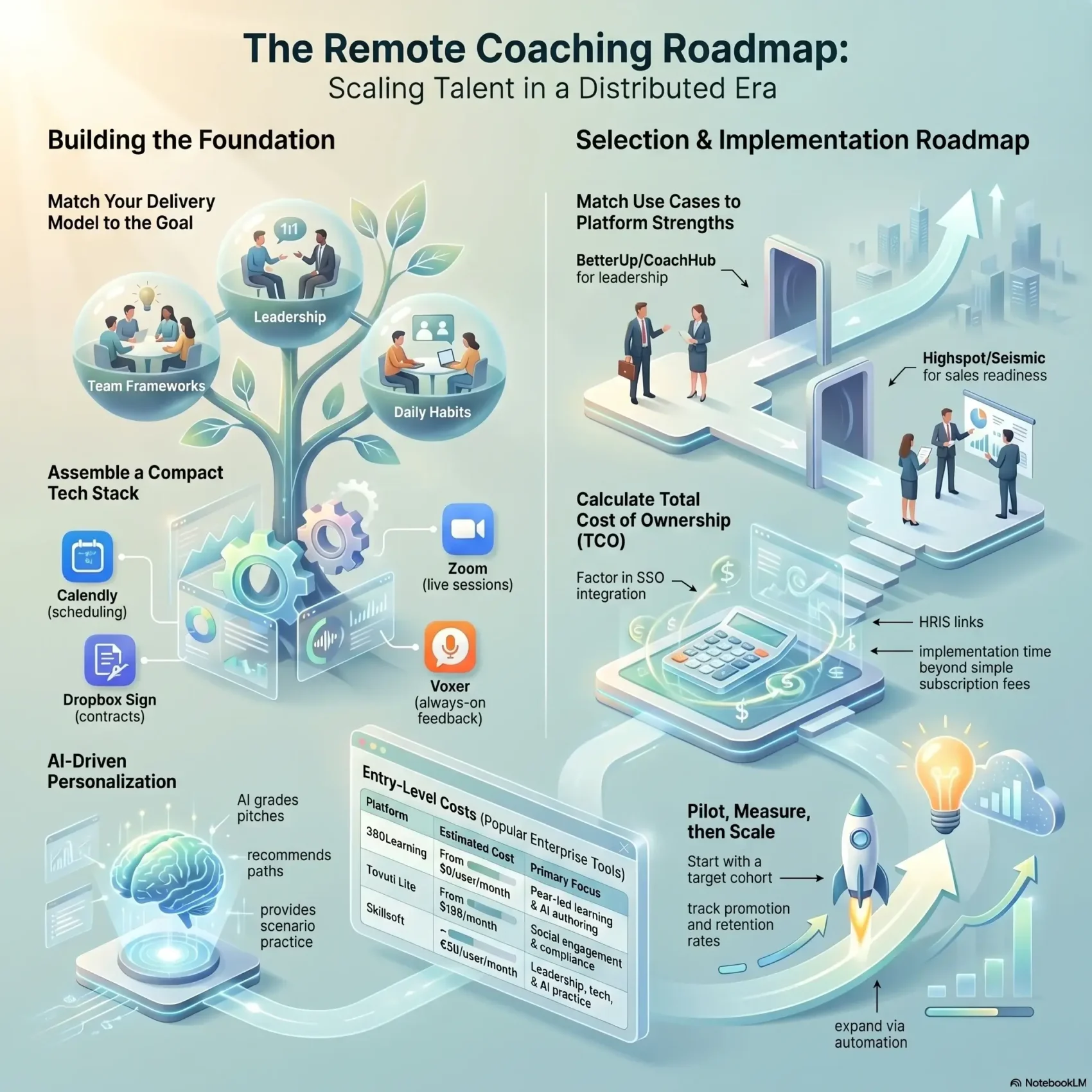
Skillsoft Coaching supplies ICF/EMCC coaches in 25+ languages and pairs a large content library with CAISY, a generative AI coach for scenario practice. Skillsoft lists €50 per month per user for up to 50 users; enterprise pricing is available on request.
- Compare BetterUp’s science-based matching and 1:1 video approach with CoachHub’s global bench and AIMY AI augmentation.
- Explore Skillsoft if you need leadership, tech, and compliance depth plus scenario practice powered by AI.
- Embed assessments to personalize journeys and track growth without manual overhead.
- Review per month pricing signals, HRIS integrations, and security/compliance fit before selection.
“Match platform capabilities to leadership pipelines and regional needs to scale development with confidence.”
Sales coaching and enablement platforms that boost performance
Sales enablement tools now pair recorded calls with AI insights so managers spend less time guessing and more time improving seller performance.
Highspot uses AI to analyze sales calls and grade pitches. It blends automated scoring with human review so you can standardize feedback and speed up coaching cycles.
Seismic (Lessonly) delivers interactive courses, role plays, and data-driven readiness plans. Seismic Learning and Seismic Knowledge centralize answers to common rep questions and shorten ramp time.
WorkRamp focuses on revenue enablement plus LMS features. It surfaces AI insights from call recordings and supports onboarding, compliance, and leadership training in one hub.
- Choose Highspot to pinpoint what’s working on calls and standardize feedback across a large team.
- Consider Seismic to ramp reps fast with role plays and a centralized knowledge base.
- Look at WorkRamp when you want revenue enablement and broader training in a single platform.
- Plan live sessions for deal strategy and async practice for pitch refinement and objection handling.
“Connect pipeline metrics to training so skills growth shows up in forecast accuracy and win rates.”
Model costs carefully—per user or per month licensing, CRM and conferencing integrations matter. For setup tips, see our virtual mentorship guide.
Collaborative learning and LXP options for coaching at scale
For scalable skill growth, look to learning platforms that blend social features, assessments, and coach-led review into the learner flow. These tools help you turn single sessions into ongoing habits.
360Learning: async practice, 1:1 feedback, and AI course authoring
360Learning focuses on peer review, mobile coaching, and AI-assisted course creation. Team plans start at $8 per registered user per month for up to 100 users. Use it to scale async practice and fast authoring.
Docebo: embed sessions inside learning paths
Docebo lets you place coach sessions directly into curated courses. It emphasizes social learning and often comes via larger annual contracts (starting near $25k/year for multi-year deals).
Tovuti, Degreed, and LinkedIn Learning
Tovuti adds social engagement and compliance tools with entry pricing around $199/month for small teams. Degreed maps skills, aggregates content, and links mentoring into career paths.
LinkedIn Learning supplies 20,000+ courses you can assign after sessions to reinforce goals and maintain momentum.
- Tip: Compare assessments, analytics depth, mobile UX, and integrations to HR and SSO before you buy.
Finding and managing coaches when you’re scaling quickly
Build a sourcing and ops plan so your people find the right help fast and your business keeps admin low.
Marketplaces and directories speed matching. Use marketplaces like BetterUp when you need vetted coaches across regions and specialties. Tap directories such as Noomii to find niche experts by industry or topic.
Centralize booking and client flow
Pick a platform that creates branded workspaces so members know where to book, message, and submit reflections.
- CoachingLoft offers public directories, scheduling, agreements, invoicing, and ways to track client progress.
- Simply.Coach provides action plans, shared workspaces, and business tools starting around $9/month.
- Standardize agreements, onboarding, and billing to cut admin for your coaching business.
Operational rules that keep quality steady
Define intake flows to capture needs up front and match coaches to people efficiently. Set availability, SLAs, and escalation paths for your coach pool.
“Balance external services with internal peer networks to meet demand without losing quality.”
Finally, track outcomes. Use action plans, session notes, and simple dashboards to spot who needs extra support and to prove ROI for your services.
Build your online coaching tech stack
As you scale, pick a compact set of tools that handle booking, calls, contracts, and between-session follow-up. A clear stack removes friction and makes every touch predictable for coaches and learners.
Scheduling and access: Calendly for frictionless bookings
Calendly syncs calendars, embeds booking links, and sends automated reminders. Plans start at $8 per month so teams can remove back-and-forth and secure access to sessions quickly.
Video and recordings: Zoom for reliable calls and replays
Run live session on Zoom for dependable video, screen share, and recordings. A Pro plan starts around $149 per year and gives you reusable content for review and training.
Contracts and compliance: Dropbox Sign for agreements
Automate agreements with Dropbox Sign. Use templates, capture signatures, and keep audit trails. Pricing begins near $15 per month for basic legal workflows.
Always-on support: Voxer for between-session feedback
Use Voxer for quick voice notes, async feedback, and clarifying questions between meetings. Pro plans start at $3.99 per month so coaches can stay connected without extra meetings.
- Standardize this tech stack so everyone knows where to book, meet, and follow up.
- Budget for per month or per year licenses and factor in seats and storage.
- Protect privacy by configuring roles, retention, and encryption across tools.
Must-have features to evaluate before you buy
Before you buy, map the features that will actually lift adoption and prove impact across teams. Look for tools that turn sessions into measurable progress and reduce admin work.
Personalization, assessments, and goal tracking for every employee
Personalization should adapt to role, goals, and skill gaps. Embedded assessments and progress tracking let you measure growth and guide next steps.
Pick platforms with clear dashboards and automated reminders so people stay on plan.
AI augmentation, integrations, and mobile apps for on-the-go learning
AI should speed content authoring and match learners to the right coach. Check for integrations with Calendly, Google, Zoom, HRIS, and SSO to cut admin.
Mobile apps must support real-world practice and deliver feedback without losing context.
Security, data privacy, and enterprise compliance standards
Verify encryption, data residency, and audit trails. Ask vendors for SOC, ISO, or equivalent compliance proof.
- Pro tip: Request rollout templates and operational resources to keep quality steady.
- Confirm analytics and exportable reports for ROI and audit needs.
- Prioritize UX so coaching experience scales across the business.
Pricing signals and total cost of ownership
Start by mapping real spend to expected adoption so pricing becomes a planning tool, not a surprise.
Use sample price points to ground your forecast: 360Learning Team at $8 per registered user per month, Tovuti Lite at $199/month, Docebo starting around $25,000/year for multi-year deals, Zoom Pro at $149/year, Calendly from $8/month, and Dropbox Sign near $15/month. Skillsoft lists about €50/month per user for small cohorts; larger quotes vary by enterprise needs.
Model subscription variables—per month vs. annual terms, user tiers, add-ons, and storage—so you compare apples to apples.
- Include integration costs: SSO, HRIS, and implementation time raise TCO.
- Plan for growth: Seat expansion and advanced analytics often need higher tiers.
- Compare bundles vs modular stacks: bundled services can simplify rollout but may include unused features.
“Pressure-test pricing from top coaching platforms with a 12–36 month forecast aligned to adoption milestones.”
Negotiate packaging to match your business priorities and tally adjacent tool spend so the final number reflects true ongoing cost.
How to choose the right platform for your business needs
Match what you must achieve—faster ramp, stronger leaders, or broad skills coverage—to vendor strengths. Start by listing your top outcomes and the teams that need them most.
Match use cases: leadership development, sales readiness, or company-wide upskilling
Shortlist by primary use case. Pick BetterUp or CoachHub for 1:1 leadership and well-being. Choose Highspot, Seismic, or WorkRamp when revenue enablement is central.
For collaborative learning and embedded training, evaluate 360Learning or Docebo. Use Degreed to map skills at scale and LinkedIn Learning to assign follow-up courses.
Pilot, measure, and iterate: KPIs that prove coaching ROI
Run a time-boxed pilot that tracks adoption, session completion, assessments, and manager ratings. Define KPIs that tie to outcomes like promotion rates, ramp time, quota attainment, retention, and engagement.
- Ask the right questions about roadmap, integrations, and data exports before you commit.
- Validate coach quality, matching logic, and multi-language coverage for global teams.
- Test reporting that slices results by cohort, role, and leader so you can prove impact.
“Choose the best online fit that solves today’s needs and scales with your ambitions.”
Implementation roadmap: from kickoff to measurable outcomes
Start your rollout by defining clear outcomes, timelines, and the cohorts that will prove value fast. Begin with one or two target groups so you can measure impact without overcommitting resources.
Onboarding coaches and members, configuring sessions, and feedback loops
Onboard coaches and members using playbooks, intake forms, and role-specific templates. Use a platform that supports automated notifications, booking, and progress tracking to reduce admin work.
Configure session cadences, intake questions, and clear expectations up front. Include automated reminders and resource links so practice continues between meetings.
Establish a short feedback loop: coach notes, manager check-ins, and learner reflections. Capture outcomes and use dashboards to track client progress and session volume.
Scaling across teams with templates, content, and automation
Use reusable content templates and AI course authoring (for example, 360Learning) to create role-specific practice fast. Embed coach time inside learning paths with platforms like Docebo and collect analytics with tools such as Skillsoft.
- You’ll start with goals, cohorts, and coach assignments, then set cadence and intake flows.
- You’ll automate reminders, resources, and follow-ups so momentum holds between sessions.
- You’ll establish feedback loops with coaches, managers, and members to refine focus areas.
- You’ll set dashboards to track client progress, session volume, and outcomes by team.
Review results quarterly. Retire what doesn’t move the needle, double down on high-impact content, and expand the program thoughtfully so your business scales without losing quality.
“Measure early, iterate often, and keep the experience simple for coaches and members.”
Conclusion
Good outcomes start when you match a platform to a clear use case and pilot it with intent. Use a focused approach to online coaching and development that centers on leadership and skill goals. Start small, learn fast, and scale what moves the needle.
Choose from marketplaces and sales tools—BetterUp, CoachHub, Highspot, 360Learning, Docebo, and LinkedIn Learning—and pair them with a compact tech stack like Zoom, Calendly, Dropbox Sign, and Voxer. That mix gives your people reliable access and the right touch between sessions.
Track adoption, session impact, and KPIs. Pilot with purpose, iterate on results, and expand confidently so coaching becomes a growth engine for your team and business.
Found this useful?
Make SmartKeys a preferred source on Google, and our articles will surface more often in your Top Stories, AI Overviews, and AI Mode.
Add as Preferred Source