Tools
Tools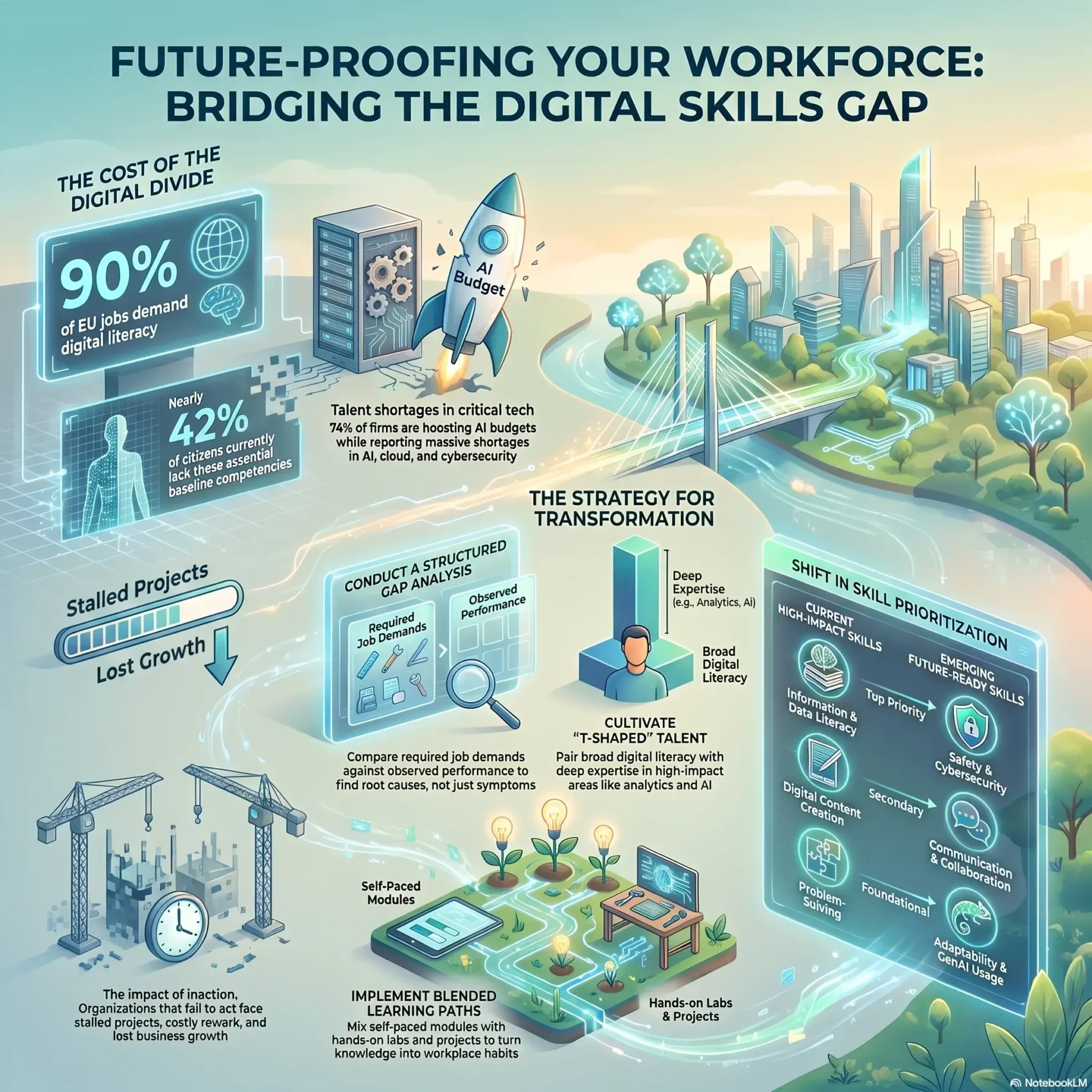
You need a clear, evidence-driven plan to match talent to tomorrow’s tech. With 90% of EU jobs now asking for basic digital literacy and 42% of citizens falling short, the stakes are real.
Organizations that fail to act lose productivity and miss growth. In 2025, most companies will raise tech and AI spending, yet many report talent shortages in AI, cloud, cybersecurity, and analytics.
This guide shows you how to turn assumptions into measurable strategy. You’ll learn how to spot where your team is strong, where opportunities exist, and where to invest for the best return.
Acting now reduces risk—missed projects, costly rework, and stalled transformation. A repeatable approach helps you build a resilient workforce, align learning to business goals, and keep top performers on a clear career path.
Key Takeaways
- Use a structured review to link capability to business resilience and growth.
- Focus investments on AI, cloud, cybersecurity, and analytics where gaps cost the most.
- Turn data into a repeatable process for continuous advantage.
- Prioritize reskilling and targeted hiring to close talent shortfalls.
- Translate findings into career paths that retain your best people.
- Act now to avoid missed opportunities and strengthen long-term strategy.
Why the digital skills gap matters today
When teams lack basic competencies, projects stall and costs rise fast. The European Commission finds 90% of EU jobs now ask for basic literacy, yet nearly 42% of citizens fall short. That mismatch translates into lost productivity and missed innovation for your business.
The cost of missed opportunities and productivity loss
Lost time, stalled initiatives, and rework drain budgets and slow delivery. You feel the impact from onboarding to daily execution when employees cannot use common tools. Shortfalls in areas like data and collaboration create bottlenecks that delay outcomes.
How the divide fuels inequality and slows growth
Access to education and training shapes who gets good jobs. Underprivileged students who lack learning tools are locked out of quality opportunities. National and industry growth slows when large groups cannot adopt new solutions.
- Quantify cost by tracking productivity and rework.
- Prioritize data literacy, collaboration, and safety first.
- Link training to business goals and long-term growth.
For practical guidance on improving literacy across your teams, see digital literacy for business.
What is digital skills gap analysis?
Start with a clear comparison: what each job demands versus what people actually do well. At its core, this is a structured comparison between required abilities and observed competencies so you can target effort where it matters most.
Defining skills, gaps, and competencies in a modern workplace
You’ll separate baseline skills, like data literacy, from role-specific capabilities such as security operations. This makes prioritization practical and tied to business outcomes.
Employer-led studies show early-career hires often lag in communication, collaboration, and safety. Paired sample assessments help quantify how big each shortfall is.
When to run an assessment and who should own it
Run this review before major tech rollouts, during transformation, and as part of annual planning. Ownership should sit with a partnership of HR, L&D, and line management so results lead to action.
“Compare demanded skills with observed performance to find root causes—not just symptoms.”
- Scope by role and level so findings map to real jobs.
- Use job analysis, competency models, surveys, and assessments as core tools and data sources.
- Translate results into role-based learning plans and hiring tied to education partnerships.
Current and future skills in demand across industries
Across sectors, employers are naming a clear set of priorities that shape hiring and training this year.
Today’s high-impact areas
Information and data literacy ranks top in a 2024 employer survey. Employers also list problem-solving and digital content creation as core abilities that drive everyday outcomes.
Future-ready priorities
Safety, communication, and collaboration rise as the next wave of must-have competencies. Surveyed firms report the largest gaps in communication/collaboration, problem-solving, and safety—areas that can block delivery if left unaddressed.
Critical technologies and what to do next
AI, cloud, cybersecurity, and analytics are the technologies shaping role requirements in the next 12–24 months.
- Benchmark teams against current demand signals: literacy, problem-solving, and content creation.
- Prioritize safety and collaboration so your workforce stays resilient as tools evolve.
- Translate technologies into concrete job-level competencies and align hiring and development to industry realities.
“Nine in ten organizations lack the talent to fuel transformation — act now to close the most urgent gaps.”
Frameworks you can use to structure your analysis
Use an established framework to turn role expectations into measurable learning outcomes. A shared model gives you clarity on what to measure and why it matters to your teams.
Applying DigComp across five core areas
The European Commission’s DigComp defines five competence areas: information and data literacy; communication and collaboration; content creation; safety; and problem solving.
Each area contains specific actions you can test — from evaluating sources to protecting privacy and handling copyright. Map tasks and tools to each area so assessments reflect real work.
Translating competencies into roles and levels
Turn competence descriptors into role profiles that list expected behaviors by level: entry, intermediate, and expert.
- Link tasks and tools to each profile so managers can judge performance.
- Use a shared taxonomy to align education partners and internal development.
- Embed knowledge items like licensing and data handling to reduce risk.
“A common framework helps you spot where gaps cluster and focus development where it counts.”
Finally, integrate the framework into hiring scorecards and performance criteria. For practical guidance on literacy programs, see digital literacy for business.
Digital skills gap analysis: a step-by-step approach
Begin by defining what success looks like for your team and linking it to measurable business outcomes. This keeps every effort tied to transformation OKRs and helps you choose the right projects to fund.
Set objectives tied to business, transformation, and OKRs
Define 2–4 clear objectives that map to revenue, efficiency, or risk reduction. Use OKRs so you can measure progress and celebrate quick wins.
Collect the right data: assessments, surveys, interviews, performance signals
Robust reviews blend quantitative assessments with qualitative inputs—surveys, interviews, and focus groups. Paired evaluations that compare importance ratings with observed competency levels often reveal shortfalls in communication/collaboration, problem-solving, and safety.
Compare demand vs. competency to quantify gaps
Compare required proficiency by job against observed competencies. Quantify each gap so managers can prioritize training rather than guessing where to invest.
Prioritize by impact, risk, and time-to-skill
Sequence projects by business impact, operational risk, and how long it takes to build a new skill. Quick wins can fund longer-term development.
Create role-based skill profiles and career pathways
- Build role profiles that list expected competencies by level.
- Select tools that standardize scoring and track progress without overloading employees or managers.
- Link learning plans to day-to-day work so staff gain experience while closing gaps.
“Connect objectives, evidence, and management routines to keep progress visible and actionable.”
Tools and data sources to make your analysis actionable
A practical mix of platforms and frontline feedback makes measurements trustworthy and useful. You’ll combine platform scores with employee voice so findings point to real causes, not guesses.
Assessment platforms, LMS/LXP, and analytics dashboards
Start with core tools: assessment platforms, an LMS or LXP, and an analytics dashboard. These let you collect quantitative data on learning and performance.
Structure your data model so scores, course completions, and on-the-job artifacts feed a single view of strengths and gaps.
Using qualitative insights to complement quantitative scores
Pair surveys, interviews, and focus groups with platform outputs. Frontline conversations uncover blockers that numbers alone miss.
- You’ll set up dashboards that show adoption, progress, and proficiency by team and workplace.
- Integrate technology with manager workflows so action follows insight without extra overhead.
- Use findings to target training to real bottlenecks and measure how closing a gap improves delivery.
“Combine platform-based measures with human input to make decisions you can act on.”
Designing solutions to close skills gaps
Focus on repeatable, role-based learning that helps employees apply knowledge on the job. Build a simple program that mixes short courses with hands-on practice so progress is visible and fast.
Blended learning paths tailored to roles and experience
Design blended learning that matches each role and level. Mix self-paced modules with instructor-led workshops and lab time.
This approach improves engagement and shortens time-to-skill. Learners practice on real projects so training directly supports business outcomes.
Accountability rhythms: check-ins, milestones, and manager enablement
Set regular check-ins and milestone reviews to keep momentum without overload. Give managers playbooks and talking points.
Manager-led coaching and short status reviews turn learning into measurable performance improvement.
Linking upskilling to rewards, career growth, and retention
Tie completion and demonstrated competence to recognition, promotions, and project opportunities.
When employees see a clear career path tied to development, adoption rises and turnover falls.
- Blend self-paced training, workshops, and labs by role and level.
- Create repeatable, simple solutions managers can scale across teams.
- Align learning to projects so new knowledge yields immediate value.
- Use rewards and clear career moves to keep your workforce motivated.
Keep the design practical and reusable so you can replicate success across departments and emerging technologies.
Experiential learning, collaboration, and mentorship
Hands-on practice turns abstract concepts into repeatable workplace habits. Embed short projects and labs so your team learns by doing. That approach builds durable competence and helps you measure progress quickly.
On-the-job projects, labs, and simulations for GenAI, data, and security
You’ll embed learning into the flow of work with real projects, sandboxes, and simulations for GenAI, data analytics, and cybersecurity. Managers and mentors give timely feedback to speed development.
Practice on real problems so employees can apply techniques immediately and show results in production.
Knowledge-sharing rituals: lunch-and-learns and cross-functional exchanges
Create regular collaboration rituals—lunch-and-learns, demos, and code walkthroughs—that spread knowledge and cut silos. Invite business analysts to share requirements methods while engineers demo coding basics.
Mentorship and reverse mentorship to accelerate capability building
Use mentorship to deliver targeted feedback and build expertise. Launch reverse mentorship so early adopters help leaders close specific gaps fast.
“Make learning part of the job and reward contributors who lift the whole team.”
- Define roles for mentors and mentees, set clear goals, and track outcomes.
- Curate short content and labs that support hands-on exercises.
- Design safe experiments so teams learn fast and convert wins into playbooks.
Governance, change management, and scaling what works
Strong governance turns pilot projects into repeatable programs that move the whole workforce forward. Governments and major funds—like the UK National Skills Fund and Singapore’s SkillsFuture—show that coordinated effort boosts impact. You need structure to keep momentum and measure returns.
Establishing a skills council and role clarity
Form a cross-functional council that sets standards and links decisions to strategy. Give clear roles to HR, L&D, and managers so each team owns parts of the plan.
Make the council the single source for policy, vendor choices, and education partnerships. That reduces duplication and keeps content aligned with industry needs.
Phased rollouts, communication, and stakeholder buy-in
Phase your rollout, test messages, and collect feedback early. Equip leaders with simple tools and talking points so they can tie training to business outcomes.
“Start small, prove value, then scale with standard playbooks.”
- Track closed gaps, adoption, and performance shifts.
- Align development to transformation milestones and new technologies.
- Standardize playbooks so you scale what works and retire what does not.
Measuring progress and ROI of your upskilling strategy
Use a compact set of indicators that reveal adoption, proficiency, and the downstream impact on delivery and quality. These metrics help you link learning to real business outcomes and show when to scale programs.
Leading and lagging indicators: adoption, proficiency, productivity, risk reduction
Start with leading indicators you can capture fast: participation rates, course completion, and practice sessions. These predict future performance and guide management actions.
Combine them with lagging measures: output, cycle time, defect rates, and incident counts. Together, they show whether training turned into better job performance and lower operational risk.
- Define KPIs that map to value: tool adoption, proficiency by role, productivity gains, and fewer incidents.
- Set data pipelines to collect participation, completion, and on-the-job artifacts plus business outputs.
- Quantify ROI by linking skill uplift to faster delivery, fewer defects, and reduced support costs.
- Track progress at individual, team, and function levels to spot patterns and remove bottlenecks.
Iterating your analysis cadence to keep pace with change
Run short measurement cycles—monthly or quarterly—so metrics feed the next wave of focus areas. This cadence lets you react to new technology needs and shifting job requirements.
Include competencies in dashboards, not just content consumption. That ensures leaders see true performance shifts and can justify hiring or internal mobility when needed.
“Measure what changes performance, report in plain language, and give managers the views they need to coach day to day.”
Future-proofing your workforce in the age of AI and transformation
Future-ready organizations build teams that mix broad know-how with deep specialty. With 74% of firms boosting AI budgets and widespread talent shortages, you must shape a workforce that adapts fast.
Building T-shaped talent and agility for ongoing innovation
Cultivate T-shaped talent by pairing wide literacy with deep expertise in priority areas like AI, data, or security. This helps your talent move between projects and keeps innovation steady.
Scanning for emerging roles and technologies to update skill maps
Set a regular scanning rhythm to spot new roles and technologies. Update role profiles and curricula so your teams match the demands of digital transformation and changing business models.
- Align learning to transformation roadmaps so change is planned, not reactive.
- Map adjacent capabilities to boost internal mobility and cut hiring delays.
- Run lightweight analysis often to validate assumptions and recalibrate early.
- Keep education partners synced so content evolves with market shifts.
“Celebrate certifications and expertise growth to make continuous learning part of your culture.”
Conclusion
Wrap up with a practical playbook that helps you move from insight to sustained performance.
Across regions, coordinated initiatives and employer evidence make one thing clear: closing the skills gap unlocks productivity and growth. Use concise analysis and data to prioritize the workforce needs that matter most to your business.
Design training and hands-on learning tied to priority technology and project work. Focus on upskilling, real practice, and targeted solutions so employees gain expertise fast and your transformation stays on track.
Equip managers with simple tools and routines, link progress to career and education moves, and measure outcomes—adoption, proficiency, and productivity. Take action now to turn opportunity into lasting advantage for your team.