Tools
Tools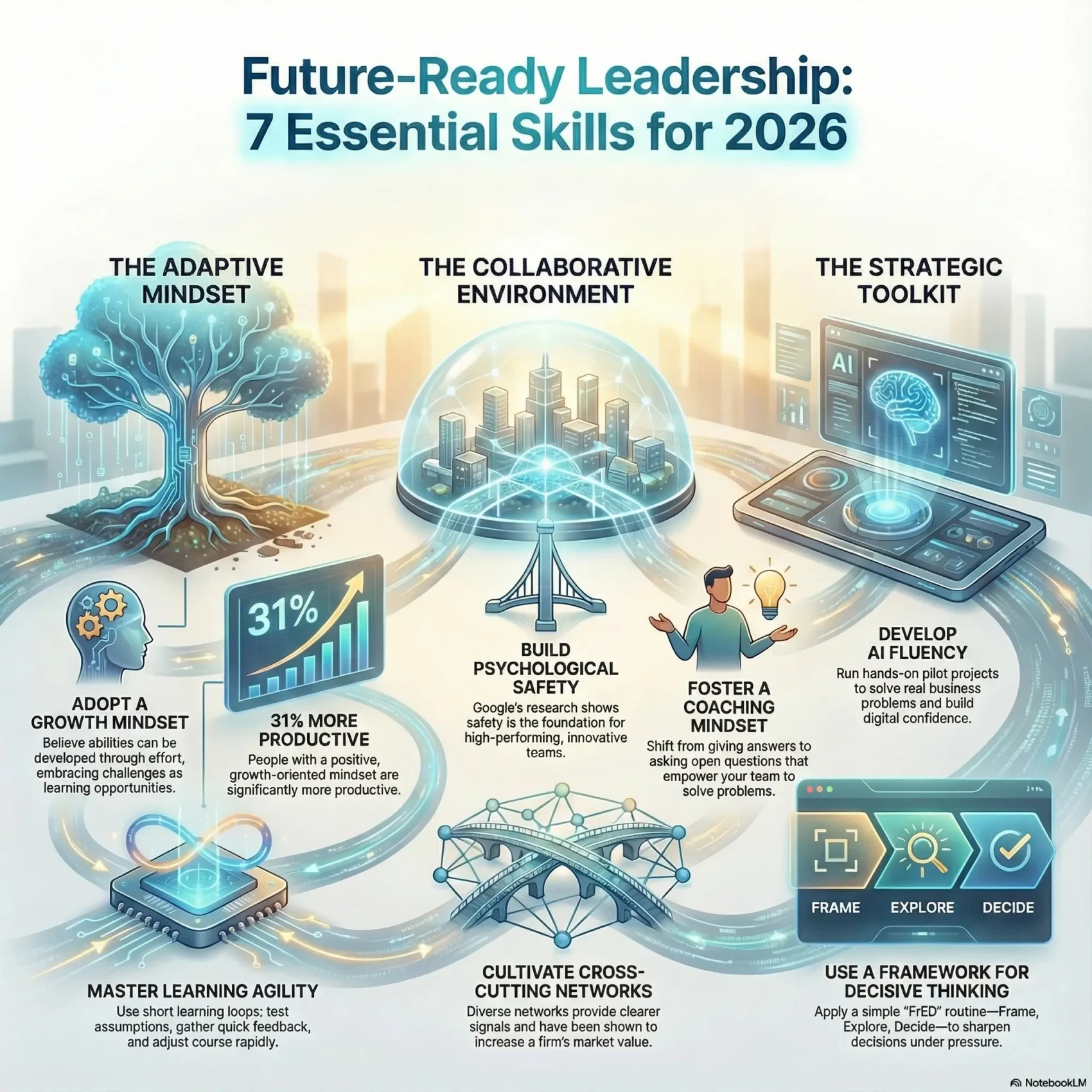
Last Updated on December 14, 2025
Chronic uncertainty in operations, supply chains, and markets means traditional answers no longer suffice. You need practical ways to navigate volatility and keep your team moving.
Adaptability and a learning orientation now extend beyond immediate teams to the whole organization. When you build cross-cutting networks and psychological safety, you enable better ideas and faster results. Research from Herminia Ibarra highlights empathy, authenticity, coaching, and culture shaping as central to this shift.
This guide previews seven core capabilities—adaptability, AI fluency, collaborative work with psychological safety, a coaching mindset, culture shaping, trust-based relationships, and decisive critical thinking—so you can align your career and your organization. Use the quick-learning cycles and cross-functional moves here to turn challenges into opportunities and to create lasting value.
Start with small, steady improvements in how you communicate, coach, and decide. For a deeper roadmap, see a focused playbook at this guide.
Key Takeaways
- Workplace volatility demands practical, repeatable approaches you can use now.
- Building trust and psychological safety unlocks better ideas and faster results.
- Combine adaptability with learning to reduce time and cost of change.
- Focus on seven capabilities that reinforce each other across the organization.
- Small, consistent improvements drive career growth and business value.
Why the 2026 Workplace Demands a New Playbook for Leadership
Work today rests on persistent uncertainty, and that means the way you guide others must change. Supply chain shocks, geopolitical shifts, climate goals, and rapid digital moves combine to create problems that rarely have one-off fixes.
The realities of chronic uncertainty: disruption, change, and opportunity
Adaptive challenges resist top-down answers. They need broad participation across your organization and ongoing learning cycles to make progress.
Technical problems can be solved by experts. Adaptive issues demand new thinking, more voices, and repeated testing.
What you’re really searching for when you look up “future leadership skills”
You want reliable ways to decide faster, lower risk, and keep innovation moving. You want methods that let others follow without burnout.
- Use diverse, cross-cutting networks to widen your view and surface new solutions.
- Model curiosity and structured thinking so teams reframe problems and connect insights.
- Build short learning loops: test assumptions, share results, and iterate quickly.
Track simple metrics like decision quality, time to alignment, and iteration speed to show business impact. For practical trends and tactics, see leadership trends.
Future leadership skills you need to master now
Focus on a compact set of behaviors that help you and your people move faster, learn more, and stay calm under pressure. These are practical capabilities you can practice daily to improve decisions and team performance.
Adaptability and learning agility: your edge in constant change
You’ll turn adaptability into a habit by running short learning cycles. Test assumptions, capture quick feedback, and adjust so your team stays effective.
AI fluency and digital confidence: integrating technology into decisions
Get hands-on with tools and data so you make smarter, faster decisions. Stay transparent about model limits and trade-offs to keep trust intact.
Collaborative leadership and psychological safety for high-performing teams
Google’s Project Aristotle shows psychological safety sits at the heart of great teams, alongside dependability, clarity, meaning, and impact.
When people speak up early, you avoid costly conflicts and surface better ideas.
Coaching mindset: from “know it all” to “learn it all”
Ask open questions, listen for insight, and help others build their ability. Coaching moves work from you to the people who own it.
Culture shaping, relationships, and decision-making under pressure
Model a growth mindset like Satya Nadella did—reward experiments and treat smart failures as investments in creativity.
Use a simple FrED routine—Frame, Explore, Decide—to sharpen critical thinking when time is short.
- Build cross-cutting networks to widen perspectives and speed problem solving.
- Codify what works so new employees plug into high-performance norms fast.
- Measure outcomes —decision quality, speed of learning, and engagement—then refine.
Build adaptability into your organization’s DNA
Treat adaptability as an operational muscle you develop through routine experiments and broad collaboration. Start by changing how groups surface problems and test small fixes.
Cross-cutting networks: broaden your view, spark better ideas
Leaders who widen their networks get clearer signals and spot opportunities earlier. A U.S. study of S&P 1500 CEOs found that moving from average to the 75th percentile of network diversity raised Tobin’s Q by an amount equal to about an $81 million market cap lift for a median firm.
From R&D to everyone: make innovation a team sport
Operationalize innovation beyond labs. Let each team prototype, share results, and run short demos. Herminia Ibarra advises you to cross-cut units and include different backgrounds in decisions. That discomfort yields better decisions and real value.
Metrics that matter: clarity, alignment, and data-driven choices
Pick a small set of outcome metrics and use them to focus the company. Track customer impact, time-to-value, iteration speed, and decision quality.
- Remove blockers: train managers to broker connections and coach experiments.
- Visible rhythms: lightweight governance, fast feedback, and clear prioritization.
- Learn fast: peer reviews and demo days make learning visible and usable.
Lead hybrid and remote teams with clarity, flexibility, and trust
To succeed with distributed teams, you must align expectations, tools, and human connection. Use clear agreements so team members know how to contribute across locations and time zones.
Design for psychological safety and dependable execution
Create explicit norms that protect psychological safety and reduce ambiguity. Define how to speak up, escalate issues, and share tentative ideas.
Run regular trust-building activities — one-on-ones, transparent progress tracking, and virtual rituals that reinforce accountability without micromanagement.
Flexible work that works: aligning employee preferences with business goals
Korn Ferry found flexible hours rank high for 80% of employees. Nearly two-thirds still work full-time in the office, yet only 19% want to be there. Use those signals to match roles to outcomes and balance preferences with operational needs.
- Clear communication: set agendas, keep decision logs, and publish written summaries.
- Manager training: upskill managers to run hybrid meetings and spot early disengagement.
- Async workflows: use smart handoffs and fewer meetings so people get focused time to execute.
- Lightweight checks: pulse surveys, quick standups, and rotating facilitators to track engagement.
- Decision clarity: state who decides, how input is gathered, and how choices are communicated to employees.
“Design rules that protect safety and speed up execution—then train your leaders to use them.”
Equip each leader with playbooks for onboarding, kickoffs, and retrospectives. Normalize two-way feedback so others help refine the way you work and improve team ability over time.
Become a tech-savvy, AI-enabled leader
Practical AI adoption starts with hands-on tests that answer one real business question at a time. Run small pilots that connect a use case to a measurable customer or efficiency outcome. That makes it easier for your team to see value and support wider rollout.
Hands-on learning: workshops, pilots, and safe-to-try experiments
Run short workshops and sandbox pilots so people try tools without risk. Use a single metric—cycle time, error rate, or revenue per user—to judge success.
Korn Ferry finds many CEOs expect AI to boost value over three years. CEOs with strong digital readiness grew revenue faster, which shows why practical trials matter.
Always-on upskilling: webinars, microlearning, and peer sharing
Design a steady learning engine: quick webinars, micro-courses, and peer demos. This lowers the barrier to new tools and spreads good ideas across your organization.
Responsible AI: ethics, transparency, and value creation
Set clear decision criteria: problem fit, data readiness, compliance, and ROI. Create simple governance on privacy and explainability so managers and teams can adopt responsibly.
- Integrate with workflows: partner with managers and technical leads to measure quality and cost changes.
- Turn lessons into playbooks: capture templates that help other teams replicate wins.
- Review outcomes: schedule regular checks to adapt guardrails and keep decisions aligned to strategy.
“Prioritize pilots that unlock customer value or material productivity gains.”
Conclusion
Wrap up what matters: practical moves you can use now to strengthen teams, sharpen decisions, and boost business results.
Research backs this approach: psychological safety anchors high-performing teams, diverse networks raise innovation and firm value, and higher engagement cuts defects and absenteeism. Use those facts to prioritize people-centered actions.
Start small. Pick one change—add a decision log, run a short AI pilot, or hold a coaching retro—and measure the outcome. Share what works and invite others to adapt it.
Keep a simple cadence: each week note three things you tried, two ways to improve, and one example to share. That steady practice turns new habits into real organizational value.