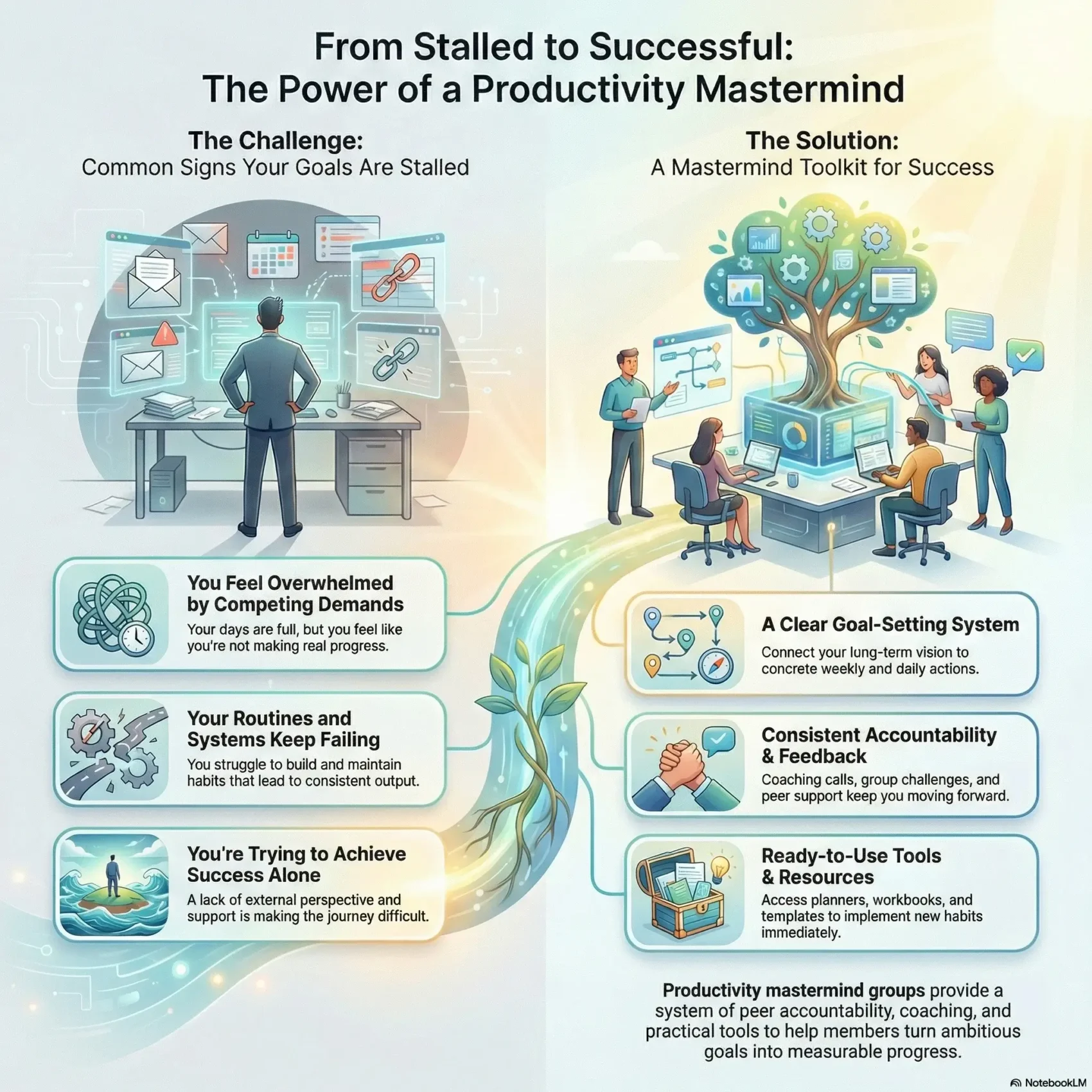
A productivity mastermind is a small group of people who meet on a fixed schedule to state their goals, report on progress, and give each other feedback. That is the whole idea. Nobody in the room is your boss, and nobody is paid to check on you. You show up, say what you said you would do, and explain what actually happened.
The reason this works has less to do with inspiration than with reporting. Once a specific person expects a specific update on a specific date, a vague intention turns into a deadline. That single change is the most useful thing a peer group gives you.
This guide covers four things. What these groups actually do. What the research supports and what it does not. How to judge a paid program before you hand over money. And how to start a free group yourself if paying makes no sense for you.
Key Takeaways
- A mastermind is a recurring meeting with peers built around goals, progress reports, and honest feedback.
- The active ingredient is accountability: a written goal plus a regular check-in beats a private plan.
- Groups suit people whose goals are clear but whose follow-through is not. They do not fix an unclear goal.
- Free peer groups often work as well as paid programs, so try one before buying anything.
- Judge a paid group on its meeting rhythm, group size, and exit terms, not on its marketing.
What a Productivity Mastermind Group Actually Is
A mastermind sits between two things you may already know. It is not a class, because nobody lectures. It is not therapy or a support circle, because the agenda is work output. It is closer to a standing meeting where four to eight people take turns being the topic.
The term comes from the author Napoleon Hill, who wrote about a “Master Mind” in The Law of Success (1928) and again in Think and Grow Rich (1937). He described it as two or more people coordinating their knowledge and effort toward one definite purpose. The modern version has dropped most of his mysticism and kept the practical part: a fixed group, a fixed rhythm, and a shared expectation that you report back.
How a Typical Session Runs
Most groups follow a pattern close to this:
- Check-in (5 to 10 minutes): each member says what they committed to last time and what happened.
- Hot seat (15 to 30 minutes): one member brings a real problem. The others ask questions before offering advice.
- Commitments (5 minutes): everyone names one or two specific actions for the next session.
The hot seat rotates, so over a few months every member gets sustained attention on their own work. Groups typically meet weekly, every two weeks, or monthly, for 60 to 90 minutes.
Is a Productivity Mastermind Right for You Today?
A mastermind helps when you know what you should be doing and keep not doing it. It helps much less when you do not yet know what you should be doing, because the group cannot decide that for you.

Signs You Will Benefit
- Your important work keeps sliding while your inbox stays clear.
- You set the same goal repeatedly and restart it every few weeks.
- You work alone and nobody notices whether you finish anything.
- You have a plan on paper but no fixed moment when someone looks at it.
If that last point is the problem, a group is a strong fit. If your days get eaten before you reach your own work, start instead with prioritization and time blocking. Then use the group to hold you to those blocks.
Who Tends to Get the Most Out of It
- Solo operators: freelancers, consultants, and one-person businesses, who have no colleagues to notice a missed deadline.
- Writers and creators: people with long projects and no external due date until the very end.
- Managers between peers: team leads who cannot discuss their own doubts with their own team.
- Parents and carers returning to bigger goals: people whose available hours are few and need to be spent well.
When a Mastermind Is the Wrong Tool
Skip it if your goal is still vague, if you need specialist technical help rather than peer perspective, or if adding a recurring meeting would genuinely break an already overloaded week. A group that you dread is worse than no group. In those cases, work on the goal itself first, using an approach for breaking a large goal into smaller steps.
What the Research Actually Supports
Mastermind marketing often quotes impressive success rates with no source attached. The honest picture is narrower but still useful, and it rests on two well-documented findings.
Written Goals Plus Regular Reporting
The closest study to the mastermind format was run by Gail Matthews at Dominican University of California. Participants were split into groups that varied in how much structure they used. At one end, people simply thought about a goal. At the other, they wrote it down, listed action commitments, shared those with a friend, and sent that friend a weekly progress report.
Of the 149 people who completed the study, those who only thought about their goals reported accomplishing or reaching the halfway point on 43% of them. Those who wrote goals, listed commitments, and shared them with a friend reached 62%. Those who added a weekly progress report to that friend reached 76%.
Two caveats matter. The sample was small, and the work was presented at a conference rather than published in a peer-reviewed journal, so treat the exact percentages as indicative rather than settled. Even so, the direction is clear. It maps neatly onto what a mastermind does: write the goal down, say it out loud to people who will remember, then report back on schedule.
If-Then Plans Turn Intentions Into Action
The second finding explains why the “commitments” part of a session matters more than the discussion. Peter Gollwitzer and Paschal Sheeran’s 2006 meta-analysis pooled 94 independent tests of implementation intentions, which are plans in the form “when situation X happens, I will do Y”. Across those tests, if-then plans produced a medium-to-large improvement in goal attainment compared with holding a goal alone.
The practical lesson for a group: “I will work on the proposal” is a weak commitment. “I will draft section two on Tuesday between 9 and 11, before opening email” is the version that survives contact with a real week. Good facilitators push members to state commitments in that second form.
Where the Evidence Is Thinner
Two claims deserve more caution. First, meta-analyses of workplace coaching do find positive effects on skills and performance. But the effects are moderate rather than transformational, and most studies look at professional coaches rather than peer groups. Second, there is the Köhler effect: a weaker group member works harder when their effort affects the whole group’s result. The effect is real, but it has mostly been tested on physical tasks in exercise research. It is a reasonable analogy for a work group, not proof.
None of this makes masterminds a bad idea. It means the sensible expectation is steadier follow-through, not a step change in your output.
The Components That Separate a Good Group From a Waste of Time
The difference between a group that lasts two years and one that quietly dissolves after five meetings is almost always structure.
A Clear Goal System
Every member needs a goal specific enough to report on. That usually means one or two quarterly objectives broken into weekly actions. If your goals are not in that shape yet, start with a method for setting goals you can actually act on, then bring them to the group.
A Fixed Rhythm and a Kept Time
The meeting needs a standing slot, a start time that is respected, and a hard finish. Groups die from drift: one rescheduled session becomes two, then nobody is sure when the next one is. Blocking the slot as protected time helps, which is the same logic behind a team-level focus time policy.
Accountability, Not Applause
A group where everyone congratulates everyone is pleasant and useless. Members need permission to ask the uncomfortable question: you said this three sessions ago, what is actually blocking it? Agree on that norm out loud at the start, because it is hard to introduce later.
Shared Notes and Resources
One shared document with each member’s goals, commitments, and dates is enough. It removes the “what did I promise?” problem and makes progress visible over months. Some groups also share templates, reading, or a running list of tools, and pairing that with productivity journaling between sessions gives you material to report on.
How to Evaluate a Paid Mastermind Before You Pay
Paid programs range from small membership communities to high-touch groups with a professional facilitator, and prices change constantly, so judge the structure rather than the sales page. Four questions do most of the work.
What Exactly Do You Get?
Ask how many live sessions happen per month, who runs them, how many people are in your group, and whether recordings exist. Named numbers are a good sign. Vague promises of “community and support” are not. Anything sold mainly as a library of lessons is a course, not a mastermind, and should be priced like one.
How Does Help Reach You Between Sessions?
Find out where members talk between meetings, how quickly questions get answered, and whether the facilitator is present there or only in calls. A dormant channel is a common disappointment.
How Does the Price Compare With the Alternatives?
Set the fee against two benchmarks: what a few hours of individual coaching in your field would cost, and what a free peer group would cost you in organizing effort. A paid group earns its price through facilitation, curated peers, and the fact that somebody else keeps it running. If it offers none of those, you are paying for a calendar invitation.
Can You Leave?
Check the minimum commitment, the notice period, and what happens if the group turns out to be the wrong fit. Trials, single-quarter terms, and clear cancellation rules all signal a provider confident in the product. Long lock-ins with no trial signal the opposite.
Free and Low-Cost Options Worth Trying First
You do not need to buy anything to test whether peer accountability works for you.
- Start your own group. Four or five people you already respect, a recurring calendar slot, and a shared document. This is the highest-value option and costs nothing but organizing effort.
- Pair up instead. One partner and a weekly 15-minute call delivers much of the effect with a fraction of the coordination. Our guide to co-working sessions with an accountability partner covers how to structure that.
- Use a drop-in room. If what you want is company while you work rather than feedback on your plans, virtual coworking spaces are a lighter fit than a mastermind.
- Join an existing community. Many professional associations and alumni networks run peer groups at no extra cost to members.
How to Start Your Own Group in Four Steps
- Pick four to six people. Similar ambition, different jobs. Same-employer groups tend to slide into work politics; identical roles produce identical blind spots.
- Agree the rules in one short document. Meeting day and time, length, hot-seat order, confidentiality, and what happens after two missed sessions in a row. Write it before the first meeting, not after the first problem.
- Run the first four sessions to a script. Check-in, one hot seat, commitments. Resist redesigning the format until you have done it four times, because most first-session awkwardness disappears by the third.
- Review at three months. Ask each member whether the group is worth the time. Change the rhythm, the size, or the format then, and give people a graceful way to leave.
Your First 30 Days in a Group
Week one: arrive with one goal, not five. Choose a single objective for the quarter and write down what “done” looks like. Then put its working blocks in the calendar, the way you would for any deep work session, and bring that calendar to the first meeting.
Weeks two and three: report honestly, including the misses. A group only helps if it sees the real picture. If you did not start, say you did not start, and let the others help you find why. This is usually where the specific barrier surfaces: an unclear next step, a task you are avoiding, or a week with no protected time at all. If avoidance is the pattern, our guide to overcoming procrastination pairs well with group check-ins, and a shorter first action often unsticks it, which is the logic behind micro-habits.
Week four: review and adjust the commitment size. Most people promise too much in week one. Look at what you actually finished and set next month’s commitments at that level. Reliable small promises build more momentum than ambitious broken ones, a point our piece on common productivity pitfalls returns to repeatedly.
Making the Group Work Alongside Your Own System
A mastermind reports on your work; it does not organize it. The two need to fit together.
Keep one list that the group’s commitments feed into, rather than a separate “mastermind list” you forget between sessions. If your capture habit is shaky, our guide to to-do lists and the piece on open loops explain why unwritten tasks keep resurfacing in your attention. For choosing what makes the cut each week, task prioritization frameworks give you a defensible answer instead of a gut feeling.
Motivation will still dip between sessions, and a group cannot carry you through that on its own. The habits covered in building self-discipline and staying motivated through the workday do that work. So does a morning routine that gets you to your desk already knowing the first task. If you want a calmer starting point before a session, a short mindfulness and focus practice helps. Distributed groups should also read up on asynchronous work, since written check-ins between calls carry much of the load when members sit in different time zones.
Conclusion
A productivity mastermind is a simple mechanism with a reliable effect: it puts a date and an audience on work that would otherwise stay private. The research on written goals and weekly reporting supports that, and the research on if-then plans explains why the commitment step matters more than the conversation.
So set expectations at the right level. A good group will not multiply your output. It will make you finish a noticeably larger share of what you intended to finish, which over a year is the more valuable outcome anyway.
Before you pay for one, run a free version for a quarter with four people and a shared document. If the format suits you, you will know by session three, and you will then be a much better judge of whether any paid program is worth its fee.
Found this useful?
Make SmartKeys a preferred source on Google, and our articles will surface more often in your Top Stories, AI Overviews, and AI Mode.
Add as Preferred Source