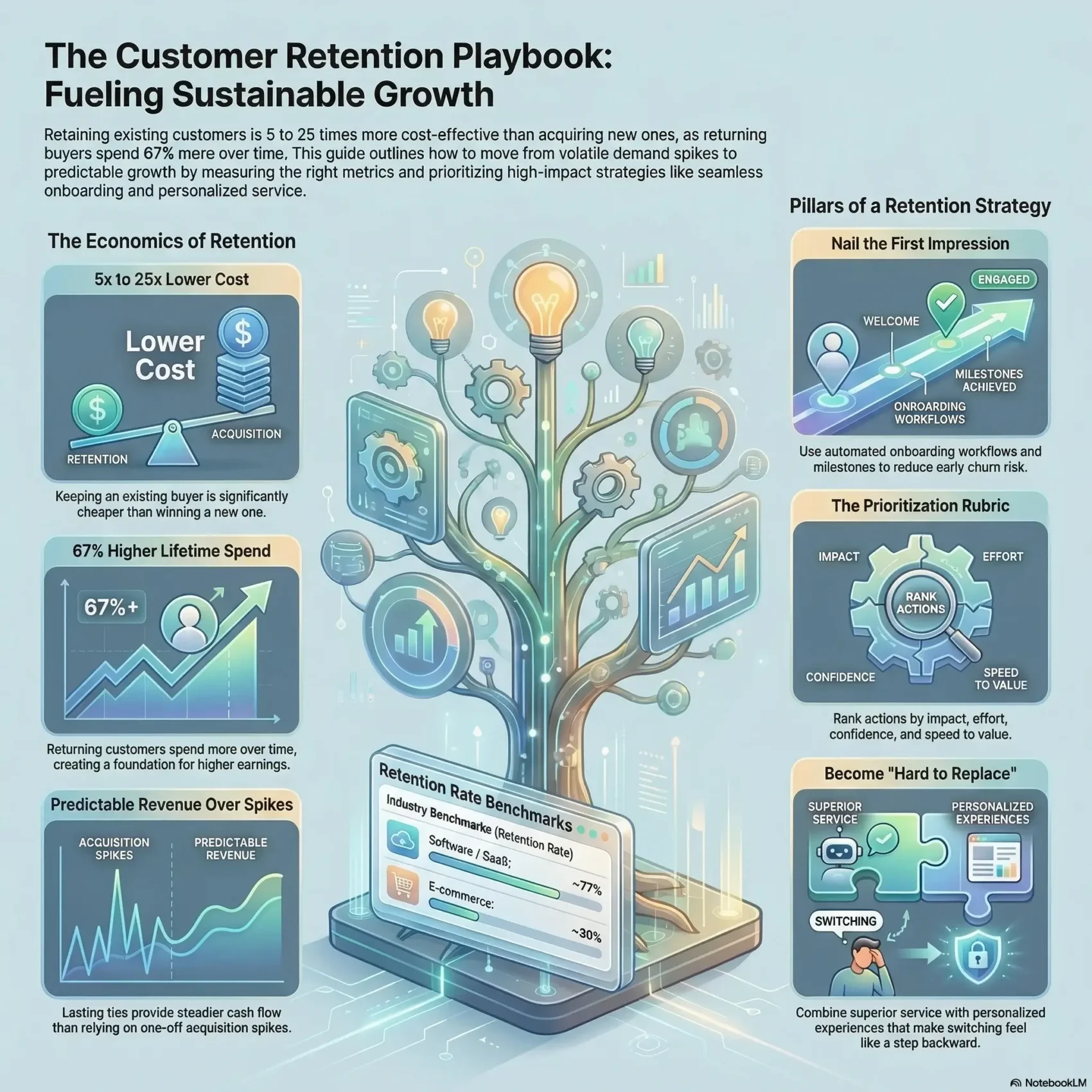
Keeping the people who already buy from you costs less and pays more over time. Customer retention means holding on to existing customers so they buy again, instead of constantly replacing the ones who leave. It sounds obvious. In practice, most budgets still point at acquisition.
This guide shows you how to measure retention honestly, then fix the parts of your business that quietly push people away: slow onboarding, vague service promises, a checkout that adds surprise fees at the last step.
Every tactic below is paired with what it costs you in effort and what you should expect to see in return.
Key Takeaways
- Retention is cheaper than acquisition, but only if you know your own numbers rather than borrowed averages.
- Measure retention rate, churn and lifetime value before choosing tactics.
- Onboarding, support speed and checkout friction deliver the fastest wins.
- Loyalty programs work when the reward is genuinely useful, not when it is merely clever.
- Small, repeated improvements compound. One big campaign rarely does.
Why Retention Beats Acquisition Right Now
Winning a new customer takes work you have already done with the people who bought from you last month. They know your brand, they have an account, and their payment details are on file. None of that has to be paid for twice.
The most quoted figure here comes from Harvard Business Review, which reported that acquiring a new customer costs anywhere from five to 25 times more than retaining an existing one, and cited Bain research that a 5% lift in retention raises profits by 25% to 95% (Harvard Business Review, 2014). Treat that range as a direction, not a promise. The spread between five and 25 is enormous, and where your business sits depends on your margins, your sales cycle and how expensive your advertising has become.
The practical point stands: if your acquisition cost is rising faster than your average order value, retention is usually the cheaper lever.
- Compare what you spend to win a customer against what you spend to keep one. Most companies have never calculated the second number.
- Do not drop acquisition entirely. A business with no new customers has a slow leak it cannot see.
- Use retention as a quality signal. A falling retention rate usually means the product or the service broke, not that marketing underperformed.
Next step: pick one quarter and move a defined slice of budget from paid media into onboarding and support. Measure both sides. If retention does not move, you have learned something cheaply.
Measure What Matters: Retention Rate, Churn, and Lifetime Value
You cannot improve retention you have not measured. Start with clear definitions and one fixed reporting period so everyone is looking at the same picture.

The customer retention rate formula
Customer retention rate (CRR) = [(E − N) / S] × 100, where S is the customers you started with, E is the customers you ended with, and N is the new customers you gained during the period.
Example: you start with 80 customers, end with 60, and gained 20 new ones. CRR = [(60 − 20) / 80] × 100 = 50%. Half the people you started the period with are gone.
Churn, and why you need both numbers
Churn is the mirror image: the share of customers who stopped buying or cancelled during the period. Retention tells you who stayed. Churn tells you how fast the leak is running.
Watch both, because they answer different questions. A business can hold retention steady while churn among new customers climbs, which means your onboarding is failing even though your long-term base looks healthy.
Lifetime value, repeat rate and purchase frequency
Customer lifetime value (CLV) estimates what one customer is worth across the whole relationship, not just the first order. A workable approximation is average order value multiplied by purchases per year multiplied by the average number of years a customer stays.
Two supporting numbers are worth tracking:
- Repeat customer rate = returning customers ÷ total customers × 100.
- Purchase frequency = total orders ÷ unique customers.
Be careful with published industry benchmarks. Most of the retention averages circulating online trace back to vendor blog posts rather than primary research, and definitions vary so widely that a “good” rate in one dataset is a poor one in another. Your own trend line over four quarters is more useful than someone else’s average. If you want a broader view of how measurement is changing, our overview of big data and customer experience covers where the data usually breaks.
Turning Metrics Into a Plan
Numbers on a dashboard change nothing. Turn them into a short list of fixes, ranked.
Score each candidate improvement on four questions. How much retention would it recover? How much work is it? How confident are you in the data behind it? How quickly would you see a result?
That last question matters more than teams expect. A change that takes two weeks and shows a result in a month teaches you something. A nine-month platform migration teaches you nothing until it is finished.
Sequence the work in this order: remove friction first, then add the things customers enjoy, then scale personalization. Fixing a broken returns process beats launching a rewards program, because a rewards program layered on top of a bad experience just makes the bad experience more expensive.
Nail First Impressions: Onboarding That Sticks
The first week decides more than most of the year that follows. A customer who cannot get your product working, or who cannot find out when their order ships, has already started drafting the cancellation email.
Build a journey, not a welcome email
Map what a new customer needs to do in their first day, first week and first month. Then make each of those steps obvious. Trigger emails at the right moment, add in-app tips where people get stuck, and give them one named contact or one clear support channel.
Self-service and visible progress
A searchable help centre with quick-start guides and short videos costs less than answering the same question 400 times. Mark milestones as people hit them: account set up, first order placed, first result achieved. Visible progress builds the habit.
- Collect light feedback during onboarding. A one-question survey after setup finds friction while it is still cheap to fix.
- Publish response times for the first 30 days. New customers are least tolerant of silence.
- Watch where people stall. The step with the biggest drop-off is your highest-value fix.
Onboarding is also where personalization earns its keep, because you still know very little about the customer and every signal counts. Our guide to AI personalization in customer experience covers what that looks like in practice.
Personalize Every Touchpoint Without Being Creepy
Personalization means using what you actually know about someone to make their next step easier. It does not mean putting a first name in a subject line.
The difference shows up in what you personalize. Recommending a refill of the thing someone bought six weeks ago is helpful. Reminding them you noticed they looked at a product twice is not.
Use data you were given, not data you inferred
The most reliable input is data customers hand over deliberately: preferences, goals, what they want to hear about. That is the idea behind zero-party data, and it is more accurate than behavioural guesswork because nobody had to interpret it.
Behind that sits your first-party data strategy: the purchase history, support conversations and product usage you collect yourself. Both matter more now that third-party tracking has become unreliable and privacy rules have tightened.
- Personalize across email, app and support so the experience is consistent rather than clever in one channel and generic in the rest.
- Set frequency caps. Over-communication reads as desperation.
- Make preferences editable. A customer who can turn things off is less likely to turn everything off.
For online retailers specifically, our breakdown of e-commerce personalization goes into which recommendation approaches hold up.
Build Trust Through Reliability and Transparency
Trust is built by doing the boring thing consistently. Promise a delivery window and hit it. Say what the return policy is before someone pays, not after.
Set expectations explicitly at the points where anxiety lives: delivery times, billing dates, renewal terms, what happens when something goes wrong.
Be open when it breaks. If there is an outage or a delay, say so quickly, give a timeline, and follow up when it is fixed. Customers forgive problems far more readily than they forgive being kept in the dark.
- Publish service standards you can actually meet, then meet them.
- Keep an incident playbook: acknowledge, give a timeline, resolve, report back.
- Write billing and return policies in language a customer can understand without help.
Subscription businesses face a sharper version of this problem, because a renewal is a decision the customer makes repeatedly. Our piece on subscription fatigue covers what makes people cancel things they still use.
Customer Service That Prevents Churn
Support is not a cost centre that happens after the sale. It is where retention is won or lost.
Zendesk’s CX Trends 2026 research, based on responses from more than 1,300 customer experience executives, found that 70% of CX leaders are rethinking the entire customer journey and 64% are increasing investment in chatbots (Zendesk CX Trends 2026). The direction of travel is clear. Whether it helps depends entirely on execution.
Continuity across channels
A customer should be able to start on chat, follow up by email and finish on the phone without repeating themselves. That requires one shared record of the conversation, not three separate inboxes.
Speed, and honest expectations
A fast acknowledgement beats a slow perfect answer. Even a short “we have this, here is when you will hear back” reduces the anxiety that drives cancellations. Publish a response time per channel and hold to it.
Give agents the context
Agents who can see purchase history, previous tickets and product usage resolve issues in one contact instead of three. That saves your team time and saves the customer the experience of explaining their problem to four different people.
- Shared inboxes and saved replies to keep answers consistent.
- Realistic response targets per channel, published where customers can see them.
- Track first-contact resolution and repeat contact rate, not just ticket volume.
If you are choosing or replacing a help desk, our Zendesk review, the Zendesk vs Freshdesk comparison and the Intercom vs Help Scout comparison cover what each actually costs once AI features are added. Broader shifts in the field are covered in our customer service trends guide.
Create a Feedback Loop That Actually Changes Something
Collecting feedback is easy. Acting on it is the part that retains customers.
Run a small number of surveys well rather than many badly. A short post-contact survey, a periodic relationship survey such as NPS, and occasional moderated user tests will tell you more than a monthly questionnaire nobody finishes.
Find the cause, not the complaint
When the same issue appears repeatedly, run a simple root cause analysis: write down the symptom, trace what contributed to it, and record the permanent fix. Route each theme to whoever can actually change it, whether that is product, operations or billing.
- Prioritize by how many customers are affected and how much effort the fix takes.
- Close the loop. Tell people what changed because of their input.
- Track themes over time so you can show which fixes moved the number.
At scale, reading every comment stops being possible. Tools that cluster and summarize open-text feedback help here, which is the subject of our guide to voice of customer AI.
Loyalty, Rewards, and Referral Programs
A rewards program works when the reward is something the customer actually wants. Points that expire before they are useful are not a reward, they are an expiry date with extra steps.
Three models cover most cases. Points suit frequent, low-value purchases. Tiers suit businesses where status and service level matter. Early or exclusive access suits brands with genuine scarcity or a release calendar.
Referrals
Referral incentives do two jobs at once: they reward an existing customer and bring in a new one who arrives pre-trusted. Store credit usually outperforms cash, because it brings the referrer back for another purchase.
Keep the rules simple
If a customer needs to read a terms page to work out what they have earned, the program has already failed. Show the balance, show what it unlocks, and make redemption take one click.
- Track participation, redemption and incremental revenue, not sign-ups alone.
- Model the margin impact before launch. Generous programs are hard to walk back.
- Test the reward with a small segment first.
Make Buying Frictionless: UX, Delivery, Returns, and Payments
The checkout is where good intentions go to die. Baymard Institute, which has tracked this across 50 separate studies, puts the average documented cart abandonment rate at 70.22%. Among shoppers who were genuinely intending to buy, the top reasons were extra costs being too high at 40%, delivery being too slow at 20%, not trusting the site with card details at 19%, and being forced to create an account at 18% (Baymard Institute).
Three of those four are fixable this quarter, and none of them require new technology.
Show the full cost early
Surprise shipping and fees at the last step are the single largest documented cause of abandonment. Show delivery cost and date on the product page.
Make returns painless
A clear, fair return policy removes the risk that stops a first purchase and the resentment that stops a second one. Self-service returns also cut support volume.
Do not force account creation
Offer guest checkout. You can invite someone to create an account after they have paid, when they have a reason to.
- Test checkout on a phone, on a slow connection, as a first-time visitor.
- Send proactive order updates so customers do not have to ask where their order is.
- Offer payment options your customers actually use, including instalment options where they fit your basket size.
Lead With Values Your Customers Share
A shared mission gives people a reason to stay that is not price. It only works when the action is real and visible.
TOMS is the standard example, and the way it changed is instructive. The company ran its one-for-one shoe donation model for over a decade, then retired it in 2021 in favour of giving a third of its net profits to grassroots organisations, having concluded the original model was not the most effective use of its giving (Forbes, 2021). Customers stayed because the commitment was genuine enough to be revised in public.
- State a mission that connects to what you actually sell.
- Publish what you contributed, not just what you intend to contribute.
- Invite participation: round-up donations, repair schemes, take-back programs.
Vague sustainability language now carries regulatory risk as well as credibility risk in several markets. If you cannot evidence a claim, do not make it.
Cultivate Community and Word of Mouth
Treat social channels as a conversation, not a broadcast tower. Reshare customer posts, answer questions in public, and make your regulars visible to each other.
Zappos built much of its reputation this way, by letting support conversations be human rather than scripted. The transferable part is not the tone, it is the permission: staff were allowed to help without reading from a card.
- Spotlight customers and make it easy for them to tag you.
- Pick two channels and do them properly rather than five badly.
- Set moderation and response standards so replies stay timely and consistent.
- Track which conversations lead to new customers.
When a community becomes the reason people stay, it stops being a marketing channel and becomes part of the product. Our guide to community-led growth covers how that works and where it fails.
Tooling Up: CRM and Service Platforms That Scale Retention
A small set of well-chosen tools beats a large set of half-configured ones. The job is simple to state: everyone who talks to a customer should be able to see the same history.
What you actually need
A CRM to hold the relationship, a shared inbox so support does not fragment, automation for routine follow-ups, and reporting you trust. That is usually enough for a long time.
“Centralize the context so it travels with the person, not with the message.”
One view of the customer
Merging order history, support notes and product usage into one record is what makes personalization practical rather than theoretical. Without it, every team improvises.
- Report on retention rate, churn, CLV and channel health in one place.
- Agree data hygiene rules before you scale. Bad data makes automation worse, not better.
- Document the workflows, so a new hire can follow them in week one.
For platform selection, our Salesforce CRM review and HubSpot Marketing Hub review cover the two most common choices, and our CRM trends overview explains how AI billing has changed what these systems cost. Teams focused specifically on reducing churn in subscription products should also look at customer success tools.
Invest in Your Team
Retention is delivered by people, and people who leave take the context with them.
Train for the two things that decide a support interaction: product knowledge, so the answer is right, and clarity, so the customer understands it. Both are teachable.
Lower staff turnover is itself a retention strategy. An agent who has been there two years recognises a recurring problem the moment it appears. A new hire opens a ticket.
- Career paths and recognition keep experienced people, which keeps institutional knowledge.
- Calibrated quality reviews so standards are consistent across the team.
- Feedback rituals that route frontline insight to product and policy.
Tie incentives to customer health rather than handle time. Rewarding speed alone produces fast, unhelpful answers.
Omnichannel strategies and unified tooling help agents hold context across channels, making every interaction feel informed rather than improvised. Where sales and marketing pull in different directions, the customer feels it too, which is the subject of our guide to aligning sales and marketing.
Stand Apart: Become Difficult to Replace
The strongest retention is a customer who cannot find a better answer elsewhere.
That is different from making it hard to leave. Contractual traps and awkward cancellation flows buy you a few months and cost you the recommendation.
Being hard to replace means solving one problem completely, so switching would mean accepting a worse outcome. It means the integrations, the history and the accumulated setup have real value to the customer, not just to you.
- Define the one thing you do better than anyone available to your customer.
- Build around it: onboarding, integrations, support that assumes the customer’s context.
- Show results, so renewal feels like a decision rather than an invoice.
“Being hard to replace is not about traps. It is about being the best available answer.”
A 90-Day Retention Plan
Start with three things, not thirteen.
Days 1 to 30: calculate your retention rate, churn and repeat purchase rate for the last four quarters. Find the point in the customer journey with the largest drop-off.
Days 31 to 60: fix that one thing. Usually it is onboarding, checkout or first-response time. Ship the change and leave the rest alone so you can attribute the result.
Days 61 to 90: measure. Compare the same cohort metrics as your baseline. Report the outcome honestly, including if it did not work, then pick the next largest drop-off.
Keep two leading indicators visible throughout: first response time and repeat contact rate. Both move before retention does, which gives you early warning.
For the wider picture of what customers now expect, our customer experience trends guide is a useful companion to this plan.
Conclusion
Customer retention is not a campaign. It is the accumulated result of a hundred small decisions about how you treat people who already trusted you once.
Measure the three numbers that matter, fix the biggest source of friction, and tell customers what changed because of what they told you. Then do it again next quarter.
The businesses that keep customers are rarely the ones with the cleverest loyalty program. They are the ones that deliver when they said they would, answer quickly when something goes wrong, and do not make their best customers feel like strangers.
Found this useful?
Make SmartKeys a preferred source on Google, and our articles will surface more often in your Top Stories, AI Overviews, and AI Mode.
Add as Preferred Source