Tools
Tools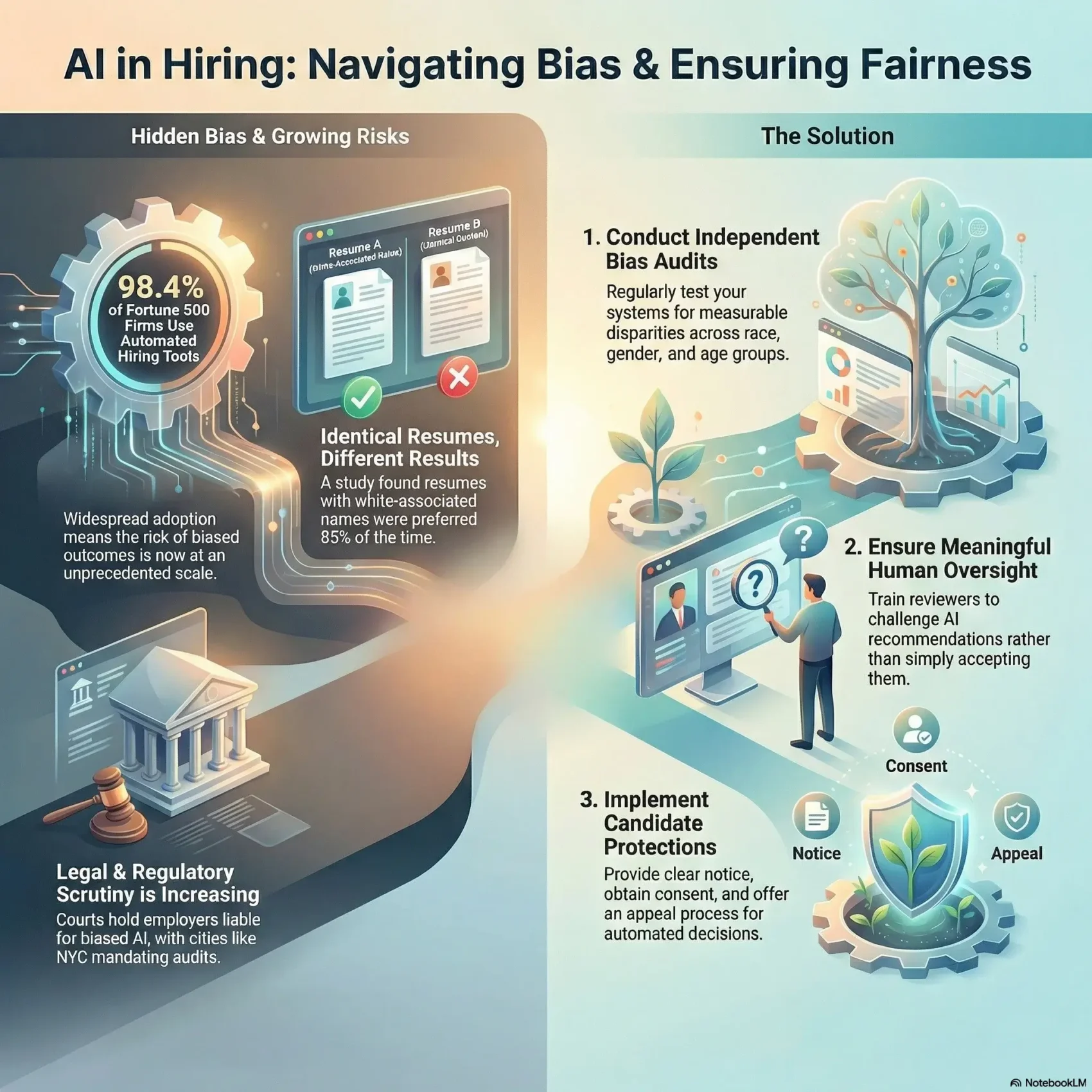
Last Updated on February 12, 2026
You’re here to understand how algorithmic tools fit into your hiring process and where unfair outcomes can appear. Over the past few years, U.S. companies adopted automated systems fast, and courts now treat flawed outcomes as legally significant.
This introduction lays out the scope and the stakes. You’ll see plain-language definitions, the research that shows identical resumes can get different scores, and the real impact on applicants and your organization.
We’ll contrast the promise of speed and scale with the risks of skewed training data and poor proxies. You’ll also get a preview of legal exposure, practical safeguards, and where small changes in your workflow can yield big fairness gains.
Key Takeaways
- Know the problem: Automated recruitment tools can introduce measurable unfairness.
- Watch the data: Skewed inputs and proxies drive distorted outcomes.
- Legal risk is real: Courts and regulators now hold companies and vendors accountable.
- Practical fixes work: Simple checks, transparency, and audits reduce harm.
- Protect your brand: Fair processes improve candidate experience and trust.
Why you’re searching for AI hiring bias today: intent, stakes, and the U.S. trendline
Your search probably begins with a simple fact: many companies now use automated tools to sort applicants.
As many as 98.4% of Fortune 500 firms already use these systems, and non-Fortune adoption is set to climb from 51% to 68% by late 2025. That shift saves time and cuts costs, but it also raises questions about fairness and legal exposure.
The stakes are practical and reputational. You want faster hiring without harming candidate trust. Regulators remind employers that using tools does not change your duty to avoid discrimination.
“Use of automated tools does not absolve employers from anti-discrimination obligations.”
Local rules in New York City and Colorado now require audits or transparency for systems that affect job outcomes. That means you should document controls, run targeted tests, and keep clear records before wide deployment.
- Prioritize fairness checks where resumes, interviews, and scoring feed decisions.
- Balance time savings with spot audits to limit unintended impact on people.
- Escalate concerns to legal or compliance early, not after a problem appears.
What AI hiring bias is and how it shows up in real screening systems
Screening systems can mirror past choices, quietly passing old patterns forward at scale.
Four core forms of bias show up in many tools and models you may use:
- Representation: non‑diverse training data that leaves groups underseen.
- Algorithmic: coded priorities that skew scores toward certain profiles.
- Predictive: systems that systematically misestimate a group’s future fit.
- Measurement: errors in labeled data or proxies that warp learning.
Signals that leak identity can be subtle. Names, education history, locations, word choice, speech patterns, or video context may act as proxies.
“A resume model once penalized mentions of ‘women’ and downgraded graduates from all‑women’s colleges.”
Practical note: removing fields is not enough. Small cues in resumes or in an interview frame can steer scores and amplify unfair outcomes for candidates.
Evidence from the past: what the data says about names, resumes, and model decisions
Empirical work reveals that early screening can reshape which applicants move forward. Small signals in a resume often change model choices long before interviews begin.
Resume simulations: white-associated names preferred in 85% of tests; gender gaps persist
Controlled tests used identical resumes with different names. The University of Washington study ran 554 resumes against 550+ job descriptions and 80 names.
White-associated names were chosen in 85.1% of trials while Black-associated names appeared in just 8.6%. Gender gaps also appeared, with men favored more often than women.
Intersectionality matters: disproportionate harms to Black men in LLM-mediated screening
The study’s intersectional analysis showed the largest harms for Black men. In some comparisons, Black men had 0% preference against white men, a stark signal about compounded harms across race and gender.
Why “remove protected attributes” isn’t enough
Removing fields like race or gender does not erase identity signals. Locations, word choice, and names let models infer protected traits from training data.
“Identity leaks through language and context, so omission alone rarely fixes unfair outcomes.”
- Use small experiments to test your screening flow with identical resumes and varied names.
- Compare selection rates by race and gender to spot skewed job pipelines.
- Track simple metrics in your data set to validate whether fixes reduce disparities.
AI hiring bias in the courts: disparate impact and expanding liability
Courts are increasingly treating automated screening tools as active players when outcomes harm groups of applicants.
The legal thread is clear: disparate impact doctrine applies when a system drives unequal results, even without intent. Federal statutes including Title VII, the ADA, ADEA, and the FHA have been brought to bear in these disputes.
Mobley v. Workday: AI as an “active participant” in hiring decisions
In Mobley v. Workday, the court let ADEA and ADA claims proceed and certified a collective. Judges found the software could be an active participant in employers’ decisions.
“The decision signals that delegating screening to a tool does not shield employers from liability.”
EEOC v. iTutorGroup: age discrimination and settlement outcomes
The EEOC alleged age discrimination tied to automated screening in iTutorGroup. That case settled with remediation and payments, showing enforcement can produce concrete obligations for employers and vendors.
Beyond employment: State Farm, SafeRent, and PERQ show cross-industry risk
Claims in lending, housing, and tenant screening show similar legal theories. Huskey v. State Farm and the SafeRent and PERQ settlements demonstrate that a flawed model or system can trigger liability outside of work.
Practical takeaways for you:
- Document model assumptions and design choices that affect decisions.
- Run disparity tests and keep records to show causation or corrective steps.
- Prepare for discovery by tracking how applicants move through your process.
Regulatory snapshot: New York City audits, Colorado’s law, and evolving U.S. guidance
Several U.S. jurisdictions now demand concrete transparency and candidate protections for automated evaluations. You must track where you post jobs and how you score applicants, because local rules change your obligations.
New York City’s annual third-party audit mandate — and the human-in-the-loop loophole
New York City requires yearly third-party audits and public summaries when a system affects employment decisions. That means you should plan how to gather evidence and publish results if you operate in the city.
Note: the law allows a disclosure exemption for systems labeled as collaborative with human reviewers. Firms sometimes call a system “human-in-the-loop” to limit reporting. Don’t rely on that gap; regulators focus on outcomes, not labels.
Colorado’s comprehensive rules and candidate appeal rights
Colorado enacted broad rules effective in 2026 that require notice, consent, and appeal rights when an automated decision harms an applicant. These provisions give candidates a path to challenge adverse outcomes.
“Anti-discrimination statutes remain enforceable even as some federal guidance shifted in 2025.”
- Map your processes against local laws where you recruit.
- Request vendor audit histories, remediation timelines, and evaluation protocols when you select a tool.
- Centralize compliance artifacts—publish summaries where required and keep third-party reports on file.
What this means for your hiring process: risks, patterns, and business impact
Overreliance on model suggestions often nudges reviewers to accept recommendations rather than question them.
Automation bias can embed unfair patterns into routine work. When reviewers trust a score, the tool effectively sets thresholds that shape which candidates progress.
This matters to outcomes: small shifts at screening can delete qualified people from a pipeline and raise the chance of costly discrimination claims under federal and state law.
Where the biggest risks live in your processes
Look at thresholds, interview rubrics, and automated rejections. Those points most often steer hiring decisions without visible checks.
Train reviewers to challenge recommendations and document their reasons. That reduces overreliance and creates an audit trail for compliance.
Translate statutes into practical checkpoints
- Define selection criteria and test their effects on groups protected by Title VII, ADA, and ADEA.
- Keep records showing tests, adjustments, and why a candidate passed or failed a screening step.
- Set a clear governance path for candidate escalations and exceptions so you do not lose qualified people to rigid rules.
Business impact: false negatives shrink talent pools, harm DEI goals, and cost time to refill roles. Estimate that loss and factor it into vendor and tool reviews.
For a practical next step, consult the AI talent acquisition guide for checks and templates you can apply to your process.
How to ensure fairness in AI-driven recruitment
Start with systems you can measure: audits, tests, and human review points. Make clear steps so your team and candidates see how decisions are made.
Independent bias audits and transparent reporting on models and decisions
Commission independent audits to test your systems for measurable disparities. Publish summaries where law requires and keep full reports on file.
Diversify and rebalance training data; combine big data with candidate-specific context
Rebalance training sets with diverse examples and validate that model recommendations match job‑relevant criteria, not proxies. Pair large data signals with candidate-specific information so the tool recognizes nonstandard but qualified profiles.
Human oversight that challenges, not rubber-stamps, recommendations
Train reviewers to question scores and document reasons for overrides. Create clear escalation paths when a score conflicts with interview evidence or work samples.
Notice, consent, and appeal mechanisms for candidates
Operationalize plain-language notices and offer appeal routes so a candidate can request human review of an adverse automated screen. Require vendors to share model cards, feature explanations, and audit histories and to commit to remediation when thresholds are exceeded.
“Controlled screening tests, like counterfactual resumes, reveal where information leaks and reduce error over time.”
Conclusion
This article leaves you with one practical aim: make decisions traceable, testable, and fair.
Start with a strong, practical plan that maps where resumes and names feed your screening flow. Run small tests, log outcomes, and document why each job decision was made.
Use audits, vendor checks, and clear notices so candidates can seek review. Remember that courts treat models and tools as active participants, and New York City audits plus Colorado rules raise the bar for companies and employers.
Keep watching cases and research on race and interview artifacts. With oversight and simple controls you protect people and your recruitment process while keeping time and speed on your side.