Tools
Tools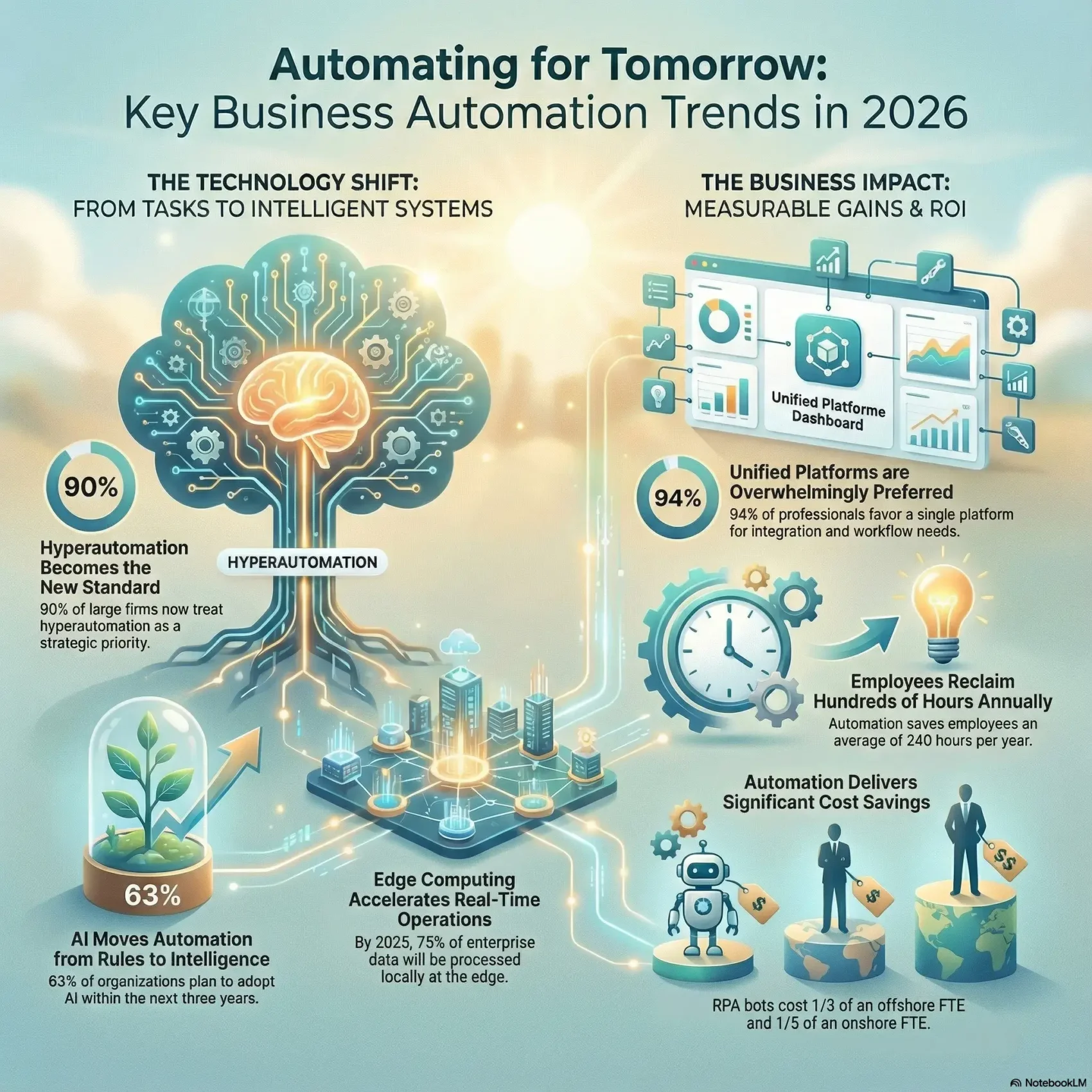
Last Updated on December 23, 2025
The shift lifts product quality and customer satisfaction. Sixty-three percent of organizations plan AI adoption in the next three years, and the AI market is expanding fast — more than 120% year-over-year. Large firms list hyperautomation as a strategic priority as the global BPA market nears $16.46 billion.
This introduction gives practical insight into what matters: open-source platforms, self-hosted tools, and unified technologies that cut costs, reduce lock-in, and speed results. You’ll see which capabilities deliver fast wins in finance, HR, sales, and IT.
Key Takeaways
- AI expands what you can automate, moving work from rules to intelligence.
- Open-source and self-hosting reduce vendor lock-in and lower costs.
- Use metrics like hours saved and error reduction to prove value.
- Edge computing and streaming analytics speed real-time decisions.
- Prioritize platforms and tools that match security and budget needs.
Executive Brief: What’s Driving Automation in the Near Future
Leaders are making automation a baseline to speed decisions and cut costs. About 60% of companies already use tools, and 80% of executives believe it can apply to most corporate decisions. That executive buy-in creates near-term momentum.
You’ll see AI take on real-time data integration: over 70% of enterprises plan to rely on AI tools for faster processing. Gartner also expects 30% of firms to automate most network activities by 2026.
What this means for your teams:
- Faster cycles: fewer manual handoffs, higher productivity, and better forecasts.
- Higher satisfaction: employees report faster work and improved collaboration.
- Clear ROI use cases: remove repetitive tasks and standardize cross-team processes.
“Start small, prove value, and scale—governance matters as systems touch sensitive data.”
To explore predictive use cases, see predictive analytics for operations.
Business automation trends in 2026: What’s new and why it matters
2026 platforms link AI, orchestration, and data to scale real work across teams. You’ll move from point tools to an ecosystem that supports end-to-end process execution and measurable outcomes.
What’s different in 2026: deeper AI, ecosystem platforms, measurable scale
Agentic AI and document intelligence let you automate decisions, not just tasks. With the AI market growing over 120% YoY and 63% of organizations planning adoption in three years, these capabilities reach production faster.
Around 90% of large firms treat hyperautomation as strategic, and 94% of professionals prefer a single platform for integration and workflow. That shift reduces tool sprawl and speeds development.
Why it matters to your U.S. operations and competitiveness
Operationalizing AI by 2025 means a fivefold rise in streaming analytics, which powers faster handoffs and cleaner customer experiences. You can cut error rates, save hours, and protect margins by automating core processes first.
“Prioritize measurable outcomes—hours saved, error reduction, and time-to-resolution become your north star.”
- Standardize: pick a unified platform to connect apps and data with fewer gaps.
- Scale: convert pilots to production while keeping governance tight.
- Compete: use portable automations for cloud and on-prem flexibility.
From RPA to AI Integration and Hyperautomation
Hyperautomation stitches AI, RPA, and process mining into end-to-end solutions that actually move work forward. This shift means you stop automating one step and start orchestrating entire journeys across systems and people.
The hyperautomation stack: AI, RPA, process mining, orchestration
Combine RPA with AI, orchestration/BPM, IoT, and mining to automate full processes rather than isolated tasks.
This stack helps you map, execute, and monitor flows so improvements scale across teams and systems.
Agentic AI moves beyond scripts to adaptive decisioning
Agentic AI upgrades scripted bots to adaptive agents that learn from outcomes.
They escalate exceptions, refine decisions, and reduce manual rework—cutting complex case time by over 50% in some organizations.
Process and task mining uncover end-to-end workflow gains
Use mining to find hidden delays, rework, and compliance gaps. That data points you to high-ROI automation solutions.
Then standardize integrations, templates, and monitoring to speed delivery and lower maintenance across your teams.
- Align orchestration with human-in-the-loop models for nuanced decisions.
- Measure impact with before/after baselines on cycle time and error rates.
- Harden governance via role-based access, audit trails, and model monitoring.
Start with critical processes—order-to-cash, procure-to-pay, request-to-resolution—to prove value fast and reinvest savings into broader process automation.
Data, Integration, and Edge Computing for Real-Time Operations
Your operations win when data flows fast, locally, and with model-driven context. Over 70% of enterprises will lean on AI-powered tools for real-time data integration and processing, so moving from batch to stream is now core to competitive service delivery.
Dynamic data integration: AI-powered pipelines across systems
You’ll connect systems with pipelines that cleanse and route information to where decisions happen. This reduces friction and improves reliability across systems and platforms.
Edge momentum: 75% of enterprise data processed locally by end of 2025
Processing at the edge cuts latency and bandwidth costs. By 2025, about 75% of enterprise data will be handled on local devices or servers, improving privacy and uptime.
Streaming analytics and AI-driven BI reshape insights delivery
Streaming analytics and AI-driven BI let you surface context-aware insights in seconds. You can personalize dashboards and alerts so frontline teams get the right information for each task.
- Reduce latency: embed small models near sensors or stores for instant detection and response.
- Keep control: pick self-hosted or hybrid software to protect sensitive information while scaling processing.
- Standardize: use event-driven APIs and consistent connectors to make integrations resilient and reusable.
- Govern: catalog data, enforce lineage, and monitor model performance to balance speed with compliance.
“Shift streaming data to the edge and you turn passive logs into immediate, actionable signals.”
Open-Source and Self-Hosted Platforms Reshape Control and Costs
Self-hosted platforms give you direct control over data, recurring fees, and model behavior. Running models on your infrastructure makes privacy and customization practical for regulated teams.
Self-hosted AI in practice: privacy, customization, and cost control
Tools like Ollama and DeepSeek let you run models locally to avoid per-call API bills. Large firms — Walmart for inventory, JPMorgan Chase for fraud, and Bosch for predictive maintenance — already show how this can scale.
Start small: host one high-value workflow, measure savings, and then expand. You’ll reduce vendor lock-in and tune models to real operational signals.
Open-source workflow platforms show rapid user and revenue growth
Open-source options such as n8n have crossed 200,000 users and grew ARR fivefold. That rise proves there is strong demand for flexible, self-hosted workflow solutions that integrate with existing tools.
- Cost control: cut API fees and optimize total cost of ownership with paid support only where needed.
- Management: use containers and IaC for reliable deployments and clear version control.
- Extensibility: plug-ins and APIs let you connect legacy systems and modern software without rewriting flows.
“Own your stack to protect data, customize models, and lower long-term costs.”
Adopting this approach helps your teams align around one platform for building, testing, and promoting automations across processes while keeping governance tight.
Sector Innovations: Manufacturing and Operations
On the plant floor, connected systems and smart tools turn design files into step-by-step work aids. That shift shortens onboarding and lowers error rates while keeping people in control.
AR instructions auto-generated from CAD: fewer errors, faster ramp-up
Auto-generated AR guides extract sequences from CAD so technicians see exact assembly steps. You cut ramp-up time and reduce manual documentation work.
AI vision for quality control boosts yield and reduces waste
AI vision inspects parts in real time and flags defects before they propagate. About half of manufacturers now use AI insights for quality checks, boosting first-pass yield and lowering scrap.
Modular lines and cobots increase flexibility for repetitive tasks
Modular lines and cobots let you reconfigure cells quickly to meet new demand. Coupled with predictive maintenance and sensor analytics, you prevent downtime and improve processing efficiency.
- You’ll standardize checks and close feedback loops to machines and teams.
- You can reuse digital assets from design through line setup to service docs.
- You’ll measure gains in OEE, time-to-first-pass yield, and changeover time.
“Connect plant data to planners and operators to turn production signals into actionable improvements.”
Cybersecurity Automation and Resilience at Scale
Scaling resilience means wiring detection, triage, and response into repeatable, automated flows.
By the end of 2025, about 91.24% of security leaders will adopt automated cybersecurity tools to protect infrastructure. That shift moves you from manual firefighting to proactive defense.
Automation-first security speeds detection and reduces noise so analysts focus on high-risk cases.
Automation-first security: 90%+ leaders adopting AI-driven tools
You’ll deploy AI models that spot anomalies and correlate signals across systems, cutting false positives and mean time to resolution.
Standardize incident workflows from alert to closure. Use audit trails and approvals to strengthen governance and compliance.
Practical stacks for SMEs: simplifying monitoring and response
SMEs can build light stacks—Grafana for monitoring plus n8n for response automation—to accelerate triage without heavy lift.
- Faster triage: automate enrichment, playbooks, and routine fixes so analysts handle the hardest cases.
- Cross-domain actions: integrate identity, endpoint, and network controls for isolation, resets, and patching.
- Reusable runbooks: codify playbooks to onboard staff and keep incident management consistent.
- Continuous improvement: run automated simulations and post-incident reviews to harden your processes.
- Protect trust: shrink exposure windows and document posture gains for customers and stakeholders.
“Right-size investment by automating high-frequency incidents first, then expand to advanced threats.”
Low/No-Code, Workflow Automation, and Intelligent Document Processing
Low/no-code platforms put idea-to-app cycles on the fast track, letting you prototype and deploy solutions with minimal developer time.
IDP adoption and impact: from unstructured data to decisions
Intelligent document processing (IDP) turns PDFs, emails, and images into structured data you can act on. About 63% of Fortune 250 firms use IDP; finance shows 71% adoption.
That capability can collapse document handling from 48 hours to under a second and cut costs by up to 70% in strong cases.
Unified platforms for integration and workflows are preferred
Nearly 94% of enterprise pros favor a single platform for integration and workflow needs. Consolidation reduces tool sprawl, simplifies governance, and speeds delivery.
Standard APIs and connectors keep your systems resilient as apps change.
Low/no-code acceleration: from ideas to applications faster
Expect 70% of new products and services to be built with low/no-code in 2026. You’ll enable business-led development while IT enforces testing, approvals, and versioning.
Target repetitive tasks like invoice capture, claims intake, KYC checks, and onboarding to unlock quick wins and measurable savings.
- Fast wins: reduce cycle time and errors through IDP-driven workflows.
- Reusable assets: templates, connectors, and observability speed future builds.
- Measure value: time saved, error reduction, and satisfaction lift prove the case for scale.
“Combine IDP, low-code, and unified platforms to convert documents into timely decisions and repeatable processes.”
Function-by-Function Impact Across Your Organization
Applying focused automation to high-volume tasks gives you fast wins and clearer ROI. Start by sequencing use cases by value and feasibility. Focus on repetitive tasks first to show measurable gains.
Finance: AP/AR, forecasting, and time savings
You’ll streamline AP/AR capture, matching, and approvals to shorten invoice cycles. Payment automation can free 500+ hours a year and 84% of finance staff make decisions faster with these tools.
Result: better forecasting, fewer errors, and higher productivity.
Marketing: campaign automation and journeys
Use automated journeys and personalized content to scale campaigns. With email and social channels already automated in many firms, you lift conversion and improve customer retention.
HR: onboarding, payroll, and employee experience
Automated onboarding and case management cut manual work and improve new-hire experience. HR adoption has surged, and 95% of HR staff report positive results after rollout.
Sales: pipeline automation and AI outreach
Automate qualification, outreach, and reporting so reps spend more time with customers. Sales teams commonly reclaim about 2 hours 15 minutes daily, boosting close rates and productivity.
IT: structured automation, self-service, and hybrid environments
IT scales with structured automation, self-service portals, and guardrails for hybrid systems. Integrate ERP, CRM, and HCM to reduce swivel-chair work and keep operations reliable.
“Sequence wins, measure hours returned, and reinvest to expand process automation across functions.”
Market Outlook, Adoption, and ROI Realities
Adoption rates and ROI metrics are the practical signals that separate pilots from full-scale deployments. The BPA market is on track for about $16.46B in 2025 at ~10.7% CAGR, and AI is expanding rapidly — more than 120% year-over-year.
BPA market growth and AI adoption trajectories
Expect steady market growth as organizations prioritize tools that cut costs and raise quality. About 63% of organizations plan AI adoption within three years, pushing platforms from experiments to production.
Proven ROI: hours saved, error reduction, and satisfaction lift
Quantify value using hours returned to the team: employees report ~240 hours saved per year; leaders estimate ~360 hours. Two-thirds of firms cite gains in quality control, customer satisfaction, and operating costs.
- Cost comparison: RPA robots run at roughly one-third the cost of an offshore FTE and one-fifth of an onshore FTE for repetitive tasks.
- Analytics impact: invest where streaming data and analytics scale real-time decisions across finance, operations, and customer work.
- Platform choice: 94% prefer unified platforms to reduce complexity and speed development.
“Benchmark adoption, time-to-value, and error rates to justify budgets and fund the next wave of high-impact use cases.”
Conclusion
You’re entering a phase where smarter systems link data, people, and rules to deliver faster outcomes.
Start with two or three high-impact processes you can prove quickly. Pick open-source, self-hosted, or unified solutions that match your security and cost goals.
Pair low/no-code speed with IT guardrails so teams move fast and stay reliable. Measure hours saved, error reduction, and satisfaction to fund the next wave.
Sharpen your edge by putting real-time data to work and by investing in skills and governance. For more on operational priorities, see BPO trends.
In the end, treat this as ongoing capability: iterate, scale, and keep outcomes front and center as you build the future.