Tools
Tools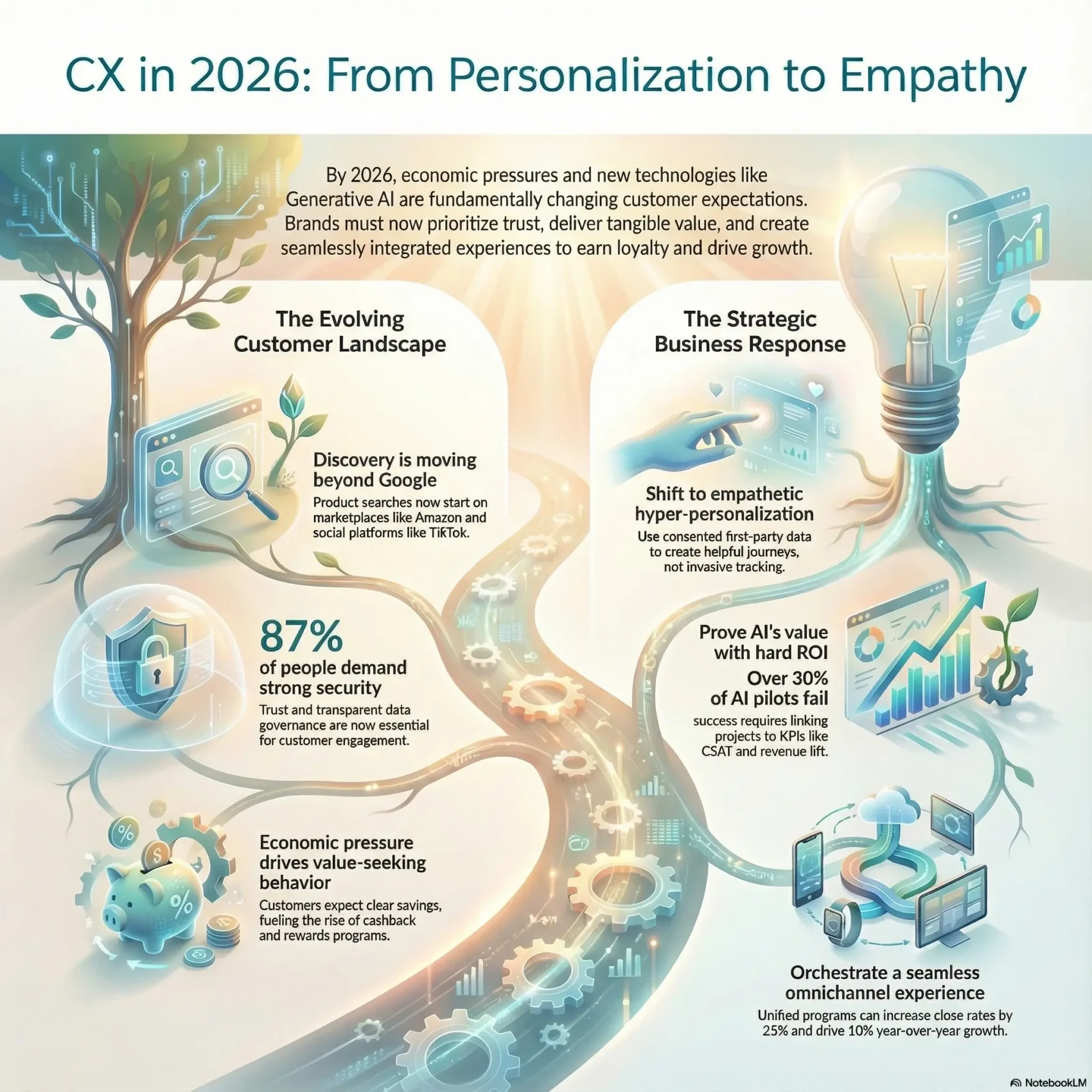
Last Updated on December 19, 2025
In this brief report you get a clear view of how the landscape is shifting in 2026. Economic pressure is changing buyer behavior, and brands are using tools like brand-funded cashback and receipt-scan programs to gather first- and zero-party data without losing trust.
Discovery is moving beyond traditional search to marketplaces and social platforms such as Amazon and TikTok. With many searches ending without a click and GenAI answers rising, your visibility and conversions depend on adapting where people look.
Practical focus matters. Many generative AI pilots stall over data quality and unclear ROI. A pragmatic plan tied to CSAT, NPS, and revenue lift helps you avoid wasted time and capture real growth.
Key Takeaways
- Economic headwinds push brands to offer value with privacy-safe data programs.
- Marketplaces and social platforms are reshaping discovery—be where people search.
- Measure AI work with hard ROI metrics to prove impact.
- Omnichannel orchestration drives higher close rates and measurable growth.
- Shift from basic personalization to empathetic, trust-first interactions.
- Use immersive tech selectively to boost loyalty and long-term value.
Why customer experience trends matter right now
Search behavior now rewards instant answers more than clicks, and that changes how you show up online.
Your aim is to turn insights into a practical plan that moves revenue, retention, and efficiency in 2026. Sixty percent of searches in the US and EU end in zero clicks. At the same time, Perplexity, ChatGPT Search, and Bing Copilot are shifting visits away from Google.
Your search intent: what you want to learn and why it matters for growth
You want clear takeaways: which levers drive results and how to measure them. This section helps you craft a strategy that ties site speed, crawl cadence, and first-party data to real KPIs.
The shift from clicks to answers: how discovery is changing
Expect up to three in ten visits to come from sources outside Google by year-end. Amazon already handles 37.6% of e-commerce sales and social media discovery—especially TikTok—is rising. CX leaders must govern AI bots so search engines and assistants represent your brands accurately.
- Meet consumers where they look: marketplaces, social channels, and AI assistants.
- Prioritize site performance, structured data, and governance for bots.
- Link your data approach to trust so customers feel respected, not tracked.
Customer experience trends shaping 2026
Rising economic pressure is reshaping what buyers expect from brands in 2026. You must offer clear savings and useful rewards while protecting trust. Simple programs that reduce out-of-pocket cost win attention fast.
Economic pressure and value-seeking behaviors drive new expectations
Many companies now fund cashback and receipt-scan programs to help consumers stretch budgets. Those programs also produce first- and zero-party data you can use with consent to improve product and services offers.
Over 87% of people won’t engage without strong security, and 54% of organizations report fragmented data that hurts real-time recommendations.
GenAI rewires discovery, decisions, and support interactions
Marketplaces, social platforms, and answer engines are changing where purchases start. You should make content and service signals readable by AI so your offerings appear in answers and recommendations.
- Treat voice as another channel that needs NLP, NLU, and clear intent mapping. Focus first on high-value use cases — order status, reordering, FAQs — and integrate with backend systems so voice interactions complete tasks rather than just provide answers.etplaces and voice agents.
- Design post-purchase workflows for automated support and smooth handoffs.
- Measure how AI-driven search affects conversion and repeat purchases.
Trust, privacy, and governance become table stakes
Privacy and trust matter more than ever. Close data gaps, secure end-to-end flows, and document governance so your use of technology is auditable.
- Unify fragmented data sources.
- Encrypt and limit access on sensitive records.
- Make AI explainable for regulators and customers alike.
Personalization to hyper-personalization: turning data into empathetic experiences
When you turn opt-in signals into timely relevance, interactions shift from generic to helpful. Use first- and zero-party data from programs like cashback and receipt scans to build accurate profiles that respect consent.
From personalized to hyper-personalized journeys using first- and zero-party data
Start small, scale safely. Create dynamic profiles that update with views, clicks, returns, and support logs. Let AI-driven segmentation adjust timing, content, and offers so each touch aligns with a buyer’s current needs.
Stats that prove the impact: buyers prefer and pay more for tailored experiences
90% of customers expect personalization; 88% of online shoppers prefer personalized experiences.
That matters because 49% make impulse buys after a tailored interaction, 62% favor recommendations, and 60% return as repeat buyers. These figures link personalization to clear value for brands and businesses.
Building profiles and real-time relevance without creeping customers out
Ground your approach in consent. Offer preference centers and transparent controls so people choose what you use and why. This builds trust while enabling next-best-action intelligence.
- Turn first- and zero-party customer data into helpful journeys, not invasive tracking.
- Integrate real-time behavioral signals across web, app, email, SMS, and in-store.
- Empower teams with tools and guardrails so personalization scales responsibly.
From hype to hard ROI: your AI reality check
AI pilots often falter when teams chase novelty instead of measurable outcomes. You need a tight plan that links automation to cost, percent of queries resolved by AI, and meaningful improvements in customer satisfaction.
Why many generative projects stall—and how you avoid the trough
At least 30% of generative AI projects are abandoned after proof of concept. Up to 50% never scale. Causes are familiar: messy data, unclear risk controls, and vague use cases.
Proving value with measurable KPIs
Executives want hard numbers. Track CSAT, NPS, FCR (70% is a common benchmark), AHT, containment rate, and revenue lift. Instrument each use case so you can show savings and productivity gains fast.
- Diagnose pilot blockers: poor data, weak guardrails, and fuzzy goals.
- Measure every deployment with CSAT, NPS, FCR, AHT, containment, and lift.
- Blend agents and automation so humans handle edge cases and AI handles volume.
Governance and enablement to scale responsibly
Form an AI council or hire a chief AI officer to codify model choice, data retention, prompt hygiene, and risk controls. Then train front-line teams so your tools deliver real benefits and your customers notice.
Use focused pilots to validate ROI before expanding across brands and business units.
Specialized AI over generic tools: purpose-built agents for CX
Purpose-built AI agents are overtaking one-size-fits-all models in mission-critical support and marketing workflows. You’ll see faster payback when models are designed for the domain, use owned data, and ship with guardrails.
Choosing trusted providers with domain data and guardrails
Pick providers that show proven CX heritage and clear responsible AI practices. Companies that own rich domain data deliver more accurate, context-aware results for your customers and consumers.
Trust matters: document how data is collected, used, and protected at every touch. That transparency reduces risk and speeds approvals.
Right-sizing models for targeted use cases and faster payback
Smaller, specialized models often beat large generic systems on cost, speed, and accuracy. Right-size the model to the task and integrate it with your current stack and services.
- Choose providers with domain data and CX track records.
- Deploy lightweight agents for high-ROI use cases first.
- Design integrations that leverage existing workflows and systems.
- Ensure agents respect brand voice, legal limits, and compliance.
Build a roadmap that scales from one validated use case to broader experiences without overengineering. That approach preserves trust and delivers clear business value.
Proactive CX: anticipate needs before customers ask
Anticipating issues before they surface is a high-impact way to reduce friction and build loyalty. 81% of customers want proactive communication, and quick resolution makes buyers 2.4x more likely to stick with a brand.
Operationalizing predictive outreach with behavioral signals
Identify signals like failed payments, shipping delays, and usage drops. Use those triggers to send timely, helpful contact that prevents inbound tickets.
KPIs that matter: proactive contact rate, time-to-resolution, issue avoidance
Set clear metrics: proactive contact rate, time-to-resolution, and issue avoidance. Aim for a 70% FCR benchmark where possible to measure impact.
- Spot signals that predict problems and route them to the right team.
- Pair automation with human follow-up so outreach feels personal, not robotic.
- Build playbooks for common service scenarios to resolve issues before customers report them.
- Connect wins to loyalty by showing you respect people’s time and anticipate their needs.
Proactive outreach lowers time to resolution and avoids many inbound contacts. For organizations and companies that act, the payoff shows in higher customer satisfaction, reduced support load, and stronger long-term loyalty.
Omnichannel orchestration: make every channel feel like one conversation
Make every route to your brand act like a single conversation, not a set of silos. A clear strategy ties web, phone, chat, in-app, and social into one view so people don’t repeat themselves.
Where people actually reach out
Most buyers start digitally: 71% begin on web or app channels, while phone use rises from 16% to 29% for complex issues. About 53% of U.S. organizations use social media for customer service, yet only half meet fast reply expectations.
Unify data to end context loss
Unify data across tools so every agent and bot sees the same history. Only 7% of contact centers achieve seamless transitions today; fixing that preserves intent and saves time.
Design seamless handoffs between bots and agents
Carry transcripts, intent, and sentiment with every handoff. That prevents repetition and reduces friction while protecting privacy with consistent opt-ins.
Why omnichannel lifts close rates and revenue
Orchestration pays. Strong omnichannel programs drive about 10% YoY growth and 25% higher close rates. Set SLAs by channel, measure outcomes, and link wins to revenue.
- Map real behavior: social for quick replies, phone for complex issues, in-app for account tasks.
- Set response-time SLAs and carry context across interactions.
- Quantify uplift and protect trust with clear data practices.
Voice commerce and conversational experiences go mainstream
Smart assistants now handle routine shopping and service tasks. You should treat voice as a full channel that connects buying, support, and account work. Voice assistant technology — from Siri to Alexa — relies on NLP, NLU, machine learning, and conversational AI to interpret intent accurately.
Building for Siri, Alexa, and voice recognition with NLP and NLU
Start with use cases that cut friction. Prioritize reorders, status checks, and quick account updates so interactions end in completion, not follow-up tickets.
Design clear intents, slot filling, and robust error handling. That improves recognition across accents and noisy environments. Test on phones, smart speakers, and in-car systems to refine accuracy.
“42% of CX leaders expect generative AI to influence voice-based interactions within two years.”
- Connect voice to commerce and service stacks so purchases and tickets complete in one flow.
- Use lightweight tools and specialized agents to keep latency low and responses correct.
- Measure voice interactions like chat and phone: containment, CSAT, and revenue impact.
- Test across devices, accents, and real-world noise to build trust and reliability.
Make governance part of the build. Document data use, consent, and fallbacks so consumers trust transactions and your teams can iterate safely.
AR, VR, and immersive storytelling that converts
Immersive AR and VR bridge the gap between browsing and buying. You can merge in-store feel with digital touchpoints so people test fit, color, and scale before they commit.
In-store and digital try-ons: from AR mirrors to 3D takeovers
Luxury companies like Louis Vuitton have used 3D takeovers on storefronts, while cosmetic brands deploy AR mirrors for real-time makeovers. These examples show how technology reduces uncertainty.
When you add immersive demos, decision time shortens and conversion rises. You’ll bring in-store and online worlds together with consistent creative, pricing, and support.
- Reduce uncertainty: try-ons and demos lower returns and speed purchase.
- Clear CTAs and help: pair immersive content with assistance so customers check out fast.
- Measure impact: connect interactions to analytics to track engagement, revenue, and retention.
“Immersive storytelling makes product benefits obvious and memorable.”
Loyalty in an age of choice: cashback, rewards, and community
Smart rewards now favor clear savings and useful access. Brand-funded cashback and receipt-scan tech let you deliver real value while gathering first- and zero-party insights that respect privacy.

Brand-funded cashback and receipt-scan tech for value-seeking consumers
Economic pressure is shifting behavior: many consumers expect special treatment and will pay more for great service. Use receipt-scan programs to recognize members across channels and tailor offers that match actual needs.
48% of consumers expect special treatment for being loyal; 86% will pay more for an excellent experience.
Designing loyalty programs customers actually use
Build rewards people redeem: cashback, smart points, and member-only perks. Segment benefits by use case, not just tier, so perks solve real problems.
- Use receipt data to personalize benefits and improve satisfaction.
- Offer service and experience upgrades—priority support, faster shipping, exclusive content.
- Be transparent about data and privacy so members trade info for clear value and trust.
Connect loyalty to your omnichannel playbook and learn more about orchestration at omnichannel strategies.
Organic brand marketing returns: stand out in a saturated, AI-polished world
Organic reach is staging a comeback as paid channels grow costlier and less predictable. You should shift budget and focus toward content that earns trust and drives lasting growth.

Authenticity wins. A flood of AI-polished posts makes raw, useful content more valuable. You’ll lean on UGC, employee stories, and creator collaborations to show real proof that resonates.
UGC, influencer collaboration, and SEO-driven content with real utility
Make helpful content your baseline. Produce pieces that answer real queries fast across search, social media, and owned channels. Optimize for answer engines and generative summaries so your brand is cited and chosen.
- You’ll invest in high-utility guides and short formats that solve problems quickly.
- Activate creators, employees, and customers to supply authentic proof people trust.
- Treat community feedback and customer data as your editorial compass for what to publish next.
- Link organic programs to loyalty and service moments so interest converts into lasting relationships.
“De-risk algorithm shifts by building owned reach and content that people search for and share.”
Conclusion
Small, focused changes can unlock major gains in loyalty and revenue in 2026.
You must move fast and keep interactions simple. Speed, convenience, and consistency matter: firms that excel can add $700M–$1B in revenue over three years and outpace market sales by ~8%.
Nearly half of people who left a brand did so because of poor service. So you’ll prioritize hyper-personalization, proactive support, omnichannel orchestration, and trustworthy data practices to protect value and lift engagement.
Act with a measurement-first mindset. Prove value quickly, scale what works, and link loyalty and satisfaction gains to durable business growth. Make continuous learning part of your rhythm so your team adapts in real time.