Tools
Tools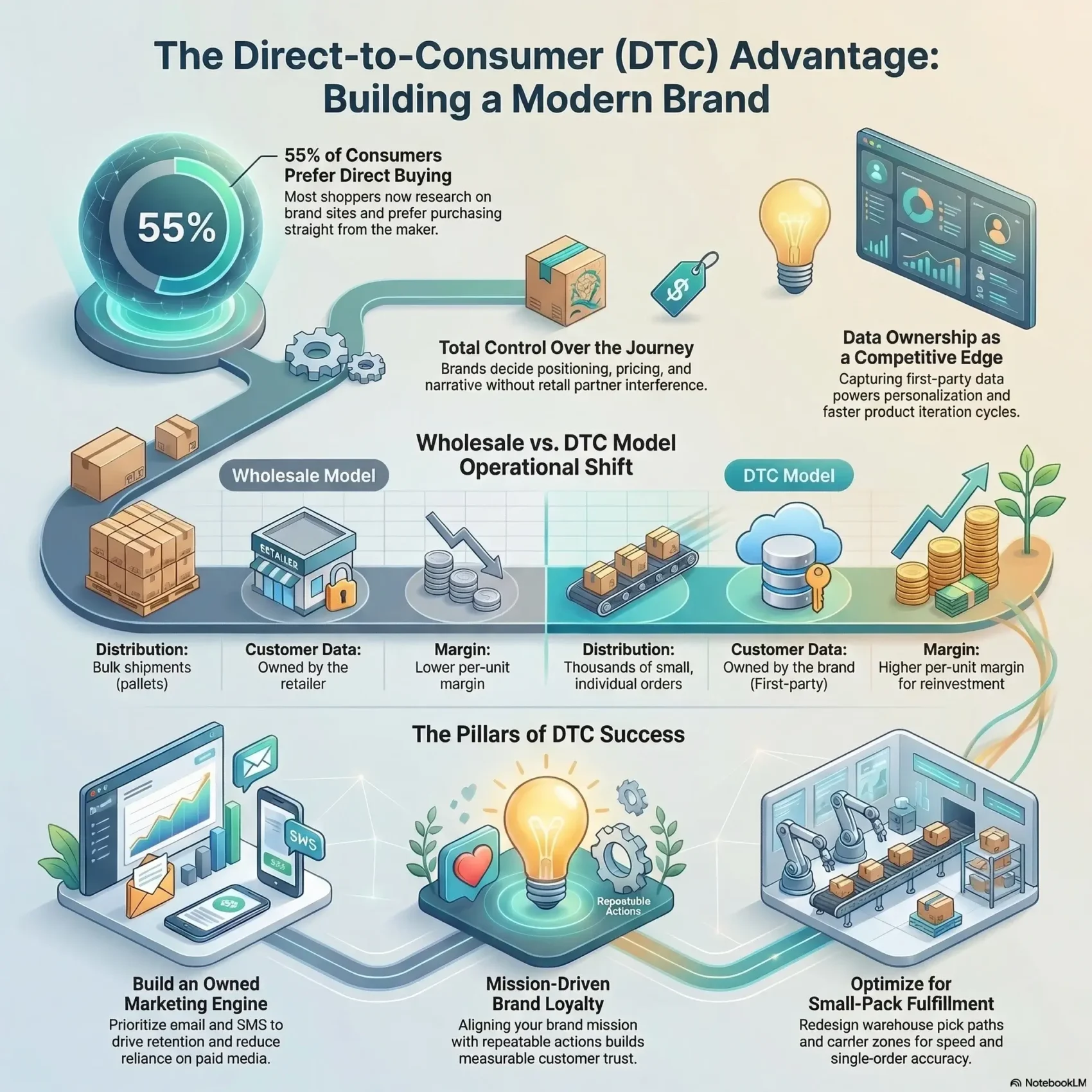
You can reshape how your brand reaches people by selling directly and owning the relationship. A clear direct-to-consumer strategy helps you control pricing, distribution, and messaging while you capture valuable first-party data.
Many shoppers now research on brand sites and prefer buying straight from makers. Brands like Nike, Warby Parker, Glossier, Bombas, Casper, MeUndies, Magic Spoon, and Chubbies show how owned channels, content, and community drive growth.
This approach cuts middlemen, preserves margin, and speeds product iteration. You’ll use owned platforms and smart marketing to reduce paid media swings and build lasting customer loyalty.
The rest of this guide maps the journey from positioning to operations, offering practical steps, trade-offs, and examples so your company can move from idea to action with clarity.
Key Takeaways
- You’ll learn how owned channels and content create durable demand.
- Leading brands use first-party data to improve product and experience.
- Expect trade-offs: capital, logistics, and data infrastructure matter.
- Practical tactics cover social, email, and lifecycle programs.
- You’ll leave with a 90-day plan and a repeatable framework.
What DTC Really Means Today: From Manufacturer to Customer Without the Middlemen
Owning the path from product to buyer rewrites who controls pricing, storytelling, and returns. Wholesale sends pallets to retailers who then own the purchase and service moments. In a dtc model you replace bulk shipments with thousands of small orders that must be picked, packed, and shipped differently.
How this model differs from wholesale and retail channels
Retailers set shelf placement, promos, and often keep customer data. When you sell directly, you decide positioning, pricing, and the product narrative across your site and channels.
What shifts when you own the entire customer journey
You capture first‑party information across browsing, purchase, and service. That data powers personalization, lifecycle marketing, and faster product iteration.
- Operations: update inventory, warehousing, and shipping playbooks for many small orders.
- Economics: trade wholesale volume for higher per‑unit margins to reinvest in marketing and service.
- Service: returns and support become visible brand levers that build loyalty.
- Commerce: your website replaces a retailer’s shelf, so PDPs, reviews, and checkout are critical.
In short, selling direct gives you more control over the customer experience and the product lifecycle. You gain speed, data, and margin—but you also take on fulfillment and service responsibilities that retailers once handled.
Why DTC Is Surging Now in the United States
Low-cost storefronts and precise ads are changing how people discover and buy products online. E-commerce platforms and social media have lowered the technical and financial barriers that once stopped small makers from reaching buyers at scale.
Platforms now bundle storefronts, payments, and logistics APIs so you can stand up a site fast. That reduces the need for retail partners and heavy upfront investment.
The role of e-commerce tools and social media in lowering barriers
Targeted ads on social media cut the cost of attention. Creative that sparks clicks drives visits to brand sites and fuels sales.
How convenience and personalization drive adoption
Today’s consumers expect fast delivery, tailored assortments, and easy returns. That makes the model a natural fit for shoppers who value convenience and personalization.
- Faster testing: data from your site helps you refine product and messaging quickly.
- Measurable marketing: owned and paid media give clearer feedback loops for scaling what works.
- Behavioral shift: 59% research on brand websites and 55% prefer buying directly from manufacturers, so habits are shifting toward brands.
The Benefits and Trade-Offs of Going Direct
You gain clearer control and stronger margins when you sell through your own channels. That means you decide how your brand looks, when you launch products, and how you price and bundle offers.
Control, margins, and speed-to-market
Benefits include faster testing and rollout. You can run limited drops, try product variations, and scale winners to grow sales quickly.
Higher gross margins let you reinvest in marketing, creative, and CX to build a stronger brand. And owning first-party data gives real customer insight—purchase patterns, on-site behavior, and service history—that informs product and lifecycle programs.
Challenges: upfront investment, fulfillment complexity, and risk
The trade-offs are real. You need upfront investment to build awareness because you can’t lean on retailers’ audiences.
Fulfillment gets more complex: pick, pack, returns, and SLAs all scale with thousands of small orders. Owning the model also means you own the risk—forecast errors, inventory imbalances, or supply chain strain can pressure cash flow and your business.
- What to plan: phased investments in systems and ops to capture benefits while lowering execution risk.
- Quick wins: test small, learn fast, and use higher margins to fund marketing that grows repeat customer value.
Build a Brand Customers Choose: Identity, Positioning, and Authenticity
A memorable identity helps shoppers recognize you in feeds, inboxes, and on the shelf. Your brand must combine a clear promise, consistent visuals, and a voice that reflects what you actually do.
Crafting a recognizable presence across channels
Start simple: define your value proposition, voice, and visual rules so your site, email, social, and packaging feel like one team. Use modular templates and a creative system to scale content without losing the look that made you distinct.
Backing your mission with actions that earn trust
Authenticity is proof in motion. Bombas’ one-for-one donations—more than 40 million pairs given—turn mission into measurable loyalty. Glossier shows how audience co-creation and community content turn followers into collaborators and buyers.
- Align mission with repeatable actions to build trust.
- Invite your audience into product ideas and feedback loops.
- Measure brand success with recall, sentiment, and direct traffic—not only clicks.
Keep the experience coherent from ad to PDP to unboxing so customers understand why they chose you and return. For omnichannel playbooks, see omnichannel strategies that tie audience, content, and media together.
“Consistency across touchpoints makes brands memorable and trustworthy.”
Make Data Your Edge: First-Party Customer Data, Measurement, and a Cookieless Present
Your data foundation determines whether you respond to trends or simply react to noise. Build disciplined collection points so the signals you gather are clean, consented, and actionable.
Collect from many places: web behavior, subscriber lists, social interactions, purchases, surveys, feedback, and CRM entries all matter. Email is a channel you fully control and a rich source of engagement information.
Collecting and activating high-quality first-party data
- Use clear consented forms, onsite events, and preference centers to improve data quality.
- Unify site, email, CRM, and platform feeds into a customer data layer you can segment and activate.
- Translate insights into dynamic merchandising, predictive replenishment, and triggered journeys for timely product and brand experiences.
Attribution, aggregation, and performance insights across walled gardens
In a cookieless present, rely on first-party IDs, server-side tagging, and modeled attribution. Treat platform-reported metrics as signals and triangulate with your own customer data to measure true incrementality.
“When you blend owned information with modeled measurement, your marketing investments become far more predictable.”
Direct-to-Consumer Strategy: The Core Pillars That Drive Growth
Your marketing mix should center on channels that build awareness, capture data, and turn one-time buyers into repeat customers. Pick a few pillars and invest in systems that let you learn fast.

Social media that builds awareness and community
Use social media to seed stories and test creative quickly. Short, thumb-stopping hooks with clear calls to action help you find an audience and spark community growth.
Influencer collaborations to extend reach
Partner with creators who match your voice. Track unique links and codes, and whitelist top performers so you scale what actually drives sales. Influencer spend topped $34B in 2023 with strong return multiples.
Email, personalization, and SMS for retention
Build an email marketing engine that covers welcome, abandonment, post-purchase, and replenishment. Personalize offers and recommendations based on behavior to raise conversion.
Layer SMS for urgent moments—back-in-stock alerts and limited drops. Mr. Squatch credits SMS with 15% of $200M revenue, so use it sparingly and with value.
Offline tactics that amplify digital performance
Targeted OOH, pop-ups, and direct mail can lift reach. Model geo and time-based effects to connect offline spend to online sales.
- Playbook: borrow bold content and subscription models from dtc brands like Magic Spoon and MeUndies to drive steady loyalty.
“Test rapidly, own your channels, and reward repeat customers with clear, relevant experiences.”
Design Your Channel Mix: Audience, Content, and Media Working Together
A smart media mix balances reach with relevance so your content finds the right audience fast. Start by naming the job for each channel: awareness, consideration, or conversion. That clarity keeps creative focused and performance measurable.
Mapping content to the funnel across platforms
Use short, entertaining clips on TikTok and Pinterest for discovery. Put community posts and shoppable feeds on Instagram to support consideration.
Run Facebook ads to quickly test product-market fit and learn which messages land. Email backs up every stage by nurturing interested shoppers and driving repeat purchases.
Balancing prospecting, retargeting, and retention
- Prospect: reach new audience groups with broad creative and clear value props.
- Retarget: show proof points and promos to high-intent visitors.
- Retain: use email/SMS and on-site personalization to keep customers coming back.
“Align media, creative, and data so each channel carries a distinct job and KPI.”
Operations That Power DTC: Inventory, Fulfillment, and Customer Experience
Packing and shipping one-off orders at scale requires different people, systems, and warehouse layouts. When you move from bulk to single-order fulfillment, every step—from pick paths to carrier handoff—changes.
Design your distribution center for speed and accuracy. Optimize DC aisles for singles picking, fast packing, and clear carrier zones so you meet delivery promises without burning margin.
Logistics and inventory rules that keep products available
Use order routing, inventory buffers, and demand forecasting to reduce split shipments and backorders. Route high-turn SKUs closer to pack stations.
Returns and service as growth levers
Standardize returns with prepaid labels, instant refunds or credits, and automated disposition to restock quickly. Elevate service with proactive comms—order status, ETAs, and self-serve help—so customers feel confident at every step.
- Audit packaging for protection, sustainability, and unboxing impact.
- Build contingency into your model with backup carriers, 3PL partners, and safety stock.
- Turn support into advocacy by training reps to resolve issues fast and add surprise-and-delight moments.
“Brands that master fast shipping, easy returns, and clear communication turn service into a customer acquisition channel.”
Proven DTC Playbooks: What Successful Brands Get Right
What separates fast-growing companies from noise is a repeatable system that ties product, marketing, and operations together. Below are compact examples you can study and adapt.
Glossier: community-first content and co-creation
Glossier grew from a blog into a cult dtc brand by listening to its audience. You can replicate this by inviting feedback and turning fans into product collaborators.
Bombas: mission that turns trust into loyalty
Bombas proved a simple promise matters. Their one-for-one donations passed 40 million pairs and converted mission into both loyalty and measurable sales.
Warby Parker, MeUndies, Magic Spoon: personalization, subscriptions, smart media
Warby reduces friction with quizzes and free home try-on. MeUndies pairs playful marketing with subscriptions and influencers. Magic Spoon scaled on bold creative and subscription models, raising significant capital to grow products and reach.
- Takeaway: align your brand, product, and ops so your promise matches delivery.
- These dtc brands prove that clear marketing plus great execution drives repeat business.
“Alignment between promise and delivery is the real moat.”
Your First 90 Days: A Practical Roadmap to Launch and Scale
A tight 90-day plan turns uncertainty into measurable progress and early revenue. Use a clear week-by-week playbook so you learn from small wins and avoid costly mistakes.
Week-by-week plan: brand, data foundation, channel testing, and optimization
Weeks 1–2: Clarify positioning and build your brand system. Set up analytics, conversion tracking, and a clean product catalog with strong PDPs.
Weeks 3–4: Stand up email marketing basics — welcome flows, cart abandonments, and post-purchase sequences. Capture zero- and first-party data and run core site tests.
Weeks 5–6: Test paid social and creators with structured creative sets and audiences. Validate offers and landing pages by measuring early sales signals.
Weeks 7–8: Expand platforms, refine targeting, and introduce SMS for high-intent alerts. Begin simple retention plays to lift repeat purchase rates.
Weeks 9–12: Optimize toward contribution margin. Scale incremental wins, cut waste, and deepen personalization and merchandising.
KPIs to track and measurement guidance
Focus KPIs: CAC, LTV, MER/ROAS, retention, and contribution margin. Track them weekly and view cohorts to see true payback windows.
- Build a measurement stack that compiles channel information and disaggregates walled‑garden data.
- Use modeled attribution that blends platform signals with your own customer data so you can reallocate spend confidently.
- Treat email marketing as an owned channel for granular engagement metrics and lifecycle optimization.
“Measure what pays back: weekly CAC and cohort LTV reveal whether you should scale or iterate.”
Conclusion
When you link product quality with repeatable delivery, your brand earns lasting trust. Build a clear, strong, data foundation that blends first-party signals with modeled measurement so you stay effective as privacy and platforms shift.
Winning direct consumer relationships comes from aligning promise, products, and the experience across every touchpoint you control.
The benefits compound when you collect good data, activate it thoughtfully, and keep your approach flexible. There are many ways to grow: social storytelling, creator partnerships, email/SMS, and selective offline plays.
Treat this as a company-wide effort—operations, finance, service, and merchandising will shape your results. Track contribution margin and LTV so you scale sales sustainably and keep improving product and experience.