Tools
Tools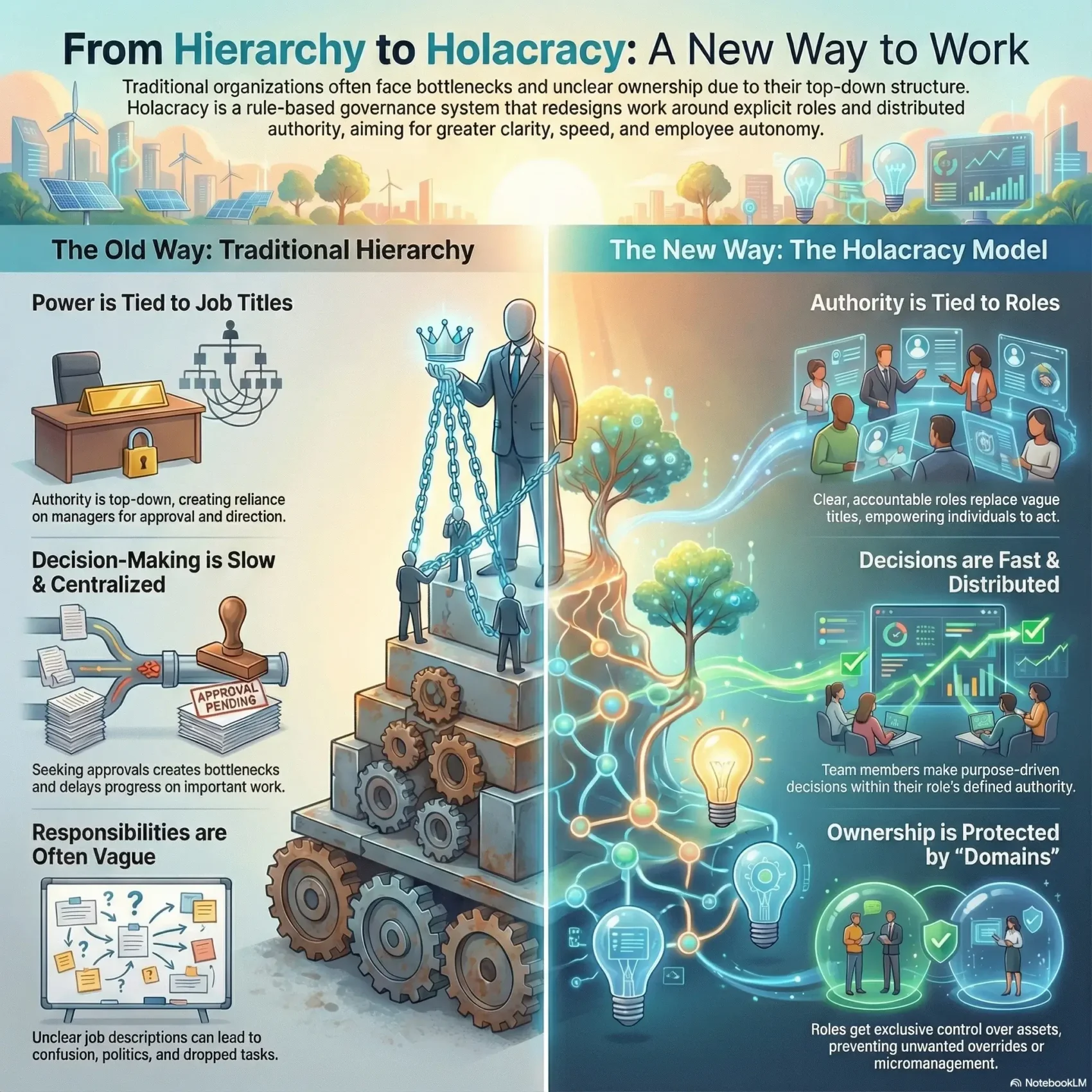
Last Updated on January 25, 2026
You’ll see how a flat, rule-based system changes day-to-day work by trading vague job titles for clear, accountable roles. In this setup, a company maps tasks into roles so responsibilities are visible and delegable.
The result is less micromanagement and fewer bottlenecks. Domains give exclusive control over assets, so a Website Manager truly owns the site and even a CEO must respect that boundary.
Regular tactical meetings and simple rules keep leaders informed without directing every decision. That means you can lead your role with authority, follow clear guardrails, and get work done faster.
This structure helps employees find who to ask, reduces politics, and makes management a set of accountabilities rather than a person. For practical process tips and SOPs for team productivity, see team SOPs and productivity.
Key Takeaways
- Roles replace titles, so responsibilities are visible and actionable.
- Domains protect critical assets and limit overrides from leadership.
- Tactical meetings focus on blockers and transparency, not status updates.
- You gain authority to act in your role while following clear rules.
- The company scales better when roles, not people, hold responsibilities.
Why You’re Exploring Holacracy Now: Intent, Fit, and What’s at Stake
You’re exploring a new governance model because current bottlenecks slow decisions and blur who owns outcomes. You want a system that aligns your organization around purpose and reduces decision friction without adding more layers of management.
Think about changes in authority: moving from title-based power to role-based authority changes how employees and managers interact. Roles make responsibilities explicit so your team knows who can act and when to escalate.
The framework channels structural changes through a decentralized governance process. Anyone can propose updates to roles or policies, and objections act as safety checks so change doesn’t derail daily work.
What’s at stake is whether this system will speed better decisions close to the work or create confusion if roles and accountabilities aren’t clearly defined and supported.
- Fit signals: cross-functional collaboration and a willingness to separate identity from role.
- Support needed: training, disciplined meetings, and time invested to make governance light and useful.
- People impact: less reliance on a single manager and more authority for role-holders to move work forward.
- Risk balance: decentralized proposals with objection checks shift power without freezing change.
Holacracy Adoption
Shifting your organization to clear roles and governance is a learning journey that unfolds in small steps. Practitioners who helped hundreds of teams found the framework stays flexible when you treat it as a toolbox, not a rigid blueprint.
Start small. Run governance and tactical meetings, write a few high-impact roles, and test changes against real tensions in your work. This builds muscle memory for proposing updates, raising objections, and clarifying accountabilities.
Plan for learning time. People need space to practice new processes. At first meetings will feel odd. Over time they reduce confusion and speed decisions.
- Map a simple process: pilot one circle, run governance rounds, then iterate.
- Define early roles around critical work and write clear accountabilities.
- Set milestones: first governance cycle, a cross-team policy, and your first delegated domain.
Teach managers how to shift from gatekeeper to context-shaper. Celebrate small wins and codify improvements so changes stick. Treat this as continuous work: your organization will evolve, and the process will too.
From Blueprint to Toolbox: Understanding the Holacracy Framework and Constitution
A clear rulebook gives teams predictable space to act, not a cage of arbitrary commands. The constitution is a compact, ~15-page rule set (v5) your organization ratifies to create shared expectations.
The rules define roles, policies, governance steps, and meeting processes. They do not spell out your org chart, the number of circles, or exactly how you group teams.
A rule-based system that increases flexibility, not rigidity
Consistent rules free people to act—you stop asking for ad hoc approvals and start making decisions within clear guardrails.
What the Constitution does—and doesn’t—prescribe
The constitution provides building blocks and a process, not a single blueprint. Use it to design fit-for-purpose structure that maps to your purpose.
Purpose as the north star for structure and decisions
Let purpose guide choices about roles and structure. When you test options, ask: does this move the organization closer to its aims?
“The system is empty until you fill it with your roles, policies, and purpose-driven decisions.”
- Examples of circles and roles vary by company, proving adaptability.
- Anyone can activate the process to evolve structure when tensions arise.
- For practical process tips and SOPs, see team SOPs and productivity.
Roles, Circles, and Domains: Redesigning Your Organizational Structure
Define tasks around clear roles so everyone knows who owns outcomes and why. Treat roles as units of work tied to purpose, not as titles tied to people. This makes expectations explicit and reduces politics.
Defining work as roles, not people or titles
Roles are written around functions like Finance, Sales, or Legal. Each role lists purpose, accountabilities, and decision limits. When you look up a role, you see who to ask and what to expect.
Circles as nested teams with clear accountabilities
Circles group related roles into a team with shared aims. A circle holds the accountabilities for a product or service. This reduces overlaps and makes structure easier to navigate.
Multiple roles across circles and how time is balanced
You can hold multiple roles in different circles. Balance time with priority agreements and tactical meetings. Use those meetings to flag conflicts early and reassign focus.
Domains: exclusive control and why even a CEO needs permission
Domains grant exclusive control over assets. For example, a Website Manager owns the site. Even the CEO must request changes. This clarifies authority and prevents hidden overrides.
- Split broad roles: break a bloated role into two focused roles so work gets done.
- Make authority explicit: publish domains so anyone can see who controls what.
- Check capacity: list all roles a person holds and set realistic priorities.
Governance That Scales: How You Evolve Structure Together
Governance works when your team treats structure as a living thing, not a one-time design.
Everyone can propose changes. Any person can suggest new roles, add accountabilities, or update policies. This removes single-point bottlenecks and spreads ownership across the organization.
Decentralized change: propose role or policy updates
Use a simple process to submit proposals. Templates lower friction and make participation easier.
Document each decision so later hires can see why a change was made and how it supports purpose.
Objections as safety checks—not vetoes
Objections are safety checks that prevent harm, not final vetoes. They force clarifying questions or alternative wording.
This keeps the governance process fast while protecting critical assets and shared work.
When to add accountabilities vs. create a new role
If a task fits the scope and workload of an existing role, add the accountability there.
Create a new role when responsibilities grow, cross boundaries, or risk overloading a single person.
- Example: add a rollout documentation policy before software releases.
- Model governance habits so roles reflect how your team actually works.
- Help managers shift from gatekeepers to contributors who refine structure with others.
Treat governance as your system’s evolution engine: frequent, small updates beat rare, disruptive reorganizations.
Delegation Without Drama: Clear Authority, Boundaries, and Real Examples
Good delegation starts with written authority, not whispered expectations. When you add accountabilities to a role or create a new role through your governance process, the handoff is explicit and visible to all team members.
Assigning work through roles and accountabilities, not job descriptions, makes decisions repeatable. You avoid confusion by documenting who can act and what limits apply.
Assigning work through roles and accountabilities
You formalize delegation by updating roles and accountabilities, not by changing vague job descriptions. This makes it easy for any person to look up who owns a task.
Keeping the right level of control
Use clear policies and coordinating roles to keep oversight without micromanaging. For example, a founder can let each business line design pricing while a Pricing Strategy policy requires final approval from a coordinating role.
- Visible handoffs: role updates show exactly what you delegate and what stays controlled.
- Reduce rework: clear accountabilities cut back-and-forth.
- Multi-role support: agree prioritization in tactical meetings when one person holds multiple roles.
- Safe refusals: people can say no to out-of-role requests, backed by rules of cooperation.
This process helps managers step back from day-to-day tasks while still shaping strategy and context. Your company gains a repeatable way to shift responsibility as the organization grows.
Goodbye Micromanagement: The Circle Lead vs. Traditional Manager
A Circle Lead’s authority is about setting strategy and clearing obstacles, not ordering day-to-day tasks. You get context, priorities, and resources from the lead. You keep control over how your role does the work.
What Circle Leads can and can’t do
Circle Leads assign people to roles, monitor performance, set priorities, and allocate resources. They can remove someone from a role when accountabilities aren’t met.
They do not hire or fire, set compensation, or dictate how you complete your job. Those decisions live outside the Circle Lead’s remit so HR and employment processes stay separate from governance.
Using strategy, role clarity, and meetings instead of directing tasks
Strategy and explicit accountabilities replace micromanagement. When expectations are written, you know which outcomes matter and can choose the best approach.
Use tactical meetings for fast updates, triage, and reprioritization. These short sessions keep the team aligned without turning into status theater.
Relying on rules of cooperation and tactical meetings for visibility
The duty of transparency lets a lead ask what you’re working on, next steps, and why. That gives visibility without eroding your authority over the job.
- Clear roles: show who owns what and reduce informal directives.
- Governance: change expectations through the process, not by command.
- Healthy management: leads remove blockers; people own outcomes.
Autonomy with Guardrails: Rules of Cooperation That Protect Employees
Your role comes with real latitude — and a few well‑placed limits to keep things fair. You get clear authority to act and to interpret how requests map to your purpose and accountabilities.
Authority to act and interpret your role
By default, you may act in ways that advance your role. If a request falls outside your accountabilities, you can say no and explain why. This protects employees and helps the organization move faster.
Requests vs. assignments: how work actually gets done
Work can be requested from your role but not assigned without consent. That distinction keeps team members from becoming task‑directed by habit.
Constraints that create clarity
Simple constraints balance freedom and safety. Examples include Circle Lead prioritization, spend approvals, and domain ownership (ask the Website Manager before editing the site).
- You’ll operate with real autonomy while following shared rules.
- You’ll use tactical meetings to align competing work and priorities.
- You’ll protect other people’s work by asking permission before impacting their domains.
- You’ll gain more psychological safety through consistent expectations.
Scaling Across Teams and Sizes: Staggered Implementation That Works
When you stretch a governance system to many teams, a staggered plan keeps momentum and reduces risk.
Why the framework fits any industry and size
The rules and roles scale. The same holacracy framework can map to startups, mid-size companies, and large organizations.
Because the organizational structure is rule-based, you reuse the same processes as scope grows. That makes it easier to predict outcomes and train teams.
Training at scale and piloting circles to de-risk rollout
Start with pilots. Run a few circles as live experiments so people learn meeting rhythms, write roles, and apply governance to real tensions.
Invest in trainers and internal coaches who support circles. They help teams practice the process and avoid theoretical workshops that don’t stick.
- Phase the rollout: enable, practice, measure, then expand.
- Track outcomes: cycle time, role clarity, and fewer handoff issues.
- Leaders sponsor: they remove blockers, model participation, and fund training.
- Let multiple roles evolve: avoid overdesign until teams gain time and experience.
With short feedback loops and shared wins from pilots, your organization builds internal capability and confidence to scale the system across more organizations and teams.
Your Team’s Lived Experience: Changes in Decision-Making, Accountability, and Work
Everyday work starts to feel different when authority maps to written roles instead of whispered instructions. You stop guessing who should act and begin checking a clear directory that lists purpose, accountabilities, and domains.
Clarity over who does what—and how you find it fast
You’ll find who does what fast by searching roles and accountabilities rather than pinging a manager for directions. That reduces interruptions and speeds handoffs.
Domains and cross-team policies make boundaries visible. Team members see who owns an asset and respect it, so work flows cleaner and fewer balls are dropped.
Shifting from approval-seeking to purpose-driven decisions
You’ll shift from asking permission to acting within your role’s authority. Tactical meetings give quick updates and triage, not long approval loops.
- You’ll feel accountability sharpen as requests go to roles with explicit scopes.
- You’ll use governance to propose changes when structure doesn’t fit the work.
- You’ll see managers focus on strategy and priorities, which supports employees’ autonomy.
In practice, team members propose a fix when they spot a gap. That habit keeps the organization adaptive and keeps decisions closer to the people doing the work.
Conclusion
Shared rules give your company predictable freedom to experiment safely. The constitution and the framework turn vague power into clear processes you fill with roles, policies, and purpose.
Start small: pilot a circle, invest in training, and refine accountabilities as you learn. That process keeps structure aligned to real work over time.
This system scales because it treats governance as iterative, not final. Managers shift from directing jobs to shaping context. Domains and authority let different people move fast without stepping on each other.
When you validate fit in a specific place, you reduce risk and strengthen buy-in. Now you’re ready to draft roles, convene a pilot, or ratify the constitution and run your next step.