Tools
Tools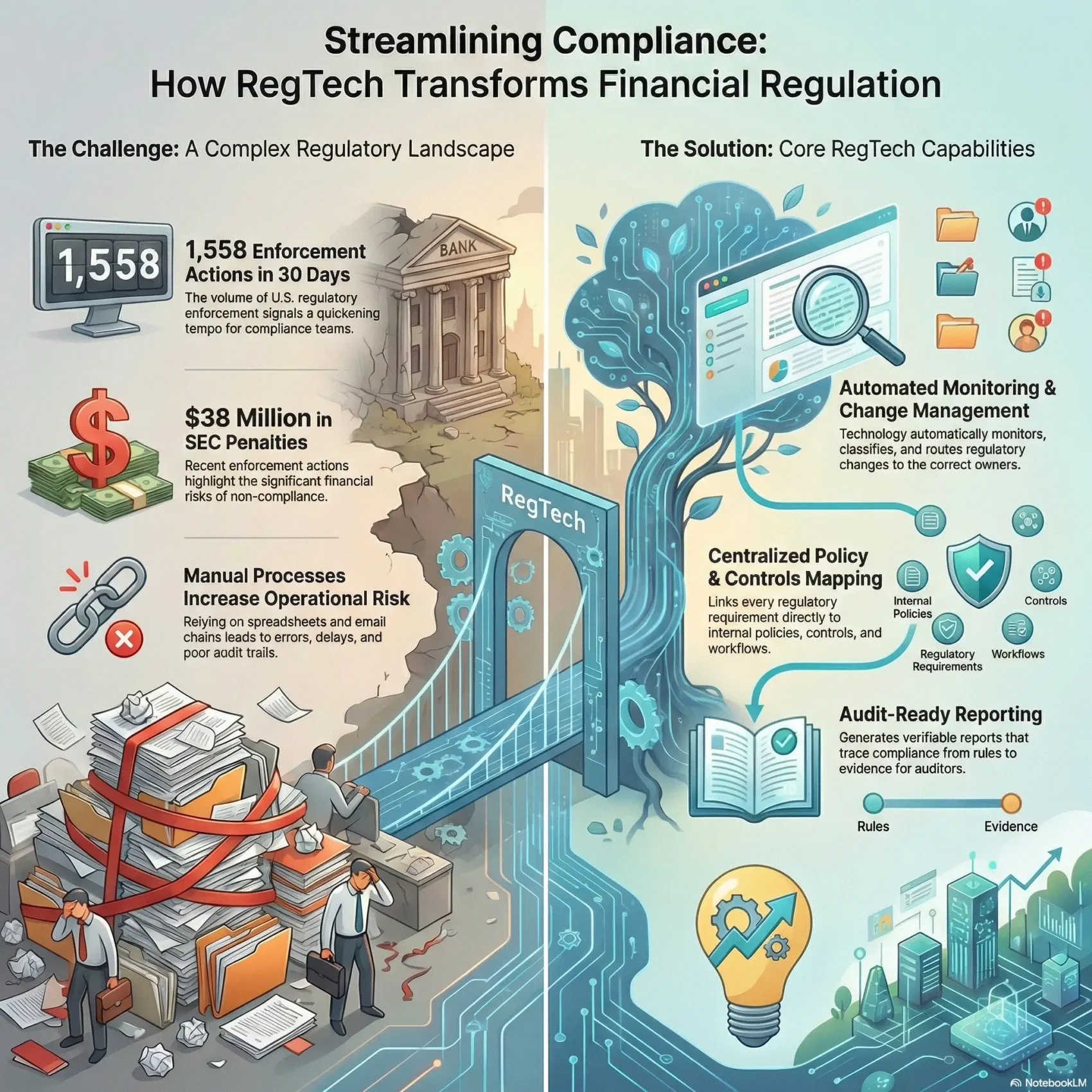
Last Updated on March 11, 2026
You work in financial services and face growing rules, rising cyber risk, and pressure to cut costs. This guide shows how regtech solutions help your financial institutions meet regulatory compliance without upending daily work.
We focus on why modern banks and firms need a reliable platform and technology today. Automated monitoring and clear reporting make it easier to track regulations and reduce manual effort.
Across the industry, companies use data to power management of policies, controls, and processes. Captured information can feed multiple tasks, so you get faster evidence for executives and boards.
Read on for a friendly, practical walkthrough of tools, services, and implementation steps that help you turn rules into business outcomes and tame operational risk.
Key Takeaways
- Automation and analytics cut compliance time and lower risk.
- Connect data once to support many reporting and monitoring tasks.
- Pick a platform that matches your institution’s risk and processes.
- Build a clear business case to show value on day one.
- Focus on governance and management to close the loop from rules to evidence.
- Evaluate vendors across the market, from end-to-end to niche innovators.
Your roadmap to this Ultimate Guide on RegTech solutions
Use this roadmap to jump straight to the chapters that match your role and pressing priorities. The guide is arranged so you can skip ahead to practical sections or follow the end-to-end path from monitoring to ROI.
Who this guide is for: risk, compliance, and business leaders
If you lead compliance or risk management, you’ll learn how to replace disjointed activities and manual processes with one platform that streamlines reporting and collaboration.
If you run a line of business, this guide shows how targeted solutions reduce time to meet requirements, keep information flowing, and support ongoing use without extra overhead.
For executives and boards, we highlight metrics that matter: efficiency gains, risk reduction, and audit-ready documentation so oversight aligns with industry expectations.
What you’ll learn: from regulatory monitoring to ROI
- How monitoring foundations and change management speed compliance and cut duplicated activities.
- Ways to map requirements into processes, controls, and clear reporting for audit readiness.
- How to frame needs, evaluate offerings, and plan adoption to fit your organization’s management approach.
- Practical examples and quick wins you can adapt to save time and prioritize high-value work.
Where helpful, we link to tools and frameworks to guide your evaluation — see our thoughts on strategy and adoption here. Follow the roadmap: start with monitoring, then move to integrations, ROI, and scale-up.
What RegTech is and why it matters for financial institutions today
Financial firms now turn to targeted tech to automate compliance tasks and cut manual work. This shift helps you handle a crowded regulatory landscape without expanding teams.
Regulatory Technology defined
Regulatory Technology is a subset of FinTech that uses information technology to strengthen compliance in financial services. It automates monitoring and reporting across your rules and laws so teams can focus on judgement, not paperwork.
Why adoption accelerated today
New regulations, higher expectations for protection, and rising cyber and fraud threats push urgency. Automation reduces manual errors, speeds audits, and lowers operational risk.
- Data and technology combine to improve monitoring with fewer hires.
- Machine learning helps classify documents and detect changes; human review keeps decisions aligned to policy.
- Early adoption gives your firm agility in a fast-moving market and better audit readiness.
The U.S. regulatory landscape at a glance in the present
The current U.S. regulatory tempo is quickening, and you need clear ways to track what matters. Across the market, enforcement and rulemaking volumes create practical pressure on teams who own monitoring and reporting.
Enforcement and rulemaking velocity: what the latest activity signals
In the past 30 days the U.S. saw 1,558 enforcement actions. The SEC alone issued enforcements totaling $37,812,859, while FTC activity fell about 55% over the same window.
These shifts help you recalibrate risk focus by industry and enforcement trends. High counts signal you should raise monitoring frequency and tighten reporting channels.
From proposed rules to final rules: staying ahead of deadlines
Fifty Final Rules become effective in the next seven days. In the last week, platforms added 11,906 new documents, 1,670 with extracted obligations and 49 mortgage lending publications.
- Automate feeds so owners get alerts when obligations land.
- Use dashboards to assign tasks, track deadlines, and prove what you monitored.
- Prioritize by enforcement exposure: combine regulations and enforcement data to guide testing and remediation.
For practical monitoring approaches and market context, see recent industry thinking on fintech trends. A steady review cadence keeps your documentation audit-ready and your teams aligned as volumes spike.
Core capabilities: automation, analytics, and machine learning in compliance
Intelligent automation and data-driven analytics reshape how you detect and act on regulatory change. These capabilities let your team move from reactive firefighting to planned, auditable work.
Regulatory monitoring and change management
Automated monitoring classifies new rules, extracts obligations, and routes items to owners. Platforms like Compliance.ai combine machine learning with human review so alerts stay accurate.
Policy management, controls mapping, and workflow automation
Use policy mapping to tie requirements to controls and tasks. Workflow automation replaces email chains and spreadsheets, giving you consistent evidence and faster approvals.
KYC/AML screening, transaction monitoring, and surveillance
Stand up screening and monitoring that link sanctions lists, transaction alerts, and surveillance feeds. Vendors such as AML Partners and Behavox show how dynamic workflows reduce false positives and lower risk.
Reporting and audit readiness with data lineage
Design reports that trace a requirement to controls, tests, and remediation. Accurate data lineage makes reporting verifiable for auditors and boards, and helps you calibrate thresholds to focus reviewers on what matters most.
- Connect case management, alerts, and escalations so nothing slips through.
- Keep configuration simple: tune thresholds, scenarios, and review rules.
- Follow a checklist: detection, assessment, policy update, control alignment, and evidence capture.
Mapping RegTech solutions to compliance processes and obligations
Turn regulatory change into actionable tasks fast by starting with a structured intake flow. Capture each regulatory requirement in a standard form, tag its priority, and route it to the right owner automatically.
Next, map requirements to controls, owners, and due dates so management has line of sight from change to execution. This mapping makes it simple to embed obligations into recurring tasks and checkpoints rather than leaving work ad hoc.
Consistent data capture matters. Store information, evidence, and approvals in one shared workspace so attestations are quick to complete and ready for auditors.
Closing the loop: attestations, evidence, and reporting
Design attestations that are short and clear for stakeholders but include links to supporting artifacts. Build reports that roll up control status, exceptions, and remediation with drilldowns to evidence and approvals.
- Use a simple taxonomy aligned to existing workflows for transparency.
- Automate tasking to cut cycle time from intake to control updates.
- Set governance rhythms—weekly, monthly, quarterly—to close gaps fast.
Finally, apply a reusable template that maps requirements, controls, evidence, and reporting. This approach scales across teams and firms and helps your platform maintain audit-ready records as rules evolve.
Who benefits: teams, executives, and boards across financial services
Improved information flow turns regulatory updates into action across your institution. That shift helps everyone from day-to-day owners to the board make better, faster decisions.
Risk and compliance functions: visibility and efficiency
You get day-one visibility with dashboards, automated alerts, and structured reporting that simplify management. Tools like Compliance.ai automate monitoring and pair machine learning with human review to cut manual work.
Product and operations: faster alignment with policies and laws
Product and operations teams receive context-rich information so they act quickly. That reduces back-and-forth, speeds approvals, and keeps your business moving.
Executive oversight: mitigating legal and reputational risk
Executives and boards gain clear status reporting and prioritized exposures. Better transparency means you can direct resources to the highest risk areas before issues escalate.
- Standardized evidence and attestations streamline audits for institutions.
- Cross-functional collaboration reduces bottlenecks across companies and services.
- Measured risk management results from clearer ownership and fewer manual steps.
Vendor landscape: platforms and niche technologies you can use
A practical vendor map helps you compare full platforms and niche products by capability and cost.
Below is a compact overview to help you match vendor strengths to your compliance priorities and internal skills.
End-to-end platforms and regulatory change engines
Ascent, ClauseMatch, and CUBE help you track rule changes, keep policy text aligned, and automate policy updates.
KYC/AML and sanctions screening innovators
Look at AML Partners (RegTechONE), ComplyAdvantage, Fenergo, and Castellum.AI for customer screening, watchlists, and alerting workflows.
Third‑party risk, surveillance, and governance tools
Aravo Solutions and Albany Group focus on vendor oversight and due diligence. For behavior and threat detection, consider Behavox and Darktrace.
Data management, document control, and consent management
Datactics supports data quality and lineage. For recording and analytics, ASC Technology AG fits regulated communications.
Cloud compliance and cookie consent are covered by Dome9, CookieFirst, and Cybot.
- Compare platforms vs. niche tools on integration readiness, information coverage, and management overhead.
- Match vendor capabilities to your team’s skills and budget before piloting.
- Prioritize vendors that provide clear data lineage, audit trails, and easy workflows for owners.
Representative RegTech companies and what they specialize in
To simplify vendor selection, we group prominent companies by the compliance functions they support. This helps you match capabilities to your priorities quickly.
Compliance change and policy management
Ascent, ClauseMatch, and CUBE automate regulatory change tracking and keep policy text aligned with obligations. Use them to reduce manual edits and speed policy updates.
AML/KYC and screening
AML Partners, ComplyAdvantage, Fenergo, and Castellum.AI focus on client lifecycle, sanctions screening, transactions scanning, and case workflows. They help you catch risks earlier and document reviews.
Third‑party oversight and governance
Aravo Solutions and Albany Group support onboarding, due diligence, and ongoing vendor monitoring. These firms centralize evidence for audits and governance meetings.
Cloud, recording, and behavioral analytics
Dome9 manages cloud posture and remediation. ASC Technology AG handles omni-channel recording and analytics for reporting. Behavox and Darktrace apply AI to monitoring behaviors and detecting anomalies.
- Decision prompts: check data coverage, integration depth, and platform maturity.
- Vet for scalability, audit trails, and how each company fits your timeline.
- Combine niche technologies with a broader platform to cover all compliance domains.
Integration with your GRC stack and legacy systems
Connecting new platforms to your existing GRC estate is the crucial step that makes automation practical across the firm. Good integrations stop duplicate work and give your team reliable, audit-ready information.

APIs, data connectors, and workflow orchestration
APIs and connectors let your platform push and pull data from core systems so owners see updates where they work. That removes manual entry and keeps reporting current.
Orchestration ties alerts, tasks, and approvals into a single flow. You can auto-assign owners, trigger reviews, and record evidence without patching spreadsheets together.
Bridging legacy processes and modern platforms
Start with high-value workflows: migrate a single process, validate the data, then expand. This sprint approach reduces disruption and shows quick wins.
“Preserve institutional knowledge while you modernize—migrate history, secure pipelines, and keep controls traceable.”
- Secure pipelines and entitlements protect sensitive data end-to-end.
- Migrate historical records to preserve audit trails and simplify maintenance.
- Embed compliance checks in daily work so adherence becomes frictionless.
- Measure success by shorter cycle times, fewer errors, and faster reporting.
Coordination matters: align IT, compliance, and operations with a clear playbook. That teamwork delivers integrations on schedule and keeps management focused on requirements and risk.
Data, transparency, and model governance in machine learning
Start with the basics: clean, traceable data makes AI interpretations defensible. You should set clear standards for data quality, lineage, and audit trails so every decision has a record.
Data quality, lineage, and auditability for regulators
Define schemas, versioning, and retention rules so you can trace information from source to report. Good lineage shows what was monitored, how obligations were extracted, and who approved actions.
Make auditability practical: keep change logs, model versions, and test sets together. That lets you produce evidence quickly for regulators and internal reviewers.
Human oversight for AI-driven interpretations
Machine learning speeds classification and extraction, but human review keeps context and policy alignment. Build review steps, thresholds, and escalation paths for high-impact items.
- Set data standards and audit trails to defend interpretations.
- Document model behavior, thresholds, and review steps.
- Monitor drift, recalibrate models, and track remediation.
- Keep reporting clear: model outputs, reviewer notes, and sign-offs.
Tip: structure regular management reviews to assess risk and update controls. That simple rhythm reduces surprises and keeps reporting consistent for audits.
Designing intelligent workflows for compliance operations
Turn ad hoc tracking into structured processes that connect risk assessments, policy edits, and reporting automatically. Replace scattered emails and spreadsheets with a shared platform that assigns owners, records deadlines, and stores evidence.
From email and spreadsheets to automated tasking and shared workspaces
You’ll convert unstructured email threads into automated tasks and shared workspaces. Set SLAs and reminders so time‑sensitive actions stay on track and exceptions surface early.
Connecting risk assessments, policy management, and reporting
Design triggers from monitoring events to route items to reviewers and capture approvals. Standardize intake forms and outputs so management can compare progress across teams.
- Embed checkpoints and controls testing into daily processes to keep compliance by design.
- Keep change logs and versioning for a clear audit trail from assessment to publication.
- Balance automation with human review so critical decisions get the right level of oversight.
Rollout tip: pilot high‑value processes, onboard business users with short training, and expand once data and workflows prove reliable.
Implementation roadmap: from business case to go‑live
Start your implementation by tying business goals to specific compliance tasks and measurable outcomes. Define objectives and use cases that map the highest-priority requirements to owners and SLAs.
Run an RFI/RFP and evaluate by risk and data needs
Structure your RFI/RFP to capture risk appetite, data sources, integration scope, and workflow coverage. Score vendors on platform fit, evidence generation, and total cost to serve your processes.
Pilot, model validation, and change management
Design a pilot with clear success criteria and model validation steps that include human review. Assign stakeholder roles and a change management plan to drive adoption.
“Measure early wins—reduced cycle time, fewer manual steps, and better reporting—to keep momentum.”
- Align management and business owners on governance and approval paths before go-live.
- Budget realistic time for integration, data migration, and user training.
- Negotiate service and support terms that match your market needs and resource levels.
Go-live checklist: confirm migrated history, validate integrations, test attestations, and set reporting rhythms so you’re audit-ready from day one.
Measuring success and ROI for RegTech investments
You can demonstrate value quickly by tracking time, errors, and enforcement exposure before and after adoption. Start with a clear baseline so every stakeholder understands where you began.
Time saved is the easiest metric to prove. Compare cycle times for intake, review, and attestations before and after automation. Track defects and rework to quantify error reduction.
Time saved, error reduction, and enforcement risk mitigation
Use dashboards to show monitoring coverage, response times, and fewer exceptions. Link faster response to reduced enforcement risk by counting issues closed within SLA windows.
Cost efficiencies vs. legacy systems and manual processes
Calculate savings from retiring legacy tools and from lower headcount hours on manual tasks. Present results to executives and audit committees with clear, repeatable metrics.
- Baseline metrics: cycle time, defects, and evidence completeness.
- Dashboards: visualize data quality, reporting completeness, and approvals.
- Business outcomes: faster product changes and smoother exams.
- Attribution: savings from consolidation and platform standardization.
- Reporting template: consistent ROI summaries for quarters and years.
Continuous monitoring, reporting, and audit readiness
Continuous monitoring turns an influx of regulatory text into timely, actionable tasks for your teams. In the last seven days, platforms ingested 11,906 new documents, extracted obligations from 1,670 items, and tracked 50 Final Rules coming into effect. That volume shows why you need a clear approach to monitoring and reporting.
Dashboards for regulatory updates, tasks, and obligations
Configure dashboards so you see updates, owners, due dates, and obligations in one view. Use color coding and filters to highlight high‑risk items and overdue tasks.
- At-a-glance: regulatory updates, task status, and owner assignments.
- Drill-down: click from a summary to the underlying requirement and evidence.
- Thresholds: set alert levels so monitoring signals stay meaningful and manageable.
Evidence capture, attestations, and board reporting
Automate linking policies, procedures, test results, and approvals so audits move faster. Run regular attestations for control owners and keep sign-offs versioned and searchable.
Pack obligations, artifacts, and timelines into exam bundles to make reviews straightforward for your firm and regulators. Establish a cadence for reconciling requirements, closing tasks, and updating stakeholders.
- Manage data quality checks to keep information feeding reports complete and current.
- Use platform automation to cut manual reporting and free time for analysis.
- Plan dashboard evolution as your program matures and the regulatory environment changes.
Industry nuances across finance and adjacent regulated sectors
Different regulated industries demand distinct controls, evidence, and monitoring approaches. You need to adapt workflows so evidence meets the expectations of examiners and auditors in each market.
Banking, securities, and investment management considerations
Banking and investment firms place high value on client lifecycle controls and transaction records. Use tools like Fenergo for KYC and onboarding where ongoing due diligence is complex.
For securities and trading, you must capture communications and recordings. ASC Technology AG helps meet communications rules and surveillance needs for trading desks.
- Data cleansing and reconciliation: Datactics supports accurate reporting across services.
- Prioritize scenarios: focus on market abuse, suitability, liquidity, and resilience first.
- Evidence expectations: map controls so auditors can trace reviews to source data.
Privacy, data protection, and consent management trends
Privacy laws and data protection rules drive how you manage consent. Tools like CookieFirst and Cybot help align cookie and consent workflows to applicable laws.
“Consent must be verifiable, easy to manage, and linked to downstream processes for protection and audit.”
Design controls that tie consent status to marketing, onboarding, and reporting so your teams act consistently. Assess vendor fit by certifications and sector maturity.
Sequencing tip: meet the highest-impact regulations first — transactions and communications for trading, KYC for onboarding, then privacy and broad data hygiene. That order reduces risk quickly while you plan wider coverage across companies and institutions.
Conclusion
Conclusion,
Close this guide with a clear path to turn compliance demands into measurable business outcomes. You now have a practical framework to evaluate regtech and the tools that help your teams monitor change, manage tasks, and capture evidence.
Put priorities first: define use cases, run an RFI/RFP, pilot, validate, and scale with strong change management. Focus on data quality, human review, and clear reporting so executives and boards can act with confidence.
When you present the plan, articulate ROI—time saved, fewer errors, and lower enforcement risk. Take the momentum forward and design a program that delivers lasting value for your financial institutions.