Tools
Tools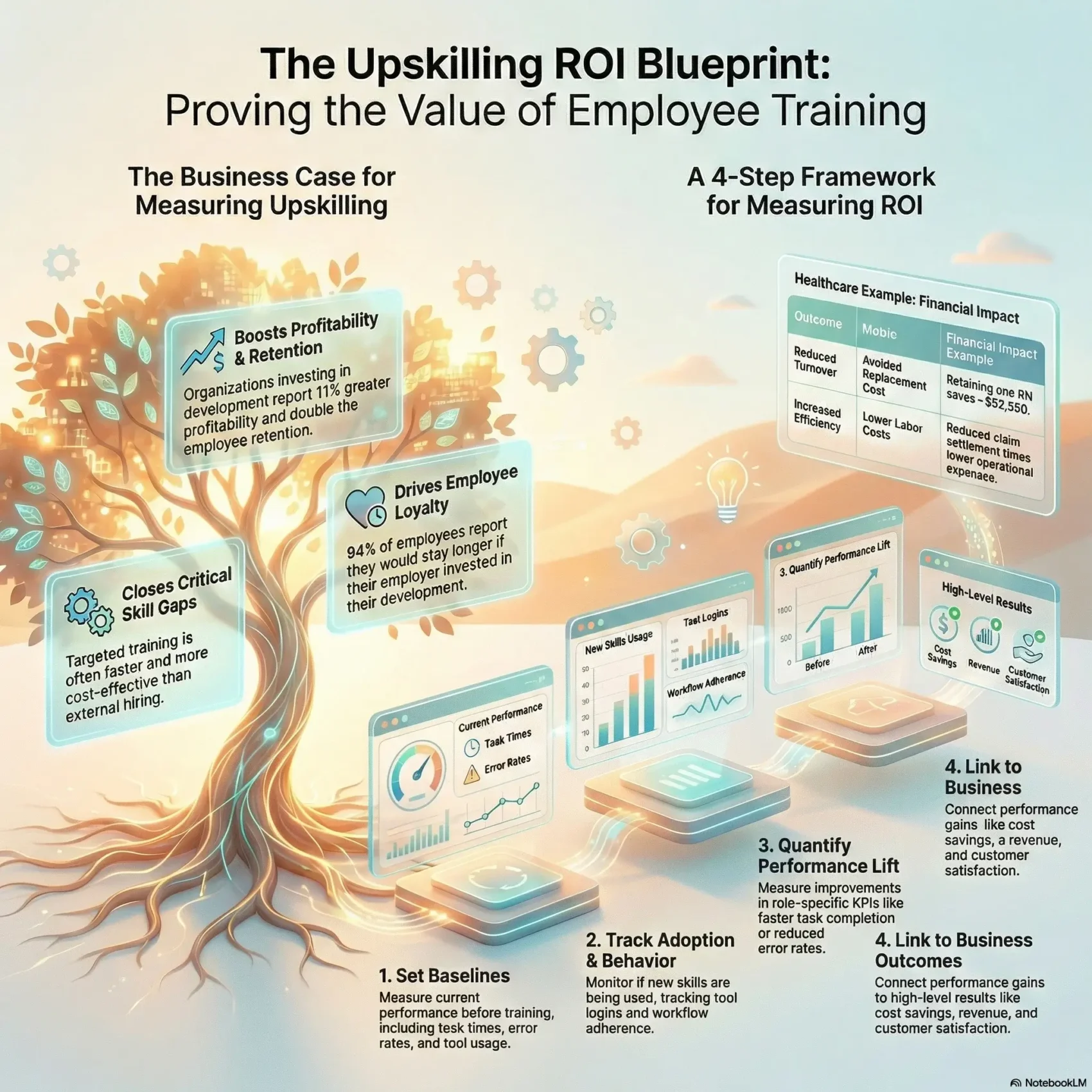
Last Updated on January 28, 2026
You want clear, defensible metrics for the training and development you fund. This introduction shows how to connect investment in employee skills to real business outcomes. Organizations that invest strategically see higher profitability and better retention, and you can measure the same effects in your company.
We’ll walk through practical steps—from setting skill baselines and tracking tool adoption to linking performance changes with revenue and retention. You’ll learn which signals matter to leaders and which are just noise.
By the end, you’ll have a simple measurement stack you can deploy quickly. That stack will help you justify investment, align programs to goals, and prioritize the efforts that drive growth, innovation, and reduced risk for your business.
Key Takeaways
- Measure skills, adoption, performance, and outcomes to create a credible ROI story.
- Focus on metrics leaders trust: productivity, retention, cost avoidance, and innovation.
- Use a lightweight measurement stack you can deploy fast across teams.
- Differentiate vanity metrics from meaningful business impact.
- Expect staged timelines for confidence in attribution and reporting.
Why Upskilling ROI Matters Right Now
In today’s tight labor market, showing clear gains from employee development wins budgets and loyalty.
Only 23% of the global workforce says they feel engaged, so development is a direct lever to boost morale and performance. Meanwhile, 83% of workers believe learning will make them more effective. Gallup finds organizations that invest in development report 11% greater profitability and double the retention.
Measuring results helps you choose programs that cut hiring costs and speed time-to-productivity. It also improves adoption of new tools and service practices so customers see better outcomes.
- You win budget and retain talent by documenting training impact on productivity and engagement.
- Targeted programs close skill gaps faster and often cheaper than external hiring.
- Linking development to customer workflows drives measurable service and throughput gains.
- Sharing clear results strengthens your employer brand and improves hiring effectiveness.
Prioritize programs that produce quick, measurable benefits so your company secures investment and builds a resilient, growth-focused workforce.
Defining Upskilling ROI and Aligning It to Your Business Goals
Open by framing training as an investment and showing how its gains map to business results. ROI in development compares measurable benefits—like productivity gains, retention improvements, cost savings, and revenue impact—to the cost of training.
What “ROI” Means in Employee Training and Development
Define ROI as a ratio of benefits over costs that captures both measurable gains and strategic value. Use concrete measures: faster task completion, lower error rates, higher engagement, and reduced hiring expenses.
Connecting ROI to strategic goals: productivity, retention, profitability, and agility
Translate each learning objective into a business goal. Link a course on a tool to adoption rates and cycle time reductions. Tie leadership training to retention and morale gains. This makes outcomes meaningful to your company.
Setting baselines and targets so your ROI signal is clear
Start with baselines for each metric—current performance, adoption, and quality. Then set targets (for example, 10% faster completion or a 5-point engagement lift). Define role-level indicators so results reflect real work.
- Short-term: tool adoption, error reduction.
- Medium-term: retention lift, faster ramp time.
- Value: avoided hiring and onboarding costs when employees fill gaps.
Use a simple logic chain: activities → behaviors → performance → outcomes. That line makes the impact clear and supports your case for continued investment in upskilling programs.
How to Measure Upskilling ROI
Start by mapping measurable signals to the tasks your teams do every day. That connection makes it easy to see whether training changes real work, not just course completions.
Track productivity with precise indicators tied to roles and workflows
Pick role-specific metrics like handling time, error rates, or first-pass yield. Measure pre/post deltas so you can quantify performance shifts attributable to training.
For example, an insurer tracked a drop in claim settlement time after staff worked on AI-driven projects. That kind of change is easy to translate into value.
Monitor resource adoption and usage after training
Track login frequency, feature usage, and workflow adherence to confirm taught tools become daily habits. If a remote desktop manager was taught, monitor usage rates to ensure adoption.
Measure employee engagement and sentiment changes
Use pulse surveys and sentiment analysis during virtual sessions to capture morale and clarity lifts.
Only 23% of the global workforce feels engaged, so small gains in employee engagement can be a strong signal your programs are working.
Link outcomes to revenue and customer impact where possible
Connect training results to conversion rates, ticket satisfaction, or department-level revenue changes. Calculate avoided costs—fewer escalations, less rework, and lower turnover—to strengthen your case.
“Measure what matters: adoption first, performance next, then business outcomes.”
- Segment by cohort, role, or location to find what works where.
- Time-box measurement windows (30/60/90 days) to capture adoption, performance, and outcomes.
- Create a concise dashboard that rolls up roles, goals, rates, and results for leaders.
Tip:Keep measurements simple, repeatable, and tied to business goals so you can iterate the program and scale what works.
Retention, Profit Margins, and Innovation: The Broader ROI Story
Training that sticks delivers both measurable cost reductions and sparks of innovation inside teams. You quantify retention gains by comparing pre/post retention rates and converting avoided turnover into dollar savings using role-based replacement costs. For example, one staff RN can cost roughly $52,350 to replace.
Quantifying retention gains and avoided turnover costs
Start with cohort-level retention rates and apply role-specific replacement costs. Multiply fewer leavers by the cost per replacement to show cashable savings.
Profit margins, cost savings, and signals of innovation post-training
Show margin lift from shifting work in-house rather than buying services. Track reduced vendor spend, lower rework rates, and faster time-to-impact when employees apply new skills immediately.
- Measure short-term savings (turnover, rework).
- Capture innovation signals (new processes, analytics use cases).
- Blend cashable benefits with strategic value like career pathways and satisfaction.
“Companies that invest in development are twice as likely to retain employees.” — Gallup
Industry Spotlight: Measuring Upskilling ROI in Healthcare
Measuring learning in clinical settings means tracking both staff retention and patient metrics. You’ll focus on roles where training can realistically fill gaps—especially entry-level positions with high turnover.
Improved retention and culture amid staffing shortages
Pinpoint priority roles where a clear training pathway reduces hire-and-replace costs. For example, replacing an RN can cost about $52,350, so retaining one clinician pays for many courses.
From engagement to patient outcomes: what to track
Track engagement, satisfaction, and task-level productivity. Link those signals to patient KPIs like wait times, readmission rates, and satisfaction scores.
“Staff engagement strongly correlates with better patient care.”
Time-to-skill, certification pathways, and program pacing
Define realistic time-to-skill and use modular courses with supported study time to prevent burnout. Factor state certification rules when choosing which roles you can train internally.
- Measure retention lifts and convert avoided turnover into dollar savings.
- Compare temporary-staff costs versus structured development tracks.
- Leverage simulations and virtual labs, and monitor adoption to confirm clinical impact.
Finally, document hiring benefits: 65% of candidates prefer employers that offer training. For more on trends in employee development, see trends in employee development.
Designing High-Impact Upskilling Programs That Maximize ROI
Prioritize fast, practical learning that ties directly to daily work and clear metrics. Short courses let you close priority gaps fast without major disruption to schedules or budgets.
Short courses for speed, flexibility, and measurable outcomes
Pick part-time, online formats that deliver measurable changes in weeks. Microlearning and AI personalization speed adoption and cut travel and downtime.
Define success up front — adoption, productivity, or performance metrics — so you can quantify the program and scale what works.
Balancing hard skills, soft skills, and technology enablement
Blend data fluency, compliance, and tool training with communication and problem-solving practice. That mix improves on-the-job performance and prepares your workforce for change.
Build manager coaching into the plan so learning transfers to everyday work and time-to-impact shortens.
- Stackable modules and flexible schedules respect workload and keep momentum.
- Choose providers with strong support, practical projects, and clear measurement plans.
- Align courses to career paths to boost satisfaction and retain talent.
“94% of employees would stay longer when employers invest in development.” — Ascento
Iterate quickly: double down on programs that lift key metrics and redesign those that don’t. This keeps your investment focused on growth and lasting success for employees and business.
Conclusion
Conclude with practical steps to prove that your learning programs move key metrics. Use the roadmap here to set baselines, measure adoption, and tie changes to revenue, retention, or cost savings.
You can prioritize training that builds critical skills and delivers clear business value. Keep dashboards concise and tell simple stories leaders can act on.
Focus on short courses and targeted content that fit workflows so employees see faster wins. That visibility boosts employee engagement and lifts morale as people track their progress.
Do this consistently and you’ll scale programs that work, show defensible results, and grow capability across the organization.