Tools
Tools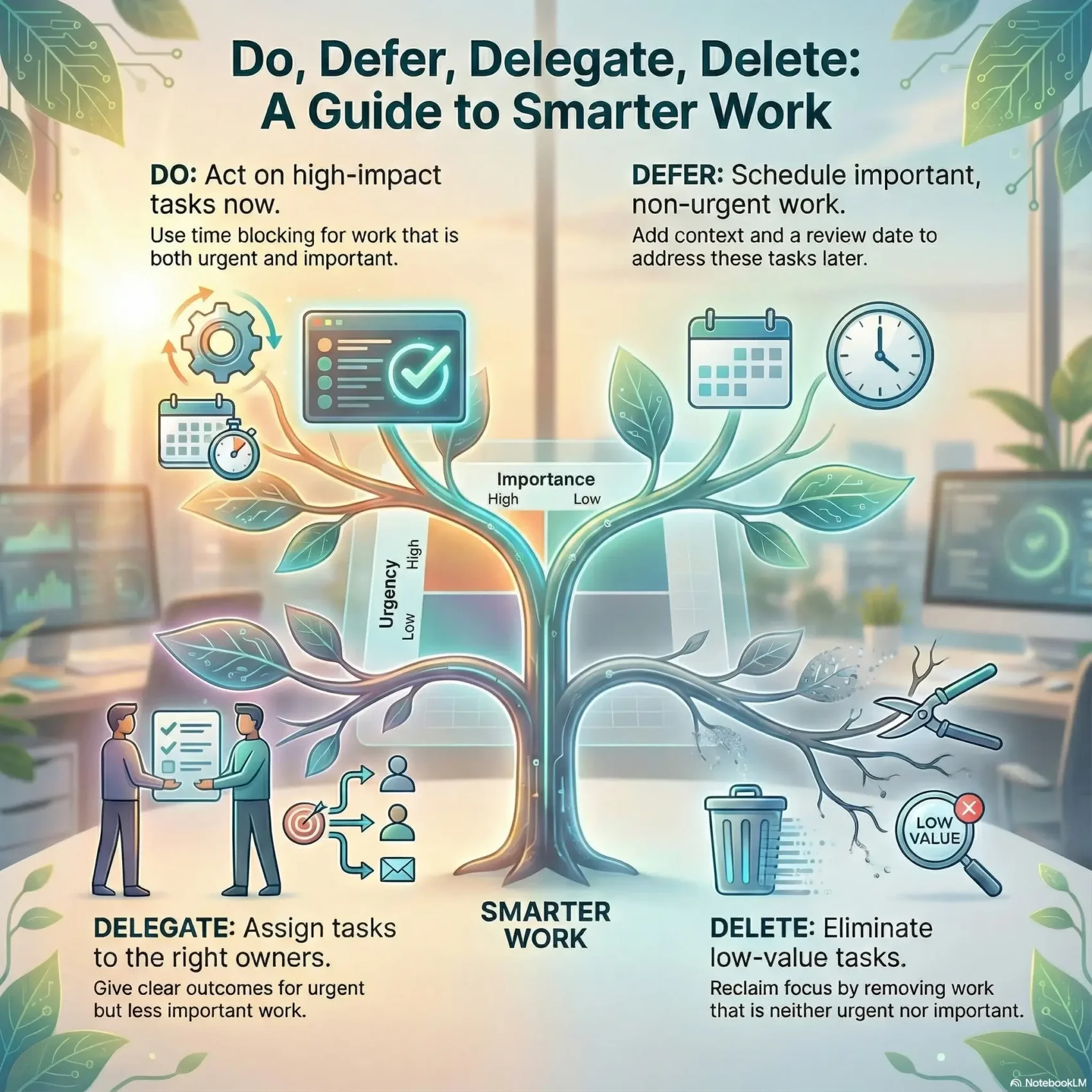
Last Updated on January 23, 2026
You deal with a lot each day, and simple choices make the difference between busy work and real progress.
This short intro shows a clear, friendly approach to the Four Ds, a practical framework adapted from the Eisenhower Matrix.
Product leaders and teams use this method to align work with strategy, cut internal noise, and make value-based trade-offs across initiatives.
The Four Ds help you decide which tasks to do now, which to defer, which to delegate, and which to delete. Deleting cuts low-value requests and meetings. Delegating gives the right people ownership. Deferring parks ideas for future cycles with clear rationale. Doing focuses execution on high-impact work and a clear definition of done.
Read on to get a friendly walkthrough so you can classify your workload, protect focus, and apply a repeatable process that boosts productivity today.
Key Takeaways
- Use the Four Ds to sort tasks quickly and reduce daily friction.
- Link urgency and importance so you stop reacting and start deciding.
- Delete low-value asks, delegate to owners, defer with reason, and do high-impact work.
- The framework scales from personal use to product and business roadmaps.
- Apply this technique daily to protect focus and align work with larger goals.
What you’ll accomplish with the 4 D’s today
Start your day by turning a messy to-do list into a short, prioritized plan you can actually finish. You’ll clear low-value items, hand off work that others can own, park non-urgent projects with context, and act on the few tasks that matter most.
Teams gain a common language to set expectations and avoid priority dilution. That keeps effort aligned with goals and boosts overall productivity.
Individually, you’ll protect focus and reduce stress by deciding quickly what to do now and what to defer. This creates measurable progress so your day ends with real wins.
“A short planning routine stops reactive work and channels energy into what moves the needle.”
- Create a brief plan that focuses on one or two Do-now items and preserves efficiency.
- Align where you spend your time with your goals, cutting noise to improve progress.
- Use simple tips to delegate and defer without creating bottlenecks later.
- Adopt a light planning cadence so momentum grows across the week, not just the day.
For practical time management tips you can apply right away, follow a quick sort every morning and block focused stretches for the top items.
The framework at a glance: how the 4 D’s map to urgency and importance
Translate urgency and importance into fast decisions that keep your work aligned with goals.
The Eisenhower Matrix organizes work across urgency and importance. You can map each quadrant to a clear action: Do for urgent and important items, Delegate for urgent but less important tasks, Defer for important but not urgent work, and Delete for items that add no value.
This framework scales from personal planning to product and business roadmaps. Modern teams use the approach to refine backlogs, run planning sessions, and protect focused blocks of work.
When you apply this technique, you reduce reactive behavior and boost deliberate prioritization. It creates transparency so your team assigns ownership fast and keeps progress aligned with strategy.
- You’ll see a crisp mapping from urgency/importance to confident next steps.
- You’ll connect a classic prioritization technique to practical actions for daily standups and planning.
- You’ll understand why individuals simplify decisions and why teams keep strategy and execution aligned.
Delete: remove low-value tasks to reclaim focus
Cutting tasks that add no value gives you more room to finish the work that matters. Deleting is an active step: you clear clutter so your calendar and backlog reflect real priorities.
- Skip or shorten meetings without a clear agenda; turn updates into async notes when possible.
- Archive nonessential emails and stop replying to requests that don’t support your goals.
- Decline miscellaneous asks that duplicate other work or drain scarce resources.
Signals a task doesn’t align with goals
Watch for simple signs: the work doesn’t ladder up to stated priorities, lacks evidence of impact, or repeats something already covered. These are low-importance things that sap your attention and productivity.
How to say no gracefully
Use short, friendly scripts that keep stakeholders aligned. Offer an alternative like an asynchronous summary, point to your current priorities, or suggest a later review date. This keeps relationships intact while protecting focus.
- You’ll identify meetings to cut or shorten, emails to archive, and requests to decline so your to-do list reflects what matters.
- You’ll declutter recurring rituals that consume time without outcomes, freeing resources and attention for higher-impact initiatives.
- You’ll remove low-value backlog items so team effort stays on features that move the needle, boosting overall productivity.
Delegate: assign work to the right people at the right time
Smart delegation moves ownership closer to the people who can act fastest. You free up your attention and build capacity when you assign outcomes, not just steps.
What to hand off
Start with repetitive tasks like invoicing, reporting, and routine execution details. These are ideal for members who have the right skills and available bandwidth.
How to delegate clearly
Define responsibilities, success metrics, and constraints. Give context, templates, and a clear definition of done so you avoid micromanaging.
Team-level benefits
Delegation distributes decision-making, lets teams own outcomes, and speeds project delivery. You’ll see better efficiency, higher productivity, and faster cycle times.
- Match tasks to strengths, not just availability.
- Use brief check-ins and shared definitions of done to keep progress visible.
- Develop members by giving stretch assignments that grow skills and ownership.
- Learn more about delegating work for better productivity: delegating work for better productivity.
Defer: schedule valuable work that doesn’t require immediate attention
A deliberate deferment puts non-urgent initiatives into a system you actually review. This keeps your daily focus clear while preserving good ideas for later.
Good candidates to defer vs. fake-urgent distractions
Defer initiatives that need more research, resources, or alignment with future goals. These are important but not urgent.
Avoid fake-urgent noise like social feeds and most email pings. Those pull your attention without real impact.
Defer without procrastinating: add context, timelines, and review points
Use a clear backlog or roadmap to store each task with reasons, next steps, and a target review date. That prevents ideas from vanishing.
- You’ll separate truly important-but-not-urgent tasks from fake-urgent noise so your attention stays where it counts.
- You’ll capture context, next steps, and a target review date for anything you defer.
- You’ll schedule check-ins during planning or quarterly reviews to turn intent into action and keep efficiency high.
- You’ll protect deep work by moving non-urgent items off your to-do list and onto a clear timeline that respects how you use time.
Defer as an intentional approach to prioritization. When you document why you defer and what will trigger a revisit, you avoid procrastination and improve long-term management of work.
Do: act on important tasks that require immediate attention
Acting decisively on high-impact work helps you turn plans into measurable progress. The “Do” step asks you to commit to current roadmap items, remove blockers, and finish with a clear definition of done.
Quick wins, time blocking, and defining “done”
Pick one to three important tasks that require immediate attention and block focused stretches to complete them without context switching.
Define “done” up front so you know what success looks like and when to stop polishing.
- Knock out two-minute tasks immediately to clear mental clutter and build momentum.
- Use time boxing to create short sprints and protect your day from interruptions.
- Remove blockers proactively—book the meeting, request the asset, or escalate a dependency—so progress keeps moving.
End the day with visible wins to reinforce a habit of finishing what matters most and improve overall productivity.
4Ds time management in your daily workflow
Use a simple scoring system to keep your backlog tight and your day focused on impact. Build a clear to-do list that separates what you will do now from what you’ll defer, delegate, or delete.
Build a prioritized to-do list and backlog you’ll actually use
Create a short list with score-based criteria: impact, effort, and alignment to goals. Score each item and keep only the top priorities in your active to-do list.
Keep a living backlog for lower-scored items and add context so nothing gets lost.
Plan your day and week: roadmap, dependencies, and meetings
Map your week with a lightweight roadmap view. Flag dependencies, project milestones, and meetings that affect delivery.
- Cluster meetings and block focused work to protect deep stretches.
- Use simple templates and shared tools so stakeholders see priorities at a glance.
Team strategy: align work with goals to avoid priority dilution
Connect requests to business objectives so prioritization decisions are transparent. This keeps your team aligned and reduces reactive shifts in strategy.
“A short, scored backlog makes prioritization fast and defensible.”
Common pitfalls and how to optimize your process
Without a repeatable filter, your day fills with noise and real priorities suffer. Use a clear approach so you respond intentionally instead of reacting to every alert.
Mislabeling urgent vs. important and reacting to noise
Teams often treat every request as urgent. That creates issues: you chase pings and lose sustained focus.
Strategy: Apply quick criteria to label urgency and importance. If a task lacks impact or alignment, move it off your active list.
Over-delegating or under-delegating: finding the balance
Delegation should match capability and oversight. Over-delegating leaves gaps; under-delegating overloads you and slows productivity.
Strategies: Assign ownership with clear outcomes, success metrics, and a lightweight check-in cadence.
Making the practice continuous, not a one-time sort
Prioritization is ongoing. Build a short daily review and a weekly refresh so priorities stay current.
- You’ll learn strategies to prevent mislabeling urgency and importance and protect sustained focus.
- You’ll spot issues like overloaded workloads and adjust delegation to match constraints.
- You’ll turn the framework into a repeatable process with quick daily and weekly reviews.
- You’ll reduce attention leaks by batching communication and setting response windows.
“Stop reacting. Use simple criteria, document decisions, and make trade-offs explicit.”
Conclusion
Small, repeatable choices let you protect focus and make steady progress on big projects. Use the simple filter—delete low-value asks, delegate to the right members, defer with context, and do the important tasks that require immediate attention.
You’ll gain clearer priorities and better productivity. Keep a short list you trust, use visible tools, and make delegation explicit so the team shares responsibility and your business sees why choices were made.
Trim meetings and things that drain energy. Review your plan regularly so priorities stay aligned with goals and projects move forward. This framework helps you prioritize tasks confidently and close each day with measurable progress.