Tools
Tools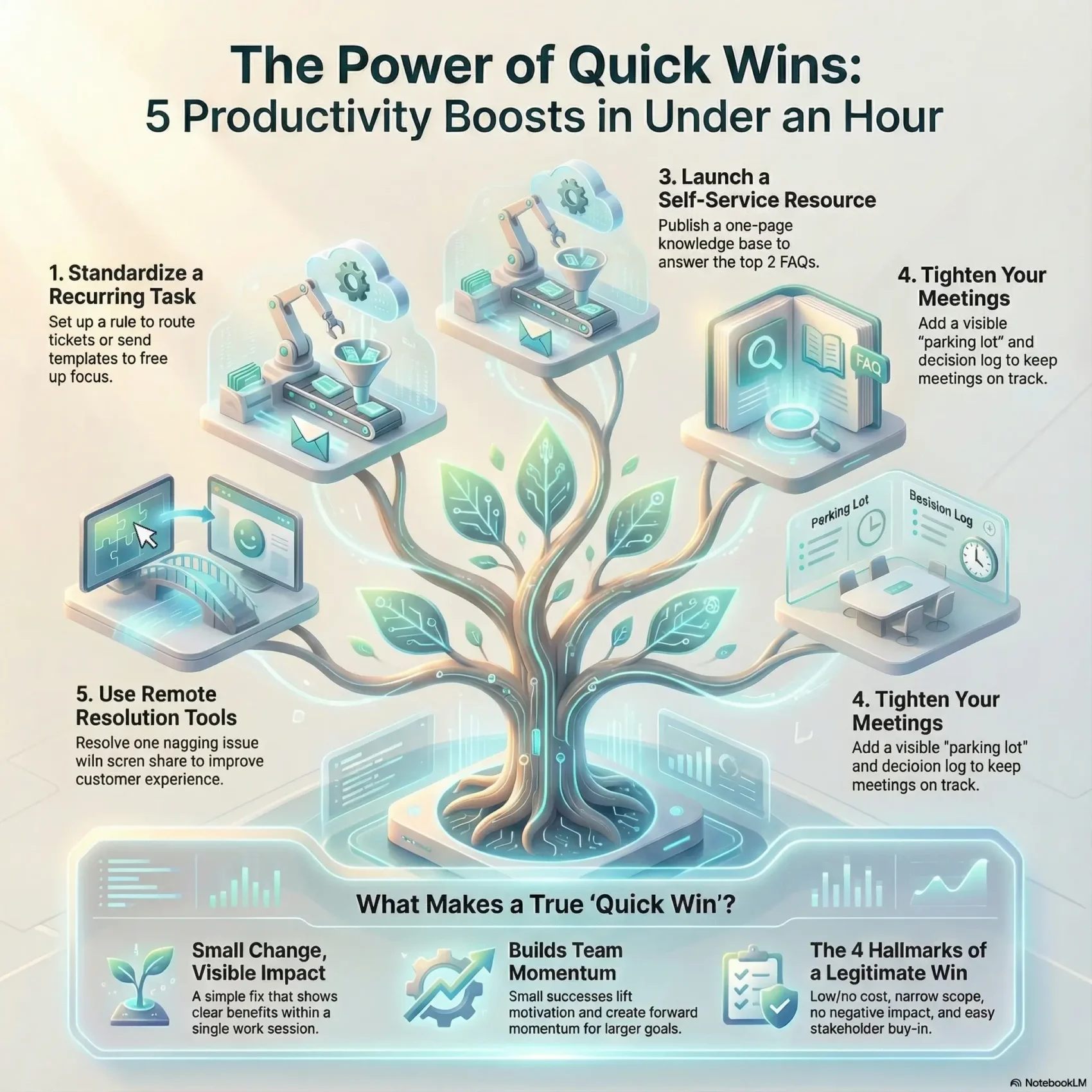
Last Updated on January 26, 2026
You can create visible progress in less than an hour. These small, targeted actions save you time and show clear impact without derailing your day.
Think of them as simple fixes that spark momentum. They require little cost, low risk, and a narrow scope so your team sees value fast and buys in.
In this introduction you’ll learn what makes a true win: tangible outcomes, easy stakeholder approval, and immediate implementability. You’ll also learn when to pick a short-term move versus a longer strategy so your business balances fast results with lasting success.
By the end you’ll be ready to pick one hour-long task that removes friction and builds confidence. That small win will point to bigger success as efforts compound over time.
Key Takeaways
- Small actions can deliver immediate value and visible impact.
- Choose items with a narrow scope and easy stakeholder buy-in.
- Use short wins to build momentum toward a larger goal.
- Balance one-hour fixes with longer process improvements.
- You can act now and prove value to your team in under an hour.
What “quick wins” really mean for your productivity right now
A true short-term win is a small change that shows visible impact within a single work session. It costs little, carries low risk, and doesn’t require heavy approvals. When you implement one, you see benefits fast.
Immediate gains matter: a small success lifts motivation, builds confidence, and creates forward momentum for your team.
In Lean Six Sigma, these improvements often surface during detailed mapping and the Measure phase. Teams park bigger ideas while acting on easy solutions so the project stays on track without losing energy.
“Small victories prove the approach and help secure stakeholder support.”
Hallmarks of a legitimate win:
- Low or no capital spend
- Narrow scope and fast timeframe (days, not months)
- No negative downstream impact
- Clear decision authority and stakeholder buy‑in
Use this mental checklist to judge ideas. If it fits, act. If not, move it to a parking lot and revisit during wider process change.
For a simple framework to run short focused efforts, try a set of focused sprints described at focus sprints for productivity.
How to choose the right win: prioritize impact, speed, and minimal disruption
First, pin down the outcome you need so you can spot changes that truly matter. Clear goals make planning faster and help you judge whether a candidate has real business value.
Set a short checklist:
- Does this save measurable time or reduce errors?
- Can it be done with existing resources?
- Will it avoid downstream disruption?
Set goals and analyze your current process
Map the main steps of the process at a high level. Look for duplicated work, manual handoffs, or needless approvals. These are where project-level insights surface fast.
Identify low‑hanging fruit with visible impact
Target fixes that need little cost and narrow scope: a one-click routing change, a brief checklist, or a trimmed approval step. Those changes often deliver immediate impact.
Secure stakeholder alignment and validate risks
Before you act, confirm decision authority and invite key stakeholders. Validate risks so your win doesn’t create problems for other projects or teams.
“Small, well-chosen changes build momentum and prove the value of broader management strategies.”
Your five quick wins to boost results in under an hour
Pick one and get a measurable improvement before the end of your work session. Each step uses minimal change management and existing tools so you see value fast.
Standardize a recurring task with a simple checklist
Create a one- or two-column checklist for onboarding, client calls, or incident triage. A short list reduces variability, avoids misses, and saves time on each run.
Automate a routine step to free up focus
Set a tiny rule that routes tickets, sends a prefilled template, or triggers notifications. It takes minutes to configure and gives your team back hours.
Launch a one‑page self‑service resource
Publish a single-page knowledge base answering the top two FAQs. Self-service cuts repetitive questions and improves response time for the whole team.
Tighten meetings with a parking lot and decision log
Add a visible parking lot on your agenda and record decisions live. This keeps meetings on track and speeds project follow‑through.
Use remote resolution tools to close one nagging issue
Resolve one problem via screen share or secure remote assist. You avoid context switching and deliver a better customer experience.
- Draft a checklist for one task to cut errors and save time.
- Configure one automation rule that routes or templates requests.
- Publish one KB page to reduce repetitive tickets.
- Add a parking lot + decision log to speed meetings.
- Fix one issue remotely to avoid travel and handoffs.
Keep the scope small, measure fewer messages or faster response time, and share this win to build momentum.
Implement and measure: build momentum and prove value fast
The fastest way to prove value is to package a single change into a one‑page plan and get it started today. Keep scope small, name the owner, and set a micro‑timeline measured in hours or days, not months.
Create a one‑page action plan, assign resources, and set a realistic micro‑timeline
Write one page that lists the steps, who does each task, and the expected time to close. Assign only the resources you need so the team can act without waiting for extra approvals.
Right‑size management with short status checks and a simple checklist. This reduces overhead and keeps costs predictable.
Track outcomes, quantify benefits, and share success stories to sustain progress
Pick two metrics that show results: response time, error rate, cycle time, or dollars saved. Track before-and-after snapshots to quantify benefits and show impact to stakeholders.
“A focused micro project proves value fast and makes it easier to fund larger efforts.”
- Use a one‑page plan to start a quick win and name the owner.
- Assign minimal resources so your team executes promptly.
- Track a couple of business metrics to measure success.
- Communicate decisions and share results to build momentum.
Real cases show the approach works: a hospital change unlocked nearly $900k in revenue, and a city’s program cut costs by $200k per year while boosting output. Use those stories to reinforce value and plan the next two or three wins so progress compounds over years.
Conclusion
Close the loop by picking a single change you can implement and measure in an hour.
Start with one quick win that aligns to your larger goal. Measure the result, share the example, and repeat the cycle.
Stack small improvements to build visible momentum and prove success to stakeholders. Real-world examples from healthcare and municipal services show these tiny moves add up.
Use this habit as management practice: choose a modest project, confirm decision authority, and report outcomes. Over years, those repeated wins shape strategy and deliver sustained business value.