Tools
Tools
Last Updated on December 9, 2025
The manufacturing sector is on the cusp of a revolution with the advent of 5G technology. This innovation promises to elevate smart factories to unprecedented levels of efficiency and innovation. With data transmission speeds up to 20 times faster than 4G, 5G is more than just a quicker connection. It’s a transformative force reshaping the advanced manufacturing landscape.
This next-generation wireless technology unlocks the potential for more automated and data-driven operations. It provides high-speed connectivity, essential for maintaining a competitive edge in today’s digital economy. The integration of 5G into manufacturing is a crucial step towards embracing Industry 4.0.
This shift is not just about upgrading your network. It’s about empowering your business to enhance productivity, streamline operations, and innovate supply chain logistics. Real-time data transmission and ultra-reliable low latency communications (URLLC) enable the use of IoT devices and applications. This drives significant advancements in operational efficiency.
The journey towards 5G manufacturing is filled with opportunities for companies focused on growth and sustainability. Let’s explore how 5G technology is catalyzing these changes. We’ll discuss the benefits, challenges, and future prospects you can expect.
Key Takeaways
- 5G provides transmission speeds 20 times faster than 4G, essential for automated manufacturing.
- Ultra-reliable low latency communications (URLLC) enable critical applications with less than 1 ms radio latency.
- 5G networks can connect one million devices in one square kilometer, facilitating massive IoT integration.
- Enhanced capabilities for real-time monitoring and predictive maintenance across manufacturing processes.
- Transitioning to 5G is crucial for leveraging Industry 4.0 and boosting operational efficiency.
- Adopting 5G can minimize costs and increase productivity through advanced automation and analytics.
Introduction to 5G Technology
5G technology marks a significant leap in mobile communication, bringing essential advancements to our digital world. It’s the fifth generation of mobile networks, offering maximum download speeds of up to 10 Gigabits. Early deployments have seen average speeds of 100-400 Mbps. This next-generation wireless technology is vital for a more connected world, especially for industries like manufacturing.
The reduction in latency is a key feature of 5G. Unlike 4G, which had latency between 60ms and 98ms, 5G aims for under 1ms. This enables near-instantaneous responses, crucial for real-time applications. It also supports at least 1 million connections per square kilometer, opening up new possibilities for network infrastructure.
5G operates in a licensed spectrum, tailored for different sectors’ needs. This ensures better reliability and security, especially in critical manufacturing environments. Features like network slicing allow for customized network functionalities. This optimizes performance for robotics and IoT solutions.
This technology is more than just faster speeds; it creates an ecosystem for advanced automation and smart factories. With ongoing enhancements, such as dynamic spectrum sharing and massive MIMO technology, 5G is leading the charge in Industry 4.0 initiatives.
Understanding the Shift Towards Industry 4.0
The transition to Industry 4.0 marks a significant change in manufacturing processes. It emphasizes automation, communication, and data analysis for better efficiency. Businesses in sectors like manufacturing and utilities are now implementing 5G in practical ways, reshaping traditional industrial settings.
Technologies like artificial intelligence, the Internet of Things (IoT), and robotics lead this digital transformation. These tools help manufacturers streamline operations and quickly address challenges. For instance, network cameras and sensors create smarter, safer, and more efficient systems.
5G technology is key, offering the bandwidth and low latency for high-resolution video transmission. This supports precise data processing and decision-making. With 5G, numerous IoT devices can connect at once, boosting automation and efficiency.
Real-time monitoring systems, using network cameras, detect anomalies early. This approach reduces downtime and defects, improving outputs. Predictive maintenance also benefits, anticipating equipment failures and extending machinery life while lowering costs.
In dangerous settings like mines and ports, 5G allows for remote monitoring of heavy machinery. This ensures worker safety and compliance with safety protocols. As factories become more interconnected, 5G enhances security and response to threats.
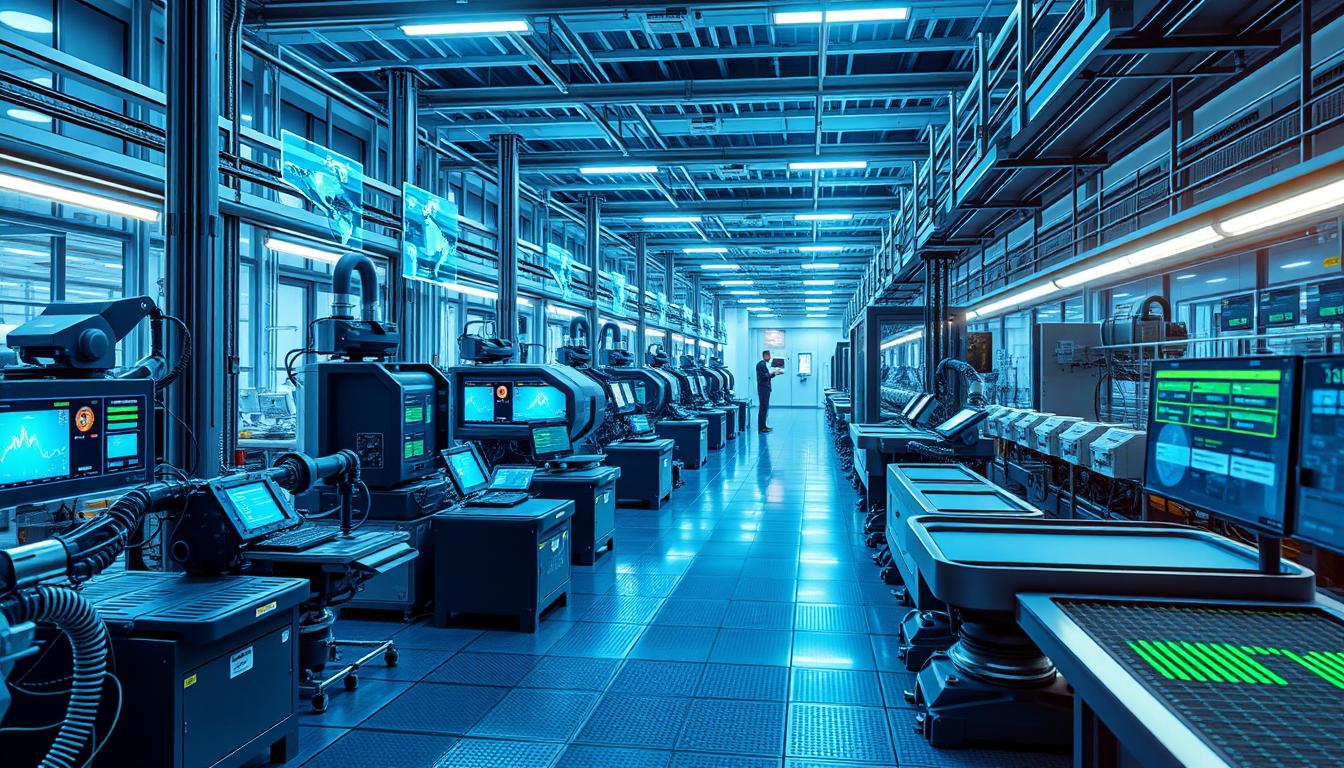
Adopting 5G can significantly enhance manufacturing operations. It could add $400 billion to $650 billion to the global GDP by 2030. High-band 5G in Industry 4.0 offers substantial value, with gains from innovations like vision quality checks and real-time controls. Collaborations, like Daimler’s with Telefónica and Ericsson, show the industry’s commitment to this transformation.
What is 5G Manufacturing?
5G Manufacturing is the integration of 5G technology into the manufacturing sector. It aims to create intelligent, connected environments. This advanced manufacturing technology streamlines operations and enhances real-time communication among devices. It leads to improved efficiency across various processes.
The features of 5G, like ultra-reliable low-latency communication and massive device connectivity, are key. They enable responsive production lines and smart supply chains. This allows manufacturers to be more agile and responsive to market demands.
Private 5G networks, similar to Wi-Fi but more advanced, offer complete control over your network. This control allows for custom service-level agreements (SLAs). It ensures your intellectual property remains private while optimizing critical manufacturing operations.
5G technology boosts mobile broadband and channel capacity, meeting the growing data demands in manufacturing. Latency can be reduced to just 1 millisecond, facilitating real-time data transmissions and quicker responses. The Industrial Internet of Things (IIoT) is a prime example, where small IoT sensors prevent downtime by continuously monitoring machine performance.
Augmented reality (AR) applications in manufacturing offer visual insights to technicians. This improves troubleshooting and training efficiency. The robust capabilities of 5G enable autonomous machines to communicate effectively. They adapt to various conditions for safe and efficient operations.
In conclusion, the shift to 5G Manufacturing marks a significant moment in smart manufacturing‘s evolution. As manufacturers adopt this transformative technology, the possibilities for innovation and operational improvement are endless.
Benefits of 5G Technology in Manufacturing
The introduction of 5G technology in manufacturing is a game-changer, boosting productivity and efficiency. It offers numerous advantages, leading to smarter factories and more automated production. For manufacturers aiming to remain competitive, grasping these benefits is essential.
Enhanced Mobile Broadband and Channel Capacity
Enhanced mobile broadband brings significant data transfer improvements to manufacturers. The increased channel capacity enables faster data exchange, supporting real-time applications. This facilitates the integration of technologies like augmented reality and advanced AI into manufacturing workflows.
Low Latency Communications
Low latency communications revolutionize manufacturing, offering response times as low as 1 millisecond. This enables rapid decision-making and operational agility, crucial in fast-paced environments. Quick communications reduce delays, boosting productivity and ensuring smooth operation of time-sensitive processes.
Massive Device Connectivity
5G technology’s ability to support massive device connectivity stands out. It allows manufacturers to connect numerous sensors and IoT devices at once, vital for smart factories. This extensive connectivity facilitates automatic data collection, better production line management, and resource optimization.
The Role of IoT Integration in Smart Factories
The integration of IoT in smart factories marks a significant transformation in manufacturing. At its core, manufacturing IoT enables devices and systems to work together seamlessly. This boosts operational efficiency and productivity. Advanced connectivity solutions, such as 5G, facilitate seamless IoT integration. They allow for real-time data collection and analysis across production lines.
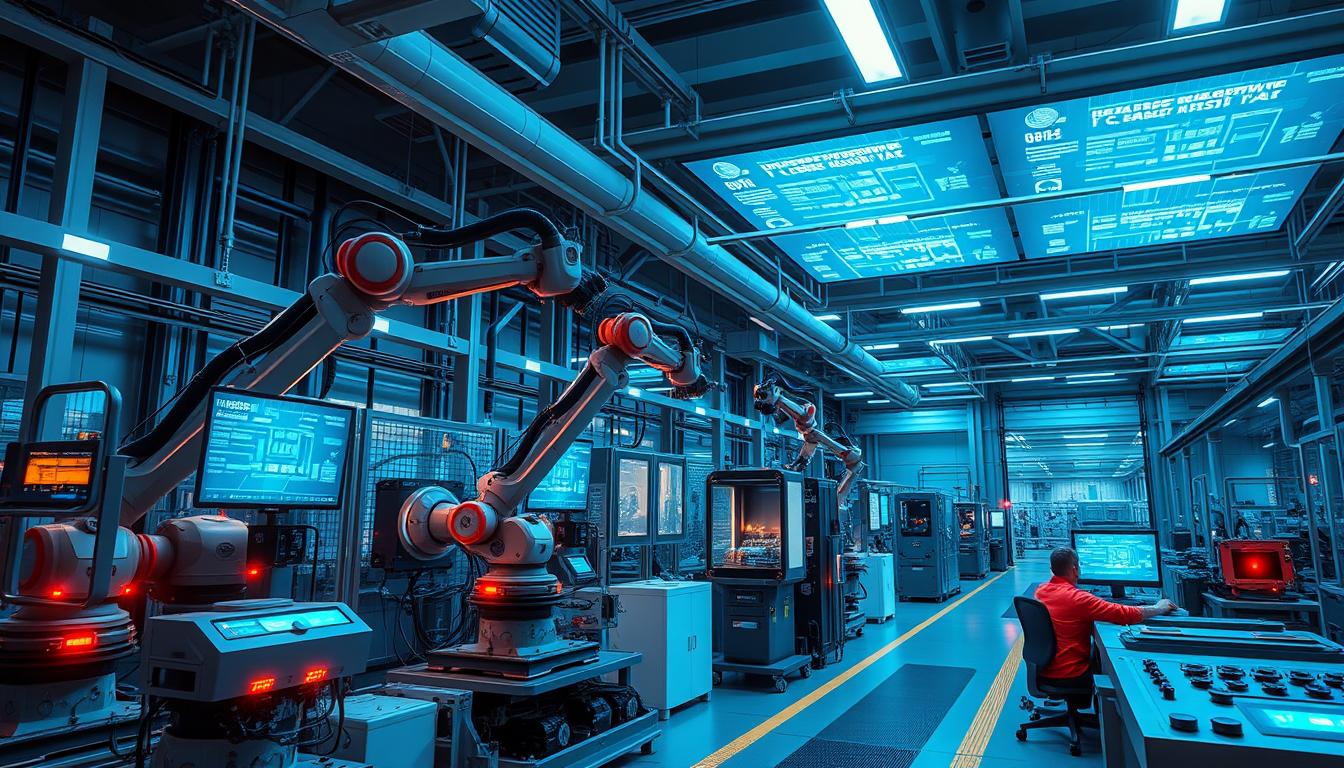
McKinsey estimates that IoT applications in manufacturing could generate up to $3.7 trillion annually by 2025. This potential is largely due to real-time monitoring capabilities in smart factories. For instance, Armal saw a nearly 40% drop in energy costs through IoT tracking of machinery.
Integrating IoT into manufacturing processes enables continuous data exchange. It monitors variables like temperature and production speed. Analytics from this data support predictive maintenance, reducing equipment breakdowns by up to 70% and maintenance costs by 25%, as Deloitte reports.
Efforts to boost operational efficiency are widespread. A remarkable 78% of supply chain leaders are actively exploring technology to enhance production speed and automate routine tasks. These innovations streamline operations and enable businesses to adapt quickly to market demands.
The synergy between IoT integration and 5G technology enables efficient communication among countless devices. 5G’s ultra-reliable low latency feature, with speeds of just one millisecond, allows for immediate feedback and adjustments. These advancements improve inventory management and supply chain oversight, embodying Industry 4.0 principles.
In summary, embracing IoT integration in smart factories unlocks opportunities for enhanced efficiency, cost reduction, and competitiveness in a rapidly changing industry.
Advanced Manufacturing and Automation
In today’s fast-paced industrial landscape, advanced manufacturing marks a significant shift in production processes. The integration of cutting-edge technologies turns traditional factories into connected ecosystems. Here, innovation and efficiency converge. Automation, facilitated by 5G technology, is a key advancement.
Real-time Data Transfer and Processing
Real-time data transfer enables instant communication among machines, crucial for enhancing automation in manufacturing systems. With 5G technology, transmission speeds are faster, and latency is reduced. This allows for immediate feedback and adjustments in production, making manufacturing environments more responsive and adaptable.
Automation in operations is significantly impacted by 5G. Autonomous robots and devices depend on seamless real-time data transfer to make quick, informed decisions. This helps maximize production speed while minimizing downtime. For instance, companies like Atlas Copco use private cellular networks to connect moving machines and secure factory environments. This highlights 5G’s critical role in fostering smart manufacturing.
The transition to advanced manufacturing through automation and 5G connectivity is already showing impressive results. At Ericsson’s 5G manufacturing plant, output per employee has seen a remarkable 120% increase. Such metrics illustrate how real-time data can unlock new levels of efficiency and operational excellence in the industry.
Use Cases of 5G in Manufacturing Environments
As manufacturing evolves, use cases of 5G technology grow in importance. It enables real-time communication and data processing, opening new paths for operational efficiency. Key areas benefiting include connected asset monitoring, predictive maintenance, and quality management.
Connected Asset Monitoring
Connected asset monitoring uses 5G to give manufacturers real-time insights into equipment performance. This technology, seen in Siemens’ Transformers factory in Mexico, boosts operational efficiency and quality control. It allows for quick actions when issues arise, ensuring problems are solved promptly.
Predictive Maintenance and Quality Management
Predictive maintenance with 5G technology helps foresee equipment failures. It analyzes real-time data to optimize operational cycles, cutting downtime and maintenance costs. This integration also enhances quality management, ensuring visual inspections meet high standards. It keeps product quality and customer satisfaction high.
The use of these technologies marks a shift towards more agile and responsive production. For more details, explore how 5G enhances manufacturing practices.
Challenges and Considerations for Implementing 5G
Adopting 5G technology comes with numerous hurdles for businesses. The hurdles of 5G adoption go beyond mere technical issues. A significant investment is needed to upgrade existing infrastructure, a task that many manufacturers find daunting. For instance, setting up macrocells can cost around $200,000, while small cells are priced at about $10,000 each.
Security is also a critical concern due to the increased risk of data breaches and cyberattacks. With the expected density of up to one million connections per square kilometer, maintaining strong security measures is vital.
Regulatory obstacles and industry standards add another layer of complexity to 5G implementation considerations. Companies must navigate the intricacies of planning permissions, spectrum costs, and the need for backhaul fiber connectivity. Each of these factors demands careful evaluation to ensure compliance and operational success.
Furthermore, a shortage of skilled technicians, engineers, and project managers is a significant challenge. Overcoming this gap through recruitment and training is essential for a smooth deployment and integration into manufacturing technology.
To manage the risks of full-scale deployment, conducting pilot projects or proof-of-concept initiatives is beneficial. These initiatives help uncover potential issues before widespread implementation, allowing businesses to adapt and prepare effectively.

5G Manufacturing and Sustainability Efforts
5G manufacturing is key to advancing sustainability in manufacturing. It boosts efficiency and supports various sustainability efforts. With 5G, production lines can connect better, optimizing resource use and cutting energy consumption.
Private 5G networks enable manufacturers to set up production facilities near end-users. This reduces transportation distances, making supply chains more sustainable and lowering emissions. These networks also make it easier to integrate 3D printing into production. Localized production cuts down on transportation needs and material waste, fitting the green manufacturing model.

Advanced analytics, powered by machine learning and AI, help businesses analyze vast datasets from private 5G networks. This aids in predictive maintenance, proactive energy management, and spotting inefficiencies that harm the environment. It’s crucial for manufacturers and 5G providers to work together to optimize these networks for sustainability.
Investing in research for energy-efficient 5G infrastructure and sustainable manufacturing is vital. Initiatives like the European Union’s “Horizon 2020” are driving innovation in green manufacturing technologies. Industry standards, set by groups like 3GPP, also play a key role in reducing energy use and managing e-waste responsibly.
The integration of 5G and sustainability is reshaping manufacturing landscapes. It offers a path to significantly cut carbon dioxide emissions, with estimates suggesting up to 21 gigatons saved by 2030. For manufacturers, this means a chance to adopt sustainable practices that boost efficiency and help the environment.
Conclusion
The integration of 5G technology is crucial for the future of manufacturing. It significantly enhances efficiency, connectivity, and innovation in manufacturing processes. By adopting 5G, your business can harness automation and real-time data analytics. This prepares your operations to excel in a competitive market.
The 5G impact on manufacturing goes beyond minor improvements. It marks a significant step towards creating smart factories of the future. With 5G’s low-latency communication and massive device connectivity, machines and devices can interact seamlessly. This enables predictive maintenance, real-time monitoring, and boosts operational efficiency.
Exploring 5G’s potential reveals its transformative value for your business. Adopting 5G prepares you for today’s needs and positions you for the future. In a world where adaptability and quick response are essential, 5G is a game-changer.
FAQ
What is 5G manufacturing?
How does 5G technology improve manufacturing processes?
What are the benefits of implementing 5G in my manufacturing business?
What challenges should I consider when adopting 5G technology?
How does 5G support sustainability in manufacturing?
What is the role of IoT integration in smart factories?
Can you give examples of use cases for 5G in manufacturing?
What does Industry 4.0 mean for manufacturing?