You are entering a time when traditional arcs no longer fit most people in the United States. Lynda Gratton and Andrew J. Scott argue we must move beyond a single track of school, steady job, then retirement. Instead, you will plan for flexible, multi-stage paths that include retraining and breaks.
This guide shows why longer lives change how you work and plan. It lays out practical steps to build skills, health, reputation, and networks so you can seize opportunity across decades.
You will learn how to treat your career as a portfolio of roles — inside firms, as an independent, and within wider ecosystems. The aim is to decouple age from stage, reduce age bias, and make room for exploration and paid work throughout your years.
We balance optimism about longer, healthier years with realism about inequality in society. Read on to get a clear, U.S.-focused roadmap that meets you where you are today and helps shape your future.
Key Takeaways
- Plan for multiple stages, not one steady arc.
- Build assets: skills, health, reputation, and networks.
- Decouple age from stage to lower ageism and boost options.
- Mix employer roles, self-employment, and ecosystem work.
- Align plans with U.S. institutions and the realities of inequality.
Why a Longer Life Changes How You Plan Your Career Today
Longer average spans of working years force you to rethink plans that once fit a single, steady path. As Gratton and Scott argue, the old three-stage model—school, steady job, retirement—no longer matches how people live and work.
You need a practical way to prepare for multi-decade, multi-stage working years. That means breaking long horizons into manageable chunks so near-term moves compound into future options.
Who this guide helps
If you’re a worker, a career changer, or an employer in the United States, this guide helps you plan flexible paths that include retraining, part-time switches, and breaks. You’ll see how to test transitions with low-stakes experiments, side projects, or short education sprints.
What to watch in policy and practice
Policy choices matter: decoupling health coverage from employment and tackling age discrimination expand realistic options. Employers can support this by offering paid learning time, flexible schedules, and portable benefits.
- Plan learning loops instead of front-loading education.
- Diversify income and skills to reduce risk.
- Map staged growth: explore, build, harvest, refresh.
To learn key skills for future work, see this guide on future job skills and practical steps you can take now.
Is a 100-Year Life Realistic? What Longer Lives Mean for Your Work, Health, and Retirement
Rising ages across the population force practical choices about money, health, and how you structure work over decades. You don’t need to assume everyone will reach a century to change how you plan. Use data and realistic scenarios to shape your next moves.

Life expectancy trends and projections
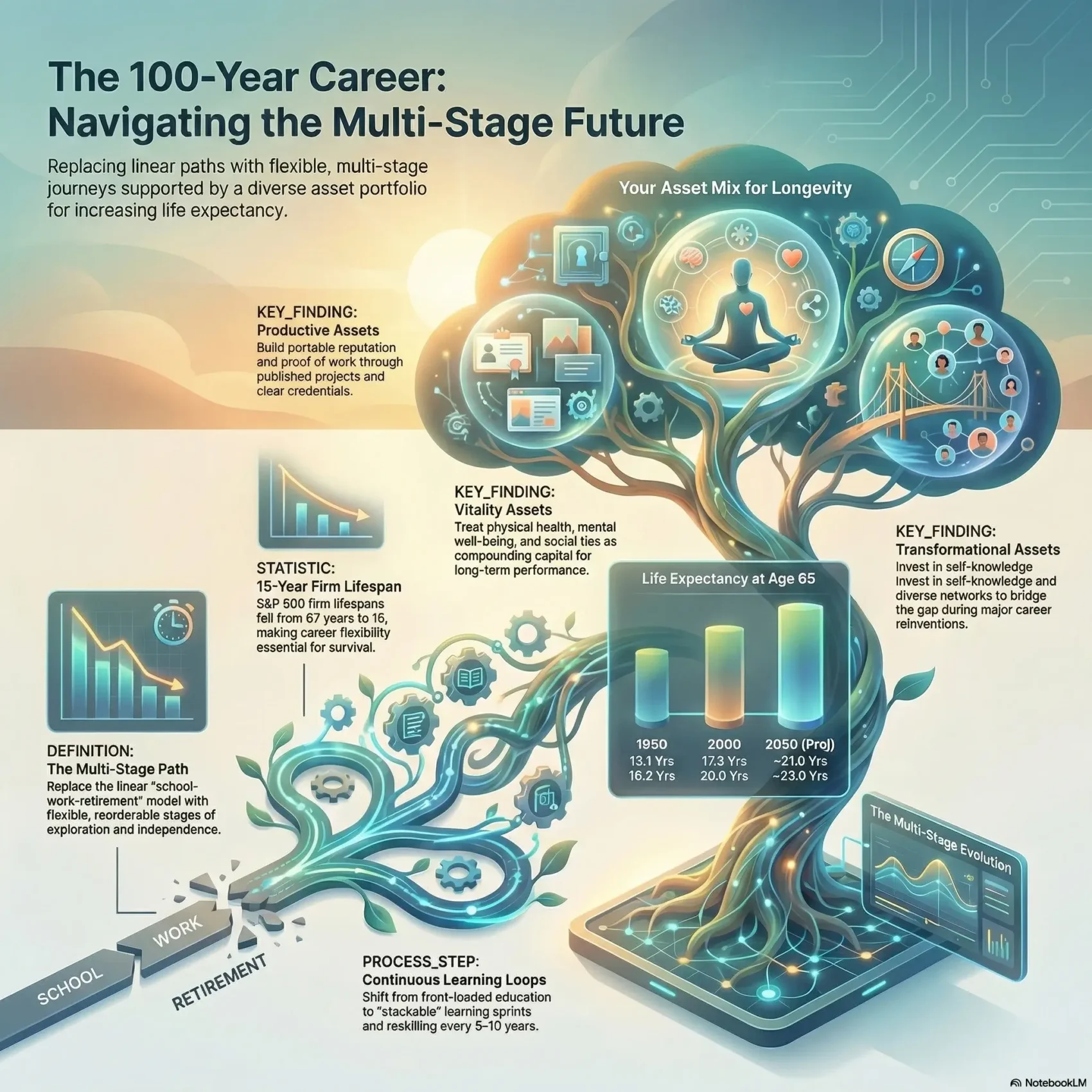
In the U.S., remaining life expectancy at age 65 rose from 13.1 (men) and 16.2 (women) in 1950 to 17.3 and 20.0 by 2000. Projections for 2050 put those numbers near 21 for men and 23 for women — roughly ages 86 and 88.
Long-term extrapolations to 2100 suggest modest further gains, but recent studies show slowing improvements. A Nature Aging analysis estimates survival to age 100 may be under 15% for females and 5% for males.
Slowing gains, inequality, and realistic planning
Gains have slowed since 1990 in top-performing countries, and the United States saw plateaus and recent declines because of COVID-19 and deaths of despair.
Inequality matters: affluent groups live longer than others. That means your personal expectancy depends on income, location, and health behavior.
Practical takeaway: stress-test for uncertainty
Plan as if you will need resources and purpose into later decades, but build flexibility. Use a conservative number for planning horizons and run stress tests for shocks like illness or caregiving.
- Base forecasts on current expectancy data, not hopeful extrapolations.
- Factor in that most people will face 80–90-year spans even if few reach a century.
- Keep contingency paths: savings, flexible work, and health investments.
Bottom line: prepare for longer spans, account for unequal outcomes, and keep options that let you pivot as the future changes for people across society.
From Three Stages to Multi-Stage Careers: Education, Work, Transitions, and Reinvention
Work now unfolds in multiple, reorderable stages instead of a single long stretch. Lynda Gratton and Andrew Scott urge abandoning the old three-stage idea because a long mid-stage strains productivity and vitality.
New stages—exploration, portfolio work, and independent producer phases—let you test ideas, diversify income, and build leverage. The shorter average lifespan of S&P 500 firms (from 67 years to about 15 by 2013) shows why flexibility matters.
Designing exploration, portfolio, and independent phases
Use short experiments—projects, bootcamps, or small gigs—to explore before you commit. Then combine part-time roles, freelance work, and learning blocks to form a portfolio approach.
When you double down, an independent producer phase helps you ship products, publish work, or lead ventures that create lasting value.
Decoupling age and stage
Decouple age and stage so people can explore in their 50s and scale in their 20s. This reduces age-based assumptions and helps teams value diverse experience.
Relationships and community as assets
You’ll invest in relationships and community—mentors, peers, and cross-generational networks—that support transitions across your lives. Organizations should recognize these intangible assets and back re-entry and refresh gates.
“The multi-stage model gives you tools to reorder work and learning to match a fast-changing world.”
- You’ll replace a rigid three-stage idea with flexible, age-agnostic stages.
- You’ll design exploration phases to test paths before larger shifts.
- You’ll build portfolio ways of working and use independent producer phases to create leverage.
Building Your Asset Mix for Longevity: Tangible and Intangible Assets You Must Invest In
Treat what you own—skills, health, and networks—as a portfolio that needs active tending. That mindset helps you prepare for repeated transitions and new phases across your years.
Productive assets
Inventory your productive assets: list skills, credentials, and evidence of work that travel with you.
Target gaps that block your next move. Use short learning sprints to add knowledge and publish proof—portfolios, papers, or public projects—to make reputation portable.
Vitality assets
Protect health and relationships like compounding capital. Sleep, prevention, and strong social ties fuel sustained performance.
Make routine checks, build buffers, and treat family and friends as active supports for transitions.
Transformational assets
Invest in identity, self-knowledge, and diverse networks. These assets boost adaptability and help you reframe changes as opportunity.
“Identity is crafted, not inherited — and reputation helps you move between roles with trust.”
Maintenance cadence
- Every 3–5 years, rebalance where you spend time and money across skills, wellbeing, and networks.
- Keep an emergency buffer and portable benefits to protect security during shifts.
- Schedule monthly micro-upgrades and quarterly learning sprints so small moves compound into real optionality.
- You’ll treat vitality as nonnegotiable and protect it with prevention and strength work.
- You’ll make reputation portable through published work and clear credentials.
- You’ll view longevity as a gift to be reinvested via restorative breaks and targeted learning.
The Future of Work in the U.S.: Learning Loops, Flexibility, and New Employment Ecosystems
Work in America is recomposing into flexible networks that favor constant learning. Medium-skilled routine jobs face automation while demand grows for both high-skill and many manual roles. That “hollowing out” changes where you should place your bets.
Hollowing out of work
Pinpoint pressure: automation hits routine tasks first. You’ll target durable skills in analysis, creativity, and service roles where demand rises. Data show the average S&P 500 firm lifespan fell to about 15 years, so companies change fast.
Continuous learning
You’ll design short learning loops—stackable courses, project sprints, and on-the-job stretch assignments. These let you reskill and upskill without pausing income.
Employment models
Large firms now rely on ecosystems of smaller vendors and startups. That makes combining company employment with self-employment a practical way to assemble income across years.
- Build a portable toolkit to move between companies.
- Negotiate flexible arrangements for study and sabbaticals.
- Use professional communities and bootcamps to accelerate opportunity.
“Treat change as a signal: double down in a firm when cycles favor it; build an external portfolio when ecosystems open new markets.”
The 100-year life career: strategies you can use to thrive across multiple stages
Break your next decade into clear stages so you can learn, earn, and pivot with confidence.
Your next-decade playbook: 20s, 30s, 40s, 50s+ planning in a longevity world
In your 20s, explore widely and build proof of work. Use short projects and public outputs to make future moves easier.
In your 30s, focus on depth: scale skills and negotiate roles that buy you time for learning and family. Target benefits that protect health and savings.
In your 40s, lead and diversify. Shift some hours to mentoring, consulting, or a portfolio of work so income is less tied to a single employer.
In your 50s and beyond, refresh and redesign roles. Phased retirement, part-time leadership, or independent projects can keep purpose and security.
Partnering with employers: flexibility, benefits, and transitions that work for you
Negotiate flexibility—remote options, reduced loads, or sabbaticals—to make room for study, caregiving, or health needs.
Ask HR for targeted benefits: HSA access, tuition support, paid leave, and phased retirement. These elements improve financial and health security during transitions.
- You’ll set stage objectives—explore, build, scale, refresh—so each period compounds momentum.
- You’ll schedule learning blocks that align with promotion windows or launches.
- You’ll document achievements and translate them into clear language employers value.
“Work across decades needs new arrangements that let people move in and out of roles without losing security.”
Use pilots—returnships, mentor circles, and cross-age projects—to reduce age bias and normalize multi-stage moves. Cite Lynda Gratton and Andrew Scott when you propose these experiments to leadership.
For practical steps on workplace scheduling and flexibility, see flexible work schedules to help frame requests with HR.
Conclusion
Preparing for extended working spans means treating each decade as an option set. Use the data: many Americans will live into their 80s and 90s, while only a minority reach a full century. That number shapes how you plan for retirement, health, and work.
Start small: assess your assets, pick the next stage, run a low-risk test, and review results every few years. Push for portable benefits, anti-ageism practices, and education loops inside companies and across society.
Carry Lynda Gratton and Andrew Scott’s idea forward: design multi-stage paths that match your values. This week, do one course, one conversation, or one habit. Those tiny moves compound into real options across decades.
Found this useful?
Make SmartKeys a preferred source on Google, and our articles will surface more often in your Top Stories, AI Overviews, and AI Mode.
Add as Preferred Source