Internal mobility means filling an open role with someone who already works for you, rather than hiring a stranger. That can be a promotion, a sideways move into another team, or a three month stint on a project in a different department. An employee mobility policy is the written rulebook for those moves: who is eligible, how they apply, who decides, and what support they get.
Two things make this urgent in 2026. Hiring from outside is expensive, and remote work has untied many jobs from a single office, so “moving roles” and “moving countries” now show up in the same conversation.
This guide covers both. You will find the four kinds of internal move, how to write the policy, how to judge readiness by skills instead of tenure, what technology genuinely helps, and how to handle a relocation without creating a tax or immigration problem.
Key Takeaways
- Internal moves cost less than external hires and shorten the time it takes someone to become productive.
- Transparent rules and published timelines are what make a mobility program feel fair.
- Cover lateral, diagonal and project moves, not just promotions.
- Judge readiness on skills and evidence, not on who the hiring manager already knows.
- Relocation needs tax, payroll and immigration checks before you approve it, not after.
Why internal mobility matters in 2026
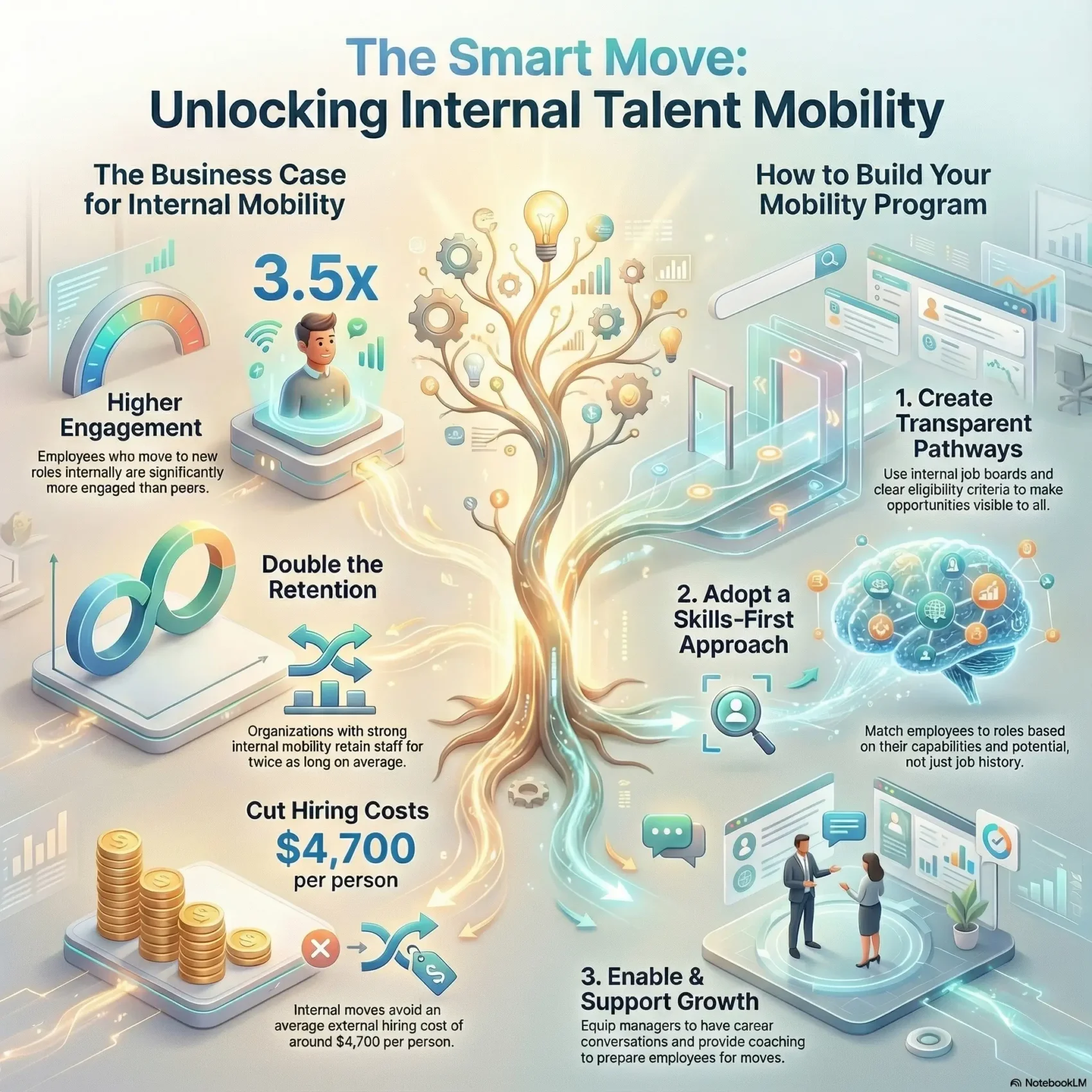
Start with the problem it solves. When a role opens, you either post it externally and wait, or you look at the people already on the payroll. The external route costs money and time. SHRM’s benchmarking puts the average cost per external hire at roughly $4,700, and that figure ignores the weeks a vacancy stays open.
The internal route is faster because you already have evidence. You know how the person performs, how they work with others, and which systems they understand. That shortens what HR teams call time-to-productivity, the stretch between a start date and the point where someone delivers at full speed.
There is a retention argument too. LinkedIn’s analysis of member career histories found that employees promoted within three years had a 70% chance of still being at the company, compared with 62% for those who made a lateral move and 45% for those who stayed put. The data is a few years old, but the pattern it describes has not been contradicted since: visible movement keeps people.
Engagement is the backdrop. Gallup measured US employee engagement at 31% in the first half of 2026, unchanged from 2025. When two thirds of your workforce is not fully engaged, a visible route to a different role is one of the few levers a manager can pull without a budget increase.
There is also a resilience benefit. If a product line is cancelled or a hiring freeze lands mid quarter, a company that already knows who can do what can redeploy people in weeks. A company without that map starts from a blank page. Our guide to redeploying staff whose tasks get automated covers that scenario in more detail.
The four kinds of internal move
People use “internal mobility” loosely. It helps to name the moves separately, because each one needs different approval and different preparation.
- Vertical: a promotion. Same field, more responsibility. A support team lead becomes support manager.
- Lateral: a sideways move at the same level. A marketing analyst moves into sales operations to learn the revenue side.
- Diagonal: a move to a different department at a higher level. A senior developer becomes a product manager.
- Project-based: a fixed-term assignment, often part time. Someone spends 20% of their week on a data migration in another team. No headcount changes, and both sides get a trial run.
Job swaps and mentorships belong in the same family. They are cheap, reversible and useful for testing whether an interest survives contact with the real work. A career lattice model treats all of these as legitimate progress, rather than treating a sideways move as a demotion.
Relocation is a separate axis. Someone can change country without changing role, or change both at once. Keep the two decisions distinct in your policy so a housing question does not delay a hiring decision.
What to put in the policy
A mobility policy fails when people cannot tell whether it applies to them. Write it so a reader answers four questions in under a minute.
Scope and eligibility
Say which roles, departments and locations are covered, and which are not. Set plain thresholds: for example, twelve months in the current role and no active performance plan. If exceptions exist for critical skills, name them rather than leaving them to negotiation.
A published process with deadlines
Set out how roles are posted, how people apply, and how long each step takes. Commit to service level agreements, meaning published maximum response times: five working days to acknowledge an application, ten to give a decision. Silence is what convinces people the process is theatre.
Support before and after the move
Name what the company pays for. Training toward the target role, a mentor, a defined handover period, and a check-in at 30 and 90 days. Someone moving into an unfamiliar function is a beginner again for a while, and the policy should say so out loud.
Who owns what
HR owns the framework, the postings and the reporting. Managers own the career conversations and the backfill plan for the role being vacated. Finance, Legal and IT come in for relocations. Write the names of the owning teams into the document so nothing sits unclaimed.
Publishing openings on an internal talent marketplace rather than circulating them privately is the single change that most often lifts internal application volume.
Skills-first mobility: matching capability to openings
A skills-first approach asks what someone can actually do, instead of reading their job title as a proxy. That matters because job requirements keep shifting. Gartner research found that 58% of the workforce needs new skills to do their jobs successfully, and that the number of skills listed for a single job was rising roughly 10% year over year. The World Economic Forum’s Future of Jobs Report 2025 makes a similar point, estimating that 39% of workers’ core skills will change by 2030.
The practical tool is a skills inventory: a maintained list of what each person can do, at what level, with evidence attached. Evidence can be a completed project, a certification, or a manager’s assessment against a published rubric.
- Assess with a mix of performance data, peer input and a short practical exercise rather than a single interview.
- Write short learning plans aimed at the specific gap between someone’s current level and the target role.
- Use project assignments and mentorships to build the missing skill on real work.
- Keep funding development for a quarter after the move, when the gap is most visible.
If you do not know where your gaps are yet, a structured digital skills gap analysis is the place to start, and our guide to upskilling and reskilling covers what to build once you know.
Technology that supports mobility
Tools do not create mobility, but they remove the friction that kills it. Four categories matter.
An internal job board makes openings visible in one place. A talent marketplace goes further and lists short projects and mentoring slots alongside full roles, so people can try a direction before committing. AI-driven learning platforms connect a skills gap to a specific course. Workflow automation handles the alerts, approvals and scheduling that otherwise stall an application for a fortnight.
AI matching sits across all of this, ranking internal candidates against a role description. It is genuinely useful for surfacing people nobody thought to ask. It also carries legal weight in Europe: under the EU AI Act, AI used for recruitment and worker management counts as high risk. Those detailed obligations were pushed back to 2 December 2027 under the digital omnibus agreed in May 2026, but the transparency duty in Article 50 applies from 2 August 2026, and the AI literacy requirement has been in force since February 2025. Our overview of EU AI Act compliance sets out what that means in practice, and our review of AI hiring tools covers the US state rules that already bite.
Whatever you buy, keep a human decision at the end. A ranked list is a shortlist, not a verdict.
Manager enablement: where programs succeed or stall
Most mobility policies die in the gap between a written rule and a manager’s incentives. Two problems recur.
The first is that career conversations never happen. Fix that by giving managers a template and a cadence: one conversation a quarter, separate from performance review, that records where someone wants to go and what the next concrete step is.
The second is talent hoarding: a manager quietly blocking a good performer’s move because losing them hurts the team. This is rational behaviour under bad incentives, so change the incentives.
- Set a release deadline. Once a move is approved, the person transfers within a defined window, typically 30 to 60 days.
- Guarantee the backfill. Approve the replacement requisition at the same time as the move, not after.
- Recognise managers who develop and export people, in the same review where you assess their team’s results.
Managers of distributed teams face this more sharply, because they see less of their people day to day. Our guide to remote leadership skills and our overview of AI in employee management both cover that ground.
Keeping access fair
A mobility program can quietly become a network for the well connected. The people who move are the ones the right manager happened to notice. That is a fixable design flaw.
Post every opening in the same place, on the same terms. Publish the skills and level expected for each role so nobody has to guess. Score interviews against a written rubric rather than an impression, and have the same panel see all candidates.
Then measure who actually moves. Track applications, interviews and offers by group. If a demographic applies at the expected rate but rarely reaches offer, the problem is in your evaluation step, not in your pipeline. Software can help with the tracking, as our review of DEI tech tools explains, and our article on diversity and inclusion at work covers the wider picture. Accessible processes matter too: see our guide to neurodiversity and inclusive workplaces.
Relocation and global mobility in a remote era
Remote work made relocation requests routine. It did not make them simple. When someone works from a different country, the questions that follow are legal and financial before they are cultural.
Check these before you approve
- Right to work. Does the person need a visa or permit, and how long does it take? A digital nomad visa may fit a temporary stay but often forbids working for a local client.
- Income tax. Where does the person become tax resident, and does a treaty prevent them being taxed twice?
- Payroll and social security. Can you legally pay them where they now live, or do you need an employer of record?
- Permanent establishment. One employee in a new country can, in some cases, create a taxable business presence for your company there. Ask your tax advisers before, not after.
Then handle the human side
Say what the company pays for and cap it: moving costs, a housing allowance for a fixed period, immigration counsel, and support for a partner’s job search. Give the person a named contact who is not their manager. Brief them on local working norms, since notice periods, holiday expectations and meeting culture vary more than most people expect.
Set a transition plan with a handover, a start date in the new time zone, and a written expectation about overlap hours. Our guides to managing cross-border teams and the work-from-anywhere economy go deeper on the day-to-day mechanics, and remote onboarding covers the first weeks.
Measuring whether it works
Pick a small number of measures and report them on a fixed cadence. A quarterly one-page report beats a dashboard nobody opens.
- Internal fill rate: the share of open roles filled by existing staff. This is the headline number.
- Time to fill, internal versus external: the argument for the program, in days.
- Retention after a move: are the people who moved still there twelve months later?
- Application-to-offer rate by group: your fairness check.
- Learning completion linked to move success: which development actually predicted a good outcome.
Pair the numbers with short interviews. Ask people who applied and were turned down what the process felt like. That is where you find why applications dry up. Our guide to talent retention strategies puts these metrics in a wider context.
Conclusion
An employee mobility policy is not an HR formality. It is the difference between knowing what your people can do and finding out only when they resign.
Start small and concrete. Publish every internal opening in one place. Write eligibility rules a reader can check in a minute. Commit to a response deadline and meet it. Guarantee the backfill so managers stop hoarding. Then measure your internal fill rate and report it quarterly.
Relocation deserves its own checklist, run by Finance, Legal and HR together, with the tax and immigration questions answered before anyone replies to the employee. For related reading, see our guides to building a talent pipeline and remote company culture.
Found this useful?
Make SmartKeys a preferred source on Google, and our articles will surface more often in your Top Stories, AI Overviews, and AI Mode.
Add as Preferred Source